



ALStudio vs Canva: Which Is Better for Content Production?
Comparisons & alternatives
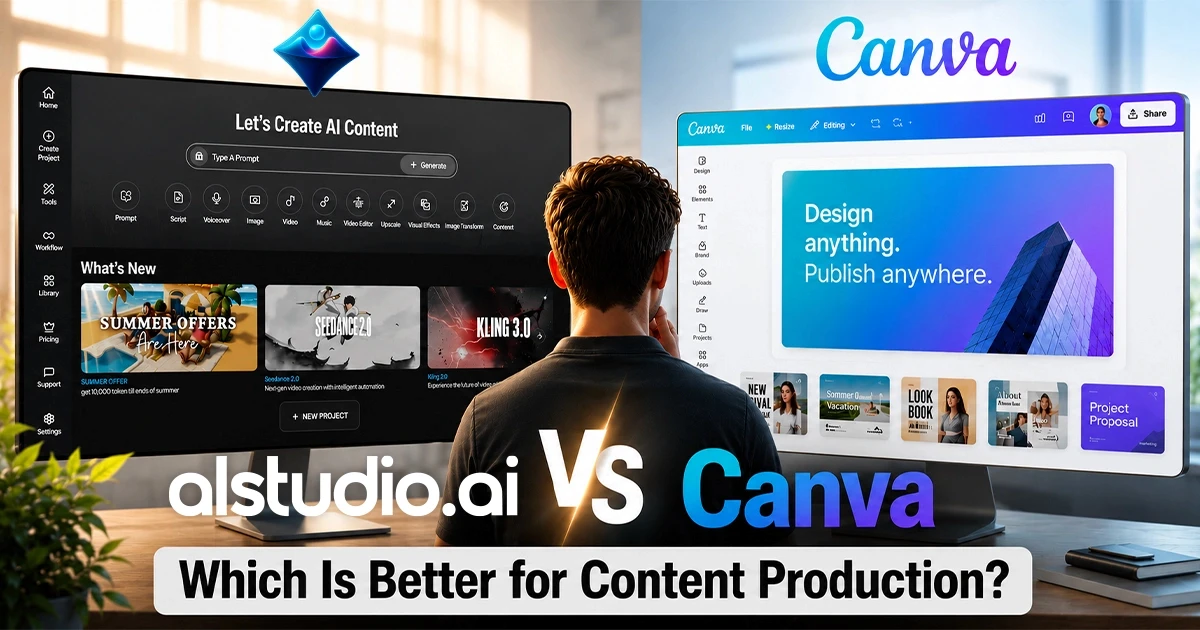
ALStudio vs Canva: Design Platform vs Creative AI Operating System
When comparing ALStudio vs Canva, most marketers expect a straightforward tool comparison. What they find instead is a fundamental split in how each platform defines the content challenge.
Canva is one of the most successful design platforms ever built. It made professional-looking graphics accessible to teams that had no design background. For presentations, social graphics, and template-based marketing, it continues to perform well.
ALStudio is built for a different problem entirely. It operates as a Creative AI Operating System, designed specifically for teams that need to produce AI-generated content at scale consistently, across multiple campaigns, formats, languages, and brands.
The comparison matters because marketing teams in 2026 are no longer asking whether AI can generate content. They are asking whether their platform can manage content production. That distinction is where ALStudio and Canva diverge most sharply.
Quick Comparison: ALStudio vs Canva at a Glance
Category | Canva | ALStudio |
Primary Purpose | Design Platform | Creative AI Operating System |
Best For | Graphics, presentations, templates | End to end content production |
AI Video | Single integration (Veo) | 18+ AI video models |
Character Consistency | Not supported as a persistent system | Character DNA |
Product Consistency | Not supported as persistent product memory | Product DNA |
Brand Memory | Brand Kit | Brand DNA |
Scene Consistency | Not supported as persistent scene system | Scene DNA |
Arabic Dialect Voiceovers | Limited | 22+ Arabic dialects |
Social Content Generation | Manual adaptation | Social Factory |
MultiBrand Production | Limited | Native workflow |
Team Scaling | Template collaboration | Production infrastructure |
Agency Workflows | Partial | Built specifically for agencies |
The short version: Canva helps teams create content. ALStudio helps teams produce content. Those are related but fundamentally different goals.
What Is the Core Difference Between ALStudio and Canva?
The short answer: Canva is a design platform built around templates. ALStudio is a Creative AI Operating System built around production workflows, AI model orchestration, and persistent brand memory.
Canva was designed to make design creation accessible. It solves a creation problem: how do teams produce graphics without a designer?
ALStudio was designed to solve a production problem: how do teams produce dozens of consistent AI assets videos, images, voiceovers, and campaign content across multiple brands, formats, and languages, without losing consistency at each step?
These are different engineering decisions. Templatebased systems store design elements. Production infrastructure stores identity characters, products, environments, and brand voice and applies that identity across every generation.
Why This Comparison Matters in 2026
Content production demands have grown significantly across marketing organizations. Teams are managing more campaigns, more formats, more languages, and more channels than previous generations of marketing infrastructure were built to handle.
AI generation has made it easier to create individual assets. What AI generation has not solved is the challenge of managing production consistency across large volumes of content.
As AI generation quality improves across the industry, competitive advantage increasingly comes from workflow efficiency, consistency, governance, and production speed rather than generation quality alone.
This is the operating reality behind the ALStudio vs Canva comparison.
How Content Production Has Evolved: Three Phases
Understanding where ALStudio and Canva each fit requires understanding how the content creation landscape has changed.
Phase 1: Design Software
The first generation of creative platforms focused on making design accessible. Tools like Canva and Photoshop helped teams produce presentations, graphics, documents, and marketing assets without requiring specialized design expertise. The challenge was creation.
Phase 2: AI Generation
The second generation introduced AIpowered content generation. Tools like image generators, AI video platforms, and voice synthesis enabled teams to produce content at speeds previously impossible. The challenge shifted from creating to generating.
Phase 3: Production Infrastructure
Today, organizations are no longer struggling to generate content. They are struggling to manage content production across multiple campaigns, brands, markets, teams, and AI systems. The objective is no longer creating one asset. The objective is operating content production at scale.
Creative AI Operating Systems represent this third phase. ALStudio was built for it. Canva was built for the first.
Where Canva Excels
A fair comparison starts with Canva's genuine strengths.
Canva became one of the most widely adopted creative platforms because it genuinely solved the design accessibility problem. Its strengths include:
Presentation creation and editing
Social media graphics
Marketing collateral and flyers
Template-based workflows
Fast team onboarding
Collaboration on shared assets
Brand Kit management for logos, colors, and fonts
Canva is the stronger choice when:
Presentation design is the primary use case
Static graphics dominate the workflow
Content volumes remain relatively low
Templatedriven marketing is sufficient
AI production is not a core operational requirement
Teams need rapid onboarding with minimal setup
The challenges appear when content moves beyond templates and into large-scale AI-generated production particularly when characters, products, environments, localization, and campaign adaptation are involved.
Where ALStudio Addresses Canva's Limitations
AI Video: One Model vs MultiModel Production
Canva includes an AI video feature through a single integration. This works for basic video generation.
ALStudio's Film Studio routes production across 18+ AI video models. This matters for teams that need to match different cinematic styles, production requirements, or output specifications across campaign types and need model selection to be part of the workflow rather than a manual decision.
Character Consistency: Templates vs Character DNA
This is one of the clearest architectural differences between the two platforms.
If you use AI to generate a brand character, a spokesperson, a mascot, a recurring figure in campaign content Canva has no persistent system for maintaining that character's appearance across generations. Each session starts from scratch. Reference images help, but they do not function as a persistent identity system.
ALStudio's Character DNA stores a character's visual identity and applies it consistently across Film Studio, Content Studio, Marketing Studio, and Editor Studio. The character remains visually consistent across generations without requiring manual reference management at each step.
Why this matters: A single character inconsistency across a campaign of 40 assets creates review cycles, regeneration cycles, and production delays. At scale, character drift is one of the most time-consuming and expensive problems in AI content production.
Product Consistency: Catalogues vs Product DNA
For ecommerce brands and product advertisers, this distinction is equally important.
When AI generates product imagery, product appearance can drift, colors shift, proportions change, packaging details become inaccurate. Without a persistent product memory system, teams must manually review and correct every generation.
ALStudio's Product DNA stores product specifications and applies them to generations across all production workflows. Product appearance stays consistent without manual correction cycles.
Brand Memory: Brand Kit vs Brand DNA
Canva Brand Kit stores logos, colors, and fonts. This is excellent for design governance and template consistency.
ALStudio's Brand DNA extends this to include AIgenerated identity: brand voice, visual style, campaign tone, and production guidelines. The difference is scope. Template consistency and AI production consistency are not the same problem.
What Brand Kit manages | What Brand DNA manages |
Logos | AI-generated visual identity |
Colors | Brand voice and tone |
Fonts | Campaign style guidelines |
Template layouts | Character and product specifications |
Multilingual and Arabic Content Production
For marketing teams operating in multilingual markets particularly MENA and GCC this difference is significant.
ALStudio supports 22+ Arabic dialects for voiceovers and is designed with Arabicfirst content production in mind. For teams producing campaign content across Gulf Arabic, Egyptian Arabic, Levantine, and other regional variants, this level of dialect specificity is not available in Canva.
MultiBrand and Agency Workflows
Marketing agencies managing multiple client brands face a structural challenge: each brand requires its own characters, products, environments, and brand voice. Without native multibrand architecture, teams rebuild the same organizational structures repeatedly for each client.
ALStudio's production infrastructure includes native multibrand workflow support, designed specifically for agencies managing simultaneous campaigns across different client identities.
The Hidden Cost of Regeneration
Most conversations about AI content tools focus on generation costs. Far fewer focus on regeneration costs.
When a character changes appearance unexpectedly, when a product becomes visually inaccurate, or when a campaign loses visual continuity midproduction, teams enter a correction cycle: review, feedback, regeneration, rereview.
A single inconsistency across a 50asset campaign can create dozens of additional review cycles and approval delays. At scale, this compounds significantly.
The biggest cost in AI content production is often not generation. It is regeneration.
Production infrastructure designed around persistent memory Character DNA, Product DNA, Scene DNA exists specifically to reduce regeneration cycles by maintaining consistency from the first generation rather than correcting it afterward.
The Hidden Cost of MultiTool Stacks
Many organizations manage their content production across separate platforms:
A design tool
An AI video platform
A voice generation tool
A copywriting system
A localization platform
A collaboration tool
Each platform performs its individual task. The challenge appears between the tools: context becomes fragmented, assets become duplicated, teams rebuild work repeatedly, and approval cycles become longer.
The issue is rarely the quality of the individual tools. The issue is operational coordination. As content volumes increase, managing the workflow becomes harder than generating the content itself.
If your team is interested in consolidating AI content production into a single operating system, ALStudio's workflow infrastructure is worth evaluating against your current stack.
Building a MultiChannel Campaign: Workflow Comparison
Production Task | Canva Workflow | ALStudio Workflow |
Character Creation | Reference images per session | Character DNA persistent across all tools |
Product Management | Manual references per generation | Product DNA stored and applied automatically |
Video Production | Single model | Multimodel, productionrouted |
Localization | External tools | Native multilingual workflow |
Campaign Adaptation | Manual recreation | Reusable DNA assets across campaigns |
Consistency Review | Humanled correction | Memory-driven consistency |
MultiBrand Production | Manual organization | Native production structure |
Arabic Voiceover | Limited | 22+ dialects |
The difference is not simply features. The difference is operational structure.
Template Consistency vs AI Consistency: Why They Are Different Problems
This distinction matters for teams making platform decisions.
Template consistency focuses on:
Logos and brand marks
Color palettes
Typography
Layout standards
AI production consistency focuses on:
Recurring character identity
Product visual accuracy
Environment and scene continuity
Brand voice across AIgenerated copy
Campaign visual identity across 50+ generated assets
A logo can be stored inside a Brand Kit. A recurring AIgenerated character cannot be managed properly through templates alone. Templates preserve design. AI production requires preserving identity.
When to Choose Canva vs When to Choose ALStudio
Choose Canva when:
Your primary output is presentations, social graphics, or marketing collateral
Your team needs fast onboarding with minimal setup
Content volumes are manageable without production infrastructure
AI video is not a core part of your workflow
You do not need persistent character or product consistency across campaigns
Choose ALStudio when:
Your team produces AI video at scale
You need consistent characters, products, or environments across campaigns
You are managing multiple brands or clients simultaneously
You are producing content across multiple languages or Arabic dialects
Your team's primary bottleneck is production consistency, not content creation
You are an agency or enterprise team with high volume campaign requirements
Conclusion
The ALStudio vs Canva comparison ultimately comes down to what problem your team is trying to solve.
Canva solves the design creation problem, and it solves it well. For teams producing templates, presentations, and static social graphics, it remains a strong and widely trusted platform.
ALStudio solves the content production problem. For teams producing AI video, managing recurring characters and products, operating across multiple brands, and producing content at scale in multiple languages particularly Arabic, ALStudio's architecture is built for those requirements in a way that design platforms were never designed to address.
As AI generation quality continues to improve across the industry, the differentiator for marketing teams is increasingly not which tool can generate content. It is which system can manage content production consistently, at scale, without compounding costs from regeneration and workflow fragmentation.
That is the distinction ALStudio vs Canva makes most clearly in 2026.
FEATURED SNIPPET
Featured Snippet Paragraph (48 words)
ALStudio is a Creative AI Operating System designed for large-scale content production with persistent brand, character, and product consistency. Canva is a design platform optimized for templates, graphics, and presentations. ALStudio handles AI video, multilingual campaigns, and multibrand agency workflows. Canva excels at design creation for lower volume marketing needs.
Featured Snippet Bullet List: ALStudio vs Canva Key Differences
Primary purpose: Canva is a design platform; ALStudio is a Creative AI Operating System
AI video: Canva uses a single integration; ALStudio routes across 18+ AI video models
Character consistency: Canva has no persistent character system; ALStudio uses Character DNA
Product consistency: Canva requires manual references; ALStudio uses Product DNA
Brand memory: Canva stores logos, colors, fonts; ALStudio adds AIgenerated identity via Brand DNA
Arabic voiceovers: Canva is limited; ALStudio supports 22+ Arabic dialects
Agency workflows: Canva is partial; ALStudio is built natively for multibrand production
Scale: Canva fits lower volume design; ALStudio fits enterprise and agency content operations
ALStudio vs Canva: Which Is Better for Content Production?
Comparisons & alternatives
ALStudio vs Canva: Design Platform vs Creative AI Operating System
When comparing ALStudio vs Canva, most marketers expect a straightforward tool comparison. What they find instead is a fundamental split in how each platform defines the content challenge.
Canva is one of the most successful design platforms ever built. It made professional-looking graphics accessible to teams that had no design background. For presentations, social graphics, and template-based marketing, it continues to perform well.
ALStudio is built for a different problem entirely. It operates as a Creative AI Operating System, designed specifically for teams that need to produce AI-generated content at scale consistently, across multiple campaigns, formats, languages, and brands.
The comparison matters because marketing teams in 2026 are no longer asking whether AI can generate content. They are asking whether their platform can manage content production. That distinction is where ALStudio and Canva diverge most sharply.
Quick Comparison: ALStudio vs Canva at a Glance
Category | Canva | ALStudio |
Primary Purpose | Design Platform | Creative AI Operating System |
Best For | Graphics, presentations, templates | End to end content production |
AI Video | Single integration (Veo) | 18+ AI video models |
Character Consistency | Not supported as a persistent system | Character DNA |
Product Consistency | Not supported as persistent product memory | Product DNA |
Brand Memory | Brand Kit | Brand DNA |
Scene Consistency | Not supported as persistent scene system | Scene DNA |
Arabic Dialect Voiceovers | Limited | 22+ Arabic dialects |
Social Content Generation | Manual adaptation | Social Factory |
MultiBrand Production | Limited | Native workflow |
Team Scaling | Template collaboration | Production infrastructure |
Agency Workflows | Partial | Built specifically for agencies |
The short version: Canva helps teams create content. ALStudio helps teams produce content. Those are related but fundamentally different goals.
What Is the Core Difference Between ALStudio and Canva?
The short answer: Canva is a design platform built around templates. ALStudio is a Creative AI Operating System built around production workflows, AI model orchestration, and persistent brand memory.
Canva was designed to make design creation accessible. It solves a creation problem: how do teams produce graphics without a designer?
ALStudio was designed to solve a production problem: how do teams produce dozens of consistent AI assets videos, images, voiceovers, and campaign content across multiple brands, formats, and languages, without losing consistency at each step?
These are different engineering decisions. Templatebased systems store design elements. Production infrastructure stores identity characters, products, environments, and brand voice and applies that identity across every generation.
Why This Comparison Matters in 2026
Content production demands have grown significantly across marketing organizations. Teams are managing more campaigns, more formats, more languages, and more channels than previous generations of marketing infrastructure were built to handle.
AI generation has made it easier to create individual assets. What AI generation has not solved is the challenge of managing production consistency across large volumes of content.
As AI generation quality improves across the industry, competitive advantage increasingly comes from workflow efficiency, consistency, governance, and production speed rather than generation quality alone.
This is the operating reality behind the ALStudio vs Canva comparison.
How Content Production Has Evolved: Three Phases
Understanding where ALStudio and Canva each fit requires understanding how the content creation landscape has changed.
Phase 1: Design Software
The first generation of creative platforms focused on making design accessible. Tools like Canva and Photoshop helped teams produce presentations, graphics, documents, and marketing assets without requiring specialized design expertise. The challenge was creation.
Phase 2: AI Generation
The second generation introduced AIpowered content generation. Tools like image generators, AI video platforms, and voice synthesis enabled teams to produce content at speeds previously impossible. The challenge shifted from creating to generating.
Phase 3: Production Infrastructure
Today, organizations are no longer struggling to generate content. They are struggling to manage content production across multiple campaigns, brands, markets, teams, and AI systems. The objective is no longer creating one asset. The objective is operating content production at scale.
Creative AI Operating Systems represent this third phase. ALStudio was built for it. Canva was built for the first.
Where Canva Excels
A fair comparison starts with Canva's genuine strengths.
Canva became one of the most widely adopted creative platforms because it genuinely solved the design accessibility problem. Its strengths include:
Presentation creation and editing
Social media graphics
Marketing collateral and flyers
Template-based workflows
Fast team onboarding
Collaboration on shared assets
Brand Kit management for logos, colors, and fonts
Canva is the stronger choice when:
Presentation design is the primary use case
Static graphics dominate the workflow
Content volumes remain relatively low
Templatedriven marketing is sufficient
AI production is not a core operational requirement
Teams need rapid onboarding with minimal setup
The challenges appear when content moves beyond templates and into large-scale AI-generated production particularly when characters, products, environments, localization, and campaign adaptation are involved.
Where ALStudio Addresses Canva's Limitations
AI Video: One Model vs MultiModel Production
Canva includes an AI video feature through a single integration. This works for basic video generation.
ALStudio's Film Studio routes production across 18+ AI video models. This matters for teams that need to match different cinematic styles, production requirements, or output specifications across campaign types and need model selection to be part of the workflow rather than a manual decision.
Character Consistency: Templates vs Character DNA
This is one of the clearest architectural differences between the two platforms.
If you use AI to generate a brand character, a spokesperson, a mascot, a recurring figure in campaign content Canva has no persistent system for maintaining that character's appearance across generations. Each session starts from scratch. Reference images help, but they do not function as a persistent identity system.
ALStudio's Character DNA stores a character's visual identity and applies it consistently across Film Studio, Content Studio, Marketing Studio, and Editor Studio. The character remains visually consistent across generations without requiring manual reference management at each step.
Why this matters: A single character inconsistency across a campaign of 40 assets creates review cycles, regeneration cycles, and production delays. At scale, character drift is one of the most time-consuming and expensive problems in AI content production.
Product Consistency: Catalogues vs Product DNA
For ecommerce brands and product advertisers, this distinction is equally important.
When AI generates product imagery, product appearance can drift, colors shift, proportions change, packaging details become inaccurate. Without a persistent product memory system, teams must manually review and correct every generation.
ALStudio's Product DNA stores product specifications and applies them to generations across all production workflows. Product appearance stays consistent without manual correction cycles.
Brand Memory: Brand Kit vs Brand DNA
Canva Brand Kit stores logos, colors, and fonts. This is excellent for design governance and template consistency.
ALStudio's Brand DNA extends this to include AIgenerated identity: brand voice, visual style, campaign tone, and production guidelines. The difference is scope. Template consistency and AI production consistency are not the same problem.
What Brand Kit manages | What Brand DNA manages |
Logos | AI-generated visual identity |
Colors | Brand voice and tone |
Fonts | Campaign style guidelines |
Template layouts | Character and product specifications |
Multilingual and Arabic Content Production
For marketing teams operating in multilingual markets particularly MENA and GCC this difference is significant.
ALStudio supports 22+ Arabic dialects for voiceovers and is designed with Arabicfirst content production in mind. For teams producing campaign content across Gulf Arabic, Egyptian Arabic, Levantine, and other regional variants, this level of dialect specificity is not available in Canva.
MultiBrand and Agency Workflows
Marketing agencies managing multiple client brands face a structural challenge: each brand requires its own characters, products, environments, and brand voice. Without native multibrand architecture, teams rebuild the same organizational structures repeatedly for each client.
ALStudio's production infrastructure includes native multibrand workflow support, designed specifically for agencies managing simultaneous campaigns across different client identities.
The Hidden Cost of Regeneration
Most conversations about AI content tools focus on generation costs. Far fewer focus on regeneration costs.
When a character changes appearance unexpectedly, when a product becomes visually inaccurate, or when a campaign loses visual continuity midproduction, teams enter a correction cycle: review, feedback, regeneration, rereview.
A single inconsistency across a 50asset campaign can create dozens of additional review cycles and approval delays. At scale, this compounds significantly.
The biggest cost in AI content production is often not generation. It is regeneration.
Production infrastructure designed around persistent memory Character DNA, Product DNA, Scene DNA exists specifically to reduce regeneration cycles by maintaining consistency from the first generation rather than correcting it afterward.
The Hidden Cost of MultiTool Stacks
Many organizations manage their content production across separate platforms:
A design tool
An AI video platform
A voice generation tool
A copywriting system
A localization platform
A collaboration tool
Each platform performs its individual task. The challenge appears between the tools: context becomes fragmented, assets become duplicated, teams rebuild work repeatedly, and approval cycles become longer.
The issue is rarely the quality of the individual tools. The issue is operational coordination. As content volumes increase, managing the workflow becomes harder than generating the content itself.
If your team is interested in consolidating AI content production into a single operating system, ALStudio's workflow infrastructure is worth evaluating against your current stack.
Building a MultiChannel Campaign: Workflow Comparison
Production Task | Canva Workflow | ALStudio Workflow |
Character Creation | Reference images per session | Character DNA persistent across all tools |
Product Management | Manual references per generation | Product DNA stored and applied automatically |
Video Production | Single model | Multimodel, productionrouted |
Localization | External tools | Native multilingual workflow |
Campaign Adaptation | Manual recreation | Reusable DNA assets across campaigns |
Consistency Review | Humanled correction | Memory-driven consistency |
MultiBrand Production | Manual organization | Native production structure |
Arabic Voiceover | Limited | 22+ dialects |
The difference is not simply features. The difference is operational structure.
Template Consistency vs AI Consistency: Why They Are Different Problems
This distinction matters for teams making platform decisions.
Template consistency focuses on:
Logos and brand marks
Color palettes
Typography
Layout standards
AI production consistency focuses on:
Recurring character identity
Product visual accuracy
Environment and scene continuity
Brand voice across AIgenerated copy
Campaign visual identity across 50+ generated assets
A logo can be stored inside a Brand Kit. A recurring AIgenerated character cannot be managed properly through templates alone. Templates preserve design. AI production requires preserving identity.
When to Choose Canva vs When to Choose ALStudio
Choose Canva when:
Your primary output is presentations, social graphics, or marketing collateral
Your team needs fast onboarding with minimal setup
Content volumes are manageable without production infrastructure
AI video is not a core part of your workflow
You do not need persistent character or product consistency across campaigns
Choose ALStudio when:
Your team produces AI video at scale
You need consistent characters, products, or environments across campaigns
You are managing multiple brands or clients simultaneously
You are producing content across multiple languages or Arabic dialects
Your team's primary bottleneck is production consistency, not content creation
You are an agency or enterprise team with high volume campaign requirements
Conclusion
The ALStudio vs Canva comparison ultimately comes down to what problem your team is trying to solve.
Canva solves the design creation problem, and it solves it well. For teams producing templates, presentations, and static social graphics, it remains a strong and widely trusted platform.
ALStudio solves the content production problem. For teams producing AI video, managing recurring characters and products, operating across multiple brands, and producing content at scale in multiple languages particularly Arabic, ALStudio's architecture is built for those requirements in a way that design platforms were never designed to address.
As AI generation quality continues to improve across the industry, the differentiator for marketing teams is increasingly not which tool can generate content. It is which system can manage content production consistently, at scale, without compounding costs from regeneration and workflow fragmentation.
That is the distinction ALStudio vs Canva makes most clearly in 2026.
FEATURED SNIPPET
Featured Snippet Paragraph (48 words)
ALStudio is a Creative AI Operating System designed for large-scale content production with persistent brand, character, and product consistency. Canva is a design platform optimized for templates, graphics, and presentations. ALStudio handles AI video, multilingual campaigns, and multibrand agency workflows. Canva excels at design creation for lower volume marketing needs.
Featured Snippet Bullet List: ALStudio vs Canva Key Differences
Primary purpose: Canva is a design platform; ALStudio is a Creative AI Operating System
AI video: Canva uses a single integration; ALStudio routes across 18+ AI video models
Character consistency: Canva has no persistent character system; ALStudio uses Character DNA
Product consistency: Canva requires manual references; ALStudio uses Product DNA
Brand memory: Canva stores logos, colors, fonts; ALStudio adds AIgenerated identity via Brand DNA
Arabic voiceovers: Canva is limited; ALStudio supports 22+ Arabic dialects
Agency workflows: Canva is partial; ALStudio is built natively for multibrand production
Scale: Canva fits lower volume design; ALStudio fits enterprise and agency content operations
ALStudio vs Canva: Which Is Better for Content Production?
Comparisons & alternatives
ALStudio vs Canva: Design Platform vs Creative AI Operating System
When comparing ALStudio vs Canva, most marketers expect a straightforward tool comparison. What they find instead is a fundamental split in how each platform defines the content challenge.
Canva is one of the most successful design platforms ever built. It made professional-looking graphics accessible to teams that had no design background. For presentations, social graphics, and template-based marketing, it continues to perform well.
ALStudio is built for a different problem entirely. It operates as a Creative AI Operating System, designed specifically for teams that need to produce AI-generated content at scale consistently, across multiple campaigns, formats, languages, and brands.
The comparison matters because marketing teams in 2026 are no longer asking whether AI can generate content. They are asking whether their platform can manage content production. That distinction is where ALStudio and Canva diverge most sharply.
Quick Comparison: ALStudio vs Canva at a Glance
Category | Canva | ALStudio |
Primary Purpose | Design Platform | Creative AI Operating System |
Best For | Graphics, presentations, templates | End to end content production |
AI Video | Single integration (Veo) | 18+ AI video models |
Character Consistency | Not supported as a persistent system | Character DNA |
Product Consistency | Not supported as persistent product memory | Product DNA |
Brand Memory | Brand Kit | Brand DNA |
Scene Consistency | Not supported as persistent scene system | Scene DNA |
Arabic Dialect Voiceovers | Limited | 22+ Arabic dialects |
Social Content Generation | Manual adaptation | Social Factory |
MultiBrand Production | Limited | Native workflow |
Team Scaling | Template collaboration | Production infrastructure |
Agency Workflows | Partial | Built specifically for agencies |
The short version: Canva helps teams create content. ALStudio helps teams produce content. Those are related but fundamentally different goals.
What Is the Core Difference Between ALStudio and Canva?
The short answer: Canva is a design platform built around templates. ALStudio is a Creative AI Operating System built around production workflows, AI model orchestration, and persistent brand memory.
Canva was designed to make design creation accessible. It solves a creation problem: how do teams produce graphics without a designer?
ALStudio was designed to solve a production problem: how do teams produce dozens of consistent AI assets videos, images, voiceovers, and campaign content across multiple brands, formats, and languages, without losing consistency at each step?
These are different engineering decisions. Templatebased systems store design elements. Production infrastructure stores identity characters, products, environments, and brand voice and applies that identity across every generation.
Why This Comparison Matters in 2026
Content production demands have grown significantly across marketing organizations. Teams are managing more campaigns, more formats, more languages, and more channels than previous generations of marketing infrastructure were built to handle.
AI generation has made it easier to create individual assets. What AI generation has not solved is the challenge of managing production consistency across large volumes of content.
As AI generation quality improves across the industry, competitive advantage increasingly comes from workflow efficiency, consistency, governance, and production speed rather than generation quality alone.
This is the operating reality behind the ALStudio vs Canva comparison.
How Content Production Has Evolved: Three Phases
Understanding where ALStudio and Canva each fit requires understanding how the content creation landscape has changed.
Phase 1: Design Software
The first generation of creative platforms focused on making design accessible. Tools like Canva and Photoshop helped teams produce presentations, graphics, documents, and marketing assets without requiring specialized design expertise. The challenge was creation.
Phase 2: AI Generation
The second generation introduced AIpowered content generation. Tools like image generators, AI video platforms, and voice synthesis enabled teams to produce content at speeds previously impossible. The challenge shifted from creating to generating.
Phase 3: Production Infrastructure
Today, organizations are no longer struggling to generate content. They are struggling to manage content production across multiple campaigns, brands, markets, teams, and AI systems. The objective is no longer creating one asset. The objective is operating content production at scale.
Creative AI Operating Systems represent this third phase. ALStudio was built for it. Canva was built for the first.
Where Canva Excels
A fair comparison starts with Canva's genuine strengths.
Canva became one of the most widely adopted creative platforms because it genuinely solved the design accessibility problem. Its strengths include:
Presentation creation and editing
Social media graphics
Marketing collateral and flyers
Template-based workflows
Fast team onboarding
Collaboration on shared assets
Brand Kit management for logos, colors, and fonts
Canva is the stronger choice when:
Presentation design is the primary use case
Static graphics dominate the workflow
Content volumes remain relatively low
Templatedriven marketing is sufficient
AI production is not a core operational requirement
Teams need rapid onboarding with minimal setup
The challenges appear when content moves beyond templates and into large-scale AI-generated production particularly when characters, products, environments, localization, and campaign adaptation are involved.
Where ALStudio Addresses Canva's Limitations
AI Video: One Model vs MultiModel Production
Canva includes an AI video feature through a single integration. This works for basic video generation.
ALStudio's Film Studio routes production across 18+ AI video models. This matters for teams that need to match different cinematic styles, production requirements, or output specifications across campaign types and need model selection to be part of the workflow rather than a manual decision.
Character Consistency: Templates vs Character DNA
This is one of the clearest architectural differences between the two platforms.
If you use AI to generate a brand character, a spokesperson, a mascot, a recurring figure in campaign content Canva has no persistent system for maintaining that character's appearance across generations. Each session starts from scratch. Reference images help, but they do not function as a persistent identity system.
ALStudio's Character DNA stores a character's visual identity and applies it consistently across Film Studio, Content Studio, Marketing Studio, and Editor Studio. The character remains visually consistent across generations without requiring manual reference management at each step.
Why this matters: A single character inconsistency across a campaign of 40 assets creates review cycles, regeneration cycles, and production delays. At scale, character drift is one of the most time-consuming and expensive problems in AI content production.
Product Consistency: Catalogues vs Product DNA
For ecommerce brands and product advertisers, this distinction is equally important.
When AI generates product imagery, product appearance can drift, colors shift, proportions change, packaging details become inaccurate. Without a persistent product memory system, teams must manually review and correct every generation.
ALStudio's Product DNA stores product specifications and applies them to generations across all production workflows. Product appearance stays consistent without manual correction cycles.
Brand Memory: Brand Kit vs Brand DNA
Canva Brand Kit stores logos, colors, and fonts. This is excellent for design governance and template consistency.
ALStudio's Brand DNA extends this to include AIgenerated identity: brand voice, visual style, campaign tone, and production guidelines. The difference is scope. Template consistency and AI production consistency are not the same problem.
What Brand Kit manages | What Brand DNA manages |
Logos | AI-generated visual identity |
Colors | Brand voice and tone |
Fonts | Campaign style guidelines |
Template layouts | Character and product specifications |
Multilingual and Arabic Content Production
For marketing teams operating in multilingual markets particularly MENA and GCC this difference is significant.
ALStudio supports 22+ Arabic dialects for voiceovers and is designed with Arabicfirst content production in mind. For teams producing campaign content across Gulf Arabic, Egyptian Arabic, Levantine, and other regional variants, this level of dialect specificity is not available in Canva.
MultiBrand and Agency Workflows
Marketing agencies managing multiple client brands face a structural challenge: each brand requires its own characters, products, environments, and brand voice. Without native multibrand architecture, teams rebuild the same organizational structures repeatedly for each client.
ALStudio's production infrastructure includes native multibrand workflow support, designed specifically for agencies managing simultaneous campaigns across different client identities.
The Hidden Cost of Regeneration
Most conversations about AI content tools focus on generation costs. Far fewer focus on regeneration costs.
When a character changes appearance unexpectedly, when a product becomes visually inaccurate, or when a campaign loses visual continuity midproduction, teams enter a correction cycle: review, feedback, regeneration, rereview.
A single inconsistency across a 50asset campaign can create dozens of additional review cycles and approval delays. At scale, this compounds significantly.
The biggest cost in AI content production is often not generation. It is regeneration.
Production infrastructure designed around persistent memory Character DNA, Product DNA, Scene DNA exists specifically to reduce regeneration cycles by maintaining consistency from the first generation rather than correcting it afterward.
The Hidden Cost of MultiTool Stacks
Many organizations manage their content production across separate platforms:
A design tool
An AI video platform
A voice generation tool
A copywriting system
A localization platform
A collaboration tool
Each platform performs its individual task. The challenge appears between the tools: context becomes fragmented, assets become duplicated, teams rebuild work repeatedly, and approval cycles become longer.
The issue is rarely the quality of the individual tools. The issue is operational coordination. As content volumes increase, managing the workflow becomes harder than generating the content itself.
If your team is interested in consolidating AI content production into a single operating system, ALStudio's workflow infrastructure is worth evaluating against your current stack.
Building a MultiChannel Campaign: Workflow Comparison
Production Task | Canva Workflow | ALStudio Workflow |
Character Creation | Reference images per session | Character DNA persistent across all tools |
Product Management | Manual references per generation | Product DNA stored and applied automatically |
Video Production | Single model | Multimodel, productionrouted |
Localization | External tools | Native multilingual workflow |
Campaign Adaptation | Manual recreation | Reusable DNA assets across campaigns |
Consistency Review | Humanled correction | Memory-driven consistency |
MultiBrand Production | Manual organization | Native production structure |
Arabic Voiceover | Limited | 22+ dialects |
The difference is not simply features. The difference is operational structure.
Template Consistency vs AI Consistency: Why They Are Different Problems
This distinction matters for teams making platform decisions.
Template consistency focuses on:
Logos and brand marks
Color palettes
Typography
Layout standards
AI production consistency focuses on:
Recurring character identity
Product visual accuracy
Environment and scene continuity
Brand voice across AIgenerated copy
Campaign visual identity across 50+ generated assets
A logo can be stored inside a Brand Kit. A recurring AIgenerated character cannot be managed properly through templates alone. Templates preserve design. AI production requires preserving identity.
When to Choose Canva vs When to Choose ALStudio
Choose Canva when:
Your primary output is presentations, social graphics, or marketing collateral
Your team needs fast onboarding with minimal setup
Content volumes are manageable without production infrastructure
AI video is not a core part of your workflow
You do not need persistent character or product consistency across campaigns
Choose ALStudio when:
Your team produces AI video at scale
You need consistent characters, products, or environments across campaigns
You are managing multiple brands or clients simultaneously
You are producing content across multiple languages or Arabic dialects
Your team's primary bottleneck is production consistency, not content creation
You are an agency or enterprise team with high volume campaign requirements
Conclusion
The ALStudio vs Canva comparison ultimately comes down to what problem your team is trying to solve.
Canva solves the design creation problem, and it solves it well. For teams producing templates, presentations, and static social graphics, it remains a strong and widely trusted platform.
ALStudio solves the content production problem. For teams producing AI video, managing recurring characters and products, operating across multiple brands, and producing content at scale in multiple languages particularly Arabic, ALStudio's architecture is built for those requirements in a way that design platforms were never designed to address.
As AI generation quality continues to improve across the industry, the differentiator for marketing teams is increasingly not which tool can generate content. It is which system can manage content production consistently, at scale, without compounding costs from regeneration and workflow fragmentation.
That is the distinction ALStudio vs Canva makes most clearly in 2026.
FEATURED SNIPPET
Featured Snippet Paragraph (48 words)
ALStudio is a Creative AI Operating System designed for large-scale content production with persistent brand, character, and product consistency. Canva is a design platform optimized for templates, graphics, and presentations. ALStudio handles AI video, multilingual campaigns, and multibrand agency workflows. Canva excels at design creation for lower volume marketing needs.
Featured Snippet Bullet List: ALStudio vs Canva Key Differences
Primary purpose: Canva is a design platform; ALStudio is a Creative AI Operating System
AI video: Canva uses a single integration; ALStudio routes across 18+ AI video models
Character consistency: Canva has no persistent character system; ALStudio uses Character DNA
Product consistency: Canva requires manual references; ALStudio uses Product DNA
Brand memory: Canva stores logos, colors, fonts; ALStudio adds AIgenerated identity via Brand DNA
Arabic voiceovers: Canva is limited; ALStudio supports 22+ Arabic dialects
Agency workflows: Canva is partial; ALStudio is built natively for multibrand production
Scale: Canva fits lower volume design; ALStudio fits enterprise and agency content operations
ALStudio vs Canva: Which Is Better for Content Production?
Comparisons & alternatives
ALStudio vs Canva: Design Platform vs Creative AI Operating System
When comparing ALStudio vs Canva, most marketers expect a straightforward tool comparison. What they find instead is a fundamental split in how each platform defines the content challenge.
Canva is one of the most successful design platforms ever built. It made professional-looking graphics accessible to teams that had no design background. For presentations, social graphics, and template-based marketing, it continues to perform well.
ALStudio is built for a different problem entirely. It operates as a Creative AI Operating System, designed specifically for teams that need to produce AI-generated content at scale consistently, across multiple campaigns, formats, languages, and brands.
The comparison matters because marketing teams in 2026 are no longer asking whether AI can generate content. They are asking whether their platform can manage content production. That distinction is where ALStudio and Canva diverge most sharply.
Quick Comparison: ALStudio vs Canva at a Glance
Category | Canva | ALStudio |
Primary Purpose | Design Platform | Creative AI Operating System |
Best For | Graphics, presentations, templates | End to end content production |
AI Video | Single integration (Veo) | 18+ AI video models |
Character Consistency | Not supported as a persistent system | Character DNA |
Product Consistency | Not supported as persistent product memory | Product DNA |
Brand Memory | Brand Kit | Brand DNA |
Scene Consistency | Not supported as persistent scene system | Scene DNA |
Arabic Dialect Voiceovers | Limited | 22+ Arabic dialects |
Social Content Generation | Manual adaptation | Social Factory |
MultiBrand Production | Limited | Native workflow |
Team Scaling | Template collaboration | Production infrastructure |
Agency Workflows | Partial | Built specifically for agencies |
The short version: Canva helps teams create content. ALStudio helps teams produce content. Those are related but fundamentally different goals.
What Is the Core Difference Between ALStudio and Canva?
The short answer: Canva is a design platform built around templates. ALStudio is a Creative AI Operating System built around production workflows, AI model orchestration, and persistent brand memory.
Canva was designed to make design creation accessible. It solves a creation problem: how do teams produce graphics without a designer?
ALStudio was designed to solve a production problem: how do teams produce dozens of consistent AI assets videos, images, voiceovers, and campaign content across multiple brands, formats, and languages, without losing consistency at each step?
These are different engineering decisions. Templatebased systems store design elements. Production infrastructure stores identity characters, products, environments, and brand voice and applies that identity across every generation.
Why This Comparison Matters in 2026
Content production demands have grown significantly across marketing organizations. Teams are managing more campaigns, more formats, more languages, and more channels than previous generations of marketing infrastructure were built to handle.
AI generation has made it easier to create individual assets. What AI generation has not solved is the challenge of managing production consistency across large volumes of content.
As AI generation quality improves across the industry, competitive advantage increasingly comes from workflow efficiency, consistency, governance, and production speed rather than generation quality alone.
This is the operating reality behind the ALStudio vs Canva comparison.
How Content Production Has Evolved: Three Phases
Understanding where ALStudio and Canva each fit requires understanding how the content creation landscape has changed.
Phase 1: Design Software
The first generation of creative platforms focused on making design accessible. Tools like Canva and Photoshop helped teams produce presentations, graphics, documents, and marketing assets without requiring specialized design expertise. The challenge was creation.
Phase 2: AI Generation
The second generation introduced AIpowered content generation. Tools like image generators, AI video platforms, and voice synthesis enabled teams to produce content at speeds previously impossible. The challenge shifted from creating to generating.
Phase 3: Production Infrastructure
Today, organizations are no longer struggling to generate content. They are struggling to manage content production across multiple campaigns, brands, markets, teams, and AI systems. The objective is no longer creating one asset. The objective is operating content production at scale.
Creative AI Operating Systems represent this third phase. ALStudio was built for it. Canva was built for the first.
Where Canva Excels
A fair comparison starts with Canva's genuine strengths.
Canva became one of the most widely adopted creative platforms because it genuinely solved the design accessibility problem. Its strengths include:
Presentation creation and editing
Social media graphics
Marketing collateral and flyers
Template-based workflows
Fast team onboarding
Collaboration on shared assets
Brand Kit management for logos, colors, and fonts
Canva is the stronger choice when:
Presentation design is the primary use case
Static graphics dominate the workflow
Content volumes remain relatively low
Templatedriven marketing is sufficient
AI production is not a core operational requirement
Teams need rapid onboarding with minimal setup
The challenges appear when content moves beyond templates and into large-scale AI-generated production particularly when characters, products, environments, localization, and campaign adaptation are involved.
Where ALStudio Addresses Canva's Limitations
AI Video: One Model vs MultiModel Production
Canva includes an AI video feature through a single integration. This works for basic video generation.
ALStudio's Film Studio routes production across 18+ AI video models. This matters for teams that need to match different cinematic styles, production requirements, or output specifications across campaign types and need model selection to be part of the workflow rather than a manual decision.
Character Consistency: Templates vs Character DNA
This is one of the clearest architectural differences between the two platforms.
If you use AI to generate a brand character, a spokesperson, a mascot, a recurring figure in campaign content Canva has no persistent system for maintaining that character's appearance across generations. Each session starts from scratch. Reference images help, but they do not function as a persistent identity system.
ALStudio's Character DNA stores a character's visual identity and applies it consistently across Film Studio, Content Studio, Marketing Studio, and Editor Studio. The character remains visually consistent across generations without requiring manual reference management at each step.
Why this matters: A single character inconsistency across a campaign of 40 assets creates review cycles, regeneration cycles, and production delays. At scale, character drift is one of the most time-consuming and expensive problems in AI content production.
Product Consistency: Catalogues vs Product DNA
For ecommerce brands and product advertisers, this distinction is equally important.
When AI generates product imagery, product appearance can drift, colors shift, proportions change, packaging details become inaccurate. Without a persistent product memory system, teams must manually review and correct every generation.
ALStudio's Product DNA stores product specifications and applies them to generations across all production workflows. Product appearance stays consistent without manual correction cycles.
Brand Memory: Brand Kit vs Brand DNA
Canva Brand Kit stores logos, colors, and fonts. This is excellent for design governance and template consistency.
ALStudio's Brand DNA extends this to include AIgenerated identity: brand voice, visual style, campaign tone, and production guidelines. The difference is scope. Template consistency and AI production consistency are not the same problem.
What Brand Kit manages | What Brand DNA manages |
Logos | AI-generated visual identity |
Colors | Brand voice and tone |
Fonts | Campaign style guidelines |
Template layouts | Character and product specifications |
Multilingual and Arabic Content Production
For marketing teams operating in multilingual markets particularly MENA and GCC this difference is significant.
ALStudio supports 22+ Arabic dialects for voiceovers and is designed with Arabicfirst content production in mind. For teams producing campaign content across Gulf Arabic, Egyptian Arabic, Levantine, and other regional variants, this level of dialect specificity is not available in Canva.
MultiBrand and Agency Workflows
Marketing agencies managing multiple client brands face a structural challenge: each brand requires its own characters, products, environments, and brand voice. Without native multibrand architecture, teams rebuild the same organizational structures repeatedly for each client.
ALStudio's production infrastructure includes native multibrand workflow support, designed specifically for agencies managing simultaneous campaigns across different client identities.
The Hidden Cost of Regeneration
Most conversations about AI content tools focus on generation costs. Far fewer focus on regeneration costs.
When a character changes appearance unexpectedly, when a product becomes visually inaccurate, or when a campaign loses visual continuity midproduction, teams enter a correction cycle: review, feedback, regeneration, rereview.
A single inconsistency across a 50asset campaign can create dozens of additional review cycles and approval delays. At scale, this compounds significantly.
The biggest cost in AI content production is often not generation. It is regeneration.
Production infrastructure designed around persistent memory Character DNA, Product DNA, Scene DNA exists specifically to reduce regeneration cycles by maintaining consistency from the first generation rather than correcting it afterward.
The Hidden Cost of MultiTool Stacks
Many organizations manage their content production across separate platforms:
A design tool
An AI video platform
A voice generation tool
A copywriting system
A localization platform
A collaboration tool
Each platform performs its individual task. The challenge appears between the tools: context becomes fragmented, assets become duplicated, teams rebuild work repeatedly, and approval cycles become longer.
The issue is rarely the quality of the individual tools. The issue is operational coordination. As content volumes increase, managing the workflow becomes harder than generating the content itself.
If your team is interested in consolidating AI content production into a single operating system, ALStudio's workflow infrastructure is worth evaluating against your current stack.
Building a MultiChannel Campaign: Workflow Comparison
Production Task | Canva Workflow | ALStudio Workflow |
Character Creation | Reference images per session | Character DNA persistent across all tools |
Product Management | Manual references per generation | Product DNA stored and applied automatically |
Video Production | Single model | Multimodel, productionrouted |
Localization | External tools | Native multilingual workflow |
Campaign Adaptation | Manual recreation | Reusable DNA assets across campaigns |
Consistency Review | Humanled correction | Memory-driven consistency |
MultiBrand Production | Manual organization | Native production structure |
Arabic Voiceover | Limited | 22+ dialects |
The difference is not simply features. The difference is operational structure.
Template Consistency vs AI Consistency: Why They Are Different Problems
This distinction matters for teams making platform decisions.
Template consistency focuses on:
Logos and brand marks
Color palettes
Typography
Layout standards
AI production consistency focuses on:
Recurring character identity
Product visual accuracy
Environment and scene continuity
Brand voice across AIgenerated copy
Campaign visual identity across 50+ generated assets
A logo can be stored inside a Brand Kit. A recurring AIgenerated character cannot be managed properly through templates alone. Templates preserve design. AI production requires preserving identity.
When to Choose Canva vs When to Choose ALStudio
Choose Canva when:
Your primary output is presentations, social graphics, or marketing collateral
Your team needs fast onboarding with minimal setup
Content volumes are manageable without production infrastructure
AI video is not a core part of your workflow
You do not need persistent character or product consistency across campaigns
Choose ALStudio when:
Your team produces AI video at scale
You need consistent characters, products, or environments across campaigns
You are managing multiple brands or clients simultaneously
You are producing content across multiple languages or Arabic dialects
Your team's primary bottleneck is production consistency, not content creation
You are an agency or enterprise team with high volume campaign requirements
Conclusion
The ALStudio vs Canva comparison ultimately comes down to what problem your team is trying to solve.
Canva solves the design creation problem, and it solves it well. For teams producing templates, presentations, and static social graphics, it remains a strong and widely trusted platform.
ALStudio solves the content production problem. For teams producing AI video, managing recurring characters and products, operating across multiple brands, and producing content at scale in multiple languages particularly Arabic, ALStudio's architecture is built for those requirements in a way that design platforms were never designed to address.
As AI generation quality continues to improve across the industry, the differentiator for marketing teams is increasingly not which tool can generate content. It is which system can manage content production consistently, at scale, without compounding costs from regeneration and workflow fragmentation.
That is the distinction ALStudio vs Canva makes most clearly in 2026.
FEATURED SNIPPET
Featured Snippet Paragraph (48 words)
ALStudio is a Creative AI Operating System designed for large-scale content production with persistent brand, character, and product consistency. Canva is a design platform optimized for templates, graphics, and presentations. ALStudio handles AI video, multilingual campaigns, and multibrand agency workflows. Canva excels at design creation for lower volume marketing needs.
Featured Snippet Bullet List: ALStudio vs Canva Key Differences
Primary purpose: Canva is a design platform; ALStudio is a Creative AI Operating System
AI video: Canva uses a single integration; ALStudio routes across 18+ AI video models
Character consistency: Canva has no persistent character system; ALStudio uses Character DNA
Product consistency: Canva requires manual references; ALStudio uses Product DNA
Brand memory: Canva stores logos, colors, fonts; ALStudio adds AIgenerated identity via Brand DNA
Arabic voiceovers: Canva is limited; ALStudio supports 22+ Arabic dialects
Agency workflows: Canva is partial; ALStudio is built natively for multibrand production
Scale: Canva fits lower volume design; ALStudio fits enterprise and agency content operations
Frequently Asked Questions
Everything you'd want to know before signing up and everything an agency buyer asks on the call.
Is ALStudio a direct replacement for Canva?
Not necessarily. Canva remains strong for presentations, static graphics, and template based design. ALStudio addresses a different category, AI video production, character and product consistency, multi brand campaign management, and multilingual content at scale. Teams with high volume AI production needs will find ALStudio's infrastructure more relevant. Teams with primarily design and presentation needs can continue with Canva.
What does ALStudio offer that Canva does not for video production?
ALStudio's Film Studio routes production across 18+ AI video models and maintains character and product consistency through a persistent DNA system. Canva's video capability is built around a single AI model integration without persistent identity management. For teams producing AI video campaigns, particularly those requiring consistent characters across multiple assets, ALStudio's architecture addresses consistency challenges that Canva's model cannot.
How does ALStudio's Brand DNA differ from Canva's Brand Kit?
Canva's Brand Kit stores logos, colors, and fonts, and applies them to templates, excellent for design governance. ALStudio's Brand DNA extends this to include AI generated visual identity, brand voice, campaign tone, and persistent character and product specifications applied across all production tools. Brand Kit governs design. Brand DNA governs AI production identity.
Which platform is better for marketing agencies managing multiple client brands?
ALStudio is built with multi brand agency workflows as a native use case. Each client brand's DNA, characters, products, environments, and brand voice, is stored and applied separately across production runs. Canva provides collaboration tools but requires manual reorganization for each brand. For agencies running simultaneous campaigns across multiple clients with AI generated content, ALStudio's native architecture reduces the operational overhead significantly.
Does switching from Canva to ALStudio require rebuilding existing assets?
Existing brand assets, logos, color systems, and fonts, can inform ALStudio's Brand DNA setup. Characters and products may require an initial DNA configuration process where visual specifications are defined and stored. The investment is in setup, not in rebuilding completed design assets. Teams transitioning from Canva to ALStudio typically run both platforms in parallel initially, migrating AI production workflows to ALStudio while maintaining Canva for presentation and static design needs.
Is ALStudio a direct replacement for Canva?
Not necessarily. Canva remains strong for presentations, static graphics, and template based design. ALStudio addresses a different category, AI video production, character and product consistency, multi brand campaign management, and multilingual content at scale. Teams with high volume AI production needs will find ALStudio's infrastructure more relevant. Teams with primarily design and presentation needs can continue with Canva.
What does ALStudio offer that Canva does not for video production?
ALStudio's Film Studio routes production across 18+ AI video models and maintains character and product consistency through a persistent DNA system. Canva's video capability is built around a single AI model integration without persistent identity management. For teams producing AI video campaigns, particularly those requiring consistent characters across multiple assets, ALStudio's architecture addresses consistency challenges that Canva's model cannot.
How does ALStudio's Brand DNA differ from Canva's Brand Kit?
Canva's Brand Kit stores logos, colors, and fonts, and applies them to templates, excellent for design governance. ALStudio's Brand DNA extends this to include AI generated visual identity, brand voice, campaign tone, and persistent character and product specifications applied across all production tools. Brand Kit governs design. Brand DNA governs AI production identity.
Which platform is better for marketing agencies managing multiple client brands?
ALStudio is built with multi brand agency workflows as a native use case. Each client brand's DNA, characters, products, environments, and brand voice, is stored and applied separately across production runs. Canva provides collaboration tools but requires manual reorganization for each brand. For agencies running simultaneous campaigns across multiple clients with AI generated content, ALStudio's native architecture reduces the operational overhead significantly.
Does switching from Canva to ALStudio require rebuilding existing assets?
Existing brand assets, logos, color systems, and fonts, can inform ALStudio's Brand DNA setup. Characters and products may require an initial DNA configuration process where visual specifications are defined and stored. The investment is in setup, not in rebuilding completed design assets. Teams transitioning from Canva to ALStudio typically run both platforms in parallel initially, migrating AI production workflows to ALStudio while maintaining Canva for presentation and static design needs.
Is ALStudio a direct replacement for Canva?
Not necessarily. Canva remains strong for presentations, static graphics, and template based design. ALStudio addresses a different category, AI video production, character and product consistency, multi brand campaign management, and multilingual content at scale. Teams with high volume AI production needs will find ALStudio's infrastructure more relevant. Teams with primarily design and presentation needs can continue with Canva.
What does ALStudio offer that Canva does not for video production?
ALStudio's Film Studio routes production across 18+ AI video models and maintains character and product consistency through a persistent DNA system. Canva's video capability is built around a single AI model integration without persistent identity management. For teams producing AI video campaigns, particularly those requiring consistent characters across multiple assets, ALStudio's architecture addresses consistency challenges that Canva's model cannot.
How does ALStudio's Brand DNA differ from Canva's Brand Kit?
Canva's Brand Kit stores logos, colors, and fonts, and applies them to templates, excellent for design governance. ALStudio's Brand DNA extends this to include AI generated visual identity, brand voice, campaign tone, and persistent character and product specifications applied across all production tools. Brand Kit governs design. Brand DNA governs AI production identity.
Which platform is better for marketing agencies managing multiple client brands?
ALStudio is built with multi brand agency workflows as a native use case. Each client brand's DNA, characters, products, environments, and brand voice, is stored and applied separately across production runs. Canva provides collaboration tools but requires manual reorganization for each brand. For agencies running simultaneous campaigns across multiple clients with AI generated content, ALStudio's native architecture reduces the operational overhead significantly.
Does switching from Canva to ALStudio require rebuilding existing assets?
Existing brand assets, logos, color systems, and fonts, can inform ALStudio's Brand DNA setup. Characters and products may require an initial DNA configuration process where visual specifications are defined and stored. The investment is in setup, not in rebuilding completed design assets. Teams transitioning from Canva to ALStudio typically run both platforms in parallel initially, migrating AI production workflows to ALStudio while maintaining Canva for presentation and static design needs.
Is ALStudio a direct replacement for Canva?
Not necessarily. Canva remains strong for presentations, static graphics, and template based design. ALStudio addresses a different category, AI video production, character and product consistency, multi brand campaign management, and multilingual content at scale. Teams with high volume AI production needs will find ALStudio's infrastructure more relevant. Teams with primarily design and presentation needs can continue with Canva.
What does ALStudio offer that Canva does not for video production?
ALStudio's Film Studio routes production across 18+ AI video models and maintains character and product consistency through a persistent DNA system. Canva's video capability is built around a single AI model integration without persistent identity management. For teams producing AI video campaigns, particularly those requiring consistent characters across multiple assets, ALStudio's architecture addresses consistency challenges that Canva's model cannot.
How does ALStudio's Brand DNA differ from Canva's Brand Kit?
Canva's Brand Kit stores logos, colors, and fonts, and applies them to templates, excellent for design governance. ALStudio's Brand DNA extends this to include AI generated visual identity, brand voice, campaign tone, and persistent character and product specifications applied across all production tools. Brand Kit governs design. Brand DNA governs AI production identity.
Which platform is better for marketing agencies managing multiple client brands?
ALStudio is built with multi brand agency workflows as a native use case. Each client brand's DNA, characters, products, environments, and brand voice, is stored and applied separately across production runs. Canva provides collaboration tools but requires manual reorganization for each brand. For agencies running simultaneous campaigns across multiple clients with AI generated content, ALStudio's native architecture reduces the operational overhead significantly.
Does switching from Canva to ALStudio require rebuilding existing assets?
Existing brand assets, logos, color systems, and fonts, can inform ALStudio's Brand DNA setup. Characters and products may require an initial DNA configuration process where visual specifications are defined and stored. The investment is in setup, not in rebuilding completed design assets. Teams transitioning from Canva to ALStudio typically run both platforms in parallel initially, migrating AI production workflows to ALStudio while maintaining Canva for presentation and static design needs.
Related blogs
Provide insights into team performance and engagement


Related blogs
Provide insights into team performance and engagement
Related blogs
Provide insights into team performance and engagement
Stay Ahead of AI Creativity
Get new AI models, creative workflows, product updates, and marketing insights delivered to your inbox.
Tools
©2026 Animus All Rights Reserved.
Stay Ahead of AI Creativity
Get new AI models, creative workflows, product updates, and marketing insights delivered to your inbox.
Tools
©2026 Animus All Rights Reserved.
Stay Ahead of AI Creativity
Get new AI models, creative workflows, product updates, and marketing insights delivered to your inbox.
Tools
©2026 Animus All Rights Reserved.