



How Agencies Can Produce More Client Content Without Hiring More Staff
Creative AI OS
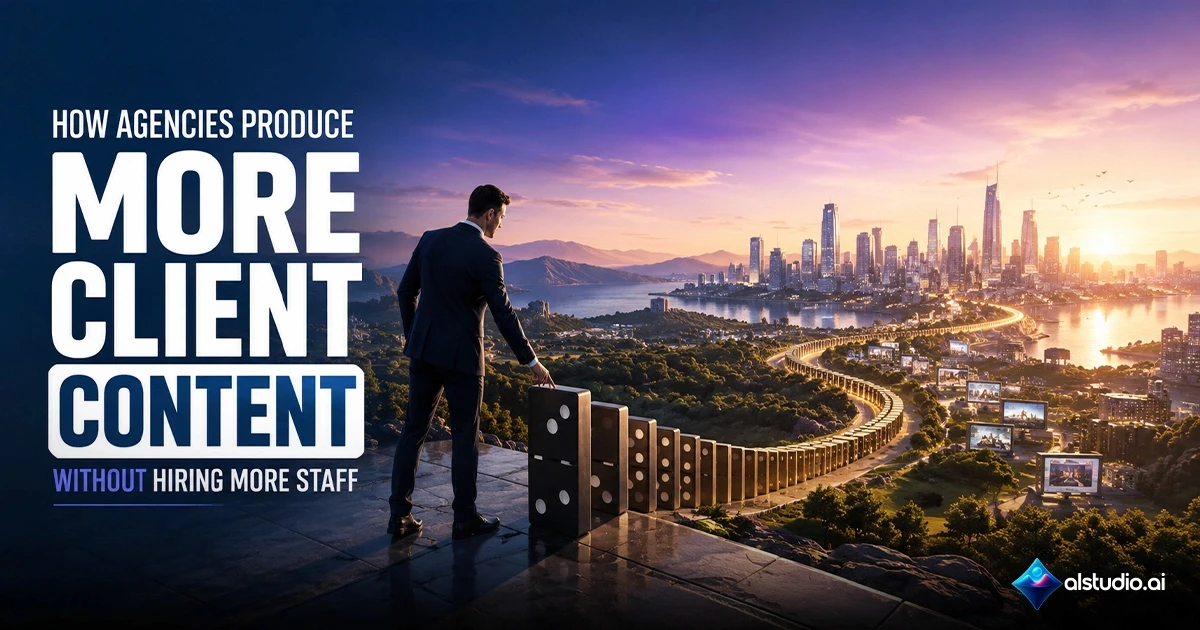
AI for Marketing Agencies:
How to Scale Output Without
Losing Quality?
AI for marketing agencies refers to the use of generative and automation tools to accelerate content creation, creative production, campaign execution, and client reporting. Used well, it lets agencies produce more work across more channels and languages while protecting brand consistency and margins. Used poorly, it produces generic output that erodes client trust. This guide explains where AI fits inside an agency, the real use cases that move the needle, the limitations to plan around, and how to implement it without breaking the quality your clients pay for.
The shift is already underway. Most agencies are no longer asking whether to adopt AI, but how to embed it into their delivery model so it strengthens rather than dilutes their craft. The agencies pulling ahead are the ones treating AI as a production system, not a novelty.
What Is AI for Marketing Agencies?
Short answer: AI for marketing agencies is the application of generative AI (text, image, video, voice) and automation to the core work agencies sell strategy support, content, creative assets, and reporting so teams can deliver faster and at greater scale.
Detailed explanation: Agencies have always been constrained by a simple equation: revenue is tied to billable hours and headcount. Every new client requires more people, and every campaign requires repeated manual production. AI changes that equation by collapsing the time between idea and finished asset.
In practice, this spans several layers:
Strategy and research — synthesizing briefs, competitor analysis, audience insights, and positioning angles.
Content production — blog posts, ad copy, social captions, email sequences, and scripts.
Creative production — images, product visuals, video, and motion assets.
Localization — adapting campaigns across languages and dialects.
Operations — reporting, QA, repurposing, and client communication.
The agencies that win don't bolt AI onto one task. They redesign their delivery pipeline around it.
Why AI Matters for Marketing Agencies
Short answer: AI matters because it breaks the link between output and headcount, letting agencies scale delivery, protect margins, and serve more channels and markets without proportionally growing the team.
Detailed explanation: The traditional agency model strains under three pressures: clients want more content across more platforms, turnaround expectations keep shrinking, and talent is expensive and hard to retain. AI addresses all three.
Why it matters in concrete terms:
Margin protection. Production work that consumed junior hours can be compressed, freeing senior talent for strategy and client relationships the parts clients actually value.
Channel coverage. A single campaign concept can be expanded into dozens of platform-native variations quickly.
Speed to market. Concepts move from brief to draft to client review in a fraction of the previous time.
Market reach. Multilingual and multi dialect production opens regional markets that were previously uneconomical to serve.
The risk is real too: when every agency has access to the same tools, undifferentiated AI output becomes a commodity. The competitive edge comes from how AI is governed and combined with human creative direction.
How AI Works Inside an Agency Workflow
Short answer: AI works best as a production layer inside a defined workflow brief in, AI-assisted draft out, human review and refinement, then delivery with brand rules enforced consistently across every asset.
Detailed explanation: The most effective agency AI workflows follow a repeatable loop rather than ad-hoc prompting. A mature pipeline looks like this:
Brief intake — the client brief, brand guidelines, and objectives are captured in a structured format.
Brand setup — brand voice, visual identity, recurring characters, products, and environments are defined once so they can be reused.
Generation — content and creative assets are produced from the brief using the defined brand parameters.
Human review — strategists and creatives edit, refine, and apply taste and judgment.
QA and consistency check — assets are checked against brand rules before delivery.
Delivery and repurposing — approved assets are adapted into all required formats and channels.
The critical insight is that consistency must be systematized. If brand voice and visual identity live only in a PDF guideline and a senior person's head, AI output will drift. When those rules are encoded into the production system itself, every generated asset stays on-brand by default.
This is where a Creative AI Operating System differs from a collection of point tools. Instead of stitching together separate apps for copy, images, and video each with its own brand setup and none aware of the others an integrated system holds the brand definition once and applies it across every studio and output.
Real Marketing Use Cases for AI
AI earns its place when tied to specific, recurring agency work. The highest value use cases:
Campaign content at scale. Turn one creative concept into a full set of platform specific posts, captions, and ad variants.
Always on social production. Maintain consistent posting cadence across multiple client accounts without burning out the team.
Product and ecommerce visuals. Generate clean, consistent product imagery and lifestyle scenes without a full photoshoot for every variation.
Performance ad creative. Produce many creative variations quickly for testing, then double down on winners.
Localization. Adapt a campaign into multiple languages and regional dialects while keeping the core message intact.
Repurposing. Convert a long form asset (a video, a report, a webinar) into derivative content across formats.
Each of these maps to billable agency work the difference is throughput.
Agency Use Cases: Scaling the Delivery Model
For agencies specifically, AI reshapes how the business itself operates:
Retainer expansion. Deliver more within existing retainers, increasing perceived value and reducing churn.
New service lines. Offer AI enabled services rapid creative testing, multilingual content, high volume social that were previously unprofitable.
Faster onboarding. Encode a new client's brand once, then produce on brand work from day one.
Junior leverage. Let smaller teams handle larger client loads, with seniors focused on direction and relationships.
Pitch velocity. Produce concept visuals and sample content during the pitch stage to win business.
The strategic shift is from selling hours to selling outcomes and volume a model AI makes economically viable.
Enterprise Use Cases: Brand Consistency at Scale
When agencies serve enterprise clients, the challenge changes from speed to governance. Large brands operate across regions, product lines, and teams, and the cost of off brand content is high.
Enterprise grade AI use cases include:
Centralized brand control so every market and team produces consistent assets.
Multi market localization that respects regional language, tone, and cultural nuance.
High volume production for large catalogs, seasonal campaigns, and ongoing always-on content.
Audit and approval workflows that keep legal, compliance, and brand teams in the loop.
For enterprise work, the value isn't just speed it's the ability to scale output while keeping every asset inside the brand's guardrails.
Benefits of AI for Marketing Agencies
Higher output per person without proportional hiring.
Faster turnaround from brief to delivery.
Consistent brand execution when rules are systematized.
Broader channel and language coverage.
Better margins on production heavy work.
More senior time for strategy and client relationships.
Limitations and Risks to Plan Around
AI is not a replacement for creative judgment, and treating it as one is the most common way agencies damage client trust.
Generic output. Without strong direction and brand systematization, AI produces forgettable work that clients could make themselves.
Quality variance. Output still requires human review; unreviewed AI work creates risk.
Brand drift. Inconsistent setup leads to off brand assets across campaigns.
Over-reliance. AI accelerates execution but does not replace strategy, taste, or client insight.
Factual and legal exposure. Claims, likeness, and IP need human verification particularly for regulated industries and public figure or likeness-based content.
The agencies that succeed treat these as governance problems to design around, not reasons to avoid AI.
Common Mistakes Agencies Make with AI
Using AI without a workflow. Ad hoc prompting produces inconsistent results and no efficiency gain.
Skipping brand setup. Generating without encoded brand rules guarantees drift.
Removing human review. Shipping unreviewed output erodes the quality clients pay for.
Tool sprawl. Stitching together disconnected apps multiplies setup work and breaks consistency.
Selling AI as the product. Clients buy outcomes, not the fact that AI was used.
Best Practices for Implementing AI in an Agency
Systematize the brand first. Define voice, visual identity, characters, products, and environments before scaling production.
Design a repeatable pipeline. Brief → generate → review → QA → deliver.
Keep humans in the loop. Use AI for throughput; reserve judgment, strategy, and taste for people.
Standardize QA. Check every asset against brand and accuracy rules before delivery.
Consolidate your stack. Favor an integrated system over disconnected point tools to protect consistency.
Train the team. Adoption fails when only one person knows how to drive the tools.
Step-by-Step: How to Roll Out AI in Your Agency
Audit your production bottlenecks. Identify where hours are lost to repetitive work.
Pick one high volume workflow (e.g., social content) to start.
Encode brand rules for that workflow so output stays consistent.
Build the pipeline with clear hand off points between AI and human review.
Run a pilot on one client or internal account.
Measure output volume, turnaround, and quality against the old process.
Standardize and expand to more workflows and clients once proven.
A quick note as you plan this: the agencies that get the most from AI are the ones that define their brand systems before scaling production. If you're setting up that foundation, platforms built around brand consistency like ALStudio.ai let you encode your brand once and reuse it across every content type, instead of rebuilding it tool by tool.
Featured Snippet Block
Featured Snippet Paragraph (52 words): AI for marketing agencies is the use of generative AI and automation to accelerate content, creative production, localization, and reporting. It lets agencies deliver more output across more channels and languages without proportional hiring provided brand rules are systematized and human review stays in the loop to protect quality and consistency.
Featured Snippet Bullet List How agencies use AI:
Producing campaign content at scale
Maintaining always on social across client accounts
Generating consistent product and ad visuals
Localizing campaigns across languages and dialects
Repurposing long form content into multiple formats
Automating reporting and QA
Comparison Table Point Tools vs. Creative AI Operating System:
Factor | Disconnected Point Tools | Creative AI Operating System |
Brand setup | Repeated in every tool | Defined once, reused everywhere |
Consistency | Drifts across apps | Enforced across all outputs |
Workflow | Manual hand-offs | Unified pipeline |
Content types | Separate apps for copy, image, video | Integrated studios |
Scaling | Setup multiplies with volume | Setup scales with the brand |
How Agencies Can Produce More Client Content Without Hiring More Staff
Creative AI OS
AI for Marketing Agencies:
How to Scale Output Without
Losing Quality?
AI for marketing agencies refers to the use of generative and automation tools to accelerate content creation, creative production, campaign execution, and client reporting. Used well, it lets agencies produce more work across more channels and languages while protecting brand consistency and margins. Used poorly, it produces generic output that erodes client trust. This guide explains where AI fits inside an agency, the real use cases that move the needle, the limitations to plan around, and how to implement it without breaking the quality your clients pay for.
The shift is already underway. Most agencies are no longer asking whether to adopt AI, but how to embed it into their delivery model so it strengthens rather than dilutes their craft. The agencies pulling ahead are the ones treating AI as a production system, not a novelty.
What Is AI for Marketing Agencies?
Short answer: AI for marketing agencies is the application of generative AI (text, image, video, voice) and automation to the core work agencies sell strategy support, content, creative assets, and reporting so teams can deliver faster and at greater scale.
Detailed explanation: Agencies have always been constrained by a simple equation: revenue is tied to billable hours and headcount. Every new client requires more people, and every campaign requires repeated manual production. AI changes that equation by collapsing the time between idea and finished asset.
In practice, this spans several layers:
Strategy and research — synthesizing briefs, competitor analysis, audience insights, and positioning angles.
Content production — blog posts, ad copy, social captions, email sequences, and scripts.
Creative production — images, product visuals, video, and motion assets.
Localization — adapting campaigns across languages and dialects.
Operations — reporting, QA, repurposing, and client communication.
The agencies that win don't bolt AI onto one task. They redesign their delivery pipeline around it.
Why AI Matters for Marketing Agencies
Short answer: AI matters because it breaks the link between output and headcount, letting agencies scale delivery, protect margins, and serve more channels and markets without proportionally growing the team.
Detailed explanation: The traditional agency model strains under three pressures: clients want more content across more platforms, turnaround expectations keep shrinking, and talent is expensive and hard to retain. AI addresses all three.
Why it matters in concrete terms:
Margin protection. Production work that consumed junior hours can be compressed, freeing senior talent for strategy and client relationships the parts clients actually value.
Channel coverage. A single campaign concept can be expanded into dozens of platform-native variations quickly.
Speed to market. Concepts move from brief to draft to client review in a fraction of the previous time.
Market reach. Multilingual and multi dialect production opens regional markets that were previously uneconomical to serve.
The risk is real too: when every agency has access to the same tools, undifferentiated AI output becomes a commodity. The competitive edge comes from how AI is governed and combined with human creative direction.
How AI Works Inside an Agency Workflow
Short answer: AI works best as a production layer inside a defined workflow brief in, AI-assisted draft out, human review and refinement, then delivery with brand rules enforced consistently across every asset.
Detailed explanation: The most effective agency AI workflows follow a repeatable loop rather than ad-hoc prompting. A mature pipeline looks like this:
Brief intake — the client brief, brand guidelines, and objectives are captured in a structured format.
Brand setup — brand voice, visual identity, recurring characters, products, and environments are defined once so they can be reused.
Generation — content and creative assets are produced from the brief using the defined brand parameters.
Human review — strategists and creatives edit, refine, and apply taste and judgment.
QA and consistency check — assets are checked against brand rules before delivery.
Delivery and repurposing — approved assets are adapted into all required formats and channels.
The critical insight is that consistency must be systematized. If brand voice and visual identity live only in a PDF guideline and a senior person's head, AI output will drift. When those rules are encoded into the production system itself, every generated asset stays on-brand by default.
This is where a Creative AI Operating System differs from a collection of point tools. Instead of stitching together separate apps for copy, images, and video each with its own brand setup and none aware of the others an integrated system holds the brand definition once and applies it across every studio and output.
Real Marketing Use Cases for AI
AI earns its place when tied to specific, recurring agency work. The highest value use cases:
Campaign content at scale. Turn one creative concept into a full set of platform specific posts, captions, and ad variants.
Always on social production. Maintain consistent posting cadence across multiple client accounts without burning out the team.
Product and ecommerce visuals. Generate clean, consistent product imagery and lifestyle scenes without a full photoshoot for every variation.
Performance ad creative. Produce many creative variations quickly for testing, then double down on winners.
Localization. Adapt a campaign into multiple languages and regional dialects while keeping the core message intact.
Repurposing. Convert a long form asset (a video, a report, a webinar) into derivative content across formats.
Each of these maps to billable agency work the difference is throughput.
Agency Use Cases: Scaling the Delivery Model
For agencies specifically, AI reshapes how the business itself operates:
Retainer expansion. Deliver more within existing retainers, increasing perceived value and reducing churn.
New service lines. Offer AI enabled services rapid creative testing, multilingual content, high volume social that were previously unprofitable.
Faster onboarding. Encode a new client's brand once, then produce on brand work from day one.
Junior leverage. Let smaller teams handle larger client loads, with seniors focused on direction and relationships.
Pitch velocity. Produce concept visuals and sample content during the pitch stage to win business.
The strategic shift is from selling hours to selling outcomes and volume a model AI makes economically viable.
Enterprise Use Cases: Brand Consistency at Scale
When agencies serve enterprise clients, the challenge changes from speed to governance. Large brands operate across regions, product lines, and teams, and the cost of off brand content is high.
Enterprise grade AI use cases include:
Centralized brand control so every market and team produces consistent assets.
Multi market localization that respects regional language, tone, and cultural nuance.
High volume production for large catalogs, seasonal campaigns, and ongoing always-on content.
Audit and approval workflows that keep legal, compliance, and brand teams in the loop.
For enterprise work, the value isn't just speed it's the ability to scale output while keeping every asset inside the brand's guardrails.
Benefits of AI for Marketing Agencies
Higher output per person without proportional hiring.
Faster turnaround from brief to delivery.
Consistent brand execution when rules are systematized.
Broader channel and language coverage.
Better margins on production heavy work.
More senior time for strategy and client relationships.
Limitations and Risks to Plan Around
AI is not a replacement for creative judgment, and treating it as one is the most common way agencies damage client trust.
Generic output. Without strong direction and brand systematization, AI produces forgettable work that clients could make themselves.
Quality variance. Output still requires human review; unreviewed AI work creates risk.
Brand drift. Inconsistent setup leads to off brand assets across campaigns.
Over-reliance. AI accelerates execution but does not replace strategy, taste, or client insight.
Factual and legal exposure. Claims, likeness, and IP need human verification particularly for regulated industries and public figure or likeness-based content.
The agencies that succeed treat these as governance problems to design around, not reasons to avoid AI.
Common Mistakes Agencies Make with AI
Using AI without a workflow. Ad hoc prompting produces inconsistent results and no efficiency gain.
Skipping brand setup. Generating without encoded brand rules guarantees drift.
Removing human review. Shipping unreviewed output erodes the quality clients pay for.
Tool sprawl. Stitching together disconnected apps multiplies setup work and breaks consistency.
Selling AI as the product. Clients buy outcomes, not the fact that AI was used.
Best Practices for Implementing AI in an Agency
Systematize the brand first. Define voice, visual identity, characters, products, and environments before scaling production.
Design a repeatable pipeline. Brief → generate → review → QA → deliver.
Keep humans in the loop. Use AI for throughput; reserve judgment, strategy, and taste for people.
Standardize QA. Check every asset against brand and accuracy rules before delivery.
Consolidate your stack. Favor an integrated system over disconnected point tools to protect consistency.
Train the team. Adoption fails when only one person knows how to drive the tools.
Step-by-Step: How to Roll Out AI in Your Agency
Audit your production bottlenecks. Identify where hours are lost to repetitive work.
Pick one high volume workflow (e.g., social content) to start.
Encode brand rules for that workflow so output stays consistent.
Build the pipeline with clear hand off points between AI and human review.
Run a pilot on one client or internal account.
Measure output volume, turnaround, and quality against the old process.
Standardize and expand to more workflows and clients once proven.
A quick note as you plan this: the agencies that get the most from AI are the ones that define their brand systems before scaling production. If you're setting up that foundation, platforms built around brand consistency like ALStudio.ai let you encode your brand once and reuse it across every content type, instead of rebuilding it tool by tool.
Featured Snippet Block
Featured Snippet Paragraph (52 words): AI for marketing agencies is the use of generative AI and automation to accelerate content, creative production, localization, and reporting. It lets agencies deliver more output across more channels and languages without proportional hiring provided brand rules are systematized and human review stays in the loop to protect quality and consistency.
Featured Snippet Bullet List How agencies use AI:
Producing campaign content at scale
Maintaining always on social across client accounts
Generating consistent product and ad visuals
Localizing campaigns across languages and dialects
Repurposing long form content into multiple formats
Automating reporting and QA
Comparison Table Point Tools vs. Creative AI Operating System:
Factor | Disconnected Point Tools | Creative AI Operating System |
Brand setup | Repeated in every tool | Defined once, reused everywhere |
Consistency | Drifts across apps | Enforced across all outputs |
Workflow | Manual hand-offs | Unified pipeline |
Content types | Separate apps for copy, image, video | Integrated studios |
Scaling | Setup multiplies with volume | Setup scales with the brand |
How Agencies Can Produce More Client Content Without Hiring More Staff
Creative AI OS
AI for Marketing Agencies:
How to Scale Output Without
Losing Quality?
AI for marketing agencies refers to the use of generative and automation tools to accelerate content creation, creative production, campaign execution, and client reporting. Used well, it lets agencies produce more work across more channels and languages while protecting brand consistency and margins. Used poorly, it produces generic output that erodes client trust. This guide explains where AI fits inside an agency, the real use cases that move the needle, the limitations to plan around, and how to implement it without breaking the quality your clients pay for.
The shift is already underway. Most agencies are no longer asking whether to adopt AI, but how to embed it into their delivery model so it strengthens rather than dilutes their craft. The agencies pulling ahead are the ones treating AI as a production system, not a novelty.
What Is AI for Marketing Agencies?
Short answer: AI for marketing agencies is the application of generative AI (text, image, video, voice) and automation to the core work agencies sell strategy support, content, creative assets, and reporting so teams can deliver faster and at greater scale.
Detailed explanation: Agencies have always been constrained by a simple equation: revenue is tied to billable hours and headcount. Every new client requires more people, and every campaign requires repeated manual production. AI changes that equation by collapsing the time between idea and finished asset.
In practice, this spans several layers:
Strategy and research — synthesizing briefs, competitor analysis, audience insights, and positioning angles.
Content production — blog posts, ad copy, social captions, email sequences, and scripts.
Creative production — images, product visuals, video, and motion assets.
Localization — adapting campaigns across languages and dialects.
Operations — reporting, QA, repurposing, and client communication.
The agencies that win don't bolt AI onto one task. They redesign their delivery pipeline around it.
Why AI Matters for Marketing Agencies
Short answer: AI matters because it breaks the link between output and headcount, letting agencies scale delivery, protect margins, and serve more channels and markets without proportionally growing the team.
Detailed explanation: The traditional agency model strains under three pressures: clients want more content across more platforms, turnaround expectations keep shrinking, and talent is expensive and hard to retain. AI addresses all three.
Why it matters in concrete terms:
Margin protection. Production work that consumed junior hours can be compressed, freeing senior talent for strategy and client relationships the parts clients actually value.
Channel coverage. A single campaign concept can be expanded into dozens of platform-native variations quickly.
Speed to market. Concepts move from brief to draft to client review in a fraction of the previous time.
Market reach. Multilingual and multi dialect production opens regional markets that were previously uneconomical to serve.
The risk is real too: when every agency has access to the same tools, undifferentiated AI output becomes a commodity. The competitive edge comes from how AI is governed and combined with human creative direction.
How AI Works Inside an Agency Workflow
Short answer: AI works best as a production layer inside a defined workflow brief in, AI-assisted draft out, human review and refinement, then delivery with brand rules enforced consistently across every asset.
Detailed explanation: The most effective agency AI workflows follow a repeatable loop rather than ad-hoc prompting. A mature pipeline looks like this:
Brief intake — the client brief, brand guidelines, and objectives are captured in a structured format.
Brand setup — brand voice, visual identity, recurring characters, products, and environments are defined once so they can be reused.
Generation — content and creative assets are produced from the brief using the defined brand parameters.
Human review — strategists and creatives edit, refine, and apply taste and judgment.
QA and consistency check — assets are checked against brand rules before delivery.
Delivery and repurposing — approved assets are adapted into all required formats and channels.
The critical insight is that consistency must be systematized. If brand voice and visual identity live only in a PDF guideline and a senior person's head, AI output will drift. When those rules are encoded into the production system itself, every generated asset stays on-brand by default.
This is where a Creative AI Operating System differs from a collection of point tools. Instead of stitching together separate apps for copy, images, and video each with its own brand setup and none aware of the others an integrated system holds the brand definition once and applies it across every studio and output.
Real Marketing Use Cases for AI
AI earns its place when tied to specific, recurring agency work. The highest value use cases:
Campaign content at scale. Turn one creative concept into a full set of platform specific posts, captions, and ad variants.
Always on social production. Maintain consistent posting cadence across multiple client accounts without burning out the team.
Product and ecommerce visuals. Generate clean, consistent product imagery and lifestyle scenes without a full photoshoot for every variation.
Performance ad creative. Produce many creative variations quickly for testing, then double down on winners.
Localization. Adapt a campaign into multiple languages and regional dialects while keeping the core message intact.
Repurposing. Convert a long form asset (a video, a report, a webinar) into derivative content across formats.
Each of these maps to billable agency work the difference is throughput.
Agency Use Cases: Scaling the Delivery Model
For agencies specifically, AI reshapes how the business itself operates:
Retainer expansion. Deliver more within existing retainers, increasing perceived value and reducing churn.
New service lines. Offer AI enabled services rapid creative testing, multilingual content, high volume social that were previously unprofitable.
Faster onboarding. Encode a new client's brand once, then produce on brand work from day one.
Junior leverage. Let smaller teams handle larger client loads, with seniors focused on direction and relationships.
Pitch velocity. Produce concept visuals and sample content during the pitch stage to win business.
The strategic shift is from selling hours to selling outcomes and volume a model AI makes economically viable.
Enterprise Use Cases: Brand Consistency at Scale
When agencies serve enterprise clients, the challenge changes from speed to governance. Large brands operate across regions, product lines, and teams, and the cost of off brand content is high.
Enterprise grade AI use cases include:
Centralized brand control so every market and team produces consistent assets.
Multi market localization that respects regional language, tone, and cultural nuance.
High volume production for large catalogs, seasonal campaigns, and ongoing always-on content.
Audit and approval workflows that keep legal, compliance, and brand teams in the loop.
For enterprise work, the value isn't just speed it's the ability to scale output while keeping every asset inside the brand's guardrails.
Benefits of AI for Marketing Agencies
Higher output per person without proportional hiring.
Faster turnaround from brief to delivery.
Consistent brand execution when rules are systematized.
Broader channel and language coverage.
Better margins on production heavy work.
More senior time for strategy and client relationships.
Limitations and Risks to Plan Around
AI is not a replacement for creative judgment, and treating it as one is the most common way agencies damage client trust.
Generic output. Without strong direction and brand systematization, AI produces forgettable work that clients could make themselves.
Quality variance. Output still requires human review; unreviewed AI work creates risk.
Brand drift. Inconsistent setup leads to off brand assets across campaigns.
Over-reliance. AI accelerates execution but does not replace strategy, taste, or client insight.
Factual and legal exposure. Claims, likeness, and IP need human verification particularly for regulated industries and public figure or likeness-based content.
The agencies that succeed treat these as governance problems to design around, not reasons to avoid AI.
Common Mistakes Agencies Make with AI
Using AI without a workflow. Ad hoc prompting produces inconsistent results and no efficiency gain.
Skipping brand setup. Generating without encoded brand rules guarantees drift.
Removing human review. Shipping unreviewed output erodes the quality clients pay for.
Tool sprawl. Stitching together disconnected apps multiplies setup work and breaks consistency.
Selling AI as the product. Clients buy outcomes, not the fact that AI was used.
Best Practices for Implementing AI in an Agency
Systematize the brand first. Define voice, visual identity, characters, products, and environments before scaling production.
Design a repeatable pipeline. Brief → generate → review → QA → deliver.
Keep humans in the loop. Use AI for throughput; reserve judgment, strategy, and taste for people.
Standardize QA. Check every asset against brand and accuracy rules before delivery.
Consolidate your stack. Favor an integrated system over disconnected point tools to protect consistency.
Train the team. Adoption fails when only one person knows how to drive the tools.
Step-by-Step: How to Roll Out AI in Your Agency
Audit your production bottlenecks. Identify where hours are lost to repetitive work.
Pick one high volume workflow (e.g., social content) to start.
Encode brand rules for that workflow so output stays consistent.
Build the pipeline with clear hand off points between AI and human review.
Run a pilot on one client or internal account.
Measure output volume, turnaround, and quality against the old process.
Standardize and expand to more workflows and clients once proven.
A quick note as you plan this: the agencies that get the most from AI are the ones that define their brand systems before scaling production. If you're setting up that foundation, platforms built around brand consistency like ALStudio.ai let you encode your brand once and reuse it across every content type, instead of rebuilding it tool by tool.
Featured Snippet Block
Featured Snippet Paragraph (52 words): AI for marketing agencies is the use of generative AI and automation to accelerate content, creative production, localization, and reporting. It lets agencies deliver more output across more channels and languages without proportional hiring provided brand rules are systematized and human review stays in the loop to protect quality and consistency.
Featured Snippet Bullet List How agencies use AI:
Producing campaign content at scale
Maintaining always on social across client accounts
Generating consistent product and ad visuals
Localizing campaigns across languages and dialects
Repurposing long form content into multiple formats
Automating reporting and QA
Comparison Table Point Tools vs. Creative AI Operating System:
Factor | Disconnected Point Tools | Creative AI Operating System |
Brand setup | Repeated in every tool | Defined once, reused everywhere |
Consistency | Drifts across apps | Enforced across all outputs |
Workflow | Manual hand-offs | Unified pipeline |
Content types | Separate apps for copy, image, video | Integrated studios |
Scaling | Setup multiplies with volume | Setup scales with the brand |
How Agencies Can Produce More Client Content Without Hiring More Staff
Creative AI OS
AI for Marketing Agencies:
How to Scale Output Without
Losing Quality?
AI for marketing agencies refers to the use of generative and automation tools to accelerate content creation, creative production, campaign execution, and client reporting. Used well, it lets agencies produce more work across more channels and languages while protecting brand consistency and margins. Used poorly, it produces generic output that erodes client trust. This guide explains where AI fits inside an agency, the real use cases that move the needle, the limitations to plan around, and how to implement it without breaking the quality your clients pay for.
The shift is already underway. Most agencies are no longer asking whether to adopt AI, but how to embed it into their delivery model so it strengthens rather than dilutes their craft. The agencies pulling ahead are the ones treating AI as a production system, not a novelty.
What Is AI for Marketing Agencies?
Short answer: AI for marketing agencies is the application of generative AI (text, image, video, voice) and automation to the core work agencies sell strategy support, content, creative assets, and reporting so teams can deliver faster and at greater scale.
Detailed explanation: Agencies have always been constrained by a simple equation: revenue is tied to billable hours and headcount. Every new client requires more people, and every campaign requires repeated manual production. AI changes that equation by collapsing the time between idea and finished asset.
In practice, this spans several layers:
Strategy and research — synthesizing briefs, competitor analysis, audience insights, and positioning angles.
Content production — blog posts, ad copy, social captions, email sequences, and scripts.
Creative production — images, product visuals, video, and motion assets.
Localization — adapting campaigns across languages and dialects.
Operations — reporting, QA, repurposing, and client communication.
The agencies that win don't bolt AI onto one task. They redesign their delivery pipeline around it.
Why AI Matters for Marketing Agencies
Short answer: AI matters because it breaks the link between output and headcount, letting agencies scale delivery, protect margins, and serve more channels and markets without proportionally growing the team.
Detailed explanation: The traditional agency model strains under three pressures: clients want more content across more platforms, turnaround expectations keep shrinking, and talent is expensive and hard to retain. AI addresses all three.
Why it matters in concrete terms:
Margin protection. Production work that consumed junior hours can be compressed, freeing senior talent for strategy and client relationships the parts clients actually value.
Channel coverage. A single campaign concept can be expanded into dozens of platform-native variations quickly.
Speed to market. Concepts move from brief to draft to client review in a fraction of the previous time.
Market reach. Multilingual and multi dialect production opens regional markets that were previously uneconomical to serve.
The risk is real too: when every agency has access to the same tools, undifferentiated AI output becomes a commodity. The competitive edge comes from how AI is governed and combined with human creative direction.
How AI Works Inside an Agency Workflow
Short answer: AI works best as a production layer inside a defined workflow brief in, AI-assisted draft out, human review and refinement, then delivery with brand rules enforced consistently across every asset.
Detailed explanation: The most effective agency AI workflows follow a repeatable loop rather than ad-hoc prompting. A mature pipeline looks like this:
Brief intake — the client brief, brand guidelines, and objectives are captured in a structured format.
Brand setup — brand voice, visual identity, recurring characters, products, and environments are defined once so they can be reused.
Generation — content and creative assets are produced from the brief using the defined brand parameters.
Human review — strategists and creatives edit, refine, and apply taste and judgment.
QA and consistency check — assets are checked against brand rules before delivery.
Delivery and repurposing — approved assets are adapted into all required formats and channels.
The critical insight is that consistency must be systematized. If brand voice and visual identity live only in a PDF guideline and a senior person's head, AI output will drift. When those rules are encoded into the production system itself, every generated asset stays on-brand by default.
This is where a Creative AI Operating System differs from a collection of point tools. Instead of stitching together separate apps for copy, images, and video each with its own brand setup and none aware of the others an integrated system holds the brand definition once and applies it across every studio and output.
Real Marketing Use Cases for AI
AI earns its place when tied to specific, recurring agency work. The highest value use cases:
Campaign content at scale. Turn one creative concept into a full set of platform specific posts, captions, and ad variants.
Always on social production. Maintain consistent posting cadence across multiple client accounts without burning out the team.
Product and ecommerce visuals. Generate clean, consistent product imagery and lifestyle scenes without a full photoshoot for every variation.
Performance ad creative. Produce many creative variations quickly for testing, then double down on winners.
Localization. Adapt a campaign into multiple languages and regional dialects while keeping the core message intact.
Repurposing. Convert a long form asset (a video, a report, a webinar) into derivative content across formats.
Each of these maps to billable agency work the difference is throughput.
Agency Use Cases: Scaling the Delivery Model
For agencies specifically, AI reshapes how the business itself operates:
Retainer expansion. Deliver more within existing retainers, increasing perceived value and reducing churn.
New service lines. Offer AI enabled services rapid creative testing, multilingual content, high volume social that were previously unprofitable.
Faster onboarding. Encode a new client's brand once, then produce on brand work from day one.
Junior leverage. Let smaller teams handle larger client loads, with seniors focused on direction and relationships.
Pitch velocity. Produce concept visuals and sample content during the pitch stage to win business.
The strategic shift is from selling hours to selling outcomes and volume a model AI makes economically viable.
Enterprise Use Cases: Brand Consistency at Scale
When agencies serve enterprise clients, the challenge changes from speed to governance. Large brands operate across regions, product lines, and teams, and the cost of off brand content is high.
Enterprise grade AI use cases include:
Centralized brand control so every market and team produces consistent assets.
Multi market localization that respects regional language, tone, and cultural nuance.
High volume production for large catalogs, seasonal campaigns, and ongoing always-on content.
Audit and approval workflows that keep legal, compliance, and brand teams in the loop.
For enterprise work, the value isn't just speed it's the ability to scale output while keeping every asset inside the brand's guardrails.
Benefits of AI for Marketing Agencies
Higher output per person without proportional hiring.
Faster turnaround from brief to delivery.
Consistent brand execution when rules are systematized.
Broader channel and language coverage.
Better margins on production heavy work.
More senior time for strategy and client relationships.
Limitations and Risks to Plan Around
AI is not a replacement for creative judgment, and treating it as one is the most common way agencies damage client trust.
Generic output. Without strong direction and brand systematization, AI produces forgettable work that clients could make themselves.
Quality variance. Output still requires human review; unreviewed AI work creates risk.
Brand drift. Inconsistent setup leads to off brand assets across campaigns.
Over-reliance. AI accelerates execution but does not replace strategy, taste, or client insight.
Factual and legal exposure. Claims, likeness, and IP need human verification particularly for regulated industries and public figure or likeness-based content.
The agencies that succeed treat these as governance problems to design around, not reasons to avoid AI.
Common Mistakes Agencies Make with AI
Using AI without a workflow. Ad hoc prompting produces inconsistent results and no efficiency gain.
Skipping brand setup. Generating without encoded brand rules guarantees drift.
Removing human review. Shipping unreviewed output erodes the quality clients pay for.
Tool sprawl. Stitching together disconnected apps multiplies setup work and breaks consistency.
Selling AI as the product. Clients buy outcomes, not the fact that AI was used.
Best Practices for Implementing AI in an Agency
Systematize the brand first. Define voice, visual identity, characters, products, and environments before scaling production.
Design a repeatable pipeline. Brief → generate → review → QA → deliver.
Keep humans in the loop. Use AI for throughput; reserve judgment, strategy, and taste for people.
Standardize QA. Check every asset against brand and accuracy rules before delivery.
Consolidate your stack. Favor an integrated system over disconnected point tools to protect consistency.
Train the team. Adoption fails when only one person knows how to drive the tools.
Step-by-Step: How to Roll Out AI in Your Agency
Audit your production bottlenecks. Identify where hours are lost to repetitive work.
Pick one high volume workflow (e.g., social content) to start.
Encode brand rules for that workflow so output stays consistent.
Build the pipeline with clear hand off points between AI and human review.
Run a pilot on one client or internal account.
Measure output volume, turnaround, and quality against the old process.
Standardize and expand to more workflows and clients once proven.
A quick note as you plan this: the agencies that get the most from AI are the ones that define their brand systems before scaling production. If you're setting up that foundation, platforms built around brand consistency like ALStudio.ai let you encode your brand once and reuse it across every content type, instead of rebuilding it tool by tool.
Featured Snippet Block
Featured Snippet Paragraph (52 words): AI for marketing agencies is the use of generative AI and automation to accelerate content, creative production, localization, and reporting. It lets agencies deliver more output across more channels and languages without proportional hiring provided brand rules are systematized and human review stays in the loop to protect quality and consistency.
Featured Snippet Bullet List How agencies use AI:
Producing campaign content at scale
Maintaining always on social across client accounts
Generating consistent product and ad visuals
Localizing campaigns across languages and dialects
Repurposing long form content into multiple formats
Automating reporting and QA
Comparison Table Point Tools vs. Creative AI Operating System:
Factor | Disconnected Point Tools | Creative AI Operating System |
Brand setup | Repeated in every tool | Defined once, reused everywhere |
Consistency | Drifts across apps | Enforced across all outputs |
Workflow | Manual hand-offs | Unified pipeline |
Content types | Separate apps for copy, image, video | Integrated studios |
Scaling | Setup multiplies with volume | Setup scales with the brand |
Frequently Asked Questions
Everything you'd want to know before signing up and everything an agency buyer asks on the call.
What are the best AI tools for marketing agencies?
The best tools depend on your workflow, but the strongest fit for agencies is an integrated Creative AI Operating System that handles content, image, and video production under one brand definition rather than separate point tools. Look for brand consistency controls, multilingual support, and a repeatable production pipeline that keeps humans in the review loop.
How much does AI cost for a marketing agency?
Costs range from low monthly subscriptions for single tools to platform pricing for integrated systems, plus the internal time to set up workflows and train the team. The more useful question is ROI: measure cost against the production hours saved and the additional client output you can deliver. Most agencies recover cost through higher throughput per person.
Can AI replace a marketing agency?
No. AI accelerates production but does not replace strategy, creative judgment, client insight, or accountability the things agencies are actually hired for. AI shifts the agency model from selling hours to selling outcomes and volume, but human direction remains the differentiator between commodity output and work clients value.
How do agencies keep AI content on-brand?
By systematizing brand rules voice, visual identity, recurring characters, products, and environments inside the production system itself, rather than relying on a static guideline document. When brand definitions are encoded once and applied to every generated asset, output stays consistent across campaigns, channels, and languages by default.
Is AI worth it for small marketing agencies?
Yes, often more so than for large ones. Small agencies gain the most leverage because AI lets a lean team handle larger client loads and offer services that were previously unprofitable. Start with one high volume workflow, prove the time savings, then expand rather than adopting everything at once.
What are the best AI tools for marketing agencies?
The best tools depend on your workflow, but the strongest fit for agencies is an integrated Creative AI Operating System that handles content, image, and video production under one brand definition rather than separate point tools. Look for brand consistency controls, multilingual support, and a repeatable production pipeline that keeps humans in the review loop.
How much does AI cost for a marketing agency?
Costs range from low monthly subscriptions for single tools to platform pricing for integrated systems, plus the internal time to set up workflows and train the team. The more useful question is ROI: measure cost against the production hours saved and the additional client output you can deliver. Most agencies recover cost through higher throughput per person.
Can AI replace a marketing agency?
No. AI accelerates production but does not replace strategy, creative judgment, client insight, or accountability the things agencies are actually hired for. AI shifts the agency model from selling hours to selling outcomes and volume, but human direction remains the differentiator between commodity output and work clients value.
How do agencies keep AI content on-brand?
By systematizing brand rules voice, visual identity, recurring characters, products, and environments inside the production system itself, rather than relying on a static guideline document. When brand definitions are encoded once and applied to every generated asset, output stays consistent across campaigns, channels, and languages by default.
Is AI worth it for small marketing agencies?
Yes, often more so than for large ones. Small agencies gain the most leverage because AI lets a lean team handle larger client loads and offer services that were previously unprofitable. Start with one high volume workflow, prove the time savings, then expand rather than adopting everything at once.
What are the best AI tools for marketing agencies?
The best tools depend on your workflow, but the strongest fit for agencies is an integrated Creative AI Operating System that handles content, image, and video production under one brand definition rather than separate point tools. Look for brand consistency controls, multilingual support, and a repeatable production pipeline that keeps humans in the review loop.
How much does AI cost for a marketing agency?
Costs range from low monthly subscriptions for single tools to platform pricing for integrated systems, plus the internal time to set up workflows and train the team. The more useful question is ROI: measure cost against the production hours saved and the additional client output you can deliver. Most agencies recover cost through higher throughput per person.
Can AI replace a marketing agency?
No. AI accelerates production but does not replace strategy, creative judgment, client insight, or accountability the things agencies are actually hired for. AI shifts the agency model from selling hours to selling outcomes and volume, but human direction remains the differentiator between commodity output and work clients value.
How do agencies keep AI content on-brand?
By systematizing brand rules voice, visual identity, recurring characters, products, and environments inside the production system itself, rather than relying on a static guideline document. When brand definitions are encoded once and applied to every generated asset, output stays consistent across campaigns, channels, and languages by default.
Is AI worth it for small marketing agencies?
Yes, often more so than for large ones. Small agencies gain the most leverage because AI lets a lean team handle larger client loads and offer services that were previously unprofitable. Start with one high volume workflow, prove the time savings, then expand rather than adopting everything at once.
What are the best AI tools for marketing agencies?
The best tools depend on your workflow, but the strongest fit for agencies is an integrated Creative AI Operating System that handles content, image, and video production under one brand definition rather than separate point tools. Look for brand consistency controls, multilingual support, and a repeatable production pipeline that keeps humans in the review loop.
How much does AI cost for a marketing agency?
Costs range from low monthly subscriptions for single tools to platform pricing for integrated systems, plus the internal time to set up workflows and train the team. The more useful question is ROI: measure cost against the production hours saved and the additional client output you can deliver. Most agencies recover cost through higher throughput per person.
Can AI replace a marketing agency?
No. AI accelerates production but does not replace strategy, creative judgment, client insight, or accountability the things agencies are actually hired for. AI shifts the agency model from selling hours to selling outcomes and volume, but human direction remains the differentiator between commodity output and work clients value.
How do agencies keep AI content on-brand?
By systematizing brand rules voice, visual identity, recurring characters, products, and environments inside the production system itself, rather than relying on a static guideline document. When brand definitions are encoded once and applied to every generated asset, output stays consistent across campaigns, channels, and languages by default.
Is AI worth it for small marketing agencies?
Yes, often more so than for large ones. Small agencies gain the most leverage because AI lets a lean team handle larger client loads and offer services that were previously unprofitable. Start with one high volume workflow, prove the time savings, then expand rather than adopting everything at once.
Related blogs
Provide insights into team performance and engagement


Related blogs
Provide insights into team performance and engagement
Related blogs
Provide insights into team performance and engagement
Stay Ahead of AI Creativity
Get new AI models, creative workflows, product updates, and marketing insights delivered to your inbox.
Tools
©2026 Animus All Rights Reserved.
Stay Ahead of AI Creativity
Get new AI models, creative workflows, product updates, and marketing insights delivered to your inbox.
Tools
©2026 Animus All Rights Reserved.
Stay Ahead of AI Creativity
Get new AI models, creative workflows, product updates, and marketing insights delivered to your inbox.
Tools
©2026 Animus All Rights Reserved.