



Why Most AI Tools Fail at Brand Consistency
Brand DNA
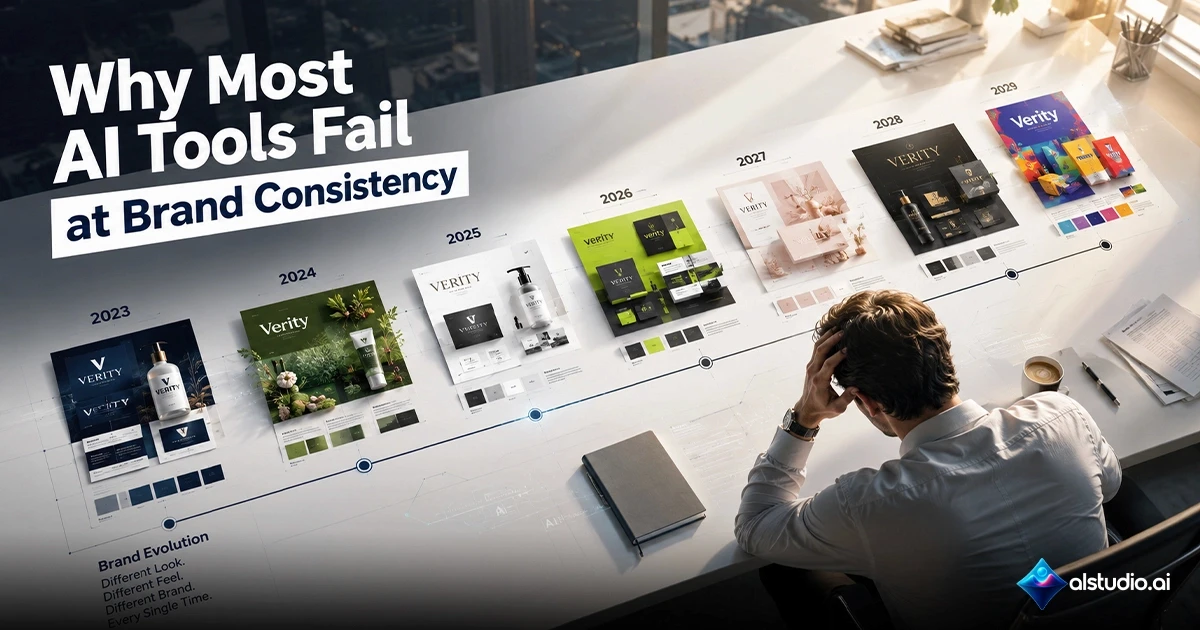
Why Most Tools Fail and What Actually Fixes It ?
AI brand consistency is one of the most misunderstood challenges in modern marketing. Teams assume the problem is prompting. They write longer briefs, build larger prompt libraries, and upload more reference images and still watch their brand drift campaign after campaign.
The problem is not prompting. The problem is memory.
This article explains why AI tools structurally fail at brand consistency, what "Brand DNA" actually means, and how organizations producing content at scale are beginning to solve the problem through identity infrastructure rather than better instructions.
Why AI Brand Consistency Fails Before You Even Start
AI Tools Were Designed for Generation, Not Memory
Most AI tools image generators, video platforms, copywriting systems, voice tools were designed to produce outputs. They were not designed to remember identity.
A language model generates based on what is in the current session context. An image model generates based on the prompt and any references supplied. A video model generates based on instructions supplied for that specific task.
When the session ends, context disappears.
The next generation starts from zero.
Every prompt becomes a fresh interpretation of the brand.
This is the architectural root cause of AI brand drift and no amount of better prompting solves an architectural problem.
The Industry Misdiagnosis
Most marketing teams respond to brand inconsistency by:
Writing longer, more detailed prompts
Building internal prompt libraries
Creating reference image folders
Training employees on prompting frameworks
These tactics improve individual output quality. They do not solve identity persistence.
The distinction matters because it determines where organizations invest effort. If consistency is a prompting problem, the solution is better instructions. If consistency is a memory problem, the solution is infrastructure.
Many teams have improved their prompting significantly without ever solving brand consistency because they were solving the wrong problem.
What AI Brand Consistency Actually Means
AI brand consistency means that your characters, products, visual identity, environments, and communication style remain recognizably identical across every output regardless of which model, tool, campaign, or team member created it.
This is distinct from output quality. A single asset can look excellent and still be inconsistent with the rest of the campaign.
The key distinction most teams miss:
Definition | Challenge Type | |
Coherence | A single asset looks correct on its own | Generation challenge |
Consistency | The hundredth asset feels like it came from the same brand as the first | Memory challenge |
AI tools are increasingly good at coherence. Very few address consistency.
The Hidden Cost of Brand Drift
Brand inconsistency is often categorized as a creative quality issue. In practice, it is an operational cost.
When a product appears differently across advertisements, approval teams request revisions. When a character changes between campaign phases, creative teams spend time correcting assets. When localized content sounds different across markets, regional teams manually adjust messaging.
The operational cost appears as:
Additional review cycles before approval
Longer campaign timelines
More agency revision requests
Increased cross team coordination
Delayed deployment
Higher per asset production cost
None of these costs appear directly in a marketing dashboard. They accumulate across hundreds or thousands of assets and they grow as content output increases.
As AI lowers the cost of generation, the cost of correcting inconsistency becomes the dominant expense in content production.
The Four Layers of Brand Consistency Most Teams Overlook
Most discussions about brand consistency focus only on tone of voice or logo usage.
AI generated content production requires consistency across four separate identity layers simultaneously.
Layer 1: Brand DNA
Brand DNA governs the foundational identity of the organization how it communicates, what it stands for, and how it presents itself visually.
Includes: Tone of voice, messaging principles, brand positioning, logo usage rules, typography, color systems
Consistency failure without it: Campaign copy sounds different across markets, social channels, or team members
Layer 2: Character DNA
Character DNA governs recurring people, mascots, spokespersons, influencers, and avatars ensuring they remain visually and behaviorally consistent across every appearance.
Includes: Facial structure, hair, clothing, expressions, personality traits, behavioral guidelines
Consistency failure without it: A brand spokesperson looks recognizably different between a product video and a paid advertisement
Layer 3: Product DNA
Product DNA governs how products appear across every generated asset maintaining exact specifications regardless of scene, lighting, or campaign context.
Includes: Product shape, packaging details, materials, logo placement, presentation rules
Consistency failure without it: A product's packaging appears slightly different across three advertisements in the same campaign
Layer 4: Environment DNA
Environment DNA governs the visual world surrounding a brand ensuring that scenes, locations, and atmospheres feel connected across campaigns.
Includes: Lighting style, set design, background aesthetics, color atmosphere, scene composition
Consistency failure without it: Individual campaign assets look professionally produced but feel visually disconnected from each other
When any one layer is missing, the others compensate poorly. The result is content that may look individually acceptable but fails to feel like a unified brand when viewed together.
The Six Most Common AI Brand Consistency Failures
1. Session Amnesia
Brand context exists only inside the active prompt window. When the session ends, the brand disappears. The next generation starts from defaults.
2. Character Drift
A recurring character changes appearance between outputs different facial features, clothing, or age. This becomes particularly visible in video production where audiences immediately notice changes.
3. Product Drift
Products slowly change between generations. Logos shift. Packaging details change. Colors alter slightly. Materials appear inconsistent across advertisements.
4. Environment Drift
Campaign visuals lose their sense of a shared world. One asset appears cinematic. The next appears corporate. The next appears minimalist. Nothing is technically wrong, but nothing feels connected.
5. Tone Collapse
Brand voice becomes generic or shifts character. A premium brand suddenly sounds casual. A confident brand becomes over formal. This failure is especially common in localized content across languages and markets.
6. Multi Operator Inconsistency
Different team members interpret the same brand differently. Without a shared identity layer, these small variations compound across a campaign.
Why Existing Methods Eventually Break Down
Why Prompt Libraries Fail at Scale
Prompt libraries appear to solve consistency initially. Teams create approved templates and instructions that improve early-stage output quality.
Over time, however:
Different versions of prompts emerge across teams
Individual employees modify prompts based on personal interpretation
New team members interpret instructions differently from original intent
The prompt library itself becomes a source of inconsistency
Prompt libraries store instructions. They do not store identity. That is why they reduce inconsistency temporarily but cannot eliminate it permanently.
Why Reference Images Are Not Enough
Reference images improve short term visual accuracy. A model can recognize what a character or product looks like at a specific moment.
What a reference image cannot store:
Brand voice
Product behavior rules
Character personality traits
Environment standards
Localization guidelines
Creative governance frameworks
The system recognizes the image. It does not remember the identity. For organizations producing content at volume, recognition alone is insufficient.
Why Traditional Brand Guidelines No Longer Scale
Brand guidelines were designed for human interpretation in environments where a limited number of campaigns were produced annually.
In an AI driven content operation producing hundreds of assets weekly across multiple markets, manual interpretation becomes the bottleneck.
A brand guidelines document describes what a brand should be. It cannot enforce it.
A PDF stores information. A memory system operationalizes it.
What Actually Solves AI Brand Consistency: The Memory Layer
The solution to AI brand consistency is not better prompts.
It is a persistent memory layer that sits between the creative brief and the generation model storing brand identity in a structured, reusable format that remains active across every session, every tool, every team member, and every campaign.
Traditional AI Workflow vs. Brand DNA Workflow
Traditional AI Workflow
Brief → Prompt → AI Model → Output
[Session ends context lost]
New brief → Prompt → AI Model → Output
[Brand context rebuilt from zero]
Brand DNA Workflow
Brief → Brand DNA Memory Layer → AI Model → Output
[Session ends identity persists]
New brief → Brand DNA Memory Layer → AI Model → Output
[Brand context automatically applied]
The difference appears subtle in a diagram.
Operationally, it changes everything about how content scales.
How ALStudio's Consistency Engine Approaches This Problem
Already using AI to generate content but spending too much time correcting brand drift? ALStudio's Constants Studio was built specifically to solve the memory problem try it free.
ALStudio built the Consistency Engine around a single principle: a brand should be defined once and remembered everywhere.
Rather than rebuilding brand context through prompts for every generation, teams store identity as structured DNA layers inside Constants Studio:
Brand DNA stores the organizational identity
Character DNA stores recurring people and personas
Product DNA stores product visual specifications
Environment DNA stores visual world standards
These identity layers remain automatically active across Content Studio, Film Studio, Marketing Studio, and Editor Studio regardless of which underlying generation model is used.
The underlying model can change. The identity layer remains constant.
This separation between generation and identity is the core architectural principle that differentiates a content generation platform from an identity infrastructure platform.
How This Works in a Real Campaign
Consider a consumer brand running a multilingual campaign across Saudi Arabia, UAE, Egypt, and France with a recurring brand character, multiple product variations, and regional adaptations.
Without persistent brand memory:
Character appearance drifts between videos
Product packaging shifts slightly across markets
French content sounds more premium than Arabic content
Gulf Arabic adaptation sounds generic; Egyptian Arabic sounds overly formal
Visual style varies depending on who generated the content
Each asset is individually acceptable; the campaign does not feel unified
With Brand DNA, Character DNA, Product DNA, and Environment DNA active:
Brand identity is defined once and persists across every output
The character remains visually consistent across all market versions
Product specifications remain identical regardless of scene or market
Brand voice maintains consistent character across Arabic and French localizations
The French campaign feels connected to the Arabic campaign
The campaign scales without losing its identity
Platform Comparison: Which AI Tools Support Brand Consistency
Platform | Brand Voice | Character Consistency | Product Consistency | Persistent Memory |
ChatGPT | Yes | No | No | Session-based |
Claude | Yes | No | No | Session-based |
Gemini | Yes | No | No | Session-based |
Jasper | Partial | No | No | Limited |
Canva | Partial | No | No | Limited |
Yes | Yes | Yes | Yes |
Most AI platforms help users describe a brand within a session. Very few can remember it across sessions, projects, and teams.
The Broader Shift: From Generative AI to Identity AI
The first generation of AI creative tools focused on generation quality.
The next generation will focus on identity governance.
This mirrors previous technology transitions:
The first generation of digital marketing focused on publishing content
The next generation focused on managing customer relationships through CRM systems
The next generation of AI will focus on governing brand identity at scale
As AI lowers the cost of content production, the ability to preserve identity across thousands of outputs becomes the primary competitive differentiator not the ability to generate them.
Organizations that treat brand memory as operational infrastructure rather than a creative team responsibility will scale content production without the compounding cost of drift correction.
The platforms that solve identity persistence will become the infrastructure layer beneath future creative operations.
AI Brand Consistency Implementation: What Teams Should Prioritize
Step 1: Identify which of the four DNA layers you are missing
Most teams have partial Brand DNA (voice and visual guidelines) but lack structured Character, Product, and Environment DNA.
Step 2: Audit your current consistency failures
Track whether drift occurs at the session level (session amnesia), the operator level (multi-operator inconsistency), or the tool level (cross-platform drift).
Step 3: Stop treating consistency as a prompting problem
Invest effort in structured identity storage rather than increasingly detailed prompt engineering.
Step 4: Centralize identity layers before scaling output
The cost of establishing persistent brand memory is fixed. The cost of correcting inconsistency grows proportionally with content volume.
Step 5: Measure consistency as an operational metric
Track revision cycles, approval times, and correction requests as direct indicators of identity infrastructure effectiveness not just creative quality metrics.
Conclusion
AI brand consistency is not a generation problem. It is a memory problem.
Most AI tools were designed to produce outputs, not to remember identity. Every session that ends takes brand context with it. Every new generation starts from zero. Every team member introduces their own interpretation. Over time, at scale, the brand drifts not because the tools are poor, but because they were never built to remember.
Better prompts improve individual outputs. They do not create persistent identity.
The organizations solving AI brand consistency at scale are not writing better prompts. They are building identity infrastructure persistent memory systems that ensure every output references the same brand, regardless of who generated it, which tool was used, or how many campaigns have passed.
That is the foundation of AI content production at scale.
Start building with persistent brand memory in ALStudio define your brand once, apply it everywhere, and stop correcting the same inconsistencies across every campaign.
Featured Snippet
Featured Snippet Paragraph (52 words)
AI brand consistency fails because most AI tools are session based they reset between sessions, losing brand context every time. The solution is a persistent memory layer called Brand DNA, which stores brand identity, character specifications, product standards, and environment rules so every generation references the same identity framework automatically, regardless of tool or team member.
Featured Snippet Bullet List: Why AI Tools Fail at Brand Consistency
AI tools reset between sessions, losing all brand context
Prompts store instructions, not persistent brand identity
Reference images improve recognition but cannot store brand rules
Prompt libraries degrade as teams grow and versions diverge
Brand drift compounds across four layers: Brand, Character, Product, and Environment
The solution is a memory layer (Brand DNA), not better prompting
Comparison Table: Prompting vs. Brand DNA
Factor | Prompt-Based Consistency | Brand DNA Consistency |
Storage | Re-entered every session | Stored permanently |
Enforcement | Depends on user discipline | System-enforced |
Team alignment | Varies by operator | Shared source of truth |
Tool portability | Tool-specific | Platform-wide |
Scalability | Degrades with volume | Designed for scale |
Drift over time | Increases | Controlled |
Why Most AI Tools Fail at Brand Consistency
Brand DNA
Why Most Tools Fail and What Actually Fixes It ?
AI brand consistency is one of the most misunderstood challenges in modern marketing. Teams assume the problem is prompting. They write longer briefs, build larger prompt libraries, and upload more reference images and still watch their brand drift campaign after campaign.
The problem is not prompting. The problem is memory.
This article explains why AI tools structurally fail at brand consistency, what "Brand DNA" actually means, and how organizations producing content at scale are beginning to solve the problem through identity infrastructure rather than better instructions.
Why AI Brand Consistency Fails Before You Even Start
AI Tools Were Designed for Generation, Not Memory
Most AI tools image generators, video platforms, copywriting systems, voice tools were designed to produce outputs. They were not designed to remember identity.
A language model generates based on what is in the current session context. An image model generates based on the prompt and any references supplied. A video model generates based on instructions supplied for that specific task.
When the session ends, context disappears.
The next generation starts from zero.
Every prompt becomes a fresh interpretation of the brand.
This is the architectural root cause of AI brand drift and no amount of better prompting solves an architectural problem.
The Industry Misdiagnosis
Most marketing teams respond to brand inconsistency by:
Writing longer, more detailed prompts
Building internal prompt libraries
Creating reference image folders
Training employees on prompting frameworks
These tactics improve individual output quality. They do not solve identity persistence.
The distinction matters because it determines where organizations invest effort. If consistency is a prompting problem, the solution is better instructions. If consistency is a memory problem, the solution is infrastructure.
Many teams have improved their prompting significantly without ever solving brand consistency because they were solving the wrong problem.
What AI Brand Consistency Actually Means
AI brand consistency means that your characters, products, visual identity, environments, and communication style remain recognizably identical across every output regardless of which model, tool, campaign, or team member created it.
This is distinct from output quality. A single asset can look excellent and still be inconsistent with the rest of the campaign.
The key distinction most teams miss:
Definition | Challenge Type | |
Coherence | A single asset looks correct on its own | Generation challenge |
Consistency | The hundredth asset feels like it came from the same brand as the first | Memory challenge |
AI tools are increasingly good at coherence. Very few address consistency.
The Hidden Cost of Brand Drift
Brand inconsistency is often categorized as a creative quality issue. In practice, it is an operational cost.
When a product appears differently across advertisements, approval teams request revisions. When a character changes between campaign phases, creative teams spend time correcting assets. When localized content sounds different across markets, regional teams manually adjust messaging.
The operational cost appears as:
Additional review cycles before approval
Longer campaign timelines
More agency revision requests
Increased cross team coordination
Delayed deployment
Higher per asset production cost
None of these costs appear directly in a marketing dashboard. They accumulate across hundreds or thousands of assets and they grow as content output increases.
As AI lowers the cost of generation, the cost of correcting inconsistency becomes the dominant expense in content production.
The Four Layers of Brand Consistency Most Teams Overlook
Most discussions about brand consistency focus only on tone of voice or logo usage.
AI generated content production requires consistency across four separate identity layers simultaneously.
Layer 1: Brand DNA
Brand DNA governs the foundational identity of the organization how it communicates, what it stands for, and how it presents itself visually.
Includes: Tone of voice, messaging principles, brand positioning, logo usage rules, typography, color systems
Consistency failure without it: Campaign copy sounds different across markets, social channels, or team members
Layer 2: Character DNA
Character DNA governs recurring people, mascots, spokespersons, influencers, and avatars ensuring they remain visually and behaviorally consistent across every appearance.
Includes: Facial structure, hair, clothing, expressions, personality traits, behavioral guidelines
Consistency failure without it: A brand spokesperson looks recognizably different between a product video and a paid advertisement
Layer 3: Product DNA
Product DNA governs how products appear across every generated asset maintaining exact specifications regardless of scene, lighting, or campaign context.
Includes: Product shape, packaging details, materials, logo placement, presentation rules
Consistency failure without it: A product's packaging appears slightly different across three advertisements in the same campaign
Layer 4: Environment DNA
Environment DNA governs the visual world surrounding a brand ensuring that scenes, locations, and atmospheres feel connected across campaigns.
Includes: Lighting style, set design, background aesthetics, color atmosphere, scene composition
Consistency failure without it: Individual campaign assets look professionally produced but feel visually disconnected from each other
When any one layer is missing, the others compensate poorly. The result is content that may look individually acceptable but fails to feel like a unified brand when viewed together.
The Six Most Common AI Brand Consistency Failures
1. Session Amnesia
Brand context exists only inside the active prompt window. When the session ends, the brand disappears. The next generation starts from defaults.
2. Character Drift
A recurring character changes appearance between outputs different facial features, clothing, or age. This becomes particularly visible in video production where audiences immediately notice changes.
3. Product Drift
Products slowly change between generations. Logos shift. Packaging details change. Colors alter slightly. Materials appear inconsistent across advertisements.
4. Environment Drift
Campaign visuals lose their sense of a shared world. One asset appears cinematic. The next appears corporate. The next appears minimalist. Nothing is technically wrong, but nothing feels connected.
5. Tone Collapse
Brand voice becomes generic or shifts character. A premium brand suddenly sounds casual. A confident brand becomes over formal. This failure is especially common in localized content across languages and markets.
6. Multi Operator Inconsistency
Different team members interpret the same brand differently. Without a shared identity layer, these small variations compound across a campaign.
Why Existing Methods Eventually Break Down
Why Prompt Libraries Fail at Scale
Prompt libraries appear to solve consistency initially. Teams create approved templates and instructions that improve early-stage output quality.
Over time, however:
Different versions of prompts emerge across teams
Individual employees modify prompts based on personal interpretation
New team members interpret instructions differently from original intent
The prompt library itself becomes a source of inconsistency
Prompt libraries store instructions. They do not store identity. That is why they reduce inconsistency temporarily but cannot eliminate it permanently.
Why Reference Images Are Not Enough
Reference images improve short term visual accuracy. A model can recognize what a character or product looks like at a specific moment.
What a reference image cannot store:
Brand voice
Product behavior rules
Character personality traits
Environment standards
Localization guidelines
Creative governance frameworks
The system recognizes the image. It does not remember the identity. For organizations producing content at volume, recognition alone is insufficient.
Why Traditional Brand Guidelines No Longer Scale
Brand guidelines were designed for human interpretation in environments where a limited number of campaigns were produced annually.
In an AI driven content operation producing hundreds of assets weekly across multiple markets, manual interpretation becomes the bottleneck.
A brand guidelines document describes what a brand should be. It cannot enforce it.
A PDF stores information. A memory system operationalizes it.
What Actually Solves AI Brand Consistency: The Memory Layer
The solution to AI brand consistency is not better prompts.
It is a persistent memory layer that sits between the creative brief and the generation model storing brand identity in a structured, reusable format that remains active across every session, every tool, every team member, and every campaign.
Traditional AI Workflow vs. Brand DNA Workflow
Traditional AI Workflow
Brief → Prompt → AI Model → Output
[Session ends context lost]
New brief → Prompt → AI Model → Output
[Brand context rebuilt from zero]
Brand DNA Workflow
Brief → Brand DNA Memory Layer → AI Model → Output
[Session ends identity persists]
New brief → Brand DNA Memory Layer → AI Model → Output
[Brand context automatically applied]
The difference appears subtle in a diagram.
Operationally, it changes everything about how content scales.
How ALStudio's Consistency Engine Approaches This Problem
Already using AI to generate content but spending too much time correcting brand drift? ALStudio's Constants Studio was built specifically to solve the memory problem try it free.
ALStudio built the Consistency Engine around a single principle: a brand should be defined once and remembered everywhere.
Rather than rebuilding brand context through prompts for every generation, teams store identity as structured DNA layers inside Constants Studio:
Brand DNA stores the organizational identity
Character DNA stores recurring people and personas
Product DNA stores product visual specifications
Environment DNA stores visual world standards
These identity layers remain automatically active across Content Studio, Film Studio, Marketing Studio, and Editor Studio regardless of which underlying generation model is used.
The underlying model can change. The identity layer remains constant.
This separation between generation and identity is the core architectural principle that differentiates a content generation platform from an identity infrastructure platform.
How This Works in a Real Campaign
Consider a consumer brand running a multilingual campaign across Saudi Arabia, UAE, Egypt, and France with a recurring brand character, multiple product variations, and regional adaptations.
Without persistent brand memory:
Character appearance drifts between videos
Product packaging shifts slightly across markets
French content sounds more premium than Arabic content
Gulf Arabic adaptation sounds generic; Egyptian Arabic sounds overly formal
Visual style varies depending on who generated the content
Each asset is individually acceptable; the campaign does not feel unified
With Brand DNA, Character DNA, Product DNA, and Environment DNA active:
Brand identity is defined once and persists across every output
The character remains visually consistent across all market versions
Product specifications remain identical regardless of scene or market
Brand voice maintains consistent character across Arabic and French localizations
The French campaign feels connected to the Arabic campaign
The campaign scales without losing its identity
Platform Comparison: Which AI Tools Support Brand Consistency
Platform | Brand Voice | Character Consistency | Product Consistency | Persistent Memory |
ChatGPT | Yes | No | No | Session-based |
Claude | Yes | No | No | Session-based |
Gemini | Yes | No | No | Session-based |
Jasper | Partial | No | No | Limited |
Canva | Partial | No | No | Limited |
Yes | Yes | Yes | Yes |
Most AI platforms help users describe a brand within a session. Very few can remember it across sessions, projects, and teams.
The Broader Shift: From Generative AI to Identity AI
The first generation of AI creative tools focused on generation quality.
The next generation will focus on identity governance.
This mirrors previous technology transitions:
The first generation of digital marketing focused on publishing content
The next generation focused on managing customer relationships through CRM systems
The next generation of AI will focus on governing brand identity at scale
As AI lowers the cost of content production, the ability to preserve identity across thousands of outputs becomes the primary competitive differentiator not the ability to generate them.
Organizations that treat brand memory as operational infrastructure rather than a creative team responsibility will scale content production without the compounding cost of drift correction.
The platforms that solve identity persistence will become the infrastructure layer beneath future creative operations.
AI Brand Consistency Implementation: What Teams Should Prioritize
Step 1: Identify which of the four DNA layers you are missing
Most teams have partial Brand DNA (voice and visual guidelines) but lack structured Character, Product, and Environment DNA.
Step 2: Audit your current consistency failures
Track whether drift occurs at the session level (session amnesia), the operator level (multi-operator inconsistency), or the tool level (cross-platform drift).
Step 3: Stop treating consistency as a prompting problem
Invest effort in structured identity storage rather than increasingly detailed prompt engineering.
Step 4: Centralize identity layers before scaling output
The cost of establishing persistent brand memory is fixed. The cost of correcting inconsistency grows proportionally with content volume.
Step 5: Measure consistency as an operational metric
Track revision cycles, approval times, and correction requests as direct indicators of identity infrastructure effectiveness not just creative quality metrics.
Conclusion
AI brand consistency is not a generation problem. It is a memory problem.
Most AI tools were designed to produce outputs, not to remember identity. Every session that ends takes brand context with it. Every new generation starts from zero. Every team member introduces their own interpretation. Over time, at scale, the brand drifts not because the tools are poor, but because they were never built to remember.
Better prompts improve individual outputs. They do not create persistent identity.
The organizations solving AI brand consistency at scale are not writing better prompts. They are building identity infrastructure persistent memory systems that ensure every output references the same brand, regardless of who generated it, which tool was used, or how many campaigns have passed.
That is the foundation of AI content production at scale.
Start building with persistent brand memory in ALStudio define your brand once, apply it everywhere, and stop correcting the same inconsistencies across every campaign.
Featured Snippet
Featured Snippet Paragraph (52 words)
AI brand consistency fails because most AI tools are session based they reset between sessions, losing brand context every time. The solution is a persistent memory layer called Brand DNA, which stores brand identity, character specifications, product standards, and environment rules so every generation references the same identity framework automatically, regardless of tool or team member.
Featured Snippet Bullet List: Why AI Tools Fail at Brand Consistency
AI tools reset between sessions, losing all brand context
Prompts store instructions, not persistent brand identity
Reference images improve recognition but cannot store brand rules
Prompt libraries degrade as teams grow and versions diverge
Brand drift compounds across four layers: Brand, Character, Product, and Environment
The solution is a memory layer (Brand DNA), not better prompting
Comparison Table: Prompting vs. Brand DNA
Factor | Prompt-Based Consistency | Brand DNA Consistency |
Storage | Re-entered every session | Stored permanently |
Enforcement | Depends on user discipline | System-enforced |
Team alignment | Varies by operator | Shared source of truth |
Tool portability | Tool-specific | Platform-wide |
Scalability | Degrades with volume | Designed for scale |
Drift over time | Increases | Controlled |
Why Most AI Tools Fail at Brand Consistency
Brand DNA
Why Most Tools Fail and What Actually Fixes It ?
AI brand consistency is one of the most misunderstood challenges in modern marketing. Teams assume the problem is prompting. They write longer briefs, build larger prompt libraries, and upload more reference images and still watch their brand drift campaign after campaign.
The problem is not prompting. The problem is memory.
This article explains why AI tools structurally fail at brand consistency, what "Brand DNA" actually means, and how organizations producing content at scale are beginning to solve the problem through identity infrastructure rather than better instructions.
Why AI Brand Consistency Fails Before You Even Start
AI Tools Were Designed for Generation, Not Memory
Most AI tools image generators, video platforms, copywriting systems, voice tools were designed to produce outputs. They were not designed to remember identity.
A language model generates based on what is in the current session context. An image model generates based on the prompt and any references supplied. A video model generates based on instructions supplied for that specific task.
When the session ends, context disappears.
The next generation starts from zero.
Every prompt becomes a fresh interpretation of the brand.
This is the architectural root cause of AI brand drift and no amount of better prompting solves an architectural problem.
The Industry Misdiagnosis
Most marketing teams respond to brand inconsistency by:
Writing longer, more detailed prompts
Building internal prompt libraries
Creating reference image folders
Training employees on prompting frameworks
These tactics improve individual output quality. They do not solve identity persistence.
The distinction matters because it determines where organizations invest effort. If consistency is a prompting problem, the solution is better instructions. If consistency is a memory problem, the solution is infrastructure.
Many teams have improved their prompting significantly without ever solving brand consistency because they were solving the wrong problem.
What AI Brand Consistency Actually Means
AI brand consistency means that your characters, products, visual identity, environments, and communication style remain recognizably identical across every output regardless of which model, tool, campaign, or team member created it.
This is distinct from output quality. A single asset can look excellent and still be inconsistent with the rest of the campaign.
The key distinction most teams miss:
Definition | Challenge Type | |
Coherence | A single asset looks correct on its own | Generation challenge |
Consistency | The hundredth asset feels like it came from the same brand as the first | Memory challenge |
AI tools are increasingly good at coherence. Very few address consistency.
The Hidden Cost of Brand Drift
Brand inconsistency is often categorized as a creative quality issue. In practice, it is an operational cost.
When a product appears differently across advertisements, approval teams request revisions. When a character changes between campaign phases, creative teams spend time correcting assets. When localized content sounds different across markets, regional teams manually adjust messaging.
The operational cost appears as:
Additional review cycles before approval
Longer campaign timelines
More agency revision requests
Increased cross team coordination
Delayed deployment
Higher per asset production cost
None of these costs appear directly in a marketing dashboard. They accumulate across hundreds or thousands of assets and they grow as content output increases.
As AI lowers the cost of generation, the cost of correcting inconsistency becomes the dominant expense in content production.
The Four Layers of Brand Consistency Most Teams Overlook
Most discussions about brand consistency focus only on tone of voice or logo usage.
AI generated content production requires consistency across four separate identity layers simultaneously.
Layer 1: Brand DNA
Brand DNA governs the foundational identity of the organization how it communicates, what it stands for, and how it presents itself visually.
Includes: Tone of voice, messaging principles, brand positioning, logo usage rules, typography, color systems
Consistency failure without it: Campaign copy sounds different across markets, social channels, or team members
Layer 2: Character DNA
Character DNA governs recurring people, mascots, spokespersons, influencers, and avatars ensuring they remain visually and behaviorally consistent across every appearance.
Includes: Facial structure, hair, clothing, expressions, personality traits, behavioral guidelines
Consistency failure without it: A brand spokesperson looks recognizably different between a product video and a paid advertisement
Layer 3: Product DNA
Product DNA governs how products appear across every generated asset maintaining exact specifications regardless of scene, lighting, or campaign context.
Includes: Product shape, packaging details, materials, logo placement, presentation rules
Consistency failure without it: A product's packaging appears slightly different across three advertisements in the same campaign
Layer 4: Environment DNA
Environment DNA governs the visual world surrounding a brand ensuring that scenes, locations, and atmospheres feel connected across campaigns.
Includes: Lighting style, set design, background aesthetics, color atmosphere, scene composition
Consistency failure without it: Individual campaign assets look professionally produced but feel visually disconnected from each other
When any one layer is missing, the others compensate poorly. The result is content that may look individually acceptable but fails to feel like a unified brand when viewed together.
The Six Most Common AI Brand Consistency Failures
1. Session Amnesia
Brand context exists only inside the active prompt window. When the session ends, the brand disappears. The next generation starts from defaults.
2. Character Drift
A recurring character changes appearance between outputs different facial features, clothing, or age. This becomes particularly visible in video production where audiences immediately notice changes.
3. Product Drift
Products slowly change between generations. Logos shift. Packaging details change. Colors alter slightly. Materials appear inconsistent across advertisements.
4. Environment Drift
Campaign visuals lose their sense of a shared world. One asset appears cinematic. The next appears corporate. The next appears minimalist. Nothing is technically wrong, but nothing feels connected.
5. Tone Collapse
Brand voice becomes generic or shifts character. A premium brand suddenly sounds casual. A confident brand becomes over formal. This failure is especially common in localized content across languages and markets.
6. Multi Operator Inconsistency
Different team members interpret the same brand differently. Without a shared identity layer, these small variations compound across a campaign.
Why Existing Methods Eventually Break Down
Why Prompt Libraries Fail at Scale
Prompt libraries appear to solve consistency initially. Teams create approved templates and instructions that improve early-stage output quality.
Over time, however:
Different versions of prompts emerge across teams
Individual employees modify prompts based on personal interpretation
New team members interpret instructions differently from original intent
The prompt library itself becomes a source of inconsistency
Prompt libraries store instructions. They do not store identity. That is why they reduce inconsistency temporarily but cannot eliminate it permanently.
Why Reference Images Are Not Enough
Reference images improve short term visual accuracy. A model can recognize what a character or product looks like at a specific moment.
What a reference image cannot store:
Brand voice
Product behavior rules
Character personality traits
Environment standards
Localization guidelines
Creative governance frameworks
The system recognizes the image. It does not remember the identity. For organizations producing content at volume, recognition alone is insufficient.
Why Traditional Brand Guidelines No Longer Scale
Brand guidelines were designed for human interpretation in environments where a limited number of campaigns were produced annually.
In an AI driven content operation producing hundreds of assets weekly across multiple markets, manual interpretation becomes the bottleneck.
A brand guidelines document describes what a brand should be. It cannot enforce it.
A PDF stores information. A memory system operationalizes it.
What Actually Solves AI Brand Consistency: The Memory Layer
The solution to AI brand consistency is not better prompts.
It is a persistent memory layer that sits between the creative brief and the generation model storing brand identity in a structured, reusable format that remains active across every session, every tool, every team member, and every campaign.
Traditional AI Workflow vs. Brand DNA Workflow
Traditional AI Workflow
Brief → Prompt → AI Model → Output
[Session ends context lost]
New brief → Prompt → AI Model → Output
[Brand context rebuilt from zero]
Brand DNA Workflow
Brief → Brand DNA Memory Layer → AI Model → Output
[Session ends identity persists]
New brief → Brand DNA Memory Layer → AI Model → Output
[Brand context automatically applied]
The difference appears subtle in a diagram.
Operationally, it changes everything about how content scales.
How ALStudio's Consistency Engine Approaches This Problem
Already using AI to generate content but spending too much time correcting brand drift? ALStudio's Constants Studio was built specifically to solve the memory problem try it free.
ALStudio built the Consistency Engine around a single principle: a brand should be defined once and remembered everywhere.
Rather than rebuilding brand context through prompts for every generation, teams store identity as structured DNA layers inside Constants Studio:
Brand DNA stores the organizational identity
Character DNA stores recurring people and personas
Product DNA stores product visual specifications
Environment DNA stores visual world standards
These identity layers remain automatically active across Content Studio, Film Studio, Marketing Studio, and Editor Studio regardless of which underlying generation model is used.
The underlying model can change. The identity layer remains constant.
This separation between generation and identity is the core architectural principle that differentiates a content generation platform from an identity infrastructure platform.
How This Works in a Real Campaign
Consider a consumer brand running a multilingual campaign across Saudi Arabia, UAE, Egypt, and France with a recurring brand character, multiple product variations, and regional adaptations.
Without persistent brand memory:
Character appearance drifts between videos
Product packaging shifts slightly across markets
French content sounds more premium than Arabic content
Gulf Arabic adaptation sounds generic; Egyptian Arabic sounds overly formal
Visual style varies depending on who generated the content
Each asset is individually acceptable; the campaign does not feel unified
With Brand DNA, Character DNA, Product DNA, and Environment DNA active:
Brand identity is defined once and persists across every output
The character remains visually consistent across all market versions
Product specifications remain identical regardless of scene or market
Brand voice maintains consistent character across Arabic and French localizations
The French campaign feels connected to the Arabic campaign
The campaign scales without losing its identity
Platform Comparison: Which AI Tools Support Brand Consistency
Platform | Brand Voice | Character Consistency | Product Consistency | Persistent Memory |
ChatGPT | Yes | No | No | Session-based |
Claude | Yes | No | No | Session-based |
Gemini | Yes | No | No | Session-based |
Jasper | Partial | No | No | Limited |
Canva | Partial | No | No | Limited |
Yes | Yes | Yes | Yes |
Most AI platforms help users describe a brand within a session. Very few can remember it across sessions, projects, and teams.
The Broader Shift: From Generative AI to Identity AI
The first generation of AI creative tools focused on generation quality.
The next generation will focus on identity governance.
This mirrors previous technology transitions:
The first generation of digital marketing focused on publishing content
The next generation focused on managing customer relationships through CRM systems
The next generation of AI will focus on governing brand identity at scale
As AI lowers the cost of content production, the ability to preserve identity across thousands of outputs becomes the primary competitive differentiator not the ability to generate them.
Organizations that treat brand memory as operational infrastructure rather than a creative team responsibility will scale content production without the compounding cost of drift correction.
The platforms that solve identity persistence will become the infrastructure layer beneath future creative operations.
AI Brand Consistency Implementation: What Teams Should Prioritize
Step 1: Identify which of the four DNA layers you are missing
Most teams have partial Brand DNA (voice and visual guidelines) but lack structured Character, Product, and Environment DNA.
Step 2: Audit your current consistency failures
Track whether drift occurs at the session level (session amnesia), the operator level (multi-operator inconsistency), or the tool level (cross-platform drift).
Step 3: Stop treating consistency as a prompting problem
Invest effort in structured identity storage rather than increasingly detailed prompt engineering.
Step 4: Centralize identity layers before scaling output
The cost of establishing persistent brand memory is fixed. The cost of correcting inconsistency grows proportionally with content volume.
Step 5: Measure consistency as an operational metric
Track revision cycles, approval times, and correction requests as direct indicators of identity infrastructure effectiveness not just creative quality metrics.
Conclusion
AI brand consistency is not a generation problem. It is a memory problem.
Most AI tools were designed to produce outputs, not to remember identity. Every session that ends takes brand context with it. Every new generation starts from zero. Every team member introduces their own interpretation. Over time, at scale, the brand drifts not because the tools are poor, but because they were never built to remember.
Better prompts improve individual outputs. They do not create persistent identity.
The organizations solving AI brand consistency at scale are not writing better prompts. They are building identity infrastructure persistent memory systems that ensure every output references the same brand, regardless of who generated it, which tool was used, or how many campaigns have passed.
That is the foundation of AI content production at scale.
Start building with persistent brand memory in ALStudio define your brand once, apply it everywhere, and stop correcting the same inconsistencies across every campaign.
Featured Snippet
Featured Snippet Paragraph (52 words)
AI brand consistency fails because most AI tools are session based they reset between sessions, losing brand context every time. The solution is a persistent memory layer called Brand DNA, which stores brand identity, character specifications, product standards, and environment rules so every generation references the same identity framework automatically, regardless of tool or team member.
Featured Snippet Bullet List: Why AI Tools Fail at Brand Consistency
AI tools reset between sessions, losing all brand context
Prompts store instructions, not persistent brand identity
Reference images improve recognition but cannot store brand rules
Prompt libraries degrade as teams grow and versions diverge
Brand drift compounds across four layers: Brand, Character, Product, and Environment
The solution is a memory layer (Brand DNA), not better prompting
Comparison Table: Prompting vs. Brand DNA
Factor | Prompt-Based Consistency | Brand DNA Consistency |
Storage | Re-entered every session | Stored permanently |
Enforcement | Depends on user discipline | System-enforced |
Team alignment | Varies by operator | Shared source of truth |
Tool portability | Tool-specific | Platform-wide |
Scalability | Degrades with volume | Designed for scale |
Drift over time | Increases | Controlled |
Why Most AI Tools Fail at Brand Consistency
Brand DNA
Why Most Tools Fail and What Actually Fixes It ?
AI brand consistency is one of the most misunderstood challenges in modern marketing. Teams assume the problem is prompting. They write longer briefs, build larger prompt libraries, and upload more reference images and still watch their brand drift campaign after campaign.
The problem is not prompting. The problem is memory.
This article explains why AI tools structurally fail at brand consistency, what "Brand DNA" actually means, and how organizations producing content at scale are beginning to solve the problem through identity infrastructure rather than better instructions.
Why AI Brand Consistency Fails Before You Even Start
AI Tools Were Designed for Generation, Not Memory
Most AI tools image generators, video platforms, copywriting systems, voice tools were designed to produce outputs. They were not designed to remember identity.
A language model generates based on what is in the current session context. An image model generates based on the prompt and any references supplied. A video model generates based on instructions supplied for that specific task.
When the session ends, context disappears.
The next generation starts from zero.
Every prompt becomes a fresh interpretation of the brand.
This is the architectural root cause of AI brand drift and no amount of better prompting solves an architectural problem.
The Industry Misdiagnosis
Most marketing teams respond to brand inconsistency by:
Writing longer, more detailed prompts
Building internal prompt libraries
Creating reference image folders
Training employees on prompting frameworks
These tactics improve individual output quality. They do not solve identity persistence.
The distinction matters because it determines where organizations invest effort. If consistency is a prompting problem, the solution is better instructions. If consistency is a memory problem, the solution is infrastructure.
Many teams have improved their prompting significantly without ever solving brand consistency because they were solving the wrong problem.
What AI Brand Consistency Actually Means
AI brand consistency means that your characters, products, visual identity, environments, and communication style remain recognizably identical across every output regardless of which model, tool, campaign, or team member created it.
This is distinct from output quality. A single asset can look excellent and still be inconsistent with the rest of the campaign.
The key distinction most teams miss:
Definition | Challenge Type | |
Coherence | A single asset looks correct on its own | Generation challenge |
Consistency | The hundredth asset feels like it came from the same brand as the first | Memory challenge |
AI tools are increasingly good at coherence. Very few address consistency.
The Hidden Cost of Brand Drift
Brand inconsistency is often categorized as a creative quality issue. In practice, it is an operational cost.
When a product appears differently across advertisements, approval teams request revisions. When a character changes between campaign phases, creative teams spend time correcting assets. When localized content sounds different across markets, regional teams manually adjust messaging.
The operational cost appears as:
Additional review cycles before approval
Longer campaign timelines
More agency revision requests
Increased cross team coordination
Delayed deployment
Higher per asset production cost
None of these costs appear directly in a marketing dashboard. They accumulate across hundreds or thousands of assets and they grow as content output increases.
As AI lowers the cost of generation, the cost of correcting inconsistency becomes the dominant expense in content production.
The Four Layers of Brand Consistency Most Teams Overlook
Most discussions about brand consistency focus only on tone of voice or logo usage.
AI generated content production requires consistency across four separate identity layers simultaneously.
Layer 1: Brand DNA
Brand DNA governs the foundational identity of the organization how it communicates, what it stands for, and how it presents itself visually.
Includes: Tone of voice, messaging principles, brand positioning, logo usage rules, typography, color systems
Consistency failure without it: Campaign copy sounds different across markets, social channels, or team members
Layer 2: Character DNA
Character DNA governs recurring people, mascots, spokespersons, influencers, and avatars ensuring they remain visually and behaviorally consistent across every appearance.
Includes: Facial structure, hair, clothing, expressions, personality traits, behavioral guidelines
Consistency failure without it: A brand spokesperson looks recognizably different between a product video and a paid advertisement
Layer 3: Product DNA
Product DNA governs how products appear across every generated asset maintaining exact specifications regardless of scene, lighting, or campaign context.
Includes: Product shape, packaging details, materials, logo placement, presentation rules
Consistency failure without it: A product's packaging appears slightly different across three advertisements in the same campaign
Layer 4: Environment DNA
Environment DNA governs the visual world surrounding a brand ensuring that scenes, locations, and atmospheres feel connected across campaigns.
Includes: Lighting style, set design, background aesthetics, color atmosphere, scene composition
Consistency failure without it: Individual campaign assets look professionally produced but feel visually disconnected from each other
When any one layer is missing, the others compensate poorly. The result is content that may look individually acceptable but fails to feel like a unified brand when viewed together.
The Six Most Common AI Brand Consistency Failures
1. Session Amnesia
Brand context exists only inside the active prompt window. When the session ends, the brand disappears. The next generation starts from defaults.
2. Character Drift
A recurring character changes appearance between outputs different facial features, clothing, or age. This becomes particularly visible in video production where audiences immediately notice changes.
3. Product Drift
Products slowly change between generations. Logos shift. Packaging details change. Colors alter slightly. Materials appear inconsistent across advertisements.
4. Environment Drift
Campaign visuals lose their sense of a shared world. One asset appears cinematic. The next appears corporate. The next appears minimalist. Nothing is technically wrong, but nothing feels connected.
5. Tone Collapse
Brand voice becomes generic or shifts character. A premium brand suddenly sounds casual. A confident brand becomes over formal. This failure is especially common in localized content across languages and markets.
6. Multi Operator Inconsistency
Different team members interpret the same brand differently. Without a shared identity layer, these small variations compound across a campaign.
Why Existing Methods Eventually Break Down
Why Prompt Libraries Fail at Scale
Prompt libraries appear to solve consistency initially. Teams create approved templates and instructions that improve early-stage output quality.
Over time, however:
Different versions of prompts emerge across teams
Individual employees modify prompts based on personal interpretation
New team members interpret instructions differently from original intent
The prompt library itself becomes a source of inconsistency
Prompt libraries store instructions. They do not store identity. That is why they reduce inconsistency temporarily but cannot eliminate it permanently.
Why Reference Images Are Not Enough
Reference images improve short term visual accuracy. A model can recognize what a character or product looks like at a specific moment.
What a reference image cannot store:
Brand voice
Product behavior rules
Character personality traits
Environment standards
Localization guidelines
Creative governance frameworks
The system recognizes the image. It does not remember the identity. For organizations producing content at volume, recognition alone is insufficient.
Why Traditional Brand Guidelines No Longer Scale
Brand guidelines were designed for human interpretation in environments where a limited number of campaigns were produced annually.
In an AI driven content operation producing hundreds of assets weekly across multiple markets, manual interpretation becomes the bottleneck.
A brand guidelines document describes what a brand should be. It cannot enforce it.
A PDF stores information. A memory system operationalizes it.
What Actually Solves AI Brand Consistency: The Memory Layer
The solution to AI brand consistency is not better prompts.
It is a persistent memory layer that sits between the creative brief and the generation model storing brand identity in a structured, reusable format that remains active across every session, every tool, every team member, and every campaign.
Traditional AI Workflow vs. Brand DNA Workflow
Traditional AI Workflow
Brief → Prompt → AI Model → Output
[Session ends context lost]
New brief → Prompt → AI Model → Output
[Brand context rebuilt from zero]
Brand DNA Workflow
Brief → Brand DNA Memory Layer → AI Model → Output
[Session ends identity persists]
New brief → Brand DNA Memory Layer → AI Model → Output
[Brand context automatically applied]
The difference appears subtle in a diagram.
Operationally, it changes everything about how content scales.
How ALStudio's Consistency Engine Approaches This Problem
Already using AI to generate content but spending too much time correcting brand drift? ALStudio's Constants Studio was built specifically to solve the memory problem try it free.
ALStudio built the Consistency Engine around a single principle: a brand should be defined once and remembered everywhere.
Rather than rebuilding brand context through prompts for every generation, teams store identity as structured DNA layers inside Constants Studio:
Brand DNA stores the organizational identity
Character DNA stores recurring people and personas
Product DNA stores product visual specifications
Environment DNA stores visual world standards
These identity layers remain automatically active across Content Studio, Film Studio, Marketing Studio, and Editor Studio regardless of which underlying generation model is used.
The underlying model can change. The identity layer remains constant.
This separation between generation and identity is the core architectural principle that differentiates a content generation platform from an identity infrastructure platform.
How This Works in a Real Campaign
Consider a consumer brand running a multilingual campaign across Saudi Arabia, UAE, Egypt, and France with a recurring brand character, multiple product variations, and regional adaptations.
Without persistent brand memory:
Character appearance drifts between videos
Product packaging shifts slightly across markets
French content sounds more premium than Arabic content
Gulf Arabic adaptation sounds generic; Egyptian Arabic sounds overly formal
Visual style varies depending on who generated the content
Each asset is individually acceptable; the campaign does not feel unified
With Brand DNA, Character DNA, Product DNA, and Environment DNA active:
Brand identity is defined once and persists across every output
The character remains visually consistent across all market versions
Product specifications remain identical regardless of scene or market
Brand voice maintains consistent character across Arabic and French localizations
The French campaign feels connected to the Arabic campaign
The campaign scales without losing its identity
Platform Comparison: Which AI Tools Support Brand Consistency
Platform | Brand Voice | Character Consistency | Product Consistency | Persistent Memory |
ChatGPT | Yes | No | No | Session-based |
Claude | Yes | No | No | Session-based |
Gemini | Yes | No | No | Session-based |
Jasper | Partial | No | No | Limited |
Canva | Partial | No | No | Limited |
Yes | Yes | Yes | Yes |
Most AI platforms help users describe a brand within a session. Very few can remember it across sessions, projects, and teams.
The Broader Shift: From Generative AI to Identity AI
The first generation of AI creative tools focused on generation quality.
The next generation will focus on identity governance.
This mirrors previous technology transitions:
The first generation of digital marketing focused on publishing content
The next generation focused on managing customer relationships through CRM systems
The next generation of AI will focus on governing brand identity at scale
As AI lowers the cost of content production, the ability to preserve identity across thousands of outputs becomes the primary competitive differentiator not the ability to generate them.
Organizations that treat brand memory as operational infrastructure rather than a creative team responsibility will scale content production without the compounding cost of drift correction.
The platforms that solve identity persistence will become the infrastructure layer beneath future creative operations.
AI Brand Consistency Implementation: What Teams Should Prioritize
Step 1: Identify which of the four DNA layers you are missing
Most teams have partial Brand DNA (voice and visual guidelines) but lack structured Character, Product, and Environment DNA.
Step 2: Audit your current consistency failures
Track whether drift occurs at the session level (session amnesia), the operator level (multi-operator inconsistency), or the tool level (cross-platform drift).
Step 3: Stop treating consistency as a prompting problem
Invest effort in structured identity storage rather than increasingly detailed prompt engineering.
Step 4: Centralize identity layers before scaling output
The cost of establishing persistent brand memory is fixed. The cost of correcting inconsistency grows proportionally with content volume.
Step 5: Measure consistency as an operational metric
Track revision cycles, approval times, and correction requests as direct indicators of identity infrastructure effectiveness not just creative quality metrics.
Conclusion
AI brand consistency is not a generation problem. It is a memory problem.
Most AI tools were designed to produce outputs, not to remember identity. Every session that ends takes brand context with it. Every new generation starts from zero. Every team member introduces their own interpretation. Over time, at scale, the brand drifts not because the tools are poor, but because they were never built to remember.
Better prompts improve individual outputs. They do not create persistent identity.
The organizations solving AI brand consistency at scale are not writing better prompts. They are building identity infrastructure persistent memory systems that ensure every output references the same brand, regardless of who generated it, which tool was used, or how many campaigns have passed.
That is the foundation of AI content production at scale.
Start building with persistent brand memory in ALStudio define your brand once, apply it everywhere, and stop correcting the same inconsistencies across every campaign.
Featured Snippet
Featured Snippet Paragraph (52 words)
AI brand consistency fails because most AI tools are session based they reset between sessions, losing brand context every time. The solution is a persistent memory layer called Brand DNA, which stores brand identity, character specifications, product standards, and environment rules so every generation references the same identity framework automatically, regardless of tool or team member.
Featured Snippet Bullet List: Why AI Tools Fail at Brand Consistency
AI tools reset between sessions, losing all brand context
Prompts store instructions, not persistent brand identity
Reference images improve recognition but cannot store brand rules
Prompt libraries degrade as teams grow and versions diverge
Brand drift compounds across four layers: Brand, Character, Product, and Environment
The solution is a memory layer (Brand DNA), not better prompting
Comparison Table: Prompting vs. Brand DNA
Factor | Prompt-Based Consistency | Brand DNA Consistency |
Storage | Re-entered every session | Stored permanently |
Enforcement | Depends on user discipline | System-enforced |
Team alignment | Varies by operator | Shared source of truth |
Tool portability | Tool-specific | Platform-wide |
Scalability | Degrades with volume | Designed for scale |
Drift over time | Increases | Controlled |
Frequently Asked Questions
Everything you'd want to know before signing up and everything an agency buyer asks on the call.
What is AI brand consistency and why is it difficult to achieve?
AI brand consistency means that every AI generated asset across images, video, copy, and voice remains aligned with the same brand identity, regardless of tool, team member, or campaign. It is difficult because most AI tools are session based: they reset between sessions and have no persistent memory of brand identity. This means brand context must be manually re entered every time, creating drift at scale.
Does using the same prompt every time solve brand consistency?
No. Reusing prompts reduces variation within a session but does not create persistent brand memory. As teams grow, prompt versions diverge. As tools change, prompts must be rewritten. As campaigns scale, manual prompt consistency becomes impractical. Prompt based consistency degrades with volume. Structured identity storage, Brand DNA, is the only method that scales without proportionally increasing human effort.
What is the difference between Brand DNA and brand guidelines?
Traditional brand guidelines are documents designed for human interpretation, they describe what a brand should be. Brand DNA is a structured, machine readable identity layer that an AI production system can reference automatically during generation. Brand guidelines tell a person what to do. Brand DNA ensures the system does it, without requiring a person to re enter the rules every time.
Which AI tools support persistent brand consistency across projects and teams?
Most major AI platforms, including ChatGPT, Claude, Gemini, Jasper, and Canva, maintain brand context only within a single session. They do not store brand identity persistently across projects, team members, or campaigns. ALStudio's Constants Studio is purpose built for persistent brand memory, storing Brand DNA, Character DNA, Product DNA, and Environment DNA as active identity layers across all production workflows.
How do I know if my team has a brand consistency problem or a prompting problem?
If improving your prompts temporarily reduces inconsistency but drift returns when team members change, sessions end, or content volume increases, you have a memory problem, not a prompting problem. The clearest indicators are: repeated revision cycles for the same consistency issues, character or product appearance varying across campaigns, and brand voice shifting between markets or operators. These are symptoms of missing identity infrastructure, not missing prompt skill.
Related blogs
Provide insights into team performance and engagement



Related blogs
Provide insights into team performance and engagement
Related blogs
Provide insights into team performance and engagement
Stay Ahead of AI Creativity
Get new AI models, creative workflows, product updates, and marketing insights delivered to your inbox.
Tools
©2026 Animus All Rights Reserved.
Stay Ahead of AI Creativity
Get new AI models, creative workflows, product updates, and marketing insights delivered to your inbox.
Tools
©2026 Animus All Rights Reserved.
Stay Ahead of AI Creativity
Get new AI models, creative workflows, product updates, and marketing insights delivered to your inbox.
Tools
©2026 Animus All Rights Reserved.