



The Biggest Challenges of AI Character Consistency
Character DNA
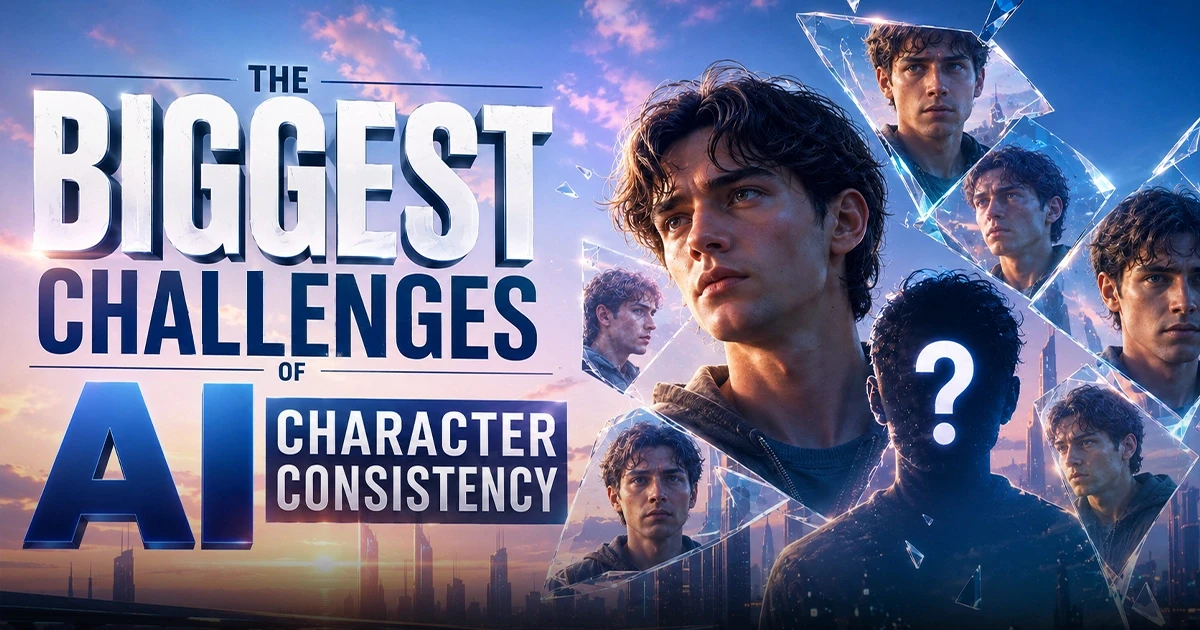
The Biggest AI Character Consistency Challenges (And How to Fix Them)
AI character consistency challenges are now one of the most common production problems in generative content workflows. The issue is not bad prompts. It is not weak creative direction. It is that most AI tools have no persistent system for character identity and without that system, consistency is impossible to maintain at scale.
A character may look exactly right in the first image. By the third variation it has shifted. By the tenth campaign asset, the face, outfit, lighting logic, and visual tone have all quietly drifted apart. The brand character is no longer one recognizable identity. It is a collection of similar-looking outputs.
This article breaks down why character consistency challenges happen, which failure patterns to watch for, and what a structured solution actually looks like in a professional production environment.
What Is AI Character Consistency?
AI character consistency is the ability to reproduce the same character the same face, body, visual style, clothing, and personality across multiple AI generations, formats, and campaigns without manually correcting every output.
It is not the same as output similarity. Similarity means two images look vaguely related. Consistency means the character identity is governed by a persistent system. Face structure, expression range, outfit rules, visual tone, and personality signals are stored and reused across every generation regardless of format, model, or team member.
For a solo creator, this means a recurring brand character looks the same in a TikTok, an Instagram Reel, a product image, and a blog illustration.
For a production team, it means a character created in Week 1 still governs every asset in Month 6.
For an agency, it means a client mascot does not subtly change every time a different team member opens a generation tool.
One is aesthetics. The other is infrastructure.
Why AI Character Consistency Challenges Are Getting Harder
Generative AI adoption in creative production is growing rapidly. Adobe's creator research found that 86% of creators now use generative AI in their workflows and unreliable output quality remains one of the leading barriers to wider adoption. At the enterprise level, Adobe's 2026 AI and Digital Trends research shows that 47% of organizations already use generative or agentic AI for journey design or omnichannel activation, but many still lack the governance infrastructure needed to scale content reliably.
As content volume increases, character consistency challenges compound. A small inconsistency that is manageable at ten assets becomes a brand governance problem at five hundred.
Why Most AI Tools Fail at Character Consistency
Most AI image and video models generate each output independently. They do not automatically remember the character from the previous session, campaign, or team member.
Diffusion models generate images by denoising a signal from noise. A prompt, reference image, and seed can guide the result but they do not create a permanent identity layer. Even when the same prompt is reused exactly, the model may reinterpret facial features, lighting, proportions, clothing, and style.
That is why prompting alone cannot solve the character consistency challenge.
Text is lossy. You cannot describe a specific face precisely enough in natural language to reproduce it perfectly across every scene, format, model, and campaign cycle. The more parameters that change lighting, pose, format, team member, model version the greater the accumulated drift.
The 5 Core AI Character Consistency Challenges
Most character consistency failures in production workflows fall into five recognizable patterns.
1. Latent Space Drift
What it is: Every generation starts from a fresh interpretation of the prompt, reference, and seed. Without a persistent identity layer, the model gradually pulls the character in different directions across sessions.
Why it matters: Faces shift across campaign assets in ways that may look minor in isolation but become obvious at scale. Brand recognition weakens because the audience is repeatedly shown slightly different versions of the same character.
How it shows up: A mascot that looks sharp in Week 1 social posts looks noticeably different in Week 4 email assets not because anyone made a mistake, but because each generation started fresh.
2. Multi-Angle Collapse
What it is: A character may look consistent in a front-facing portrait but break when shown from the side, in motion, or in a cinematic scene. Maintaining identity while also handling pose, camera angle, environment, and lighting creates a compound generation load.
Why it matters: The character works in still portraits but fails in video, action shots, product scenes, or multi-angle storytelling.
How it shows up: A brand spokesperson looks perfect in a headshot. The same character generated mid-stride in a product video looks like a different person.
3. Format Fragmentation
What it is: Most AI systems treat a 1:1 social post, a 9:16 Reel, a 16:9 video, and a website banner as completely separate generation tasks. There is no format-aware identity system governing the character across all outputs.
Why it matters: The same character looks different across TikTok, Instagram, YouTube, paid ads, landing pages, and email assets. The campaign feels less coherent even when each individual asset looks technically polished.
How it shows up: The same campaign produces a character who appears slightly taller, differently lit, and differently styled across each channel because each format was generated independently.
4. Team Drift
What it is: When multiple people generate the same character, each team member brings a different prompt style, reference image selection, wording choice, and creative interpretation. The model responds to each person differently.
Why it matters: At low volume, this is manageable. At hundreds of assets per month, it becomes a brand governance problem. Creative directors cannot manually catch every variation.
How it shows up: One designer builds a mascot from a detailed structured brief. A second builds from a written description of the first output. A video producer builds from a screenshot. By Week 3, the brand has three slightly different mascots live across channels.
5. Memory Reset
What it is: Most AI platforms do not preserve character identity across projects, sessions, logins, or long campaign cycles. A character defined three weeks ago must be recreated in a new session.
Why it matters: Long-running campaigns, seasonal series, recurring mascots, and brand characters degrade over time not because the brief changed, but because the system reset.
How it shows up: A Ramadan campaign mascot created in Week 1 has to be reconstructed from notes and screenshots in Week 5. The reconstruction introduces variation. The final weeks of the campaign feature a slightly different character than the opening weeks.
The 4 Types of Character Consistency Brands Actually Need
Most conversations about character consistency focus only on face matching. That is the smallest layer of the problem. Professional content production needs four types of consistency working together.
Type | What It Covers | Why It Matters |
Face Consistency | Bone structure, facial features, expression range | Audiences identify characters by face first. Drift at this layer breaks recognition immediately. |
Style Consistency | Color palette, lighting behavior, texture, visual tone | A character rendered in different visual worlds no longer feels like part of the same brand universe. |
Narrative Consistency | Personality, posture, clothing logic, role in the brand story | A character must behave like the same person, not just look similar. |
Cross-Team Consistency | Same identity across creators, tools, teams, and formats | The hardest and most business-critical layer at scale. It requires governance, not better prompting. |
When one layer breaks, the others follow. A team can achieve face consistency and still fail because the lighting, wardrobe, posture, or personality changes across formats. At scale, AI does not fix weak creative systems it amplifies them.
Common Mistakes Teams Make When Trying to Solve Character Consistency
Relying Entirely on Prompt Reuse
Prompt reuse helps with quality. It does not solve identity. A prompt can describe a character, but it cannot reliably preserve the same face, expression range, clothing logic, and visual style across different models, sessions, formats, and team members.
Using Reference Images Without a Shared System
Reference images are useful for single-session guidance. They are not a governance system. Each team member may upload a different reference. References must be re-supplied per project. They degrade with repeated generation cycles. They do not carry style, narrative, or personality rules.
Treating Consistency as a Generation Problem Instead of an Operations Problem
The most counterintuitive finding in building production-grade character systems is that the biggest source of inconsistency is often not the model it is the workflow. One team member generates from a detailed brief. Another generates from memory. A third applies different lighting direction. The model can be strong. The workflow still breaks.
Character consistency is not only a generation challenge. It is an operations and governance challenge.
Applying LoRA Without Considering Operational Cost
LoRA is technically strong for recurring characters inside one model environment. But it requires training images, setup time, storage, and per-model management. For teams managing many characters, clients, or campaigns, the operational cost accumulates quickly.
Character Consistency Methods Compared
Method | Best For | Key Limitation |
Prompt Reuse | Simple experiments | Text cannot fully encode a specific identity |
Seed Reuse | Minor variations in the same model | Breaks across models, formats, and major scene changes |
Reference Images | Single-session visual guidance | Requires repeated manual upload and control |
LoRA / Fine-Tuning | Recurring characters inside one model | Training time, model lock-in, per-character management |
Character DNA | Team-based, multi-format, multi-campaign production | Requires a system built around persistent identity |
Reference Workflows vs. Character DNA
Reference images are a useful starting point. They are not a scalable solution for professional character consistency.
Feature | Reference Workflows | ALStudio Character DNA |
Setup | Upload a reference image and re-prompt each session | Define once inside Constants Studio |
Team Use | Each person may upload a different reference | Shared automatically across the team |
Campaign Use | Must be re-supplied per project | Active across campaigns |
Consistency Over Time | Degrades with repeated generation cycles | Governed at the system level |
Multi-Format Support | Requires manual adjustment per format | Applied across images, videos, scripts, and campaigns |
Model Portability | Often tied to one platform or model | Designed for use across 18+ image and video models |
Governance | Depends on creator discipline | Built into the Creative AI OS layer |
Reference workflows produce approximations. They can work for a single image, a short test, or a small solo project. Once a campaign involves multiple weeks, formats, markets, or team members, they begin to fail.
How ALStudio Solves AI Character Consistency Challenges
If you are managing recurring characters across campaigns, formats, or team members, a reference workflow is not a system it is a workaround. ALStudio's Character DNA is built to replace that workaround with governed identity. Start free — no credit card required.
Character DNA: What It Is and How It Works
Character DNA is ALStudio's system for storing a complete character identity once, then applying it automatically across every generation.
It can include:
Face identity and reference
Expression range
Outfit and wardrobe rules
Visual style and tone
Personality and behavioral signals
Lighting behavior
Character role
Brand-world fit
Character DNA lives inside Constants Studio — ALStudio's shared memory layer. Constants Studio is not a production environment. It is the foundation beneath the production workflow. It stores the identity rules that must remain consistent across Content Studio, Film Studio, Marketing Studio, and Editor Studio.
Character DNA sits alongside:
Brand DNA
Product DNA
Environment DNA
Visual Style
Logo and Color Palette
Brand Voice
Campaign Constants
Once Character DNA is active, team members do not need to rewrite the same identity prompt, search for reference files, or manually recreate character rules. The character is already there — consistent, governed, and ready to produce.
Who Faces These Character Consistency Challenges?
Marketing Teams
Marketing teams need consistent characters across paid ads, landing pages, social posts, email campaigns, and product launches. Without a shared identity system, the same character looks slightly different across every channel even when the creative brief is identical.
E-Commerce Brands
E-commerce brands using mascots or recurring campaign characters need identity stability across seasonal drops, product visuals, and promotional campaigns. A mascot that shifts between Ramadan, Summer, and White Friday loses the brand recognition that made it valuable.
Agencies
Agencies face the hardest version of the character consistency challenge. They manage different clients, characters, brand rules, markets, languages, and team members simultaneously. Manual review at high volume is not sustainable.
Enterprise Content Teams
Enterprise teams producing content across regions, languages, and formats need governance built into the production workflow itself. If consistency depends on manual review and individual discipline, it cannot scale.
Content Creators
Creators using recurring AI characters need audiences to recognize the same persona across episodes, formats, and platforms. Inconsistency erodes the character equity that builds audience loyalty over time.
Real-World Use Case: A Brand Mascot Across a 6-Week Ramadan Campaign
Without a Shared Character System
Week 1: One designer creates the mascot from a detailed prompt. The face, outfit, and expression range look strong.
Week 2: Another designer creates a new batch from a written description of the first output. The face shifts slightly. The outfit color becomes warmer.
Week 3: The video producer generates a reel. Without a shared identity system, the character is rebuilt from memory and a reference screenshot. The face, posture, and visual tone diverge further.
By Week 4: The brand has three slightly different mascots live across social, email, and video. The campaign feels less coherent. Recognition compounds less efficiently. The creative team spends time manually correcting inconsistencies instead of producing new content.
With Character DNA Active
The mascot is defined once inside Constants Studio. Face reference, expression range, outfit parameters, visual tone, lighting behavior, and character rules are all active across the full workflow.
The designer, video producer, and content coordinator all generate from the same governed identity. The campaign builds recognition week after week instead of diluting it. No one has to rebuild the character. No one has to check if their version matches someone else's version.
Best Practices for Managing AI Character Consistency at Scale
Define the character at the system level, not the prompt level. Identity should be stored and automatically applied not reconstructed per session.
Govern all four consistency types together. Face, style, narrative, and cross-team consistency must all be addressed. Solving only one creates better-looking drift.
Treat team workflow as a consistency risk. Align the team on generation inputs before production starts. Different prompting styles, reference images, and creative interpretations are the leading cause of campaign drift.
Use format-aware identity rules. A character identity should adapt automatically to 1:1, 9:16, and 16:9 not be manually rebuilt per format.
Build for campaign duration. A character system that works for one week but resets for the next is not a system. It is a workaround.
Audit at the campaign level, not just the asset level. Individual assets can look good while the campaign as a whole has drifted. Review all assets together regularly.
Final Takeaway
The root problem behind most AI character consistency challenges is not that the models are imprecise. The deeper problem is that most production workflows have no system for character identity.
Every generation becomes a fresh interpretation. Every team member introduces variation. Every campaign slowly accumulates drift. Reference workflows produce approximations. Character DNA creates governed identity.
The same face. The same style. The same character. Across every format, team member, and campaign phase.
Character DNA is one layer of ALStudio's Creative AI OS built to make consistency the default output, not a manual quality gate.
Start free on ALStudio — no watermark on any plan, no credit card required. Full access to Character DNA, all four Studios, and 18+ AI generation models starts at $19/month on the Creator plan.
Featured Snippet
Featured Snippet Paragraph (for Google AI Overviews / Perplexity / ChatGPT extraction)
AI character consistency challenges occur when generative AI tools lack a persistent identity layer, causing faces, outfits, styles, and personality signals to drift across sessions, formats, and team members. The five core challenges are latent space drift, multi-angle collapse, format fragmentation, team drift, and memory reset. The solution is not better prompting it is architecture that stores and governs character identity at the system level.
Featured Snippet Bullet List
The 5 biggest AI character consistency challenges:
Latent space drift — Models reinterpret character identity with each generation because no persistent identity is stored
Multi-angle collapse — Characters built for portraits break when viewed from different angles, poses, or in video
Format fragmentation — The same character looks different across social, video, and display formats because each is generated independently
Team drift — Different team members introduce variation through different prompt styles, references, and creative interpretations
Memory reset — Most AI platforms do not preserve character identity across sessions, projects, or campaign cycles
Comparison Table
Method | Works for Solo Creators | Works for Teams | Works Across Campaigns | Works Across Formats |
Prompt Reuse | Partially | No | No | No |
Seed Reuse | Partially | No | No | No |
Reference Images | Yes | Partially | No | No |
LoRA / Fine-Tuning | Yes | Partially | Partially | No |
Character DNA (ALStudio) | Yes | Yes | Yes | Yes |
The Biggest Challenges of AI Character Consistency
Character DNA
The Biggest AI Character Consistency Challenges (And How to Fix Them)
AI character consistency challenges are now one of the most common production problems in generative content workflows. The issue is not bad prompts. It is not weak creative direction. It is that most AI tools have no persistent system for character identity and without that system, consistency is impossible to maintain at scale.
A character may look exactly right in the first image. By the third variation it has shifted. By the tenth campaign asset, the face, outfit, lighting logic, and visual tone have all quietly drifted apart. The brand character is no longer one recognizable identity. It is a collection of similar-looking outputs.
This article breaks down why character consistency challenges happen, which failure patterns to watch for, and what a structured solution actually looks like in a professional production environment.
What Is AI Character Consistency?
AI character consistency is the ability to reproduce the same character the same face, body, visual style, clothing, and personality across multiple AI generations, formats, and campaigns without manually correcting every output.
It is not the same as output similarity. Similarity means two images look vaguely related. Consistency means the character identity is governed by a persistent system. Face structure, expression range, outfit rules, visual tone, and personality signals are stored and reused across every generation regardless of format, model, or team member.
For a solo creator, this means a recurring brand character looks the same in a TikTok, an Instagram Reel, a product image, and a blog illustration.
For a production team, it means a character created in Week 1 still governs every asset in Month 6.
For an agency, it means a client mascot does not subtly change every time a different team member opens a generation tool.
One is aesthetics. The other is infrastructure.
Why AI Character Consistency Challenges Are Getting Harder
Generative AI adoption in creative production is growing rapidly. Adobe's creator research found that 86% of creators now use generative AI in their workflows and unreliable output quality remains one of the leading barriers to wider adoption. At the enterprise level, Adobe's 2026 AI and Digital Trends research shows that 47% of organizations already use generative or agentic AI for journey design or omnichannel activation, but many still lack the governance infrastructure needed to scale content reliably.
As content volume increases, character consistency challenges compound. A small inconsistency that is manageable at ten assets becomes a brand governance problem at five hundred.
Why Most AI Tools Fail at Character Consistency
Most AI image and video models generate each output independently. They do not automatically remember the character from the previous session, campaign, or team member.
Diffusion models generate images by denoising a signal from noise. A prompt, reference image, and seed can guide the result but they do not create a permanent identity layer. Even when the same prompt is reused exactly, the model may reinterpret facial features, lighting, proportions, clothing, and style.
That is why prompting alone cannot solve the character consistency challenge.
Text is lossy. You cannot describe a specific face precisely enough in natural language to reproduce it perfectly across every scene, format, model, and campaign cycle. The more parameters that change lighting, pose, format, team member, model version the greater the accumulated drift.
The 5 Core AI Character Consistency Challenges
Most character consistency failures in production workflows fall into five recognizable patterns.
1. Latent Space Drift
What it is: Every generation starts from a fresh interpretation of the prompt, reference, and seed. Without a persistent identity layer, the model gradually pulls the character in different directions across sessions.
Why it matters: Faces shift across campaign assets in ways that may look minor in isolation but become obvious at scale. Brand recognition weakens because the audience is repeatedly shown slightly different versions of the same character.
How it shows up: A mascot that looks sharp in Week 1 social posts looks noticeably different in Week 4 email assets not because anyone made a mistake, but because each generation started fresh.
2. Multi-Angle Collapse
What it is: A character may look consistent in a front-facing portrait but break when shown from the side, in motion, or in a cinematic scene. Maintaining identity while also handling pose, camera angle, environment, and lighting creates a compound generation load.
Why it matters: The character works in still portraits but fails in video, action shots, product scenes, or multi-angle storytelling.
How it shows up: A brand spokesperson looks perfect in a headshot. The same character generated mid-stride in a product video looks like a different person.
3. Format Fragmentation
What it is: Most AI systems treat a 1:1 social post, a 9:16 Reel, a 16:9 video, and a website banner as completely separate generation tasks. There is no format-aware identity system governing the character across all outputs.
Why it matters: The same character looks different across TikTok, Instagram, YouTube, paid ads, landing pages, and email assets. The campaign feels less coherent even when each individual asset looks technically polished.
How it shows up: The same campaign produces a character who appears slightly taller, differently lit, and differently styled across each channel because each format was generated independently.
4. Team Drift
What it is: When multiple people generate the same character, each team member brings a different prompt style, reference image selection, wording choice, and creative interpretation. The model responds to each person differently.
Why it matters: At low volume, this is manageable. At hundreds of assets per month, it becomes a brand governance problem. Creative directors cannot manually catch every variation.
How it shows up: One designer builds a mascot from a detailed structured brief. A second builds from a written description of the first output. A video producer builds from a screenshot. By Week 3, the brand has three slightly different mascots live across channels.
5. Memory Reset
What it is: Most AI platforms do not preserve character identity across projects, sessions, logins, or long campaign cycles. A character defined three weeks ago must be recreated in a new session.
Why it matters: Long-running campaigns, seasonal series, recurring mascots, and brand characters degrade over time not because the brief changed, but because the system reset.
How it shows up: A Ramadan campaign mascot created in Week 1 has to be reconstructed from notes and screenshots in Week 5. The reconstruction introduces variation. The final weeks of the campaign feature a slightly different character than the opening weeks.
The 4 Types of Character Consistency Brands Actually Need
Most conversations about character consistency focus only on face matching. That is the smallest layer of the problem. Professional content production needs four types of consistency working together.
Type | What It Covers | Why It Matters |
Face Consistency | Bone structure, facial features, expression range | Audiences identify characters by face first. Drift at this layer breaks recognition immediately. |
Style Consistency | Color palette, lighting behavior, texture, visual tone | A character rendered in different visual worlds no longer feels like part of the same brand universe. |
Narrative Consistency | Personality, posture, clothing logic, role in the brand story | A character must behave like the same person, not just look similar. |
Cross-Team Consistency | Same identity across creators, tools, teams, and formats | The hardest and most business-critical layer at scale. It requires governance, not better prompting. |
When one layer breaks, the others follow. A team can achieve face consistency and still fail because the lighting, wardrobe, posture, or personality changes across formats. At scale, AI does not fix weak creative systems it amplifies them.
Common Mistakes Teams Make When Trying to Solve Character Consistency
Relying Entirely on Prompt Reuse
Prompt reuse helps with quality. It does not solve identity. A prompt can describe a character, but it cannot reliably preserve the same face, expression range, clothing logic, and visual style across different models, sessions, formats, and team members.
Using Reference Images Without a Shared System
Reference images are useful for single-session guidance. They are not a governance system. Each team member may upload a different reference. References must be re-supplied per project. They degrade with repeated generation cycles. They do not carry style, narrative, or personality rules.
Treating Consistency as a Generation Problem Instead of an Operations Problem
The most counterintuitive finding in building production-grade character systems is that the biggest source of inconsistency is often not the model it is the workflow. One team member generates from a detailed brief. Another generates from memory. A third applies different lighting direction. The model can be strong. The workflow still breaks.
Character consistency is not only a generation challenge. It is an operations and governance challenge.
Applying LoRA Without Considering Operational Cost
LoRA is technically strong for recurring characters inside one model environment. But it requires training images, setup time, storage, and per-model management. For teams managing many characters, clients, or campaigns, the operational cost accumulates quickly.
Character Consistency Methods Compared
Method | Best For | Key Limitation |
Prompt Reuse | Simple experiments | Text cannot fully encode a specific identity |
Seed Reuse | Minor variations in the same model | Breaks across models, formats, and major scene changes |
Reference Images | Single-session visual guidance | Requires repeated manual upload and control |
LoRA / Fine-Tuning | Recurring characters inside one model | Training time, model lock-in, per-character management |
Character DNA | Team-based, multi-format, multi-campaign production | Requires a system built around persistent identity |
Reference Workflows vs. Character DNA
Reference images are a useful starting point. They are not a scalable solution for professional character consistency.
Feature | Reference Workflows | ALStudio Character DNA |
Setup | Upload a reference image and re-prompt each session | Define once inside Constants Studio |
Team Use | Each person may upload a different reference | Shared automatically across the team |
Campaign Use | Must be re-supplied per project | Active across campaigns |
Consistency Over Time | Degrades with repeated generation cycles | Governed at the system level |
Multi-Format Support | Requires manual adjustment per format | Applied across images, videos, scripts, and campaigns |
Model Portability | Often tied to one platform or model | Designed for use across 18+ image and video models |
Governance | Depends on creator discipline | Built into the Creative AI OS layer |
Reference workflows produce approximations. They can work for a single image, a short test, or a small solo project. Once a campaign involves multiple weeks, formats, markets, or team members, they begin to fail.
How ALStudio Solves AI Character Consistency Challenges
If you are managing recurring characters across campaigns, formats, or team members, a reference workflow is not a system it is a workaround. ALStudio's Character DNA is built to replace that workaround with governed identity. Start free — no credit card required.
Character DNA: What It Is and How It Works
Character DNA is ALStudio's system for storing a complete character identity once, then applying it automatically across every generation.
It can include:
Face identity and reference
Expression range
Outfit and wardrobe rules
Visual style and tone
Personality and behavioral signals
Lighting behavior
Character role
Brand-world fit
Character DNA lives inside Constants Studio — ALStudio's shared memory layer. Constants Studio is not a production environment. It is the foundation beneath the production workflow. It stores the identity rules that must remain consistent across Content Studio, Film Studio, Marketing Studio, and Editor Studio.
Character DNA sits alongside:
Brand DNA
Product DNA
Environment DNA
Visual Style
Logo and Color Palette
Brand Voice
Campaign Constants
Once Character DNA is active, team members do not need to rewrite the same identity prompt, search for reference files, or manually recreate character rules. The character is already there — consistent, governed, and ready to produce.
Who Faces These Character Consistency Challenges?
Marketing Teams
Marketing teams need consistent characters across paid ads, landing pages, social posts, email campaigns, and product launches. Without a shared identity system, the same character looks slightly different across every channel even when the creative brief is identical.
E-Commerce Brands
E-commerce brands using mascots or recurring campaign characters need identity stability across seasonal drops, product visuals, and promotional campaigns. A mascot that shifts between Ramadan, Summer, and White Friday loses the brand recognition that made it valuable.
Agencies
Agencies face the hardest version of the character consistency challenge. They manage different clients, characters, brand rules, markets, languages, and team members simultaneously. Manual review at high volume is not sustainable.
Enterprise Content Teams
Enterprise teams producing content across regions, languages, and formats need governance built into the production workflow itself. If consistency depends on manual review and individual discipline, it cannot scale.
Content Creators
Creators using recurring AI characters need audiences to recognize the same persona across episodes, formats, and platforms. Inconsistency erodes the character equity that builds audience loyalty over time.
Real-World Use Case: A Brand Mascot Across a 6-Week Ramadan Campaign
Without a Shared Character System
Week 1: One designer creates the mascot from a detailed prompt. The face, outfit, and expression range look strong.
Week 2: Another designer creates a new batch from a written description of the first output. The face shifts slightly. The outfit color becomes warmer.
Week 3: The video producer generates a reel. Without a shared identity system, the character is rebuilt from memory and a reference screenshot. The face, posture, and visual tone diverge further.
By Week 4: The brand has three slightly different mascots live across social, email, and video. The campaign feels less coherent. Recognition compounds less efficiently. The creative team spends time manually correcting inconsistencies instead of producing new content.
With Character DNA Active
The mascot is defined once inside Constants Studio. Face reference, expression range, outfit parameters, visual tone, lighting behavior, and character rules are all active across the full workflow.
The designer, video producer, and content coordinator all generate from the same governed identity. The campaign builds recognition week after week instead of diluting it. No one has to rebuild the character. No one has to check if their version matches someone else's version.
Best Practices for Managing AI Character Consistency at Scale
Define the character at the system level, not the prompt level. Identity should be stored and automatically applied not reconstructed per session.
Govern all four consistency types together. Face, style, narrative, and cross-team consistency must all be addressed. Solving only one creates better-looking drift.
Treat team workflow as a consistency risk. Align the team on generation inputs before production starts. Different prompting styles, reference images, and creative interpretations are the leading cause of campaign drift.
Use format-aware identity rules. A character identity should adapt automatically to 1:1, 9:16, and 16:9 not be manually rebuilt per format.
Build for campaign duration. A character system that works for one week but resets for the next is not a system. It is a workaround.
Audit at the campaign level, not just the asset level. Individual assets can look good while the campaign as a whole has drifted. Review all assets together regularly.
Final Takeaway
The root problem behind most AI character consistency challenges is not that the models are imprecise. The deeper problem is that most production workflows have no system for character identity.
Every generation becomes a fresh interpretation. Every team member introduces variation. Every campaign slowly accumulates drift. Reference workflows produce approximations. Character DNA creates governed identity.
The same face. The same style. The same character. Across every format, team member, and campaign phase.
Character DNA is one layer of ALStudio's Creative AI OS built to make consistency the default output, not a manual quality gate.
Start free on ALStudio — no watermark on any plan, no credit card required. Full access to Character DNA, all four Studios, and 18+ AI generation models starts at $19/month on the Creator plan.
Featured Snippet
Featured Snippet Paragraph (for Google AI Overviews / Perplexity / ChatGPT extraction)
AI character consistency challenges occur when generative AI tools lack a persistent identity layer, causing faces, outfits, styles, and personality signals to drift across sessions, formats, and team members. The five core challenges are latent space drift, multi-angle collapse, format fragmentation, team drift, and memory reset. The solution is not better prompting it is architecture that stores and governs character identity at the system level.
Featured Snippet Bullet List
The 5 biggest AI character consistency challenges:
Latent space drift — Models reinterpret character identity with each generation because no persistent identity is stored
Multi-angle collapse — Characters built for portraits break when viewed from different angles, poses, or in video
Format fragmentation — The same character looks different across social, video, and display formats because each is generated independently
Team drift — Different team members introduce variation through different prompt styles, references, and creative interpretations
Memory reset — Most AI platforms do not preserve character identity across sessions, projects, or campaign cycles
Comparison Table
Method | Works for Solo Creators | Works for Teams | Works Across Campaigns | Works Across Formats |
Prompt Reuse | Partially | No | No | No |
Seed Reuse | Partially | No | No | No |
Reference Images | Yes | Partially | No | No |
LoRA / Fine-Tuning | Yes | Partially | Partially | No |
Character DNA (ALStudio) | Yes | Yes | Yes | Yes |
The Biggest Challenges of AI Character Consistency
Character DNA
The Biggest AI Character Consistency Challenges (And How to Fix Them)
AI character consistency challenges are now one of the most common production problems in generative content workflows. The issue is not bad prompts. It is not weak creative direction. It is that most AI tools have no persistent system for character identity and without that system, consistency is impossible to maintain at scale.
A character may look exactly right in the first image. By the third variation it has shifted. By the tenth campaign asset, the face, outfit, lighting logic, and visual tone have all quietly drifted apart. The brand character is no longer one recognizable identity. It is a collection of similar-looking outputs.
This article breaks down why character consistency challenges happen, which failure patterns to watch for, and what a structured solution actually looks like in a professional production environment.
What Is AI Character Consistency?
AI character consistency is the ability to reproduce the same character the same face, body, visual style, clothing, and personality across multiple AI generations, formats, and campaigns without manually correcting every output.
It is not the same as output similarity. Similarity means two images look vaguely related. Consistency means the character identity is governed by a persistent system. Face structure, expression range, outfit rules, visual tone, and personality signals are stored and reused across every generation regardless of format, model, or team member.
For a solo creator, this means a recurring brand character looks the same in a TikTok, an Instagram Reel, a product image, and a blog illustration.
For a production team, it means a character created in Week 1 still governs every asset in Month 6.
For an agency, it means a client mascot does not subtly change every time a different team member opens a generation tool.
One is aesthetics. The other is infrastructure.
Why AI Character Consistency Challenges Are Getting Harder
Generative AI adoption in creative production is growing rapidly. Adobe's creator research found that 86% of creators now use generative AI in their workflows and unreliable output quality remains one of the leading barriers to wider adoption. At the enterprise level, Adobe's 2026 AI and Digital Trends research shows that 47% of organizations already use generative or agentic AI for journey design or omnichannel activation, but many still lack the governance infrastructure needed to scale content reliably.
As content volume increases, character consistency challenges compound. A small inconsistency that is manageable at ten assets becomes a brand governance problem at five hundred.
Why Most AI Tools Fail at Character Consistency
Most AI image and video models generate each output independently. They do not automatically remember the character from the previous session, campaign, or team member.
Diffusion models generate images by denoising a signal from noise. A prompt, reference image, and seed can guide the result but they do not create a permanent identity layer. Even when the same prompt is reused exactly, the model may reinterpret facial features, lighting, proportions, clothing, and style.
That is why prompting alone cannot solve the character consistency challenge.
Text is lossy. You cannot describe a specific face precisely enough in natural language to reproduce it perfectly across every scene, format, model, and campaign cycle. The more parameters that change lighting, pose, format, team member, model version the greater the accumulated drift.
The 5 Core AI Character Consistency Challenges
Most character consistency failures in production workflows fall into five recognizable patterns.
1. Latent Space Drift
What it is: Every generation starts from a fresh interpretation of the prompt, reference, and seed. Without a persistent identity layer, the model gradually pulls the character in different directions across sessions.
Why it matters: Faces shift across campaign assets in ways that may look minor in isolation but become obvious at scale. Brand recognition weakens because the audience is repeatedly shown slightly different versions of the same character.
How it shows up: A mascot that looks sharp in Week 1 social posts looks noticeably different in Week 4 email assets not because anyone made a mistake, but because each generation started fresh.
2. Multi-Angle Collapse
What it is: A character may look consistent in a front-facing portrait but break when shown from the side, in motion, or in a cinematic scene. Maintaining identity while also handling pose, camera angle, environment, and lighting creates a compound generation load.
Why it matters: The character works in still portraits but fails in video, action shots, product scenes, or multi-angle storytelling.
How it shows up: A brand spokesperson looks perfect in a headshot. The same character generated mid-stride in a product video looks like a different person.
3. Format Fragmentation
What it is: Most AI systems treat a 1:1 social post, a 9:16 Reel, a 16:9 video, and a website banner as completely separate generation tasks. There is no format-aware identity system governing the character across all outputs.
Why it matters: The same character looks different across TikTok, Instagram, YouTube, paid ads, landing pages, and email assets. The campaign feels less coherent even when each individual asset looks technically polished.
How it shows up: The same campaign produces a character who appears slightly taller, differently lit, and differently styled across each channel because each format was generated independently.
4. Team Drift
What it is: When multiple people generate the same character, each team member brings a different prompt style, reference image selection, wording choice, and creative interpretation. The model responds to each person differently.
Why it matters: At low volume, this is manageable. At hundreds of assets per month, it becomes a brand governance problem. Creative directors cannot manually catch every variation.
How it shows up: One designer builds a mascot from a detailed structured brief. A second builds from a written description of the first output. A video producer builds from a screenshot. By Week 3, the brand has three slightly different mascots live across channels.
5. Memory Reset
What it is: Most AI platforms do not preserve character identity across projects, sessions, logins, or long campaign cycles. A character defined three weeks ago must be recreated in a new session.
Why it matters: Long-running campaigns, seasonal series, recurring mascots, and brand characters degrade over time not because the brief changed, but because the system reset.
How it shows up: A Ramadan campaign mascot created in Week 1 has to be reconstructed from notes and screenshots in Week 5. The reconstruction introduces variation. The final weeks of the campaign feature a slightly different character than the opening weeks.
The 4 Types of Character Consistency Brands Actually Need
Most conversations about character consistency focus only on face matching. That is the smallest layer of the problem. Professional content production needs four types of consistency working together.
Type | What It Covers | Why It Matters |
Face Consistency | Bone structure, facial features, expression range | Audiences identify characters by face first. Drift at this layer breaks recognition immediately. |
Style Consistency | Color palette, lighting behavior, texture, visual tone | A character rendered in different visual worlds no longer feels like part of the same brand universe. |
Narrative Consistency | Personality, posture, clothing logic, role in the brand story | A character must behave like the same person, not just look similar. |
Cross-Team Consistency | Same identity across creators, tools, teams, and formats | The hardest and most business-critical layer at scale. It requires governance, not better prompting. |
When one layer breaks, the others follow. A team can achieve face consistency and still fail because the lighting, wardrobe, posture, or personality changes across formats. At scale, AI does not fix weak creative systems it amplifies them.
Common Mistakes Teams Make When Trying to Solve Character Consistency
Relying Entirely on Prompt Reuse
Prompt reuse helps with quality. It does not solve identity. A prompt can describe a character, but it cannot reliably preserve the same face, expression range, clothing logic, and visual style across different models, sessions, formats, and team members.
Using Reference Images Without a Shared System
Reference images are useful for single-session guidance. They are not a governance system. Each team member may upload a different reference. References must be re-supplied per project. They degrade with repeated generation cycles. They do not carry style, narrative, or personality rules.
Treating Consistency as a Generation Problem Instead of an Operations Problem
The most counterintuitive finding in building production-grade character systems is that the biggest source of inconsistency is often not the model it is the workflow. One team member generates from a detailed brief. Another generates from memory. A third applies different lighting direction. The model can be strong. The workflow still breaks.
Character consistency is not only a generation challenge. It is an operations and governance challenge.
Applying LoRA Without Considering Operational Cost
LoRA is technically strong for recurring characters inside one model environment. But it requires training images, setup time, storage, and per-model management. For teams managing many characters, clients, or campaigns, the operational cost accumulates quickly.
Character Consistency Methods Compared
Method | Best For | Key Limitation |
Prompt Reuse | Simple experiments | Text cannot fully encode a specific identity |
Seed Reuse | Minor variations in the same model | Breaks across models, formats, and major scene changes |
Reference Images | Single-session visual guidance | Requires repeated manual upload and control |
LoRA / Fine-Tuning | Recurring characters inside one model | Training time, model lock-in, per-character management |
Character DNA | Team-based, multi-format, multi-campaign production | Requires a system built around persistent identity |
Reference Workflows vs. Character DNA
Reference images are a useful starting point. They are not a scalable solution for professional character consistency.
Feature | Reference Workflows | ALStudio Character DNA |
Setup | Upload a reference image and re-prompt each session | Define once inside Constants Studio |
Team Use | Each person may upload a different reference | Shared automatically across the team |
Campaign Use | Must be re-supplied per project | Active across campaigns |
Consistency Over Time | Degrades with repeated generation cycles | Governed at the system level |
Multi-Format Support | Requires manual adjustment per format | Applied across images, videos, scripts, and campaigns |
Model Portability | Often tied to one platform or model | Designed for use across 18+ image and video models |
Governance | Depends on creator discipline | Built into the Creative AI OS layer |
Reference workflows produce approximations. They can work for a single image, a short test, or a small solo project. Once a campaign involves multiple weeks, formats, markets, or team members, they begin to fail.
How ALStudio Solves AI Character Consistency Challenges
If you are managing recurring characters across campaigns, formats, or team members, a reference workflow is not a system it is a workaround. ALStudio's Character DNA is built to replace that workaround with governed identity. Start free — no credit card required.
Character DNA: What It Is and How It Works
Character DNA is ALStudio's system for storing a complete character identity once, then applying it automatically across every generation.
It can include:
Face identity and reference
Expression range
Outfit and wardrobe rules
Visual style and tone
Personality and behavioral signals
Lighting behavior
Character role
Brand-world fit
Character DNA lives inside Constants Studio — ALStudio's shared memory layer. Constants Studio is not a production environment. It is the foundation beneath the production workflow. It stores the identity rules that must remain consistent across Content Studio, Film Studio, Marketing Studio, and Editor Studio.
Character DNA sits alongside:
Brand DNA
Product DNA
Environment DNA
Visual Style
Logo and Color Palette
Brand Voice
Campaign Constants
Once Character DNA is active, team members do not need to rewrite the same identity prompt, search for reference files, or manually recreate character rules. The character is already there — consistent, governed, and ready to produce.
Who Faces These Character Consistency Challenges?
Marketing Teams
Marketing teams need consistent characters across paid ads, landing pages, social posts, email campaigns, and product launches. Without a shared identity system, the same character looks slightly different across every channel even when the creative brief is identical.
E-Commerce Brands
E-commerce brands using mascots or recurring campaign characters need identity stability across seasonal drops, product visuals, and promotional campaigns. A mascot that shifts between Ramadan, Summer, and White Friday loses the brand recognition that made it valuable.
Agencies
Agencies face the hardest version of the character consistency challenge. They manage different clients, characters, brand rules, markets, languages, and team members simultaneously. Manual review at high volume is not sustainable.
Enterprise Content Teams
Enterprise teams producing content across regions, languages, and formats need governance built into the production workflow itself. If consistency depends on manual review and individual discipline, it cannot scale.
Content Creators
Creators using recurring AI characters need audiences to recognize the same persona across episodes, formats, and platforms. Inconsistency erodes the character equity that builds audience loyalty over time.
Real-World Use Case: A Brand Mascot Across a 6-Week Ramadan Campaign
Without a Shared Character System
Week 1: One designer creates the mascot from a detailed prompt. The face, outfit, and expression range look strong.
Week 2: Another designer creates a new batch from a written description of the first output. The face shifts slightly. The outfit color becomes warmer.
Week 3: The video producer generates a reel. Without a shared identity system, the character is rebuilt from memory and a reference screenshot. The face, posture, and visual tone diverge further.
By Week 4: The brand has three slightly different mascots live across social, email, and video. The campaign feels less coherent. Recognition compounds less efficiently. The creative team spends time manually correcting inconsistencies instead of producing new content.
With Character DNA Active
The mascot is defined once inside Constants Studio. Face reference, expression range, outfit parameters, visual tone, lighting behavior, and character rules are all active across the full workflow.
The designer, video producer, and content coordinator all generate from the same governed identity. The campaign builds recognition week after week instead of diluting it. No one has to rebuild the character. No one has to check if their version matches someone else's version.
Best Practices for Managing AI Character Consistency at Scale
Define the character at the system level, not the prompt level. Identity should be stored and automatically applied not reconstructed per session.
Govern all four consistency types together. Face, style, narrative, and cross-team consistency must all be addressed. Solving only one creates better-looking drift.
Treat team workflow as a consistency risk. Align the team on generation inputs before production starts. Different prompting styles, reference images, and creative interpretations are the leading cause of campaign drift.
Use format-aware identity rules. A character identity should adapt automatically to 1:1, 9:16, and 16:9 not be manually rebuilt per format.
Build for campaign duration. A character system that works for one week but resets for the next is not a system. It is a workaround.
Audit at the campaign level, not just the asset level. Individual assets can look good while the campaign as a whole has drifted. Review all assets together regularly.
Final Takeaway
The root problem behind most AI character consistency challenges is not that the models are imprecise. The deeper problem is that most production workflows have no system for character identity.
Every generation becomes a fresh interpretation. Every team member introduces variation. Every campaign slowly accumulates drift. Reference workflows produce approximations. Character DNA creates governed identity.
The same face. The same style. The same character. Across every format, team member, and campaign phase.
Character DNA is one layer of ALStudio's Creative AI OS built to make consistency the default output, not a manual quality gate.
Start free on ALStudio — no watermark on any plan, no credit card required. Full access to Character DNA, all four Studios, and 18+ AI generation models starts at $19/month on the Creator plan.
Featured Snippet
Featured Snippet Paragraph (for Google AI Overviews / Perplexity / ChatGPT extraction)
AI character consistency challenges occur when generative AI tools lack a persistent identity layer, causing faces, outfits, styles, and personality signals to drift across sessions, formats, and team members. The five core challenges are latent space drift, multi-angle collapse, format fragmentation, team drift, and memory reset. The solution is not better prompting it is architecture that stores and governs character identity at the system level.
Featured Snippet Bullet List
The 5 biggest AI character consistency challenges:
Latent space drift — Models reinterpret character identity with each generation because no persistent identity is stored
Multi-angle collapse — Characters built for portraits break when viewed from different angles, poses, or in video
Format fragmentation — The same character looks different across social, video, and display formats because each is generated independently
Team drift — Different team members introduce variation through different prompt styles, references, and creative interpretations
Memory reset — Most AI platforms do not preserve character identity across sessions, projects, or campaign cycles
Comparison Table
Method | Works for Solo Creators | Works for Teams | Works Across Campaigns | Works Across Formats |
Prompt Reuse | Partially | No | No | No |
Seed Reuse | Partially | No | No | No |
Reference Images | Yes | Partially | No | No |
LoRA / Fine-Tuning | Yes | Partially | Partially | No |
Character DNA (ALStudio) | Yes | Yes | Yes | Yes |
The Biggest Challenges of AI Character Consistency
Character DNA
The Biggest AI Character Consistency Challenges (And How to Fix Them)
AI character consistency challenges are now one of the most common production problems in generative content workflows. The issue is not bad prompts. It is not weak creative direction. It is that most AI tools have no persistent system for character identity and without that system, consistency is impossible to maintain at scale.
A character may look exactly right in the first image. By the third variation it has shifted. By the tenth campaign asset, the face, outfit, lighting logic, and visual tone have all quietly drifted apart. The brand character is no longer one recognizable identity. It is a collection of similar-looking outputs.
This article breaks down why character consistency challenges happen, which failure patterns to watch for, and what a structured solution actually looks like in a professional production environment.
What Is AI Character Consistency?
AI character consistency is the ability to reproduce the same character the same face, body, visual style, clothing, and personality across multiple AI generations, formats, and campaigns without manually correcting every output.
It is not the same as output similarity. Similarity means two images look vaguely related. Consistency means the character identity is governed by a persistent system. Face structure, expression range, outfit rules, visual tone, and personality signals are stored and reused across every generation regardless of format, model, or team member.
For a solo creator, this means a recurring brand character looks the same in a TikTok, an Instagram Reel, a product image, and a blog illustration.
For a production team, it means a character created in Week 1 still governs every asset in Month 6.
For an agency, it means a client mascot does not subtly change every time a different team member opens a generation tool.
One is aesthetics. The other is infrastructure.
Why AI Character Consistency Challenges Are Getting Harder
Generative AI adoption in creative production is growing rapidly. Adobe's creator research found that 86% of creators now use generative AI in their workflows and unreliable output quality remains one of the leading barriers to wider adoption. At the enterprise level, Adobe's 2026 AI and Digital Trends research shows that 47% of organizations already use generative or agentic AI for journey design or omnichannel activation, but many still lack the governance infrastructure needed to scale content reliably.
As content volume increases, character consistency challenges compound. A small inconsistency that is manageable at ten assets becomes a brand governance problem at five hundred.
Why Most AI Tools Fail at Character Consistency
Most AI image and video models generate each output independently. They do not automatically remember the character from the previous session, campaign, or team member.
Diffusion models generate images by denoising a signal from noise. A prompt, reference image, and seed can guide the result but they do not create a permanent identity layer. Even when the same prompt is reused exactly, the model may reinterpret facial features, lighting, proportions, clothing, and style.
That is why prompting alone cannot solve the character consistency challenge.
Text is lossy. You cannot describe a specific face precisely enough in natural language to reproduce it perfectly across every scene, format, model, and campaign cycle. The more parameters that change lighting, pose, format, team member, model version the greater the accumulated drift.
The 5 Core AI Character Consistency Challenges
Most character consistency failures in production workflows fall into five recognizable patterns.
1. Latent Space Drift
What it is: Every generation starts from a fresh interpretation of the prompt, reference, and seed. Without a persistent identity layer, the model gradually pulls the character in different directions across sessions.
Why it matters: Faces shift across campaign assets in ways that may look minor in isolation but become obvious at scale. Brand recognition weakens because the audience is repeatedly shown slightly different versions of the same character.
How it shows up: A mascot that looks sharp in Week 1 social posts looks noticeably different in Week 4 email assets not because anyone made a mistake, but because each generation started fresh.
2. Multi-Angle Collapse
What it is: A character may look consistent in a front-facing portrait but break when shown from the side, in motion, or in a cinematic scene. Maintaining identity while also handling pose, camera angle, environment, and lighting creates a compound generation load.
Why it matters: The character works in still portraits but fails in video, action shots, product scenes, or multi-angle storytelling.
How it shows up: A brand spokesperson looks perfect in a headshot. The same character generated mid-stride in a product video looks like a different person.
3. Format Fragmentation
What it is: Most AI systems treat a 1:1 social post, a 9:16 Reel, a 16:9 video, and a website banner as completely separate generation tasks. There is no format-aware identity system governing the character across all outputs.
Why it matters: The same character looks different across TikTok, Instagram, YouTube, paid ads, landing pages, and email assets. The campaign feels less coherent even when each individual asset looks technically polished.
How it shows up: The same campaign produces a character who appears slightly taller, differently lit, and differently styled across each channel because each format was generated independently.
4. Team Drift
What it is: When multiple people generate the same character, each team member brings a different prompt style, reference image selection, wording choice, and creative interpretation. The model responds to each person differently.
Why it matters: At low volume, this is manageable. At hundreds of assets per month, it becomes a brand governance problem. Creative directors cannot manually catch every variation.
How it shows up: One designer builds a mascot from a detailed structured brief. A second builds from a written description of the first output. A video producer builds from a screenshot. By Week 3, the brand has three slightly different mascots live across channels.
5. Memory Reset
What it is: Most AI platforms do not preserve character identity across projects, sessions, logins, or long campaign cycles. A character defined three weeks ago must be recreated in a new session.
Why it matters: Long-running campaigns, seasonal series, recurring mascots, and brand characters degrade over time not because the brief changed, but because the system reset.
How it shows up: A Ramadan campaign mascot created in Week 1 has to be reconstructed from notes and screenshots in Week 5. The reconstruction introduces variation. The final weeks of the campaign feature a slightly different character than the opening weeks.
The 4 Types of Character Consistency Brands Actually Need
Most conversations about character consistency focus only on face matching. That is the smallest layer of the problem. Professional content production needs four types of consistency working together.
Type | What It Covers | Why It Matters |
Face Consistency | Bone structure, facial features, expression range | Audiences identify characters by face first. Drift at this layer breaks recognition immediately. |
Style Consistency | Color palette, lighting behavior, texture, visual tone | A character rendered in different visual worlds no longer feels like part of the same brand universe. |
Narrative Consistency | Personality, posture, clothing logic, role in the brand story | A character must behave like the same person, not just look similar. |
Cross-Team Consistency | Same identity across creators, tools, teams, and formats | The hardest and most business-critical layer at scale. It requires governance, not better prompting. |
When one layer breaks, the others follow. A team can achieve face consistency and still fail because the lighting, wardrobe, posture, or personality changes across formats. At scale, AI does not fix weak creative systems it amplifies them.
Common Mistakes Teams Make When Trying to Solve Character Consistency
Relying Entirely on Prompt Reuse
Prompt reuse helps with quality. It does not solve identity. A prompt can describe a character, but it cannot reliably preserve the same face, expression range, clothing logic, and visual style across different models, sessions, formats, and team members.
Using Reference Images Without a Shared System
Reference images are useful for single-session guidance. They are not a governance system. Each team member may upload a different reference. References must be re-supplied per project. They degrade with repeated generation cycles. They do not carry style, narrative, or personality rules.
Treating Consistency as a Generation Problem Instead of an Operations Problem
The most counterintuitive finding in building production-grade character systems is that the biggest source of inconsistency is often not the model it is the workflow. One team member generates from a detailed brief. Another generates from memory. A third applies different lighting direction. The model can be strong. The workflow still breaks.
Character consistency is not only a generation challenge. It is an operations and governance challenge.
Applying LoRA Without Considering Operational Cost
LoRA is technically strong for recurring characters inside one model environment. But it requires training images, setup time, storage, and per-model management. For teams managing many characters, clients, or campaigns, the operational cost accumulates quickly.
Character Consistency Methods Compared
Method | Best For | Key Limitation |
Prompt Reuse | Simple experiments | Text cannot fully encode a specific identity |
Seed Reuse | Minor variations in the same model | Breaks across models, formats, and major scene changes |
Reference Images | Single-session visual guidance | Requires repeated manual upload and control |
LoRA / Fine-Tuning | Recurring characters inside one model | Training time, model lock-in, per-character management |
Character DNA | Team-based, multi-format, multi-campaign production | Requires a system built around persistent identity |
Reference Workflows vs. Character DNA
Reference images are a useful starting point. They are not a scalable solution for professional character consistency.
Feature | Reference Workflows | ALStudio Character DNA |
Setup | Upload a reference image and re-prompt each session | Define once inside Constants Studio |
Team Use | Each person may upload a different reference | Shared automatically across the team |
Campaign Use | Must be re-supplied per project | Active across campaigns |
Consistency Over Time | Degrades with repeated generation cycles | Governed at the system level |
Multi-Format Support | Requires manual adjustment per format | Applied across images, videos, scripts, and campaigns |
Model Portability | Often tied to one platform or model | Designed for use across 18+ image and video models |
Governance | Depends on creator discipline | Built into the Creative AI OS layer |
Reference workflows produce approximations. They can work for a single image, a short test, or a small solo project. Once a campaign involves multiple weeks, formats, markets, or team members, they begin to fail.
How ALStudio Solves AI Character Consistency Challenges
If you are managing recurring characters across campaigns, formats, or team members, a reference workflow is not a system it is a workaround. ALStudio's Character DNA is built to replace that workaround with governed identity. Start free — no credit card required.
Character DNA: What It Is and How It Works
Character DNA is ALStudio's system for storing a complete character identity once, then applying it automatically across every generation.
It can include:
Face identity and reference
Expression range
Outfit and wardrobe rules
Visual style and tone
Personality and behavioral signals
Lighting behavior
Character role
Brand-world fit
Character DNA lives inside Constants Studio — ALStudio's shared memory layer. Constants Studio is not a production environment. It is the foundation beneath the production workflow. It stores the identity rules that must remain consistent across Content Studio, Film Studio, Marketing Studio, and Editor Studio.
Character DNA sits alongside:
Brand DNA
Product DNA
Environment DNA
Visual Style
Logo and Color Palette
Brand Voice
Campaign Constants
Once Character DNA is active, team members do not need to rewrite the same identity prompt, search for reference files, or manually recreate character rules. The character is already there — consistent, governed, and ready to produce.
Who Faces These Character Consistency Challenges?
Marketing Teams
Marketing teams need consistent characters across paid ads, landing pages, social posts, email campaigns, and product launches. Without a shared identity system, the same character looks slightly different across every channel even when the creative brief is identical.
E-Commerce Brands
E-commerce brands using mascots or recurring campaign characters need identity stability across seasonal drops, product visuals, and promotional campaigns. A mascot that shifts between Ramadan, Summer, and White Friday loses the brand recognition that made it valuable.
Agencies
Agencies face the hardest version of the character consistency challenge. They manage different clients, characters, brand rules, markets, languages, and team members simultaneously. Manual review at high volume is not sustainable.
Enterprise Content Teams
Enterprise teams producing content across regions, languages, and formats need governance built into the production workflow itself. If consistency depends on manual review and individual discipline, it cannot scale.
Content Creators
Creators using recurring AI characters need audiences to recognize the same persona across episodes, formats, and platforms. Inconsistency erodes the character equity that builds audience loyalty over time.
Real-World Use Case: A Brand Mascot Across a 6-Week Ramadan Campaign
Without a Shared Character System
Week 1: One designer creates the mascot from a detailed prompt. The face, outfit, and expression range look strong.
Week 2: Another designer creates a new batch from a written description of the first output. The face shifts slightly. The outfit color becomes warmer.
Week 3: The video producer generates a reel. Without a shared identity system, the character is rebuilt from memory and a reference screenshot. The face, posture, and visual tone diverge further.
By Week 4: The brand has three slightly different mascots live across social, email, and video. The campaign feels less coherent. Recognition compounds less efficiently. The creative team spends time manually correcting inconsistencies instead of producing new content.
With Character DNA Active
The mascot is defined once inside Constants Studio. Face reference, expression range, outfit parameters, visual tone, lighting behavior, and character rules are all active across the full workflow.
The designer, video producer, and content coordinator all generate from the same governed identity. The campaign builds recognition week after week instead of diluting it. No one has to rebuild the character. No one has to check if their version matches someone else's version.
Best Practices for Managing AI Character Consistency at Scale
Define the character at the system level, not the prompt level. Identity should be stored and automatically applied not reconstructed per session.
Govern all four consistency types together. Face, style, narrative, and cross-team consistency must all be addressed. Solving only one creates better-looking drift.
Treat team workflow as a consistency risk. Align the team on generation inputs before production starts. Different prompting styles, reference images, and creative interpretations are the leading cause of campaign drift.
Use format-aware identity rules. A character identity should adapt automatically to 1:1, 9:16, and 16:9 not be manually rebuilt per format.
Build for campaign duration. A character system that works for one week but resets for the next is not a system. It is a workaround.
Audit at the campaign level, not just the asset level. Individual assets can look good while the campaign as a whole has drifted. Review all assets together regularly.
Final Takeaway
The root problem behind most AI character consistency challenges is not that the models are imprecise. The deeper problem is that most production workflows have no system for character identity.
Every generation becomes a fresh interpretation. Every team member introduces variation. Every campaign slowly accumulates drift. Reference workflows produce approximations. Character DNA creates governed identity.
The same face. The same style. The same character. Across every format, team member, and campaign phase.
Character DNA is one layer of ALStudio's Creative AI OS built to make consistency the default output, not a manual quality gate.
Start free on ALStudio — no watermark on any plan, no credit card required. Full access to Character DNA, all four Studios, and 18+ AI generation models starts at $19/month on the Creator plan.
Featured Snippet
Featured Snippet Paragraph (for Google AI Overviews / Perplexity / ChatGPT extraction)
AI character consistency challenges occur when generative AI tools lack a persistent identity layer, causing faces, outfits, styles, and personality signals to drift across sessions, formats, and team members. The five core challenges are latent space drift, multi-angle collapse, format fragmentation, team drift, and memory reset. The solution is not better prompting it is architecture that stores and governs character identity at the system level.
Featured Snippet Bullet List
The 5 biggest AI character consistency challenges:
Latent space drift — Models reinterpret character identity with each generation because no persistent identity is stored
Multi-angle collapse — Characters built for portraits break when viewed from different angles, poses, or in video
Format fragmentation — The same character looks different across social, video, and display formats because each is generated independently
Team drift — Different team members introduce variation through different prompt styles, references, and creative interpretations
Memory reset — Most AI platforms do not preserve character identity across sessions, projects, or campaign cycles
Comparison Table
Method | Works for Solo Creators | Works for Teams | Works Across Campaigns | Works Across Formats |
Prompt Reuse | Partially | No | No | No |
Seed Reuse | Partially | No | No | No |
Reference Images | Yes | Partially | No | No |
LoRA / Fine-Tuning | Yes | Partially | Partially | No |
Character DNA (ALStudio) | Yes | Yes | Yes | Yes |
Frequently Asked Questions
Everything you'd want to know before signing up and everything an agency buyer asks on the call.
What are the most common AI character consistency challenges in professional content production?
The five most common challenges are latent space drift, multi angle collapse, format fragmentation, team drift, and memory reset. Each one occurs because most AI tools generate outputs independently, with no persistent system storing and governing the character identity. At scale, these challenges compound into a brand governance problem that manual review cannot solve.
Can prompt engineering fix AI character consistency challenges, or is a different approach needed?
Prompt engineering can improve individual output quality, but it cannot solve character consistency at scale. Text cannot fully encode a specific face, expression range, outfit system, and visual tone. It cannot be shared automatically across team members, and it does not persist between sessions or campaigns. A persistent identity layer, not a better prompt, is the structural requirement.
How does ALStudio Character DNA compare to using LoRA for consistent AI characters?
Lora adapts a model's behavior around a learned character identity and is technically effective inside a single model environment. However, it requires training images, setup time, storage, and per model management. ALStudio's Character DNA is designed for production teams that need consistency across multiple models, formats, campaigns, and team members without model specific training overhead. Character DNA is defined once and applied automatically.
What does it cost to maintain consistent AI characters using ALStudio?
ALStudio's free plan includes access to core identity features including Character DNA, with 5 images and 1 video. No watermark is applied on any plan. Full access to Character DNA, all four Studios, and 18+ AI generation models starts at $19/month on the Creator plan. Enterprise plans with team governance, advanced campaign features, and multi user access are available separately.
How do agencies manage AI character consistency across multiple client campaigns?
Agencies face the hardest version of the character consistency challenge because they manage multiple clients, characters, markets, and team members simultaneously. The only scalable approach is to store each character's identity at the system level, not depend on shared documents, screenshots, or prompt discipline. ALStudio's Constants Studio allows agencies to define a separate Character DNA per client, with shared access across the team and automatic application across all generation Studios.
Related blogs
Provide insights into team performance and engagement


Related blogs
Provide insights into team performance and engagement
Related blogs
Provide insights into team performance and engagement
Stay Ahead of AI Creativity
Get new AI models, creative workflows, product updates, and marketing insights delivered to your inbox.
Tools
©2026 Animus All Rights Reserved.
Stay Ahead of AI Creativity
Get new AI models, creative workflows, product updates, and marketing insights delivered to your inbox.
Tools
©2026 Animus All Rights Reserved.
Stay Ahead of AI Creativity
Get new AI models, creative workflows, product updates, and marketing insights delivered to your inbox.
Tools
©2026 Animus All Rights Reserved.