



The Complete Guide to AI Content Production in 2026
Creative AI OS
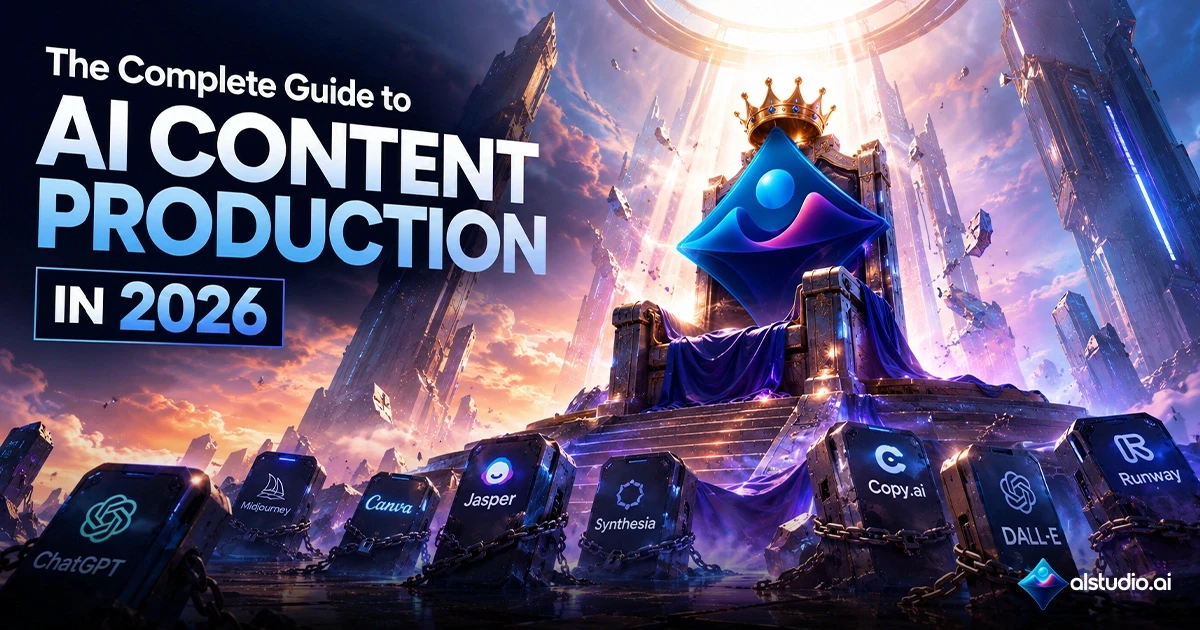
The Complete Guide to AI Content Production in 2026
AI content production is the end-to-end process of using artificial intelligence to generate, refine, manage, and distribute creative assets images, video, copy, voiceover, and campaign materials inside a defined brand workflow. In 2026, the generation problem is largely solved. The challenge is maintaining consistent brand identity, character continuity, product accuracy, and operational control across every output at scale.
You can produce an image in four seconds, a video in two minutes, and a campaign brief before your coffee gets cold and still end up with 50 outputs that share no visual identity, no tonal consistency, and no coherent story.
The tools got faster. The problem moved upstream.
This is the guide we wish existed when we started building ALStudio. Not a roundup of disconnected AI apps, but a practical explanation of what AI content production actually requires when content volume scales beyond a single creator and becomes a business operation.
Why AI Content Production Became a Boardroom Problem
Until recently, content production was constrained by human bandwidth. Teams could only create as much content as their designers, writers, editors, agencies, and freelancers could physically produce.
Generative AI changed that equation.
A team that previously produced twenty assets per month can now generate hundreds. A team that once needed weeks to build a campaign can create drafts in hours.
But this new abundance introduced a new challenge. The bottleneck shifted.
The question is no longer: Can we create enough content?
The question is now: Can we keep all this content aligned with the same brand?
As AI adoption spreads across organizations, content governance, identity consistency, and production coordination become strategic business concerns rather than purely creative ones.
AI content production has evolved from a creation problem into an operational problem.
The Evolution of AI Content Production
The history of content production can be understood as a series of bottlenecks.
Era | Primary Constraint | Dominant Solution |
2010 to 2020 | Production Speed | Agencies and Creative Teams |
2020 to 2023 | Content Volume | Marketing Automation |
2023 to 2025 | Content Generation | Generative AI Tools |
2026 onwards | Consistency and Governance | Creative AI Operating Systems |
Most organizations today are still solving yesterday's problem. They continue evaluating AI tools based on generation quality alone.
Yet generation quality is improving across nearly every major platform. Consistency, governance, collaboration, and workflow orchestration are becoming the new competitive advantages.
What Is AI Content Production?
AI content production is the end-to-end process of using artificial intelligence to generate, assemble, refine, localize, manage, and distribute creative assets including written content, images, videos, voiceovers, advertisements, social content, and campaign materials within a defined brand identity and production workflow.
For many teams, the reality looks very different. A brief is written in one platform. Images are generated in another. Videos are rendered elsewhere. Voiceovers come from a fourth system. Publishing happens in a fifth.
The result is a workflow filled with manual exports, re-uploads, formatting issues, lost context, and brand inconsistency.
That is not production infrastructure. That is creative fragmentation.
The most important distinction in 2026 is this:
Generating content is easy. Maintaining identity across content is difficult.
A team can generate hundreds of assets per day and still reject most of them because the character changed, the product appearance shifted, the tone drifted, or the campaign no longer feels connected.
Generation is largely solved. Production infrastructure is not.
The Hidden Cost of Fragmented AI Workflows
Most organizations underestimate the operational cost of disconnected AI tools.
The expense is rarely the subscription itself. The expense is the work that happens between subscriptions.
A marketing team might use one platform for writing, another for image generation, another for video production, another for voiceover, and another for publishing. Each handoff requires exporting files, re-uploading assets, re-explaining context, checking consistency, and correcting errors.
At small scale, these inefficiencies appear manageable. At enterprise scale, they become a production tax.
Teams spend hours rebuilding information that already exists somewhere else in the workflow. Product references are uploaded repeatedly. Brand guidelines are copied into prompts over and over again. Characters, environments, and campaign rules must be recreated every time a project moves between systems.
The result is an invisible cost that rarely appears in software budgets but directly impacts production speed, content quality, and campaign consistency.
The organizations that gain the most value from AI are not necessarily the organizations using the most AI tools. They are the organizations that reduce the number of creative handoffs.
What Is a Creative AI OS?
A Creative AI OS (Creative AI Operating System) is a production environment that connects content creation, visual generation, video production, localization, publishing, collaboration, and brand memory inside a unified workflow.
Traditional AI tools generate outputs. A Creative AI OS manages production. The difference is substantial.
An image generator helps create an image.
A video model helps create a video.
A copywriting tool helps create text.
A Creative AI OS coordinates the entire lifecycle.
It stores identity. Maintains consistency. Connects workflows. Tracks assets. Orchestrates production. And ensures every output remains connected to the same brand foundation.
This shift mirrors what happened in software development. Individual tools eventually evolved into integrated operating environments. Creative production is beginning the same transition.
The AI Content Production Maturity Model
Most organizations progress through predictable stages as they adopt AI. The challenge is that many companies believe they have reached maturity simply because they use generative AI. In reality, generation is only the second stage.
Level | Stage | Primary Focus |
Level 1 | Manual Production | Human-driven content creation |
Level 2 | AI Generation | Faster asset creation |
Level 3 | AI Workflows | Connected automation between tools |
Level 4 | Creative AI OS | Unified production infrastructure |
Level 5 | Autonomous Production | AI-managed campaign execution |
Level 1: Manual Production
Content depends entirely on designers, writers, editors, and agencies. Production speed is the primary constraint.
Level 2: AI Generation
Organizations adopt image generators, copywriting tools, video models, and voice platforms. Output increases dramatically. Consistency problems begin to emerge.
Level 3: AI Workflows
Teams connect tools through automations and workflow platforms. Efficiency improves. Identity management remains difficult.
Level 4: Creative AI OS
Content production becomes centralized. Brand memory becomes reusable. Teams operate from shared creative infrastructure. Consistency scales alongside production volume.
Level 5: Autonomous Production
Campaigns begin with strategic objectives rather than asset requests. AI systems coordinate production, localization, optimization, and adaptation automatically.
Most organizations currently operate between Levels 2 and 3. The next competitive advantage lies in reaching Level 4.
Why Most AI Tools Fail at Content Production
Most AI platforms were built as generation endpoints. They accept prompts and return outputs. What they do not do is remember.
They do not remember your character, your product, your visual world, your campaign history, your brand tone, or your production standards.
Every session begins from zero. Every handoff loses context. Every workflow introduces opportunities for drift.
In building ALStudio's Consistency Engine across image generation, video production, multilingual voiceovers, social content workflows, and product advertising systems, we repeatedly encountered the same challenge: generation quality was improving faster than consistency infrastructure.
Every time we switched models, changed platforms, or handed a project to another team member, the character drifted, the brand voice shifted, and the campaign started looking like it had been produced by entirely different organizations.
Generic outputs are often a symptom of a deeper issue: the absence of a persistent identity system. Without memory, every generation becomes an approximation.
Why AI Content Production Breaks in Practice
Most failures occur gradually. Small inconsistencies accumulate until a campaign no longer feels unified.
Character Drift
AI models do not naturally remember characters between sessions. Each generation recreates appearance from scratch. The result is a brand ambassador who slowly transforms into a different person over time.
Product Inconsistency
Products are repeatedly reinterpreted. Labels move. Packaging changes. Colors shift. Materials look different. Without a locked product identity, product marketing becomes unreliable.
Brand Voice Bleed
Different tools generate different tones. Copy sounds corporate. Visuals feel playful. Voiceovers feel unrelated. The campaign loses coherence.
Credit Burn Collapse
Many AI platforms rely on complex credit systems. Teams struggle to forecast costs. Projects stall unexpectedly. Production becomes constrained by billing architecture rather than creative requirements.
Fragmented Handoff Loss
Every export and re-upload creates friction. Files lose metadata. Formats change. Context disappears. Quality degrades. The workflow becomes the bottleneck.
The Five Layers of Modern AI Content Production
Successful AI content production requires more than generation models. Modern production systems operate across five interconnected layers.
Layer 1: Strategy
Business goals, audience insights, campaign objectives, and positioning.
Layer 2: Identity
Brand DNA, Product DNA, Character DNA, and visual standards.
Layer 3: Generation
Images, videos, copy, voiceovers, and creative assets.
Layer 4: Operations
Approvals, collaboration, workflows, localization, and publishing.
Layer 5: Optimization
Performance analysis, iteration, testing, and campaign improvement.
Most AI tools focus only on Layer 3. The highest-performing organizations build infrastructure across all five layers.
Why Governance Is Becoming More Important Than Generation
As AI adoption expands across organizations, governance becomes increasingly important. Multiple departments create content simultaneously. Regional teams localize campaigns independently. Agencies manage dozens of brands. Enterprise organizations operate across multiple markets.
Without centralized governance, organizations face brand inconsistency, compliance risks, duplicate content creation, asset fragmentation, uncontrolled messaging, and loss of campaign traceability.
The next generation of AI platforms will not compete solely on generation quality. They will compete on governance quality. Organizations need systems that scale identity, not merely output.
The 4 Types of AI Content Production Brands Actually Need
Most discussions treat all content as one category. In reality, there are four distinct production systems.
Production Type | What It Covers | Why It Matters |
Written Content Production | Blogs, scripts, SEO, email, captions | Controls messaging and brand voice |
Visual and Video Production | Images, videos, product content, UGC | Highest-risk category for consistency drift |
Campaign Orchestration | Publishing, workflows, social factories | Connects assets into campaigns |
Multilingual Production | Localization, dialects, regional adaptation | Essential for global and MENA brands |
Each requires different workflows. All require the same identity foundation.
AI Content Production Workflow
The most effective AI content production workflows follow a structured pipeline:
Strategy → Brand Identity → Brief Creation → Content Development → Image Generation → Video Production → Localization → Publishing → Performance Optimization
The mistake most teams make is starting at generation. The strongest workflows begin with identity. Everything downstream becomes easier.
AI Content Production Stack vs Creative AI OS
Traditional AI Stack | Creative AI OS |
5 to 10 separate tools | Unified system |
Manual handoffs | Connected workflow |
Multiple subscriptions | Centralized platform |
Brand drift | Persistent identity |
Fragmented assets | Shared memory |
Repeated setup | Reusable infrastructure |
Per-tool learning curves | Single workspace |
This distinction becomes increasingly important as production volume increases.
How Major AI Platforms Approach Content Production Consistency
Platform | Consistency Approach | Limitations |
Runway | Reference uploads | No persistent brand memory |
Canva Magic Studio | Brand Kit | Limited to visual brand assets |
Standalone Video Models | Stateless generation | No memory between sessions |
ALStudio | Character DNA, Product DNA, Scene DNA, Brand DNA | Persistent across projects and workflows |
The distinction is simple. Reference systems remember temporarily. Identity systems remember permanently.
A Practical Example: A Ramadan Campaign
Imagine a regional fashion brand preparing a Ramadan campaign. Requirements include 12 social posts, 3 product videos, 2 reels, Arabic voiceovers, English captions, across Instagram, TikTok, and Meta Ads — within three weeks.
Without a unified system, teams spend much of that time rebuilding context. Characters drift. Products change. Assets become disconnected.
With a shared identity system, the campaign operates from one foundation. Every asset inherits the same brand memory. The workflow becomes production rather than reconstruction.
How ALStudio Solves AI Content Production
ALStudio was designed as a complete Creative AI OS rather than a single-stage tool. Instead of optimizing one step, it connects the entire production lifecycle:
Constants Studio — stores Character DNA, Product DNA, Scene DNA, and Brand DNA
Content Studio — written content and copywriting
Film Studio — video production
Marketing Studio — campaign assembly and publishing
Editor Studio — creative editing and refinement
ALStudio's Consistency Engine acts as the shared identity layer across all production workflows. Each identity element is defined once. Every generation automatically inherits that information regardless of model, team member, project, campaign, or session.
The result is a production environment where the hundredth asset can remain as consistent as the first.
Measuring AI Content Production Success
Many teams measure AI success using output volume. That metric is becoming increasingly misleading. Producing more content does not necessarily create more value.
The most effective organizations evaluate AI content production using metrics such as:
Brand consistency score
Campaign production time
Cost per asset
Asset reuse rate
Localization speed
Review cycle reduction
Time to campaign launch
Cross-channel consistency
The goal is not maximizing content quantity. The goal is maximizing content quality, consistency, and operational efficiency at scale.
Who Needs AI Content Production Infrastructure?
Marketing Teams — Need consistent campaigns across multiple channels and contributors.
Ecommerce Brands — Need product consistency across thousands of assets.
Agencies — Need separate identity systems for multiple clients.
Content Creators — Need recurring formats that remain recognizable over time.
The common challenge is not generation. It is maintaining identity while scaling output.
The Future of AI Content Production
Over the next five years, AI content production will evolve in four major directions:
Persistent Creative Memory — Systems will remember brands permanently.
Multi-Agent Production Teams — Specialized AI agents will collaborate across workflows.
Real-Time Localization — Campaigns will adapt instantly across languages and markets.
Autonomous Campaign Generation — Entire campaign systems will operate from strategic inputs.
Generation quality will continue improving. The competitive advantage will shift toward systems that remember, coordinate, and govern creative work.
Build a Production System, Not Another Workflow
AI content production is entering a new phase. The organizations that win will not be the ones generating the most content. They will be the ones maintaining the strongest identity while scaling output across teams, markets, languages, and campaigns.
ALStudio's Creative AI OS was built for that challenge. With Constants Studio, Content Studio, Film Studio, Marketing Studio, and Editor Studio connected through a shared Consistency Engine, teams can move from isolated generations to scalable production infrastructure.
Because content is no longer the bottleneck. Consistency is.
Start free with ALStudio. No watermark. No credit card required.
Featured Snippet
What is AI content production?
AI content production is the end-to-end process of using artificial intelligence to generate, manage, and distribute creative assets including images, video, copy, voiceovers, and campaign materials within a defined brand workflow. In 2026, the core challenge is no longer generation speed. It is maintaining consistent brand identity, character continuity, and operational control across high-volume output. The most effective AI content production systems operate across five layers: strategy, identity, generation, operations, and optimization not generation alone.
The Complete Guide to AI Content Production in 2026
Creative AI OS
The Complete Guide to AI Content Production in 2026
AI content production is the end-to-end process of using artificial intelligence to generate, refine, manage, and distribute creative assets images, video, copy, voiceover, and campaign materials inside a defined brand workflow. In 2026, the generation problem is largely solved. The challenge is maintaining consistent brand identity, character continuity, product accuracy, and operational control across every output at scale.
You can produce an image in four seconds, a video in two minutes, and a campaign brief before your coffee gets cold and still end up with 50 outputs that share no visual identity, no tonal consistency, and no coherent story.
The tools got faster. The problem moved upstream.
This is the guide we wish existed when we started building ALStudio. Not a roundup of disconnected AI apps, but a practical explanation of what AI content production actually requires when content volume scales beyond a single creator and becomes a business operation.
Why AI Content Production Became a Boardroom Problem
Until recently, content production was constrained by human bandwidth. Teams could only create as much content as their designers, writers, editors, agencies, and freelancers could physically produce.
Generative AI changed that equation.
A team that previously produced twenty assets per month can now generate hundreds. A team that once needed weeks to build a campaign can create drafts in hours.
But this new abundance introduced a new challenge. The bottleneck shifted.
The question is no longer: Can we create enough content?
The question is now: Can we keep all this content aligned with the same brand?
As AI adoption spreads across organizations, content governance, identity consistency, and production coordination become strategic business concerns rather than purely creative ones.
AI content production has evolved from a creation problem into an operational problem.
The Evolution of AI Content Production
The history of content production can be understood as a series of bottlenecks.
Era | Primary Constraint | Dominant Solution |
2010 to 2020 | Production Speed | Agencies and Creative Teams |
2020 to 2023 | Content Volume | Marketing Automation |
2023 to 2025 | Content Generation | Generative AI Tools |
2026 onwards | Consistency and Governance | Creative AI Operating Systems |
Most organizations today are still solving yesterday's problem. They continue evaluating AI tools based on generation quality alone.
Yet generation quality is improving across nearly every major platform. Consistency, governance, collaboration, and workflow orchestration are becoming the new competitive advantages.
What Is AI Content Production?
AI content production is the end-to-end process of using artificial intelligence to generate, assemble, refine, localize, manage, and distribute creative assets including written content, images, videos, voiceovers, advertisements, social content, and campaign materials within a defined brand identity and production workflow.
For many teams, the reality looks very different. A brief is written in one platform. Images are generated in another. Videos are rendered elsewhere. Voiceovers come from a fourth system. Publishing happens in a fifth.
The result is a workflow filled with manual exports, re-uploads, formatting issues, lost context, and brand inconsistency.
That is not production infrastructure. That is creative fragmentation.
The most important distinction in 2026 is this:
Generating content is easy. Maintaining identity across content is difficult.
A team can generate hundreds of assets per day and still reject most of them because the character changed, the product appearance shifted, the tone drifted, or the campaign no longer feels connected.
Generation is largely solved. Production infrastructure is not.
The Hidden Cost of Fragmented AI Workflows
Most organizations underestimate the operational cost of disconnected AI tools.
The expense is rarely the subscription itself. The expense is the work that happens between subscriptions.
A marketing team might use one platform for writing, another for image generation, another for video production, another for voiceover, and another for publishing. Each handoff requires exporting files, re-uploading assets, re-explaining context, checking consistency, and correcting errors.
At small scale, these inefficiencies appear manageable. At enterprise scale, they become a production tax.
Teams spend hours rebuilding information that already exists somewhere else in the workflow. Product references are uploaded repeatedly. Brand guidelines are copied into prompts over and over again. Characters, environments, and campaign rules must be recreated every time a project moves between systems.
The result is an invisible cost that rarely appears in software budgets but directly impacts production speed, content quality, and campaign consistency.
The organizations that gain the most value from AI are not necessarily the organizations using the most AI tools. They are the organizations that reduce the number of creative handoffs.
What Is a Creative AI OS?
A Creative AI OS (Creative AI Operating System) is a production environment that connects content creation, visual generation, video production, localization, publishing, collaboration, and brand memory inside a unified workflow.
Traditional AI tools generate outputs. A Creative AI OS manages production. The difference is substantial.
An image generator helps create an image.
A video model helps create a video.
A copywriting tool helps create text.
A Creative AI OS coordinates the entire lifecycle.
It stores identity. Maintains consistency. Connects workflows. Tracks assets. Orchestrates production. And ensures every output remains connected to the same brand foundation.
This shift mirrors what happened in software development. Individual tools eventually evolved into integrated operating environments. Creative production is beginning the same transition.
The AI Content Production Maturity Model
Most organizations progress through predictable stages as they adopt AI. The challenge is that many companies believe they have reached maturity simply because they use generative AI. In reality, generation is only the second stage.
Level | Stage | Primary Focus |
Level 1 | Manual Production | Human-driven content creation |
Level 2 | AI Generation | Faster asset creation |
Level 3 | AI Workflows | Connected automation between tools |
Level 4 | Creative AI OS | Unified production infrastructure |
Level 5 | Autonomous Production | AI-managed campaign execution |
Level 1: Manual Production
Content depends entirely on designers, writers, editors, and agencies. Production speed is the primary constraint.
Level 2: AI Generation
Organizations adopt image generators, copywriting tools, video models, and voice platforms. Output increases dramatically. Consistency problems begin to emerge.
Level 3: AI Workflows
Teams connect tools through automations and workflow platforms. Efficiency improves. Identity management remains difficult.
Level 4: Creative AI OS
Content production becomes centralized. Brand memory becomes reusable. Teams operate from shared creative infrastructure. Consistency scales alongside production volume.
Level 5: Autonomous Production
Campaigns begin with strategic objectives rather than asset requests. AI systems coordinate production, localization, optimization, and adaptation automatically.
Most organizations currently operate between Levels 2 and 3. The next competitive advantage lies in reaching Level 4.
Why Most AI Tools Fail at Content Production
Most AI platforms were built as generation endpoints. They accept prompts and return outputs. What they do not do is remember.
They do not remember your character, your product, your visual world, your campaign history, your brand tone, or your production standards.
Every session begins from zero. Every handoff loses context. Every workflow introduces opportunities for drift.
In building ALStudio's Consistency Engine across image generation, video production, multilingual voiceovers, social content workflows, and product advertising systems, we repeatedly encountered the same challenge: generation quality was improving faster than consistency infrastructure.
Every time we switched models, changed platforms, or handed a project to another team member, the character drifted, the brand voice shifted, and the campaign started looking like it had been produced by entirely different organizations.
Generic outputs are often a symptom of a deeper issue: the absence of a persistent identity system. Without memory, every generation becomes an approximation.
Why AI Content Production Breaks in Practice
Most failures occur gradually. Small inconsistencies accumulate until a campaign no longer feels unified.
Character Drift
AI models do not naturally remember characters between sessions. Each generation recreates appearance from scratch. The result is a brand ambassador who slowly transforms into a different person over time.
Product Inconsistency
Products are repeatedly reinterpreted. Labels move. Packaging changes. Colors shift. Materials look different. Without a locked product identity, product marketing becomes unreliable.
Brand Voice Bleed
Different tools generate different tones. Copy sounds corporate. Visuals feel playful. Voiceovers feel unrelated. The campaign loses coherence.
Credit Burn Collapse
Many AI platforms rely on complex credit systems. Teams struggle to forecast costs. Projects stall unexpectedly. Production becomes constrained by billing architecture rather than creative requirements.
Fragmented Handoff Loss
Every export and re-upload creates friction. Files lose metadata. Formats change. Context disappears. Quality degrades. The workflow becomes the bottleneck.
The Five Layers of Modern AI Content Production
Successful AI content production requires more than generation models. Modern production systems operate across five interconnected layers.
Layer 1: Strategy
Business goals, audience insights, campaign objectives, and positioning.
Layer 2: Identity
Brand DNA, Product DNA, Character DNA, and visual standards.
Layer 3: Generation
Images, videos, copy, voiceovers, and creative assets.
Layer 4: Operations
Approvals, collaboration, workflows, localization, and publishing.
Layer 5: Optimization
Performance analysis, iteration, testing, and campaign improvement.
Most AI tools focus only on Layer 3. The highest-performing organizations build infrastructure across all five layers.
Why Governance Is Becoming More Important Than Generation
As AI adoption expands across organizations, governance becomes increasingly important. Multiple departments create content simultaneously. Regional teams localize campaigns independently. Agencies manage dozens of brands. Enterprise organizations operate across multiple markets.
Without centralized governance, organizations face brand inconsistency, compliance risks, duplicate content creation, asset fragmentation, uncontrolled messaging, and loss of campaign traceability.
The next generation of AI platforms will not compete solely on generation quality. They will compete on governance quality. Organizations need systems that scale identity, not merely output.
The 4 Types of AI Content Production Brands Actually Need
Most discussions treat all content as one category. In reality, there are four distinct production systems.
Production Type | What It Covers | Why It Matters |
Written Content Production | Blogs, scripts, SEO, email, captions | Controls messaging and brand voice |
Visual and Video Production | Images, videos, product content, UGC | Highest-risk category for consistency drift |
Campaign Orchestration | Publishing, workflows, social factories | Connects assets into campaigns |
Multilingual Production | Localization, dialects, regional adaptation | Essential for global and MENA brands |
Each requires different workflows. All require the same identity foundation.
AI Content Production Workflow
The most effective AI content production workflows follow a structured pipeline:
Strategy → Brand Identity → Brief Creation → Content Development → Image Generation → Video Production → Localization → Publishing → Performance Optimization
The mistake most teams make is starting at generation. The strongest workflows begin with identity. Everything downstream becomes easier.
AI Content Production Stack vs Creative AI OS
Traditional AI Stack | Creative AI OS |
5 to 10 separate tools | Unified system |
Manual handoffs | Connected workflow |
Multiple subscriptions | Centralized platform |
Brand drift | Persistent identity |
Fragmented assets | Shared memory |
Repeated setup | Reusable infrastructure |
Per-tool learning curves | Single workspace |
This distinction becomes increasingly important as production volume increases.
How Major AI Platforms Approach Content Production Consistency
Platform | Consistency Approach | Limitations |
Runway | Reference uploads | No persistent brand memory |
Canva Magic Studio | Brand Kit | Limited to visual brand assets |
Standalone Video Models | Stateless generation | No memory between sessions |
ALStudio | Character DNA, Product DNA, Scene DNA, Brand DNA | Persistent across projects and workflows |
The distinction is simple. Reference systems remember temporarily. Identity systems remember permanently.
A Practical Example: A Ramadan Campaign
Imagine a regional fashion brand preparing a Ramadan campaign. Requirements include 12 social posts, 3 product videos, 2 reels, Arabic voiceovers, English captions, across Instagram, TikTok, and Meta Ads — within three weeks.
Without a unified system, teams spend much of that time rebuilding context. Characters drift. Products change. Assets become disconnected.
With a shared identity system, the campaign operates from one foundation. Every asset inherits the same brand memory. The workflow becomes production rather than reconstruction.
How ALStudio Solves AI Content Production
ALStudio was designed as a complete Creative AI OS rather than a single-stage tool. Instead of optimizing one step, it connects the entire production lifecycle:
Constants Studio — stores Character DNA, Product DNA, Scene DNA, and Brand DNA
Content Studio — written content and copywriting
Film Studio — video production
Marketing Studio — campaign assembly and publishing
Editor Studio — creative editing and refinement
ALStudio's Consistency Engine acts as the shared identity layer across all production workflows. Each identity element is defined once. Every generation automatically inherits that information regardless of model, team member, project, campaign, or session.
The result is a production environment where the hundredth asset can remain as consistent as the first.
Measuring AI Content Production Success
Many teams measure AI success using output volume. That metric is becoming increasingly misleading. Producing more content does not necessarily create more value.
The most effective organizations evaluate AI content production using metrics such as:
Brand consistency score
Campaign production time
Cost per asset
Asset reuse rate
Localization speed
Review cycle reduction
Time to campaign launch
Cross-channel consistency
The goal is not maximizing content quantity. The goal is maximizing content quality, consistency, and operational efficiency at scale.
Who Needs AI Content Production Infrastructure?
Marketing Teams — Need consistent campaigns across multiple channels and contributors.
Ecommerce Brands — Need product consistency across thousands of assets.
Agencies — Need separate identity systems for multiple clients.
Content Creators — Need recurring formats that remain recognizable over time.
The common challenge is not generation. It is maintaining identity while scaling output.
The Future of AI Content Production
Over the next five years, AI content production will evolve in four major directions:
Persistent Creative Memory — Systems will remember brands permanently.
Multi-Agent Production Teams — Specialized AI agents will collaborate across workflows.
Real-Time Localization — Campaigns will adapt instantly across languages and markets.
Autonomous Campaign Generation — Entire campaign systems will operate from strategic inputs.
Generation quality will continue improving. The competitive advantage will shift toward systems that remember, coordinate, and govern creative work.
Build a Production System, Not Another Workflow
AI content production is entering a new phase. The organizations that win will not be the ones generating the most content. They will be the ones maintaining the strongest identity while scaling output across teams, markets, languages, and campaigns.
ALStudio's Creative AI OS was built for that challenge. With Constants Studio, Content Studio, Film Studio, Marketing Studio, and Editor Studio connected through a shared Consistency Engine, teams can move from isolated generations to scalable production infrastructure.
Because content is no longer the bottleneck. Consistency is.
Start free with ALStudio. No watermark. No credit card required.
Featured Snippet
What is AI content production?
AI content production is the end-to-end process of using artificial intelligence to generate, manage, and distribute creative assets including images, video, copy, voiceovers, and campaign materials within a defined brand workflow. In 2026, the core challenge is no longer generation speed. It is maintaining consistent brand identity, character continuity, and operational control across high-volume output. The most effective AI content production systems operate across five layers: strategy, identity, generation, operations, and optimization not generation alone.
The Complete Guide to AI Content Production in 2026
Creative AI OS
The Complete Guide to AI Content Production in 2026
AI content production is the end-to-end process of using artificial intelligence to generate, refine, manage, and distribute creative assets images, video, copy, voiceover, and campaign materials inside a defined brand workflow. In 2026, the generation problem is largely solved. The challenge is maintaining consistent brand identity, character continuity, product accuracy, and operational control across every output at scale.
You can produce an image in four seconds, a video in two minutes, and a campaign brief before your coffee gets cold and still end up with 50 outputs that share no visual identity, no tonal consistency, and no coherent story.
The tools got faster. The problem moved upstream.
This is the guide we wish existed when we started building ALStudio. Not a roundup of disconnected AI apps, but a practical explanation of what AI content production actually requires when content volume scales beyond a single creator and becomes a business operation.
Why AI Content Production Became a Boardroom Problem
Until recently, content production was constrained by human bandwidth. Teams could only create as much content as their designers, writers, editors, agencies, and freelancers could physically produce.
Generative AI changed that equation.
A team that previously produced twenty assets per month can now generate hundreds. A team that once needed weeks to build a campaign can create drafts in hours.
But this new abundance introduced a new challenge. The bottleneck shifted.
The question is no longer: Can we create enough content?
The question is now: Can we keep all this content aligned with the same brand?
As AI adoption spreads across organizations, content governance, identity consistency, and production coordination become strategic business concerns rather than purely creative ones.
AI content production has evolved from a creation problem into an operational problem.
The Evolution of AI Content Production
The history of content production can be understood as a series of bottlenecks.
Era | Primary Constraint | Dominant Solution |
2010 to 2020 | Production Speed | Agencies and Creative Teams |
2020 to 2023 | Content Volume | Marketing Automation |
2023 to 2025 | Content Generation | Generative AI Tools |
2026 onwards | Consistency and Governance | Creative AI Operating Systems |
Most organizations today are still solving yesterday's problem. They continue evaluating AI tools based on generation quality alone.
Yet generation quality is improving across nearly every major platform. Consistency, governance, collaboration, and workflow orchestration are becoming the new competitive advantages.
What Is AI Content Production?
AI content production is the end-to-end process of using artificial intelligence to generate, assemble, refine, localize, manage, and distribute creative assets including written content, images, videos, voiceovers, advertisements, social content, and campaign materials within a defined brand identity and production workflow.
For many teams, the reality looks very different. A brief is written in one platform. Images are generated in another. Videos are rendered elsewhere. Voiceovers come from a fourth system. Publishing happens in a fifth.
The result is a workflow filled with manual exports, re-uploads, formatting issues, lost context, and brand inconsistency.
That is not production infrastructure. That is creative fragmentation.
The most important distinction in 2026 is this:
Generating content is easy. Maintaining identity across content is difficult.
A team can generate hundreds of assets per day and still reject most of them because the character changed, the product appearance shifted, the tone drifted, or the campaign no longer feels connected.
Generation is largely solved. Production infrastructure is not.
The Hidden Cost of Fragmented AI Workflows
Most organizations underestimate the operational cost of disconnected AI tools.
The expense is rarely the subscription itself. The expense is the work that happens between subscriptions.
A marketing team might use one platform for writing, another for image generation, another for video production, another for voiceover, and another for publishing. Each handoff requires exporting files, re-uploading assets, re-explaining context, checking consistency, and correcting errors.
At small scale, these inefficiencies appear manageable. At enterprise scale, they become a production tax.
Teams spend hours rebuilding information that already exists somewhere else in the workflow. Product references are uploaded repeatedly. Brand guidelines are copied into prompts over and over again. Characters, environments, and campaign rules must be recreated every time a project moves between systems.
The result is an invisible cost that rarely appears in software budgets but directly impacts production speed, content quality, and campaign consistency.
The organizations that gain the most value from AI are not necessarily the organizations using the most AI tools. They are the organizations that reduce the number of creative handoffs.
What Is a Creative AI OS?
A Creative AI OS (Creative AI Operating System) is a production environment that connects content creation, visual generation, video production, localization, publishing, collaboration, and brand memory inside a unified workflow.
Traditional AI tools generate outputs. A Creative AI OS manages production. The difference is substantial.
An image generator helps create an image.
A video model helps create a video.
A copywriting tool helps create text.
A Creative AI OS coordinates the entire lifecycle.
It stores identity. Maintains consistency. Connects workflows. Tracks assets. Orchestrates production. And ensures every output remains connected to the same brand foundation.
This shift mirrors what happened in software development. Individual tools eventually evolved into integrated operating environments. Creative production is beginning the same transition.
The AI Content Production Maturity Model
Most organizations progress through predictable stages as they adopt AI. The challenge is that many companies believe they have reached maturity simply because they use generative AI. In reality, generation is only the second stage.
Level | Stage | Primary Focus |
Level 1 | Manual Production | Human-driven content creation |
Level 2 | AI Generation | Faster asset creation |
Level 3 | AI Workflows | Connected automation between tools |
Level 4 | Creative AI OS | Unified production infrastructure |
Level 5 | Autonomous Production | AI-managed campaign execution |
Level 1: Manual Production
Content depends entirely on designers, writers, editors, and agencies. Production speed is the primary constraint.
Level 2: AI Generation
Organizations adopt image generators, copywriting tools, video models, and voice platforms. Output increases dramatically. Consistency problems begin to emerge.
Level 3: AI Workflows
Teams connect tools through automations and workflow platforms. Efficiency improves. Identity management remains difficult.
Level 4: Creative AI OS
Content production becomes centralized. Brand memory becomes reusable. Teams operate from shared creative infrastructure. Consistency scales alongside production volume.
Level 5: Autonomous Production
Campaigns begin with strategic objectives rather than asset requests. AI systems coordinate production, localization, optimization, and adaptation automatically.
Most organizations currently operate between Levels 2 and 3. The next competitive advantage lies in reaching Level 4.
Why Most AI Tools Fail at Content Production
Most AI platforms were built as generation endpoints. They accept prompts and return outputs. What they do not do is remember.
They do not remember your character, your product, your visual world, your campaign history, your brand tone, or your production standards.
Every session begins from zero. Every handoff loses context. Every workflow introduces opportunities for drift.
In building ALStudio's Consistency Engine across image generation, video production, multilingual voiceovers, social content workflows, and product advertising systems, we repeatedly encountered the same challenge: generation quality was improving faster than consistency infrastructure.
Every time we switched models, changed platforms, or handed a project to another team member, the character drifted, the brand voice shifted, and the campaign started looking like it had been produced by entirely different organizations.
Generic outputs are often a symptom of a deeper issue: the absence of a persistent identity system. Without memory, every generation becomes an approximation.
Why AI Content Production Breaks in Practice
Most failures occur gradually. Small inconsistencies accumulate until a campaign no longer feels unified.
Character Drift
AI models do not naturally remember characters between sessions. Each generation recreates appearance from scratch. The result is a brand ambassador who slowly transforms into a different person over time.
Product Inconsistency
Products are repeatedly reinterpreted. Labels move. Packaging changes. Colors shift. Materials look different. Without a locked product identity, product marketing becomes unreliable.
Brand Voice Bleed
Different tools generate different tones. Copy sounds corporate. Visuals feel playful. Voiceovers feel unrelated. The campaign loses coherence.
Credit Burn Collapse
Many AI platforms rely on complex credit systems. Teams struggle to forecast costs. Projects stall unexpectedly. Production becomes constrained by billing architecture rather than creative requirements.
Fragmented Handoff Loss
Every export and re-upload creates friction. Files lose metadata. Formats change. Context disappears. Quality degrades. The workflow becomes the bottleneck.
The Five Layers of Modern AI Content Production
Successful AI content production requires more than generation models. Modern production systems operate across five interconnected layers.
Layer 1: Strategy
Business goals, audience insights, campaign objectives, and positioning.
Layer 2: Identity
Brand DNA, Product DNA, Character DNA, and visual standards.
Layer 3: Generation
Images, videos, copy, voiceovers, and creative assets.
Layer 4: Operations
Approvals, collaboration, workflows, localization, and publishing.
Layer 5: Optimization
Performance analysis, iteration, testing, and campaign improvement.
Most AI tools focus only on Layer 3. The highest-performing organizations build infrastructure across all five layers.
Why Governance Is Becoming More Important Than Generation
As AI adoption expands across organizations, governance becomes increasingly important. Multiple departments create content simultaneously. Regional teams localize campaigns independently. Agencies manage dozens of brands. Enterprise organizations operate across multiple markets.
Without centralized governance, organizations face brand inconsistency, compliance risks, duplicate content creation, asset fragmentation, uncontrolled messaging, and loss of campaign traceability.
The next generation of AI platforms will not compete solely on generation quality. They will compete on governance quality. Organizations need systems that scale identity, not merely output.
The 4 Types of AI Content Production Brands Actually Need
Most discussions treat all content as one category. In reality, there are four distinct production systems.
Production Type | What It Covers | Why It Matters |
Written Content Production | Blogs, scripts, SEO, email, captions | Controls messaging and brand voice |
Visual and Video Production | Images, videos, product content, UGC | Highest-risk category for consistency drift |
Campaign Orchestration | Publishing, workflows, social factories | Connects assets into campaigns |
Multilingual Production | Localization, dialects, regional adaptation | Essential for global and MENA brands |
Each requires different workflows. All require the same identity foundation.
AI Content Production Workflow
The most effective AI content production workflows follow a structured pipeline:
Strategy → Brand Identity → Brief Creation → Content Development → Image Generation → Video Production → Localization → Publishing → Performance Optimization
The mistake most teams make is starting at generation. The strongest workflows begin with identity. Everything downstream becomes easier.
AI Content Production Stack vs Creative AI OS
Traditional AI Stack | Creative AI OS |
5 to 10 separate tools | Unified system |
Manual handoffs | Connected workflow |
Multiple subscriptions | Centralized platform |
Brand drift | Persistent identity |
Fragmented assets | Shared memory |
Repeated setup | Reusable infrastructure |
Per-tool learning curves | Single workspace |
This distinction becomes increasingly important as production volume increases.
How Major AI Platforms Approach Content Production Consistency
Platform | Consistency Approach | Limitations |
Runway | Reference uploads | No persistent brand memory |
Canva Magic Studio | Brand Kit | Limited to visual brand assets |
Standalone Video Models | Stateless generation | No memory between sessions |
ALStudio | Character DNA, Product DNA, Scene DNA, Brand DNA | Persistent across projects and workflows |
The distinction is simple. Reference systems remember temporarily. Identity systems remember permanently.
A Practical Example: A Ramadan Campaign
Imagine a regional fashion brand preparing a Ramadan campaign. Requirements include 12 social posts, 3 product videos, 2 reels, Arabic voiceovers, English captions, across Instagram, TikTok, and Meta Ads — within three weeks.
Without a unified system, teams spend much of that time rebuilding context. Characters drift. Products change. Assets become disconnected.
With a shared identity system, the campaign operates from one foundation. Every asset inherits the same brand memory. The workflow becomes production rather than reconstruction.
How ALStudio Solves AI Content Production
ALStudio was designed as a complete Creative AI OS rather than a single-stage tool. Instead of optimizing one step, it connects the entire production lifecycle:
Constants Studio — stores Character DNA, Product DNA, Scene DNA, and Brand DNA
Content Studio — written content and copywriting
Film Studio — video production
Marketing Studio — campaign assembly and publishing
Editor Studio — creative editing and refinement
ALStudio's Consistency Engine acts as the shared identity layer across all production workflows. Each identity element is defined once. Every generation automatically inherits that information regardless of model, team member, project, campaign, or session.
The result is a production environment where the hundredth asset can remain as consistent as the first.
Measuring AI Content Production Success
Many teams measure AI success using output volume. That metric is becoming increasingly misleading. Producing more content does not necessarily create more value.
The most effective organizations evaluate AI content production using metrics such as:
Brand consistency score
Campaign production time
Cost per asset
Asset reuse rate
Localization speed
Review cycle reduction
Time to campaign launch
Cross-channel consistency
The goal is not maximizing content quantity. The goal is maximizing content quality, consistency, and operational efficiency at scale.
Who Needs AI Content Production Infrastructure?
Marketing Teams — Need consistent campaigns across multiple channels and contributors.
Ecommerce Brands — Need product consistency across thousands of assets.
Agencies — Need separate identity systems for multiple clients.
Content Creators — Need recurring formats that remain recognizable over time.
The common challenge is not generation. It is maintaining identity while scaling output.
The Future of AI Content Production
Over the next five years, AI content production will evolve in four major directions:
Persistent Creative Memory — Systems will remember brands permanently.
Multi-Agent Production Teams — Specialized AI agents will collaborate across workflows.
Real-Time Localization — Campaigns will adapt instantly across languages and markets.
Autonomous Campaign Generation — Entire campaign systems will operate from strategic inputs.
Generation quality will continue improving. The competitive advantage will shift toward systems that remember, coordinate, and govern creative work.
Build a Production System, Not Another Workflow
AI content production is entering a new phase. The organizations that win will not be the ones generating the most content. They will be the ones maintaining the strongest identity while scaling output across teams, markets, languages, and campaigns.
ALStudio's Creative AI OS was built for that challenge. With Constants Studio, Content Studio, Film Studio, Marketing Studio, and Editor Studio connected through a shared Consistency Engine, teams can move from isolated generations to scalable production infrastructure.
Because content is no longer the bottleneck. Consistency is.
Start free with ALStudio. No watermark. No credit card required.
Featured Snippet
What is AI content production?
AI content production is the end-to-end process of using artificial intelligence to generate, manage, and distribute creative assets including images, video, copy, voiceovers, and campaign materials within a defined brand workflow. In 2026, the core challenge is no longer generation speed. It is maintaining consistent brand identity, character continuity, and operational control across high-volume output. The most effective AI content production systems operate across five layers: strategy, identity, generation, operations, and optimization not generation alone.
The Complete Guide to AI Content Production in 2026
Creative AI OS
The Complete Guide to AI Content Production in 2026
AI content production is the end-to-end process of using artificial intelligence to generate, refine, manage, and distribute creative assets images, video, copy, voiceover, and campaign materials inside a defined brand workflow. In 2026, the generation problem is largely solved. The challenge is maintaining consistent brand identity, character continuity, product accuracy, and operational control across every output at scale.
You can produce an image in four seconds, a video in two minutes, and a campaign brief before your coffee gets cold and still end up with 50 outputs that share no visual identity, no tonal consistency, and no coherent story.
The tools got faster. The problem moved upstream.
This is the guide we wish existed when we started building ALStudio. Not a roundup of disconnected AI apps, but a practical explanation of what AI content production actually requires when content volume scales beyond a single creator and becomes a business operation.
Why AI Content Production Became a Boardroom Problem
Until recently, content production was constrained by human bandwidth. Teams could only create as much content as their designers, writers, editors, agencies, and freelancers could physically produce.
Generative AI changed that equation.
A team that previously produced twenty assets per month can now generate hundreds. A team that once needed weeks to build a campaign can create drafts in hours.
But this new abundance introduced a new challenge. The bottleneck shifted.
The question is no longer: Can we create enough content?
The question is now: Can we keep all this content aligned with the same brand?
As AI adoption spreads across organizations, content governance, identity consistency, and production coordination become strategic business concerns rather than purely creative ones.
AI content production has evolved from a creation problem into an operational problem.
The Evolution of AI Content Production
The history of content production can be understood as a series of bottlenecks.
Era | Primary Constraint | Dominant Solution |
2010 to 2020 | Production Speed | Agencies and Creative Teams |
2020 to 2023 | Content Volume | Marketing Automation |
2023 to 2025 | Content Generation | Generative AI Tools |
2026 onwards | Consistency and Governance | Creative AI Operating Systems |
Most organizations today are still solving yesterday's problem. They continue evaluating AI tools based on generation quality alone.
Yet generation quality is improving across nearly every major platform. Consistency, governance, collaboration, and workflow orchestration are becoming the new competitive advantages.
What Is AI Content Production?
AI content production is the end-to-end process of using artificial intelligence to generate, assemble, refine, localize, manage, and distribute creative assets including written content, images, videos, voiceovers, advertisements, social content, and campaign materials within a defined brand identity and production workflow.
For many teams, the reality looks very different. A brief is written in one platform. Images are generated in another. Videos are rendered elsewhere. Voiceovers come from a fourth system. Publishing happens in a fifth.
The result is a workflow filled with manual exports, re-uploads, formatting issues, lost context, and brand inconsistency.
That is not production infrastructure. That is creative fragmentation.
The most important distinction in 2026 is this:
Generating content is easy. Maintaining identity across content is difficult.
A team can generate hundreds of assets per day and still reject most of them because the character changed, the product appearance shifted, the tone drifted, or the campaign no longer feels connected.
Generation is largely solved. Production infrastructure is not.
The Hidden Cost of Fragmented AI Workflows
Most organizations underestimate the operational cost of disconnected AI tools.
The expense is rarely the subscription itself. The expense is the work that happens between subscriptions.
A marketing team might use one platform for writing, another for image generation, another for video production, another for voiceover, and another for publishing. Each handoff requires exporting files, re-uploading assets, re-explaining context, checking consistency, and correcting errors.
At small scale, these inefficiencies appear manageable. At enterprise scale, they become a production tax.
Teams spend hours rebuilding information that already exists somewhere else in the workflow. Product references are uploaded repeatedly. Brand guidelines are copied into prompts over and over again. Characters, environments, and campaign rules must be recreated every time a project moves between systems.
The result is an invisible cost that rarely appears in software budgets but directly impacts production speed, content quality, and campaign consistency.
The organizations that gain the most value from AI are not necessarily the organizations using the most AI tools. They are the organizations that reduce the number of creative handoffs.
What Is a Creative AI OS?
A Creative AI OS (Creative AI Operating System) is a production environment that connects content creation, visual generation, video production, localization, publishing, collaboration, and brand memory inside a unified workflow.
Traditional AI tools generate outputs. A Creative AI OS manages production. The difference is substantial.
An image generator helps create an image.
A video model helps create a video.
A copywriting tool helps create text.
A Creative AI OS coordinates the entire lifecycle.
It stores identity. Maintains consistency. Connects workflows. Tracks assets. Orchestrates production. And ensures every output remains connected to the same brand foundation.
This shift mirrors what happened in software development. Individual tools eventually evolved into integrated operating environments. Creative production is beginning the same transition.
The AI Content Production Maturity Model
Most organizations progress through predictable stages as they adopt AI. The challenge is that many companies believe they have reached maturity simply because they use generative AI. In reality, generation is only the second stage.
Level | Stage | Primary Focus |
Level 1 | Manual Production | Human-driven content creation |
Level 2 | AI Generation | Faster asset creation |
Level 3 | AI Workflows | Connected automation between tools |
Level 4 | Creative AI OS | Unified production infrastructure |
Level 5 | Autonomous Production | AI-managed campaign execution |
Level 1: Manual Production
Content depends entirely on designers, writers, editors, and agencies. Production speed is the primary constraint.
Level 2: AI Generation
Organizations adopt image generators, copywriting tools, video models, and voice platforms. Output increases dramatically. Consistency problems begin to emerge.
Level 3: AI Workflows
Teams connect tools through automations and workflow platforms. Efficiency improves. Identity management remains difficult.
Level 4: Creative AI OS
Content production becomes centralized. Brand memory becomes reusable. Teams operate from shared creative infrastructure. Consistency scales alongside production volume.
Level 5: Autonomous Production
Campaigns begin with strategic objectives rather than asset requests. AI systems coordinate production, localization, optimization, and adaptation automatically.
Most organizations currently operate between Levels 2 and 3. The next competitive advantage lies in reaching Level 4.
Why Most AI Tools Fail at Content Production
Most AI platforms were built as generation endpoints. They accept prompts and return outputs. What they do not do is remember.
They do not remember your character, your product, your visual world, your campaign history, your brand tone, or your production standards.
Every session begins from zero. Every handoff loses context. Every workflow introduces opportunities for drift.
In building ALStudio's Consistency Engine across image generation, video production, multilingual voiceovers, social content workflows, and product advertising systems, we repeatedly encountered the same challenge: generation quality was improving faster than consistency infrastructure.
Every time we switched models, changed platforms, or handed a project to another team member, the character drifted, the brand voice shifted, and the campaign started looking like it had been produced by entirely different organizations.
Generic outputs are often a symptom of a deeper issue: the absence of a persistent identity system. Without memory, every generation becomes an approximation.
Why AI Content Production Breaks in Practice
Most failures occur gradually. Small inconsistencies accumulate until a campaign no longer feels unified.
Character Drift
AI models do not naturally remember characters between sessions. Each generation recreates appearance from scratch. The result is a brand ambassador who slowly transforms into a different person over time.
Product Inconsistency
Products are repeatedly reinterpreted. Labels move. Packaging changes. Colors shift. Materials look different. Without a locked product identity, product marketing becomes unreliable.
Brand Voice Bleed
Different tools generate different tones. Copy sounds corporate. Visuals feel playful. Voiceovers feel unrelated. The campaign loses coherence.
Credit Burn Collapse
Many AI platforms rely on complex credit systems. Teams struggle to forecast costs. Projects stall unexpectedly. Production becomes constrained by billing architecture rather than creative requirements.
Fragmented Handoff Loss
Every export and re-upload creates friction. Files lose metadata. Formats change. Context disappears. Quality degrades. The workflow becomes the bottleneck.
The Five Layers of Modern AI Content Production
Successful AI content production requires more than generation models. Modern production systems operate across five interconnected layers.
Layer 1: Strategy
Business goals, audience insights, campaign objectives, and positioning.
Layer 2: Identity
Brand DNA, Product DNA, Character DNA, and visual standards.
Layer 3: Generation
Images, videos, copy, voiceovers, and creative assets.
Layer 4: Operations
Approvals, collaboration, workflows, localization, and publishing.
Layer 5: Optimization
Performance analysis, iteration, testing, and campaign improvement.
Most AI tools focus only on Layer 3. The highest-performing organizations build infrastructure across all five layers.
Why Governance Is Becoming More Important Than Generation
As AI adoption expands across organizations, governance becomes increasingly important. Multiple departments create content simultaneously. Regional teams localize campaigns independently. Agencies manage dozens of brands. Enterprise organizations operate across multiple markets.
Without centralized governance, organizations face brand inconsistency, compliance risks, duplicate content creation, asset fragmentation, uncontrolled messaging, and loss of campaign traceability.
The next generation of AI platforms will not compete solely on generation quality. They will compete on governance quality. Organizations need systems that scale identity, not merely output.
The 4 Types of AI Content Production Brands Actually Need
Most discussions treat all content as one category. In reality, there are four distinct production systems.
Production Type | What It Covers | Why It Matters |
Written Content Production | Blogs, scripts, SEO, email, captions | Controls messaging and brand voice |
Visual and Video Production | Images, videos, product content, UGC | Highest-risk category for consistency drift |
Campaign Orchestration | Publishing, workflows, social factories | Connects assets into campaigns |
Multilingual Production | Localization, dialects, regional adaptation | Essential for global and MENA brands |
Each requires different workflows. All require the same identity foundation.
AI Content Production Workflow
The most effective AI content production workflows follow a structured pipeline:
Strategy → Brand Identity → Brief Creation → Content Development → Image Generation → Video Production → Localization → Publishing → Performance Optimization
The mistake most teams make is starting at generation. The strongest workflows begin with identity. Everything downstream becomes easier.
AI Content Production Stack vs Creative AI OS
Traditional AI Stack | Creative AI OS |
5 to 10 separate tools | Unified system |
Manual handoffs | Connected workflow |
Multiple subscriptions | Centralized platform |
Brand drift | Persistent identity |
Fragmented assets | Shared memory |
Repeated setup | Reusable infrastructure |
Per-tool learning curves | Single workspace |
This distinction becomes increasingly important as production volume increases.
How Major AI Platforms Approach Content Production Consistency
Platform | Consistency Approach | Limitations |
Runway | Reference uploads | No persistent brand memory |
Canva Magic Studio | Brand Kit | Limited to visual brand assets |
Standalone Video Models | Stateless generation | No memory between sessions |
ALStudio | Character DNA, Product DNA, Scene DNA, Brand DNA | Persistent across projects and workflows |
The distinction is simple. Reference systems remember temporarily. Identity systems remember permanently.
A Practical Example: A Ramadan Campaign
Imagine a regional fashion brand preparing a Ramadan campaign. Requirements include 12 social posts, 3 product videos, 2 reels, Arabic voiceovers, English captions, across Instagram, TikTok, and Meta Ads — within three weeks.
Without a unified system, teams spend much of that time rebuilding context. Characters drift. Products change. Assets become disconnected.
With a shared identity system, the campaign operates from one foundation. Every asset inherits the same brand memory. The workflow becomes production rather than reconstruction.
How ALStudio Solves AI Content Production
ALStudio was designed as a complete Creative AI OS rather than a single-stage tool. Instead of optimizing one step, it connects the entire production lifecycle:
Constants Studio — stores Character DNA, Product DNA, Scene DNA, and Brand DNA
Content Studio — written content and copywriting
Film Studio — video production
Marketing Studio — campaign assembly and publishing
Editor Studio — creative editing and refinement
ALStudio's Consistency Engine acts as the shared identity layer across all production workflows. Each identity element is defined once. Every generation automatically inherits that information regardless of model, team member, project, campaign, or session.
The result is a production environment where the hundredth asset can remain as consistent as the first.
Measuring AI Content Production Success
Many teams measure AI success using output volume. That metric is becoming increasingly misleading. Producing more content does not necessarily create more value.
The most effective organizations evaluate AI content production using metrics such as:
Brand consistency score
Campaign production time
Cost per asset
Asset reuse rate
Localization speed
Review cycle reduction
Time to campaign launch
Cross-channel consistency
The goal is not maximizing content quantity. The goal is maximizing content quality, consistency, and operational efficiency at scale.
Who Needs AI Content Production Infrastructure?
Marketing Teams — Need consistent campaigns across multiple channels and contributors.
Ecommerce Brands — Need product consistency across thousands of assets.
Agencies — Need separate identity systems for multiple clients.
Content Creators — Need recurring formats that remain recognizable over time.
The common challenge is not generation. It is maintaining identity while scaling output.
The Future of AI Content Production
Over the next five years, AI content production will evolve in four major directions:
Persistent Creative Memory — Systems will remember brands permanently.
Multi-Agent Production Teams — Specialized AI agents will collaborate across workflows.
Real-Time Localization — Campaigns will adapt instantly across languages and markets.
Autonomous Campaign Generation — Entire campaign systems will operate from strategic inputs.
Generation quality will continue improving. The competitive advantage will shift toward systems that remember, coordinate, and govern creative work.
Build a Production System, Not Another Workflow
AI content production is entering a new phase. The organizations that win will not be the ones generating the most content. They will be the ones maintaining the strongest identity while scaling output across teams, markets, languages, and campaigns.
ALStudio's Creative AI OS was built for that challenge. With Constants Studio, Content Studio, Film Studio, Marketing Studio, and Editor Studio connected through a shared Consistency Engine, teams can move from isolated generations to scalable production infrastructure.
Because content is no longer the bottleneck. Consistency is.
Start free with ALStudio. No watermark. No credit card required.
Featured Snippet
What is AI content production?
AI content production is the end-to-end process of using artificial intelligence to generate, manage, and distribute creative assets including images, video, copy, voiceovers, and campaign materials within a defined brand workflow. In 2026, the core challenge is no longer generation speed. It is maintaining consistent brand identity, character continuity, and operational control across high-volume output. The most effective AI content production systems operate across five layers: strategy, identity, generation, operations, and optimization not generation alone.
Frequently Asked Questions
Everything you'd want to know before signing up and everything an agency buyer asks on the call.
What is the difference between AI content generation and AI content production?
AI content generation refers to creating individual assets using AI tools, such as an image, a video clip, or a piece of copy. AI content production is the complete operational process: strategy, identity management, generation, workflow, localization, publishing, and performance optimization. Generation is one step inside a larger production system.
How do I maintain brand consistency in AI content production?
Brand consistency in AI content production requires a persistent identity system, not prompt engineering. Storing Brand DNA, Character DNA, Product DNA, and Scene DNA as reusable data ensures every generated asset inherits the same visual and tonal foundation, regardless of which model, team member, or session produced it.
What is a Creative AI OS and how does it differ from individual AI tools?
A Creative AI OS is a unified production environment that connects generation, workflow orchestration, collaboration, localization, publishing, and identity management. Individual AI tools create outputs. A Creative AI OS manages the entire production lifecycle. The key difference is persistent memory: individual tools reset between sessions, while a Creative AI OS retains brand identity across every project.
Why does brand drift happen in AI content production?
Brand drift occurs because most AI tools are stateless, meaning they have no memory of previous sessions. Each generation recreates characters, products, and visual styles from scratch. When multiple tools and team members are involved, small inconsistencies compound across assets until the campaign no longer feels unified. The solution is a shared identity layer that persists across every stage of production.
What metrics should teams use to measure AI content production success?
Output volume alone is an insufficient measure. Leading organizations track brand consistency scores, cost per asset, campaign production time, asset reuse rate, localization speed, review cycle reduction, time to campaign launch, and cross channel consistency. These metrics reflect the operational efficiency and identity integrity of the production system, not just how many assets were created.
Related blogs
Provide insights into team performance and engagement


Related blogs
Provide insights into team performance and engagement
Related blogs
Provide insights into team performance and engagement
Stay Ahead of AI Creativity
Get new AI models, creative workflows, product updates, and marketing insights delivered to your inbox.
Tools
©2026 Animus All Rights Reserved.
Stay Ahead of AI Creativity
Get new AI models, creative workflows, product updates, and marketing insights delivered to your inbox.
Tools
©2026 Animus All Rights Reserved.
Stay Ahead of AI Creativity
Get new AI models, creative workflows, product updates, and marketing insights delivered to your inbox.
Tools
©2026 Animus All Rights Reserved.