



How to Turn One Product Photo Into a Complete Marketing Campaign
Product DNA
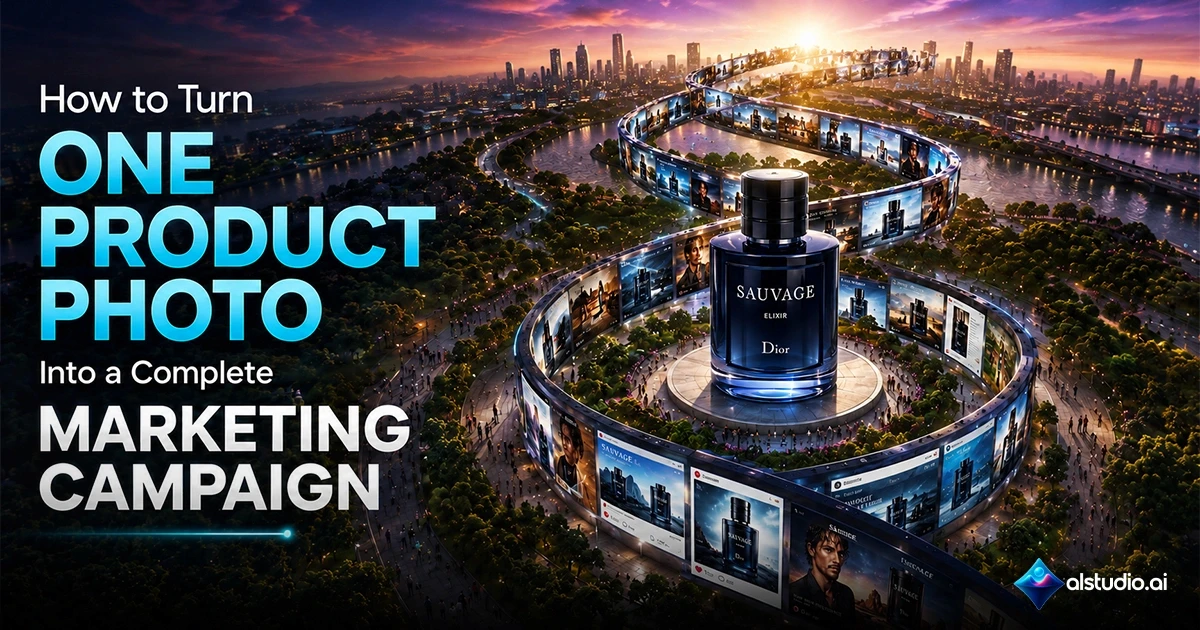
How to Build an AI Product Marketing Campaign From
a Single Photo | ALStudio
Meta Description: Learn how to run an AI product marketing campaign from one image. Generate lifestyle photos, video ads, captions, and voiceovers all consistent, all from a single product photo.
Slug: /blog/ai-product-marketing-campaign
Schema: FAQPage + SoftwareApplication
How to Build an AI Product Marketing Campaign From a Single Photo
Running an AI product marketing campaign used to mean stitching together five different tools, three freelancers, and a week of back-and-forth revisions. Today, a single product photo can become the foundation of a complete campaign lifestyle imagery, video ads, social captions, email banners, and multilingual voiceovers generated in hours and held together by a consistent product identity.
The challenge is not generation. Any modern AI tool can create an individual asset.
The challenge is consistency.
Most AI tools produce assets that feel disconnected: the product shape shifts, brand colors drift, copy and visuals tell different stories. That is where campaigns break down.
ALStudio's Creative AI OS was built specifically around this problem. Its Product DNA system stores product identity once and applies it across every image, video, copy output, and voiceover so marketing teams move from a single product photo to a fully produced, on-brand campaign in hours rather than weeks.
What Is an AI Product Marketing Campaign Pipeline?
An AI product marketing campaign pipeline is a structured workflow that transforms a single product image into every campaign asset required across channels while maintaining a consistent visual identity throughout.
Instead of creating assets one by one, the pipeline treats the product photo as a single source of truth for the entire campaign ecosystem.
A complete pipeline produces:
Product hero images
Lifestyle photography
Social media creatives
Video advertisements
Email banners
Landing page visuals
Ad copy and headlines
Social captions
Multilingual voiceovers
Localized content versions
A skincare brand, for example, may photograph one hero product on Monday and have Instagram creatives, TikTok ads, Meta banners, email graphics, and Arabic voiceovers ready for publication by Tuesday.
The difference between a collection of AI tools and a campaign pipeline is memory.
A campaign pipeline remembers the product. A collection of tools does not.
From Product Photography to Campaign Production: What Changed
Traditional product marketing required multiple specialized workflows running in sequence.
A typical launch involved:
Product photography
Graphic design
Copywriting
Video editing
Motion graphics
Localization
Voice production
Quality assurance
Each stage introduced delays, handoffs, revisions, and consistency failures.
AI now allows marketers to generate most of these assets automatically. But generation alone does not produce a campaign. A campaign requires a shared product identity, shared visual language, shared messaging, and shared brand standards applied across every output.
Without those elements, teams produce individual assets rather than a unified campaign.
The workflow has shifted from asset creation to campaign orchestration.
The question is no longer: "Can AI create this asset?"
The question is: "Can AI create all campaign assets and keep them consistent?"
That is a fundamentally harder problem.
Why Most AI Tools Fail at AI Product Marketing Campaign Production
Most AI creative tools are stateless. They do not remember your product. They do not remember your brand. They do not remember your previous generations.
Every session starts from zero.
A team may use:
An image generator for lifestyle photos
A video platform for product ads
A writing tool for captions
A voice platform for narration
Each tool interprets the product independently. The results may be individually impressive, but they rarely feel like a single campaign.
The bottle changes shape. The packaging shifts slightly. The color palette drifts. The messaging loses alignment.
The campaign starts to look like multiple brands rather than one.
Many platforms have responded with brand kits logos, fonts, and color systems. While useful, brand kits address brand identity, not product identity.
A logo is not a product. A brand kit cannot guarantee that a product looks identical across dozens of generated assets.
The Hidden Cost of Rebuilding Product Context
Most teams significantly underestimate how much time is spent recreating product context.
A typical disconnected AI workflow looks like this:
Upload the product image to an image generator
Upload it again to a video platform
Describe product features to a copywriting tool
Recreate brand guidelines in design software
Review and correct outputs manually
Repeat for every campaign
The bottleneck is not generation speed. It is context reconstruction.
As campaign volume increases, this cost compounds rapidly. Teams find that generating content becomes fast, but maintaining consistency becomes the new full-time job. Eventually, most creative time shifts away from production and toward quality control.
This is why organizations increasingly evaluate AI platforms on operational efficiency rather than generation quality alone.
What Can Be Generated From One Product Photo?
With the right AI campaign infrastructure, a single product image can generate:
Images
Product hero photography
Lifestyle imagery
Social media creatives
Ecommerce banners
Landing page visuals
Video
Product demonstrations
Social media ads
UGC-style content
Product launch videos
Short-form vertical content
Written Content
Ad copy and headlines
CTAs
Product descriptions
Social captions
Audio
Voiceovers
Product narration
Regional dialect versions
Multilingual campaign adaptations
Marketing Assets
Meta ads
TikTok creatives
Instagram content
LinkedIn campaigns
Email banners
Website graphics
The objective is not to generate more content. The objective is to generate a complete AI product marketing campaign from one source asset.
The 4 Types of Campaign Consistency Brands Actually Need
1. Product Consistency
The same product shape, finish, packaging, and dimensions across every asset. Without this, products appear as different SKUs across channels.
2. Brand Consistency
The same logo usage, colors, typography, and messaging applied across all campaign outputs.
3. Scene Consistency
The same environment, lighting, and visual language throughout the campaign. This creates the feeling of a real, coordinated production shoot.
4. Character Consistency
The same spokesperson, model, creator, or brand ambassador across all assets. Essential for storytelling-driven campaigns.
When one type fails, overall campaign quality suffers. The four types function as an interdependent system and all four need to be maintained simultaneously for an AI product marketing campaign to hold together.
Common Campaign Asset Failures in Practice
Product Shape Drift
Cause: Product structure is regenerated independently per tool.
Impact: Products appear as different versions of themselves across assets.
Background Inconsistency
Cause: Scene environments are recreated without shared references.
Impact: Campaign visuals feel disconnected rather than cohesive.
Brand Color Drift
Cause: Brand colors are approximated rather than enforced.
Impact: Assets fail brand review and require manual correction.
Copy-Visual Disconnection
Cause: Copy and imagery are generated in separate tools with no shared brief.
Impact: Messaging and visuals communicate different product benefits.
Format Collapse Under Scale
Cause: Asset adaptation for different channels is done manually.
Impact: Teams spend more time resizing than creating.
Traditional Workflow vs ALStudio Workflow
Function | Traditional Workflow | ALStudio |
Product Image Upload | Multiple times | Once |
Lifestyle Images | Separate process | Included |
Product Video | Separate platform | Included |
Copywriting | Separate tool | Included |
Voiceovers | Separate provider | Included |
Arabic Localization | Manual | Included |
Brand Consistency | Manual QA | Brand DNA |
Product Consistency | Manual QA | Product DNA |
Team Collaboration | Multiple platforms | Unified workspace |
Production Time | Days to weeks | Hours |
The difference is not only speed. It is operational control over the entire AI product marketing campaign from a single workspace.
AI Campaign Generation: Fragmented Stack vs ALStudio
Capability | ChatGPT + Image Tool + Video Tool + Voice Tool | ALStudio |
Images | Yes | Yes |
Video | Partial | Yes |
Voiceovers | Separate tool | Included |
Product Memory | No | Product DNA |
Brand Memory | Limited | Brand DNA |
Character Consistency | Manual | Character DNA |
Environment Consistency | Manual | Environment DNA |
Workflow Management | Fragmented | Unified |
Arabic Dialects | Multiple tools | Native |
The challenge is rarely generating individual assets. The challenge is managing the workflow between them without losing product identity.
How Product DNA Solves the Campaign Consistency Problem
Product DNA is ALStudio's persistent product identity layer.
It stores the following once:
Product shape and structure
Packaging design
Label details
Colors and surface finish
Every generation workflow references that stored identity rather than reinterpreting the product from scratch.
Film Studio uses Product DNA for video generation. Marketing Studio uses Product DNA for campaign production. Content Studio uses Product DNA to align written outputs with the visual product identity.
Product DNA works in conjunction with:
Brand DNA — brand voice, visual standards, and messaging guidelines
Character DNA — consistent spokespeople, models, and creators
Environment DNA — consistent scenes, lighting, and settings
Together, these form the consistency infrastructure behind a complete AI product marketing campaign.
This is the difference between reference-based generation and identity-based generation.
A Practical Example: Launching a New Skincare Serum
A three-person marketing team at a skincare brand launches a Vitamin C serum across UAE and Egypt. They have one product image.
Traditional Workflow
The image is uploaded to multiple tools individually. Lifestyle imagery varies across platforms. Copy and visuals become misaligned. Video production requires a separate workflow. Arabic localization is handled manually. Quality assurance becomes the bottleneck. The campaign launches late.
ALStudio Workflow
The product image is uploaded once. Product DNA stores the bottle structure, label details, packaging colors, and product finish. The team enters a single campaign brief. The system generates lifestyle imagery, product videos, ad creatives, captions, headlines, and Arabic voiceovers for both markets — every asset anchored to the same product identity. The campaign launches on time.
AI Content Production Is Growing Faster Than Creative Teams
Marketing teams face increasing pressure to produce:
More content formats
More channels
More languages
More campaigns
Without proportional increases in headcount.
This creates a critical operational requirement: scale production without scaling complexity.
The organizations gaining the most value from AI are not always those generating the highest-quality individual assets. They are the organizations that have eliminated the most operational friction — redundant uploads, manual QA cycles, fragmented tools, and inconsistent outputs.
The future of AI product marketing campaign production belongs to systems, not isolated tools.
Why Product Consistency Directly Affects Ecommerce Conversion
Consistency affects more than creative quality. It affects buyer trust.
Customers encounter products across social media, advertising, landing pages, ecommerce stores, and email campaigns. When the product appears slightly different in each environment, trust erodes — even if the difference is subtle.
A bottle that changes shape. A label that shifts position. A color that drifts between platforms.
These inconsistencies create subconscious friction in the buying process. Product DNA ensures every customer touchpoint from first impression on social through to the checkout page presents the same product identity.
For ecommerce brands, visual consistency is a conversion advantage, not just a creative standard.
Who Needs an AI Product Marketing Campaign System?
Marketing Teams
Teams managing frequent product launches need campaign consistency without manual review cycles on every asset.
Ecommerce Brands
Brands that rely on visual trust across multiple customer touchpoints.
Agencies
Agencies managing multiple client campaigns simultaneously need scalable brand and product memory across accounts.
Content Creators
Creators who need professional campaign-level output without large production teams or budgets.
Related Resources
What Is Brand DNA in AI Content Creation?
What Is a Creative AI OS?
How to Keep the Same AI Character Across Every Image and Video
Why AI Tools Fail at Brand Consistency
How to Create Consistent AI Ads Without Reuploading Assets Every Time
Featured Snippet
Optimized for: "How to create an AI product marketing campaign from one photo"
An AI product marketing campaign can be built from a single product photo using a Creative AI OS like ALStudio. The process works as follows:
Upload your product photo once to the platform
Product DNA stores the product's shape, packaging, colors, and finish
Enter a campaign brief with target channels, messaging, and markets
The system generates lifestyle images, video ads, social captions, email banners, and voiceovers
Every asset stays anchored to the same product identity across all formats
The key difference from using separate AI tools is that a single platform maintains product consistency throughout generatio eliminating brand drift, shape inconsistency, and disconnected messaging across your campaign.
How to Turn One Product Photo Into a Complete Marketing Campaign
Product DNA
How to Build an AI Product Marketing Campaign From
a Single Photo | ALStudio
Meta Description: Learn how to run an AI product marketing campaign from one image. Generate lifestyle photos, video ads, captions, and voiceovers all consistent, all from a single product photo.
Slug: /blog/ai-product-marketing-campaign
Schema: FAQPage + SoftwareApplication
How to Build an AI Product Marketing Campaign From a Single Photo
Running an AI product marketing campaign used to mean stitching together five different tools, three freelancers, and a week of back-and-forth revisions. Today, a single product photo can become the foundation of a complete campaign lifestyle imagery, video ads, social captions, email banners, and multilingual voiceovers generated in hours and held together by a consistent product identity.
The challenge is not generation. Any modern AI tool can create an individual asset.
The challenge is consistency.
Most AI tools produce assets that feel disconnected: the product shape shifts, brand colors drift, copy and visuals tell different stories. That is where campaigns break down.
ALStudio's Creative AI OS was built specifically around this problem. Its Product DNA system stores product identity once and applies it across every image, video, copy output, and voiceover so marketing teams move from a single product photo to a fully produced, on-brand campaign in hours rather than weeks.
What Is an AI Product Marketing Campaign Pipeline?
An AI product marketing campaign pipeline is a structured workflow that transforms a single product image into every campaign asset required across channels while maintaining a consistent visual identity throughout.
Instead of creating assets one by one, the pipeline treats the product photo as a single source of truth for the entire campaign ecosystem.
A complete pipeline produces:
Product hero images
Lifestyle photography
Social media creatives
Video advertisements
Email banners
Landing page visuals
Ad copy and headlines
Social captions
Multilingual voiceovers
Localized content versions
A skincare brand, for example, may photograph one hero product on Monday and have Instagram creatives, TikTok ads, Meta banners, email graphics, and Arabic voiceovers ready for publication by Tuesday.
The difference between a collection of AI tools and a campaign pipeline is memory.
A campaign pipeline remembers the product. A collection of tools does not.
From Product Photography to Campaign Production: What Changed
Traditional product marketing required multiple specialized workflows running in sequence.
A typical launch involved:
Product photography
Graphic design
Copywriting
Video editing
Motion graphics
Localization
Voice production
Quality assurance
Each stage introduced delays, handoffs, revisions, and consistency failures.
AI now allows marketers to generate most of these assets automatically. But generation alone does not produce a campaign. A campaign requires a shared product identity, shared visual language, shared messaging, and shared brand standards applied across every output.
Without those elements, teams produce individual assets rather than a unified campaign.
The workflow has shifted from asset creation to campaign orchestration.
The question is no longer: "Can AI create this asset?"
The question is: "Can AI create all campaign assets and keep them consistent?"
That is a fundamentally harder problem.
Why Most AI Tools Fail at AI Product Marketing Campaign Production
Most AI creative tools are stateless. They do not remember your product. They do not remember your brand. They do not remember your previous generations.
Every session starts from zero.
A team may use:
An image generator for lifestyle photos
A video platform for product ads
A writing tool for captions
A voice platform for narration
Each tool interprets the product independently. The results may be individually impressive, but they rarely feel like a single campaign.
The bottle changes shape. The packaging shifts slightly. The color palette drifts. The messaging loses alignment.
The campaign starts to look like multiple brands rather than one.
Many platforms have responded with brand kits logos, fonts, and color systems. While useful, brand kits address brand identity, not product identity.
A logo is not a product. A brand kit cannot guarantee that a product looks identical across dozens of generated assets.
The Hidden Cost of Rebuilding Product Context
Most teams significantly underestimate how much time is spent recreating product context.
A typical disconnected AI workflow looks like this:
Upload the product image to an image generator
Upload it again to a video platform
Describe product features to a copywriting tool
Recreate brand guidelines in design software
Review and correct outputs manually
Repeat for every campaign
The bottleneck is not generation speed. It is context reconstruction.
As campaign volume increases, this cost compounds rapidly. Teams find that generating content becomes fast, but maintaining consistency becomes the new full-time job. Eventually, most creative time shifts away from production and toward quality control.
This is why organizations increasingly evaluate AI platforms on operational efficiency rather than generation quality alone.
What Can Be Generated From One Product Photo?
With the right AI campaign infrastructure, a single product image can generate:
Images
Product hero photography
Lifestyle imagery
Social media creatives
Ecommerce banners
Landing page visuals
Video
Product demonstrations
Social media ads
UGC-style content
Product launch videos
Short-form vertical content
Written Content
Ad copy and headlines
CTAs
Product descriptions
Social captions
Audio
Voiceovers
Product narration
Regional dialect versions
Multilingual campaign adaptations
Marketing Assets
Meta ads
TikTok creatives
Instagram content
LinkedIn campaigns
Email banners
Website graphics
The objective is not to generate more content. The objective is to generate a complete AI product marketing campaign from one source asset.
The 4 Types of Campaign Consistency Brands Actually Need
1. Product Consistency
The same product shape, finish, packaging, and dimensions across every asset. Without this, products appear as different SKUs across channels.
2. Brand Consistency
The same logo usage, colors, typography, and messaging applied across all campaign outputs.
3. Scene Consistency
The same environment, lighting, and visual language throughout the campaign. This creates the feeling of a real, coordinated production shoot.
4. Character Consistency
The same spokesperson, model, creator, or brand ambassador across all assets. Essential for storytelling-driven campaigns.
When one type fails, overall campaign quality suffers. The four types function as an interdependent system and all four need to be maintained simultaneously for an AI product marketing campaign to hold together.
Common Campaign Asset Failures in Practice
Product Shape Drift
Cause: Product structure is regenerated independently per tool.
Impact: Products appear as different versions of themselves across assets.
Background Inconsistency
Cause: Scene environments are recreated without shared references.
Impact: Campaign visuals feel disconnected rather than cohesive.
Brand Color Drift
Cause: Brand colors are approximated rather than enforced.
Impact: Assets fail brand review and require manual correction.
Copy-Visual Disconnection
Cause: Copy and imagery are generated in separate tools with no shared brief.
Impact: Messaging and visuals communicate different product benefits.
Format Collapse Under Scale
Cause: Asset adaptation for different channels is done manually.
Impact: Teams spend more time resizing than creating.
Traditional Workflow vs ALStudio Workflow
Function | Traditional Workflow | ALStudio |
Product Image Upload | Multiple times | Once |
Lifestyle Images | Separate process | Included |
Product Video | Separate platform | Included |
Copywriting | Separate tool | Included |
Voiceovers | Separate provider | Included |
Arabic Localization | Manual | Included |
Brand Consistency | Manual QA | Brand DNA |
Product Consistency | Manual QA | Product DNA |
Team Collaboration | Multiple platforms | Unified workspace |
Production Time | Days to weeks | Hours |
The difference is not only speed. It is operational control over the entire AI product marketing campaign from a single workspace.
AI Campaign Generation: Fragmented Stack vs ALStudio
Capability | ChatGPT + Image Tool + Video Tool + Voice Tool | ALStudio |
Images | Yes | Yes |
Video | Partial | Yes |
Voiceovers | Separate tool | Included |
Product Memory | No | Product DNA |
Brand Memory | Limited | Brand DNA |
Character Consistency | Manual | Character DNA |
Environment Consistency | Manual | Environment DNA |
Workflow Management | Fragmented | Unified |
Arabic Dialects | Multiple tools | Native |
The challenge is rarely generating individual assets. The challenge is managing the workflow between them without losing product identity.
How Product DNA Solves the Campaign Consistency Problem
Product DNA is ALStudio's persistent product identity layer.
It stores the following once:
Product shape and structure
Packaging design
Label details
Colors and surface finish
Every generation workflow references that stored identity rather than reinterpreting the product from scratch.
Film Studio uses Product DNA for video generation. Marketing Studio uses Product DNA for campaign production. Content Studio uses Product DNA to align written outputs with the visual product identity.
Product DNA works in conjunction with:
Brand DNA — brand voice, visual standards, and messaging guidelines
Character DNA — consistent spokespeople, models, and creators
Environment DNA — consistent scenes, lighting, and settings
Together, these form the consistency infrastructure behind a complete AI product marketing campaign.
This is the difference between reference-based generation and identity-based generation.
A Practical Example: Launching a New Skincare Serum
A three-person marketing team at a skincare brand launches a Vitamin C serum across UAE and Egypt. They have one product image.
Traditional Workflow
The image is uploaded to multiple tools individually. Lifestyle imagery varies across platforms. Copy and visuals become misaligned. Video production requires a separate workflow. Arabic localization is handled manually. Quality assurance becomes the bottleneck. The campaign launches late.
ALStudio Workflow
The product image is uploaded once. Product DNA stores the bottle structure, label details, packaging colors, and product finish. The team enters a single campaign brief. The system generates lifestyle imagery, product videos, ad creatives, captions, headlines, and Arabic voiceovers for both markets — every asset anchored to the same product identity. The campaign launches on time.
AI Content Production Is Growing Faster Than Creative Teams
Marketing teams face increasing pressure to produce:
More content formats
More channels
More languages
More campaigns
Without proportional increases in headcount.
This creates a critical operational requirement: scale production without scaling complexity.
The organizations gaining the most value from AI are not always those generating the highest-quality individual assets. They are the organizations that have eliminated the most operational friction — redundant uploads, manual QA cycles, fragmented tools, and inconsistent outputs.
The future of AI product marketing campaign production belongs to systems, not isolated tools.
Why Product Consistency Directly Affects Ecommerce Conversion
Consistency affects more than creative quality. It affects buyer trust.
Customers encounter products across social media, advertising, landing pages, ecommerce stores, and email campaigns. When the product appears slightly different in each environment, trust erodes — even if the difference is subtle.
A bottle that changes shape. A label that shifts position. A color that drifts between platforms.
These inconsistencies create subconscious friction in the buying process. Product DNA ensures every customer touchpoint from first impression on social through to the checkout page presents the same product identity.
For ecommerce brands, visual consistency is a conversion advantage, not just a creative standard.
Who Needs an AI Product Marketing Campaign System?
Marketing Teams
Teams managing frequent product launches need campaign consistency without manual review cycles on every asset.
Ecommerce Brands
Brands that rely on visual trust across multiple customer touchpoints.
Agencies
Agencies managing multiple client campaigns simultaneously need scalable brand and product memory across accounts.
Content Creators
Creators who need professional campaign-level output without large production teams or budgets.
Related Resources
What Is Brand DNA in AI Content Creation?
What Is a Creative AI OS?
How to Keep the Same AI Character Across Every Image and Video
Why AI Tools Fail at Brand Consistency
How to Create Consistent AI Ads Without Reuploading Assets Every Time
Featured Snippet
Optimized for: "How to create an AI product marketing campaign from one photo"
An AI product marketing campaign can be built from a single product photo using a Creative AI OS like ALStudio. The process works as follows:
Upload your product photo once to the platform
Product DNA stores the product's shape, packaging, colors, and finish
Enter a campaign brief with target channels, messaging, and markets
The system generates lifestyle images, video ads, social captions, email banners, and voiceovers
Every asset stays anchored to the same product identity across all formats
The key difference from using separate AI tools is that a single platform maintains product consistency throughout generatio eliminating brand drift, shape inconsistency, and disconnected messaging across your campaign.
How to Turn One Product Photo Into a Complete Marketing Campaign
Product DNA
How to Build an AI Product Marketing Campaign From
a Single Photo | ALStudio
Meta Description: Learn how to run an AI product marketing campaign from one image. Generate lifestyle photos, video ads, captions, and voiceovers all consistent, all from a single product photo.
Slug: /blog/ai-product-marketing-campaign
Schema: FAQPage + SoftwareApplication
How to Build an AI Product Marketing Campaign From a Single Photo
Running an AI product marketing campaign used to mean stitching together five different tools, three freelancers, and a week of back-and-forth revisions. Today, a single product photo can become the foundation of a complete campaign lifestyle imagery, video ads, social captions, email banners, and multilingual voiceovers generated in hours and held together by a consistent product identity.
The challenge is not generation. Any modern AI tool can create an individual asset.
The challenge is consistency.
Most AI tools produce assets that feel disconnected: the product shape shifts, brand colors drift, copy and visuals tell different stories. That is where campaigns break down.
ALStudio's Creative AI OS was built specifically around this problem. Its Product DNA system stores product identity once and applies it across every image, video, copy output, and voiceover so marketing teams move from a single product photo to a fully produced, on-brand campaign in hours rather than weeks.
What Is an AI Product Marketing Campaign Pipeline?
An AI product marketing campaign pipeline is a structured workflow that transforms a single product image into every campaign asset required across channels while maintaining a consistent visual identity throughout.
Instead of creating assets one by one, the pipeline treats the product photo as a single source of truth for the entire campaign ecosystem.
A complete pipeline produces:
Product hero images
Lifestyle photography
Social media creatives
Video advertisements
Email banners
Landing page visuals
Ad copy and headlines
Social captions
Multilingual voiceovers
Localized content versions
A skincare brand, for example, may photograph one hero product on Monday and have Instagram creatives, TikTok ads, Meta banners, email graphics, and Arabic voiceovers ready for publication by Tuesday.
The difference between a collection of AI tools and a campaign pipeline is memory.
A campaign pipeline remembers the product. A collection of tools does not.
From Product Photography to Campaign Production: What Changed
Traditional product marketing required multiple specialized workflows running in sequence.
A typical launch involved:
Product photography
Graphic design
Copywriting
Video editing
Motion graphics
Localization
Voice production
Quality assurance
Each stage introduced delays, handoffs, revisions, and consistency failures.
AI now allows marketers to generate most of these assets automatically. But generation alone does not produce a campaign. A campaign requires a shared product identity, shared visual language, shared messaging, and shared brand standards applied across every output.
Without those elements, teams produce individual assets rather than a unified campaign.
The workflow has shifted from asset creation to campaign orchestration.
The question is no longer: "Can AI create this asset?"
The question is: "Can AI create all campaign assets and keep them consistent?"
That is a fundamentally harder problem.
Why Most AI Tools Fail at AI Product Marketing Campaign Production
Most AI creative tools are stateless. They do not remember your product. They do not remember your brand. They do not remember your previous generations.
Every session starts from zero.
A team may use:
An image generator for lifestyle photos
A video platform for product ads
A writing tool for captions
A voice platform for narration
Each tool interprets the product independently. The results may be individually impressive, but they rarely feel like a single campaign.
The bottle changes shape. The packaging shifts slightly. The color palette drifts. The messaging loses alignment.
The campaign starts to look like multiple brands rather than one.
Many platforms have responded with brand kits logos, fonts, and color systems. While useful, brand kits address brand identity, not product identity.
A logo is not a product. A brand kit cannot guarantee that a product looks identical across dozens of generated assets.
The Hidden Cost of Rebuilding Product Context
Most teams significantly underestimate how much time is spent recreating product context.
A typical disconnected AI workflow looks like this:
Upload the product image to an image generator
Upload it again to a video platform
Describe product features to a copywriting tool
Recreate brand guidelines in design software
Review and correct outputs manually
Repeat for every campaign
The bottleneck is not generation speed. It is context reconstruction.
As campaign volume increases, this cost compounds rapidly. Teams find that generating content becomes fast, but maintaining consistency becomes the new full-time job. Eventually, most creative time shifts away from production and toward quality control.
This is why organizations increasingly evaluate AI platforms on operational efficiency rather than generation quality alone.
What Can Be Generated From One Product Photo?
With the right AI campaign infrastructure, a single product image can generate:
Images
Product hero photography
Lifestyle imagery
Social media creatives
Ecommerce banners
Landing page visuals
Video
Product demonstrations
Social media ads
UGC-style content
Product launch videos
Short-form vertical content
Written Content
Ad copy and headlines
CTAs
Product descriptions
Social captions
Audio
Voiceovers
Product narration
Regional dialect versions
Multilingual campaign adaptations
Marketing Assets
Meta ads
TikTok creatives
Instagram content
LinkedIn campaigns
Email banners
Website graphics
The objective is not to generate more content. The objective is to generate a complete AI product marketing campaign from one source asset.
The 4 Types of Campaign Consistency Brands Actually Need
1. Product Consistency
The same product shape, finish, packaging, and dimensions across every asset. Without this, products appear as different SKUs across channels.
2. Brand Consistency
The same logo usage, colors, typography, and messaging applied across all campaign outputs.
3. Scene Consistency
The same environment, lighting, and visual language throughout the campaign. This creates the feeling of a real, coordinated production shoot.
4. Character Consistency
The same spokesperson, model, creator, or brand ambassador across all assets. Essential for storytelling-driven campaigns.
When one type fails, overall campaign quality suffers. The four types function as an interdependent system and all four need to be maintained simultaneously for an AI product marketing campaign to hold together.
Common Campaign Asset Failures in Practice
Product Shape Drift
Cause: Product structure is regenerated independently per tool.
Impact: Products appear as different versions of themselves across assets.
Background Inconsistency
Cause: Scene environments are recreated without shared references.
Impact: Campaign visuals feel disconnected rather than cohesive.
Brand Color Drift
Cause: Brand colors are approximated rather than enforced.
Impact: Assets fail brand review and require manual correction.
Copy-Visual Disconnection
Cause: Copy and imagery are generated in separate tools with no shared brief.
Impact: Messaging and visuals communicate different product benefits.
Format Collapse Under Scale
Cause: Asset adaptation for different channels is done manually.
Impact: Teams spend more time resizing than creating.
Traditional Workflow vs ALStudio Workflow
Function | Traditional Workflow | ALStudio |
Product Image Upload | Multiple times | Once |
Lifestyle Images | Separate process | Included |
Product Video | Separate platform | Included |
Copywriting | Separate tool | Included |
Voiceovers | Separate provider | Included |
Arabic Localization | Manual | Included |
Brand Consistency | Manual QA | Brand DNA |
Product Consistency | Manual QA | Product DNA |
Team Collaboration | Multiple platforms | Unified workspace |
Production Time | Days to weeks | Hours |
The difference is not only speed. It is operational control over the entire AI product marketing campaign from a single workspace.
AI Campaign Generation: Fragmented Stack vs ALStudio
Capability | ChatGPT + Image Tool + Video Tool + Voice Tool | ALStudio |
Images | Yes | Yes |
Video | Partial | Yes |
Voiceovers | Separate tool | Included |
Product Memory | No | Product DNA |
Brand Memory | Limited | Brand DNA |
Character Consistency | Manual | Character DNA |
Environment Consistency | Manual | Environment DNA |
Workflow Management | Fragmented | Unified |
Arabic Dialects | Multiple tools | Native |
The challenge is rarely generating individual assets. The challenge is managing the workflow between them without losing product identity.
How Product DNA Solves the Campaign Consistency Problem
Product DNA is ALStudio's persistent product identity layer.
It stores the following once:
Product shape and structure
Packaging design
Label details
Colors and surface finish
Every generation workflow references that stored identity rather than reinterpreting the product from scratch.
Film Studio uses Product DNA for video generation. Marketing Studio uses Product DNA for campaign production. Content Studio uses Product DNA to align written outputs with the visual product identity.
Product DNA works in conjunction with:
Brand DNA — brand voice, visual standards, and messaging guidelines
Character DNA — consistent spokespeople, models, and creators
Environment DNA — consistent scenes, lighting, and settings
Together, these form the consistency infrastructure behind a complete AI product marketing campaign.
This is the difference between reference-based generation and identity-based generation.
A Practical Example: Launching a New Skincare Serum
A three-person marketing team at a skincare brand launches a Vitamin C serum across UAE and Egypt. They have one product image.
Traditional Workflow
The image is uploaded to multiple tools individually. Lifestyle imagery varies across platforms. Copy and visuals become misaligned. Video production requires a separate workflow. Arabic localization is handled manually. Quality assurance becomes the bottleneck. The campaign launches late.
ALStudio Workflow
The product image is uploaded once. Product DNA stores the bottle structure, label details, packaging colors, and product finish. The team enters a single campaign brief. The system generates lifestyle imagery, product videos, ad creatives, captions, headlines, and Arabic voiceovers for both markets — every asset anchored to the same product identity. The campaign launches on time.
AI Content Production Is Growing Faster Than Creative Teams
Marketing teams face increasing pressure to produce:
More content formats
More channels
More languages
More campaigns
Without proportional increases in headcount.
This creates a critical operational requirement: scale production without scaling complexity.
The organizations gaining the most value from AI are not always those generating the highest-quality individual assets. They are the organizations that have eliminated the most operational friction — redundant uploads, manual QA cycles, fragmented tools, and inconsistent outputs.
The future of AI product marketing campaign production belongs to systems, not isolated tools.
Why Product Consistency Directly Affects Ecommerce Conversion
Consistency affects more than creative quality. It affects buyer trust.
Customers encounter products across social media, advertising, landing pages, ecommerce stores, and email campaigns. When the product appears slightly different in each environment, trust erodes — even if the difference is subtle.
A bottle that changes shape. A label that shifts position. A color that drifts between platforms.
These inconsistencies create subconscious friction in the buying process. Product DNA ensures every customer touchpoint from first impression on social through to the checkout page presents the same product identity.
For ecommerce brands, visual consistency is a conversion advantage, not just a creative standard.
Who Needs an AI Product Marketing Campaign System?
Marketing Teams
Teams managing frequent product launches need campaign consistency without manual review cycles on every asset.
Ecommerce Brands
Brands that rely on visual trust across multiple customer touchpoints.
Agencies
Agencies managing multiple client campaigns simultaneously need scalable brand and product memory across accounts.
Content Creators
Creators who need professional campaign-level output without large production teams or budgets.
Related Resources
What Is Brand DNA in AI Content Creation?
What Is a Creative AI OS?
How to Keep the Same AI Character Across Every Image and Video
Why AI Tools Fail at Brand Consistency
How to Create Consistent AI Ads Without Reuploading Assets Every Time
Featured Snippet
Optimized for: "How to create an AI product marketing campaign from one photo"
An AI product marketing campaign can be built from a single product photo using a Creative AI OS like ALStudio. The process works as follows:
Upload your product photo once to the platform
Product DNA stores the product's shape, packaging, colors, and finish
Enter a campaign brief with target channels, messaging, and markets
The system generates lifestyle images, video ads, social captions, email banners, and voiceovers
Every asset stays anchored to the same product identity across all formats
The key difference from using separate AI tools is that a single platform maintains product consistency throughout generatio eliminating brand drift, shape inconsistency, and disconnected messaging across your campaign.
How to Turn One Product Photo Into a Complete Marketing Campaign
Product DNA
How to Build an AI Product Marketing Campaign From
a Single Photo | ALStudio
Meta Description: Learn how to run an AI product marketing campaign from one image. Generate lifestyle photos, video ads, captions, and voiceovers all consistent, all from a single product photo.
Slug: /blog/ai-product-marketing-campaign
Schema: FAQPage + SoftwareApplication
How to Build an AI Product Marketing Campaign From a Single Photo
Running an AI product marketing campaign used to mean stitching together five different tools, three freelancers, and a week of back-and-forth revisions. Today, a single product photo can become the foundation of a complete campaign lifestyle imagery, video ads, social captions, email banners, and multilingual voiceovers generated in hours and held together by a consistent product identity.
The challenge is not generation. Any modern AI tool can create an individual asset.
The challenge is consistency.
Most AI tools produce assets that feel disconnected: the product shape shifts, brand colors drift, copy and visuals tell different stories. That is where campaigns break down.
ALStudio's Creative AI OS was built specifically around this problem. Its Product DNA system stores product identity once and applies it across every image, video, copy output, and voiceover so marketing teams move from a single product photo to a fully produced, on-brand campaign in hours rather than weeks.
What Is an AI Product Marketing Campaign Pipeline?
An AI product marketing campaign pipeline is a structured workflow that transforms a single product image into every campaign asset required across channels while maintaining a consistent visual identity throughout.
Instead of creating assets one by one, the pipeline treats the product photo as a single source of truth for the entire campaign ecosystem.
A complete pipeline produces:
Product hero images
Lifestyle photography
Social media creatives
Video advertisements
Email banners
Landing page visuals
Ad copy and headlines
Social captions
Multilingual voiceovers
Localized content versions
A skincare brand, for example, may photograph one hero product on Monday and have Instagram creatives, TikTok ads, Meta banners, email graphics, and Arabic voiceovers ready for publication by Tuesday.
The difference between a collection of AI tools and a campaign pipeline is memory.
A campaign pipeline remembers the product. A collection of tools does not.
From Product Photography to Campaign Production: What Changed
Traditional product marketing required multiple specialized workflows running in sequence.
A typical launch involved:
Product photography
Graphic design
Copywriting
Video editing
Motion graphics
Localization
Voice production
Quality assurance
Each stage introduced delays, handoffs, revisions, and consistency failures.
AI now allows marketers to generate most of these assets automatically. But generation alone does not produce a campaign. A campaign requires a shared product identity, shared visual language, shared messaging, and shared brand standards applied across every output.
Without those elements, teams produce individual assets rather than a unified campaign.
The workflow has shifted from asset creation to campaign orchestration.
The question is no longer: "Can AI create this asset?"
The question is: "Can AI create all campaign assets and keep them consistent?"
That is a fundamentally harder problem.
Why Most AI Tools Fail at AI Product Marketing Campaign Production
Most AI creative tools are stateless. They do not remember your product. They do not remember your brand. They do not remember your previous generations.
Every session starts from zero.
A team may use:
An image generator for lifestyle photos
A video platform for product ads
A writing tool for captions
A voice platform for narration
Each tool interprets the product independently. The results may be individually impressive, but they rarely feel like a single campaign.
The bottle changes shape. The packaging shifts slightly. The color palette drifts. The messaging loses alignment.
The campaign starts to look like multiple brands rather than one.
Many platforms have responded with brand kits logos, fonts, and color systems. While useful, brand kits address brand identity, not product identity.
A logo is not a product. A brand kit cannot guarantee that a product looks identical across dozens of generated assets.
The Hidden Cost of Rebuilding Product Context
Most teams significantly underestimate how much time is spent recreating product context.
A typical disconnected AI workflow looks like this:
Upload the product image to an image generator
Upload it again to a video platform
Describe product features to a copywriting tool
Recreate brand guidelines in design software
Review and correct outputs manually
Repeat for every campaign
The bottleneck is not generation speed. It is context reconstruction.
As campaign volume increases, this cost compounds rapidly. Teams find that generating content becomes fast, but maintaining consistency becomes the new full-time job. Eventually, most creative time shifts away from production and toward quality control.
This is why organizations increasingly evaluate AI platforms on operational efficiency rather than generation quality alone.
What Can Be Generated From One Product Photo?
With the right AI campaign infrastructure, a single product image can generate:
Images
Product hero photography
Lifestyle imagery
Social media creatives
Ecommerce banners
Landing page visuals
Video
Product demonstrations
Social media ads
UGC-style content
Product launch videos
Short-form vertical content
Written Content
Ad copy and headlines
CTAs
Product descriptions
Social captions
Audio
Voiceovers
Product narration
Regional dialect versions
Multilingual campaign adaptations
Marketing Assets
Meta ads
TikTok creatives
Instagram content
LinkedIn campaigns
Email banners
Website graphics
The objective is not to generate more content. The objective is to generate a complete AI product marketing campaign from one source asset.
The 4 Types of Campaign Consistency Brands Actually Need
1. Product Consistency
The same product shape, finish, packaging, and dimensions across every asset. Without this, products appear as different SKUs across channels.
2. Brand Consistency
The same logo usage, colors, typography, and messaging applied across all campaign outputs.
3. Scene Consistency
The same environment, lighting, and visual language throughout the campaign. This creates the feeling of a real, coordinated production shoot.
4. Character Consistency
The same spokesperson, model, creator, or brand ambassador across all assets. Essential for storytelling-driven campaigns.
When one type fails, overall campaign quality suffers. The four types function as an interdependent system and all four need to be maintained simultaneously for an AI product marketing campaign to hold together.
Common Campaign Asset Failures in Practice
Product Shape Drift
Cause: Product structure is regenerated independently per tool.
Impact: Products appear as different versions of themselves across assets.
Background Inconsistency
Cause: Scene environments are recreated without shared references.
Impact: Campaign visuals feel disconnected rather than cohesive.
Brand Color Drift
Cause: Brand colors are approximated rather than enforced.
Impact: Assets fail brand review and require manual correction.
Copy-Visual Disconnection
Cause: Copy and imagery are generated in separate tools with no shared brief.
Impact: Messaging and visuals communicate different product benefits.
Format Collapse Under Scale
Cause: Asset adaptation for different channels is done manually.
Impact: Teams spend more time resizing than creating.
Traditional Workflow vs ALStudio Workflow
Function | Traditional Workflow | ALStudio |
Product Image Upload | Multiple times | Once |
Lifestyle Images | Separate process | Included |
Product Video | Separate platform | Included |
Copywriting | Separate tool | Included |
Voiceovers | Separate provider | Included |
Arabic Localization | Manual | Included |
Brand Consistency | Manual QA | Brand DNA |
Product Consistency | Manual QA | Product DNA |
Team Collaboration | Multiple platforms | Unified workspace |
Production Time | Days to weeks | Hours |
The difference is not only speed. It is operational control over the entire AI product marketing campaign from a single workspace.
AI Campaign Generation: Fragmented Stack vs ALStudio
Capability | ChatGPT + Image Tool + Video Tool + Voice Tool | ALStudio |
Images | Yes | Yes |
Video | Partial | Yes |
Voiceovers | Separate tool | Included |
Product Memory | No | Product DNA |
Brand Memory | Limited | Brand DNA |
Character Consistency | Manual | Character DNA |
Environment Consistency | Manual | Environment DNA |
Workflow Management | Fragmented | Unified |
Arabic Dialects | Multiple tools | Native |
The challenge is rarely generating individual assets. The challenge is managing the workflow between them without losing product identity.
How Product DNA Solves the Campaign Consistency Problem
Product DNA is ALStudio's persistent product identity layer.
It stores the following once:
Product shape and structure
Packaging design
Label details
Colors and surface finish
Every generation workflow references that stored identity rather than reinterpreting the product from scratch.
Film Studio uses Product DNA for video generation. Marketing Studio uses Product DNA for campaign production. Content Studio uses Product DNA to align written outputs with the visual product identity.
Product DNA works in conjunction with:
Brand DNA — brand voice, visual standards, and messaging guidelines
Character DNA — consistent spokespeople, models, and creators
Environment DNA — consistent scenes, lighting, and settings
Together, these form the consistency infrastructure behind a complete AI product marketing campaign.
This is the difference between reference-based generation and identity-based generation.
A Practical Example: Launching a New Skincare Serum
A three-person marketing team at a skincare brand launches a Vitamin C serum across UAE and Egypt. They have one product image.
Traditional Workflow
The image is uploaded to multiple tools individually. Lifestyle imagery varies across platforms. Copy and visuals become misaligned. Video production requires a separate workflow. Arabic localization is handled manually. Quality assurance becomes the bottleneck. The campaign launches late.
ALStudio Workflow
The product image is uploaded once. Product DNA stores the bottle structure, label details, packaging colors, and product finish. The team enters a single campaign brief. The system generates lifestyle imagery, product videos, ad creatives, captions, headlines, and Arabic voiceovers for both markets — every asset anchored to the same product identity. The campaign launches on time.
AI Content Production Is Growing Faster Than Creative Teams
Marketing teams face increasing pressure to produce:
More content formats
More channels
More languages
More campaigns
Without proportional increases in headcount.
This creates a critical operational requirement: scale production without scaling complexity.
The organizations gaining the most value from AI are not always those generating the highest-quality individual assets. They are the organizations that have eliminated the most operational friction — redundant uploads, manual QA cycles, fragmented tools, and inconsistent outputs.
The future of AI product marketing campaign production belongs to systems, not isolated tools.
Why Product Consistency Directly Affects Ecommerce Conversion
Consistency affects more than creative quality. It affects buyer trust.
Customers encounter products across social media, advertising, landing pages, ecommerce stores, and email campaigns. When the product appears slightly different in each environment, trust erodes — even if the difference is subtle.
A bottle that changes shape. A label that shifts position. A color that drifts between platforms.
These inconsistencies create subconscious friction in the buying process. Product DNA ensures every customer touchpoint from first impression on social through to the checkout page presents the same product identity.
For ecommerce brands, visual consistency is a conversion advantage, not just a creative standard.
Who Needs an AI Product Marketing Campaign System?
Marketing Teams
Teams managing frequent product launches need campaign consistency without manual review cycles on every asset.
Ecommerce Brands
Brands that rely on visual trust across multiple customer touchpoints.
Agencies
Agencies managing multiple client campaigns simultaneously need scalable brand and product memory across accounts.
Content Creators
Creators who need professional campaign-level output without large production teams or budgets.
Related Resources
What Is Brand DNA in AI Content Creation?
What Is a Creative AI OS?
How to Keep the Same AI Character Across Every Image and Video
Why AI Tools Fail at Brand Consistency
How to Create Consistent AI Ads Without Reuploading Assets Every Time
Featured Snippet
Optimized for: "How to create an AI product marketing campaign from one photo"
An AI product marketing campaign can be built from a single product photo using a Creative AI OS like ALStudio. The process works as follows:
Upload your product photo once to the platform
Product DNA stores the product's shape, packaging, colors, and finish
Enter a campaign brief with target channels, messaging, and markets
The system generates lifestyle images, video ads, social captions, email banners, and voiceovers
Every asset stays anchored to the same product identity across all formats
The key difference from using separate AI tools is that a single platform maintains product consistency throughout generatio eliminating brand drift, shape inconsistency, and disconnected messaging across your campaign.
Frequently Asked Questions
Everything you'd want to know before signing up and everything an agency buyer asks on the call.
Can I build a complete AI product marketing campaign from a single product photo?
Yes. With a Creative AI OS like ALStudio, one product image can generate lifestyle photography, video ads, social media creatives, email banners, ad copy, captions, and multilingual voiceovers, all in a single workflow. The system stores product identity so every output remains visually consistent.
What is the difference between Product DNA and a Brand Kit?
A Brand Kit stores logos, colors, and fonts. Product DNA stores the visual identity of the product itself, including shape, packaging, surface finish, label structure, and dimensions, and applies that identity consistently across every image and video generation. Brand Kits address brand identity; Product DNA addresses product identity.
Why do AI-generated campaign assets look inconsistent across tools?
Most AI tools are stateless, meaning they do not remember your product or brand between sessions. When separate tools handle images, video, copy, and voice, each interprets the product independently. This causes shape drift, color variation, and messaging misalignment. A unified platform with persistent product memory solves this.
How long does it take to produce an AI product marketing campaign?
With a traditional multi tool workflow, a product launch campaign typically takes days to weeks. With ALStudio's unified pipeline, the same campaign, including lifestyle images, video ads, captions, and localized voiceovers, can be produced in hours.
Does ALStudio support Arabic language campaigns?
Yes. ALStudio includes native Arabic localization capabilities, including Arabic voiceover generation across regional dialects, making it purpose built for MENA and GCC market campaigns without requiring separate localization tools.
Related blogs
Provide insights into team performance and engagement


Related blogs
Provide insights into team performance and engagement
Related blogs
Provide insights into team performance and engagement
Stay Ahead of AI Creativity
Get new AI models, creative workflows, product updates, and marketing insights delivered to your inbox.
Tools
©2026 Animus All Rights Reserved.
Stay Ahead of AI Creativity
Get new AI models, creative workflows, product updates, and marketing insights delivered to your inbox.
Tools
©2026 Animus All Rights Reserved.
Stay Ahead of AI Creativity
Get new AI models, creative workflows, product updates, and marketing insights delivered to your inbox.
Tools
©2026 Animus All Rights Reserved.