



AI UGC Ads: A Complete Guide for Ecommerce Brands
Character DNA
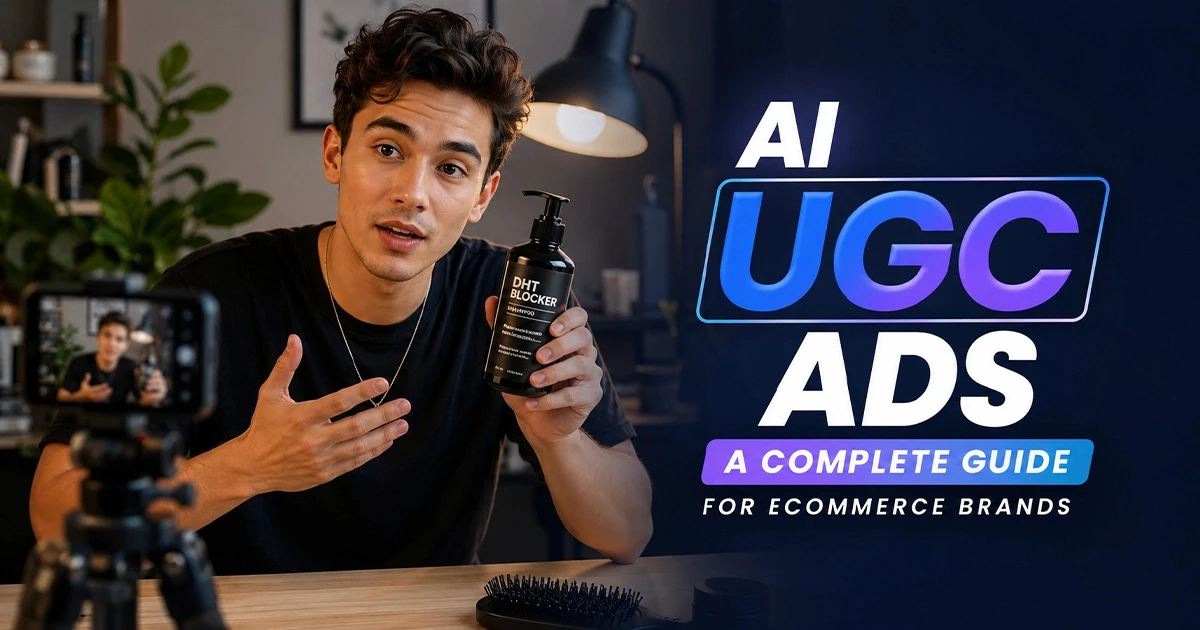
AI UGC Ads: A Complete Guide for Ecommerce Brands (2026)
Ecommerce brands can generate dozens of AI UGC ads in an afternoon. The problem is not output volume it is that without a system to lock in brand identity, product appearance, and character consistency, those ads look like they belong to forty different companies rather than one. AI UGC advertising works when the infrastructure behind it is built for consistency, not just speed.
The global influencer marketing market which AI UGC is increasingly displacing at the performance ad layer was valued at $24 billion in 2024 and is projected to keep growing, according to Influencer Marketing Hub. For ecommerce brands running paid social at any meaningful volume, the cost and time demands of traditional creator-produced UGC have become a structural bottleneck. AI UGC entered that gap. But the tools the market defaulted to stacked, siloed, and inherently fragmented introduced a different set of problems.
While building ALStudio's Consistency Engine, we ran directly into this ourselves. Across dozens of multi-tool UGC pipeline tests, the pattern was consistent: brands would generate 30 to 40 ad variants, and roughly a third ended up looking like a completely different company had made them. That observation shaped the architecture we built.
What Is an AI UGC Ad?
An AI UGC ad is a short-form video advertisement that replicates the format, tone, and visual language of user-generated content but is produced entirely or primarily using AI tools rather than real creators.
In practice, this means AI-generated avatars or characters delivering a product pitch in a direct-to-camera style, using scripted voiceover, with product footage or AI-generated visuals edited into a TikTok- or Reels-native format. The result looks and behaves like organic creator content but is produced at the speed and cost of software.
The distinction most people miss is the difference between AI UGC as a format and AI UGC as a production system. Most tools in the market Creatify, HeyGen, Arcads solve for the format. They give you an avatar, a script template, and a render. What they do not solve is the system question: how does ad number 38 look like it came from the same brand as ad number one? How does the product look identical across every scene? How does the voice match the regional dialect of your audience rather than defaulting to a generic Arabic translation? Those are infrastructure questions, not tool questions.
Why Most AI UGC Tools Fail Ecommerce Brands at Scale
The structural failure in most AI UGC workflows is that they are stacks, not systems. Brands are instructed by the tools themselves and by the guides built around them to use four or five separate platforms to produce a single ad: one for scripting, one for avatars, one for voiceover, one for motion, one for editing. A standard AI UGC stack commonly involves HeyGen, a motion tool, a voiceover tool, a caption tool, and a final editing tool five separate contexts, five separate billing relationships, and five separate places where brand identity can drift.
In our internal testing across multiple AI models and production pipelines, we found one pattern that repeated without exception: the more tools in the stack, the more sessions required to produce a campaign, the less consistent the visual identity across that campaign. It is not a user error. It is an architectural one. Brand DNA, Product DNA, and Character DNA cannot persist across systems that do not share memory.
The industry is beginning to acknowledge this. Multiple verified G2 reviews flag avatar saturation — where audiences start recognizing the same AI faces across competing brands as an emerging credibility problem. TechRadar's coverage of AI-generated content has referenced community feedback describing the "uncanny valley" effect as a brand trust issue even when viewers cannot articulate exactly what feels wrong. The tool providers have not solved this because their architecture was never built to solve it. They were built for speed on one asset. They were not built to hold a brand's identity across a campaign of forty.
Common AI UGC Ad Failures in Ecommerce Campaigns
1. Avatar Saturation
Cause: Major platforms share avatar libraries across all customers, so the same face appears in competing brand ads.
Impact: Audiences recognize the AI face from another brand's ad, which collapses the authenticity premise that makes UGC-format ads effective in the first place.
2. Product Drift
Cause: No persistent product reference is stored in the production system; each ad generation starts from scratch.
Impact: The product looks different across ad variants different color, different angle, different proportions which undermines purchase confidence at the bottom of the funnel.
3. Brand Voice Collapse
Cause: Script generation, voiceover, and visual editing happen in separate tools with no shared brand context.
Impact: Ads from the same campaign sound and look tonally inconsistent, reducing brand recognition and increasing CPMs over time as the algorithm struggles to define the audience.
4. Dialect Defaulting
Cause: Western UGC tools offer a single "Arabic" language option rather than dialect-specific production.
Impact: For MENA and GCC ecommerce audiences, generic Arabic voiceover reads as foreign and untargeted particularly damaging in high-trust product categories like beauty, health, and food.
5. Credit Expiry and Cost Creep
Cause: Tools like Creatify operate on a monthly credit model with no rollover verified on G2, where the Starter plan at $33/month provides 100 credits that expire each cycle.
Impact: High-volume ecommerce brands hit hard limits during campaign peaks, creating unpredictable production costs.
How Ecommerce Teams Measure AI UGC Ad Success
Many brands evaluate AI UGC ads using production metrics such as cost per video, number of variants generated, or time saved per campaign. Those metrics are useful, but they are not the metrics that determine profitability.
The most important AI UGC performance metrics are commercial metrics: how quickly the creative earns attention, converts that attention into traffic, and turns traffic into profitable sales.
Metric | What It Measures | Why It Matters |
Thumb Stop Rate | How many viewers stop scrolling when the ad appears | Shows whether the hook is strong enough |
CTR | How many viewers click after watching | Measures creative relevance and offer clarity |
Video Completion Rate | How much of the ad people watch | Shows whether the story holds attention |
CPA | Cost to acquire one customer | Directly connects AI UGC to profitability |
ROAS | Revenue generated from ad spend | The ultimate performance metric for ecommerce |
Creative Fatigue Rate | How quickly performance declines | Shows how often the brand needs new variants |
Variant Production Velocity | How quickly new creative tests are launched | Determines how fast the team can learn |
The real advantage of AI UGC ads is not simply cheaper production. It is faster creative testing. Ecommerce brands win when they test more hooks, more angles, more personas, more product claims, and more formats before competitors do. A brand that can produce and test 40 AI UGC video ads in one cycle has more learning speed than a brand waiting two weeks for five creator videos.
That is why consistency matters so much. If every variant looks like a different brand, the performance data becomes polluted. You are no longer testing hooks or offers you are testing accidental visual drift.
The Modern AI UGC Ad Workflow
The strongest ecommerce teams do not treat AI UGC as a one-off video generator. They treat it as a repeatable creative production workflow.
Step 1: Define Product DNA
Before creating the first ad, the product needs to be locked. That includes packaging, color, proportions, material, texture, label placement, hero angles, use cases, and visual restrictions.
For ecommerce, Product DNA is critical because the ad and the product page must feel like the same item. If the product looks more premium in the ad than it does on the landing page, trust drops. If it looks different in every variant, customers hesitate before buying.
Step 2: Generate Multiple Hooks
AI UGC ads work best when the brand tests multiple opening angles.
Hook Type | Example |
Problem Hook | "If your makeup melts before noon, this is why." |
Comparison Hook | "I tested three serums, and this one surprised me." |
Objection Hook | "I thought this would feel sticky, but it did not." |
Social Proof Hook | "This is why everyone keeps asking about this product." |
Before/After Hook | "Here is what changed after seven days." |
The hook is usually the highest-leverage part of a short-form ad. If the first three seconds fail, the rest of the video does not matter.
Step 3: Produce Ad Variants
Once the product identity and hooks are clear, the team can produce multiple AI UGC video ads using different characters, scripts, visual environments, and formats.
This is where most fragmented workflows break. If each ad is generated in a different tool or session, every variant becomes slightly different. A proper AI UGC platform should let the team generate volume while keeping the same brand, product, and character identity active across every output.
Step 4: Localize for Each Market
Localization is not translation.
For ecommerce brands selling across MENA, the same ad should not sound identical in Egypt, Saudi Arabia, the UAE, and Qatar. Dialect, rhythm, phrasing, trust cues, and product claims all affect performance.
Generic Arabic voiceover often feels neutral, foreign, or overly formal. AI UGC ads for MENA audiences need dialect-specific production: Egyptian Arabic, Saudi Arabic, Gulf Arabic, Levantine Arabic, and other local variations depending on the target market.
Step 5: Measure and Iterate
The final step is not publishing. The final step is learning.
Winning AI UGC teams review performance data, identify which hooks and formats perform best, then generate new variants from the same Brand DNA, Product DNA, and Character DNA.
AI UGC becomes most effective when production and testing operate as a continuous feedback loop rather than a one-time campaign.
AI UGC Ads vs Traditional Creator UGC: Cost Comparison
Production Method | Typical Output | Cost Structure | Best For |
Traditional Creator UGC | 1–5 videos per creator | Creator fee, revisions, usage rights, shipping, coordination | Hero content, authentic testimonials, influencer-led launches |
Single-Purpose AI UGC Tools | 10–50 variants | Subscription plus credits or usage limits | Fast avatar-style ads and simple testing |
Creative AI OS | Full campaign production | Platform cost with reusable brand memory | Multi-SKU, multi-market, multilingual campaign production |
The economics of AI UGC ads are driven less by reducing production cost and more by increasing creative testing volume.
A traditional creator campaign might give a brand five usable videos. An AI UGC workflow can give the same brand 40 structured variants across different hooks, personas, scenes, and dialects. That does not automatically make AI UGC better bad variants are still bad variants but it gives the team more shots at finding a winner.
The mistake is thinking AI UGC replaces all creator content. A stronger model is hybrid: real creator content for trust-building and high-authenticity stories, AI UGC for performance testing, localization, product variations, and campaign scaling.
When AI UGC Ads Are Not the Right Solution
AI UGC is not ideal for every campaign. Traditional creator-produced content may still outperform AI-generated content when:
Deep personal storytelling is required
The creator's real reputation is part of the offer
The product depends on lived experience or emotional credibility
Regulatory environments require extensive disclosure
Community trust depends on a real person using the product
The brand is launching a sensitive health, finance, or personal-care claim
This matters because the wrong use of AI UGC can damage trust. If a skincare brand uses AI UGC to imply real personal results, it risks feeling deceptive. If a wellness brand uses an AI avatar to discuss medical outcomes, it may create legal and ethical risk. If a premium fashion brand uses a generic avatar with weak styling, it can make the product look cheaper.
For many ecommerce brands, the strongest strategy is not "AI instead of creators." It is creator-produced hero content supported by large-scale AI UGC testing and localization.
The UGC Consistency Framework
Most discussions about AI UGC consistency focus only on visual style. That is too narrow. By the time an ecommerce brand is producing UGC at volume multiple SKUs, multiple audience segments, multiple formats there are four distinct consistency problems that each require a different type of infrastructure.
Consistency Type | What It Covers | Why It Matters |
The same face, body type, mannerisms, and personality appear across every ad that features a spokesperson | Without it, your brand's "face" changes between ads, destroying character trust and recall | |
The same product identical color, shape, packaging, proportions appears in every scene regardless of environment | Inconsistent product appearance creates hesitation because the item in the ad does not fully match the item being sold | |
Logo, color palette, font, tone of voice, and visual style applied uniformly across every output, for every team member | Especially critical for agencies managing multiple campaign sets; without it, ads from week one and week eight look like different brands | |
The same setting a kitchen, a studio, a lifestyle backdrop is reproducible across ad variants without manual rebuilding | Allows product families and campaign series to feel architecturally coherent rather than randomly assembled |
When two or more consistency types fail simultaneously which is what happens in fragmented tool stacks the cumulative effect is a set of ads that consumers correctly read as inauthentic. The UGC format only works when it feels like it came from a real person with a consistent identity. Inconsistency exposes the production layer and kills the format's core advantage.
The purpose of a Creative AI OS is to make these layers persistent instead of manual.
AI UGC Platform Comparison (2026)
The best AI UGC tool for ecommerce depends on whether the brand needs simple avatar videos or full campaign production.
Platform | Avatar Creation | Product Consistency | Arabic Dialects | Persistent Brand Memory | Best For |
HeyGen | Yes | Limited | Limited | No | Avatar-led explainer videos and multilingual talking-head content |
Creatify | Yes | Limited | Limited | No | URL-to-video product ads and quick ecommerce variants |
Arcads | Yes | Limited | Limited | No | AI creator-style ads and fast UGC production |
Kling 3.0 | No native UGC workflow | Reference-based | No | No | Cinematic video generation and visual motion |
ALStudio | Yes | Product DNA | 22+ Arabic dialects | Yes | Full AI UGC campaign production with brand, product, character, and environment consistency |
This is the key difference: most AI UGC platforms help ecommerce teams create an ad. ALStudio helps them operate an AI UGC production system.
For a single video, that distinction may not matter. For 40 variants across multiple products, markets, dialects, and formats, it becomes the difference between a usable campaign and a folder full of disconnected assets.
How Major AI Platforms Handle UGC Consistency
The key distinction in this category is between reference-based consistency and persistent consistency. Reference-based means a tool accepts an image or face reference at the time of generation, producing consistent output in that session. Persistent means the brand's identity is stored as living infrastructure and applied automatically across every generation, every campaign, every team member's workflow, without re-uploading references each time.
Platform | Consistency Feature | How It Works | Notes |
HeyGen | Avatar selection | Users choose from a large library of pre-built avatars or upload a custom one; the same avatar can be reused across projects | Strong for avatar-led videos, but not a persistent ecommerce product memory system |
Creatify AI | Avatar library | 1,500+ avatars on Pro plan with URL-to-video pipeline; batch mode enables volume production | G2 reviews note inconsistent avatar quality and limited creative customization on lower plans |
Kling 3.0 | Video model with reference input | Reference-based scene and character continuity within a generation session | Active, high-performance model in 2026 production stacks; ALStudio integrates Kling 3.0 as one of its 18+ video models |
Sora 2 (OpenAI) | — | Deprecated April 26, 2026; no longer a viable tool in the AI UGC production stack | — |
ALStudio | Constants Studio | Stores Brand DNA, Product DNA, Character DNA, and Environment DNA as persistent objects | Built for full campaign production rather than one-off video generation |
None of the standalone platforms store brand identity as persistent, reusable infrastructure — a Character DNA or Product DNA object that lives inside the system and travels with every generation automatically. That architectural gap is precisely what ALStudio's Constants Studio was built to close.
AI UGC Ad Examples by Ecommerce Category
AI UGC ads do not work the same way across every ecommerce category. The best hooks, visual environments, and consistency priorities change depending on what the customer needs to believe before buying.
Beauty and Skincare: Product consistency, skin-tone sensitivity, and believable application scenes. AI UGC works well for product explainers, routine demos, ingredient education, and localized Ramadan or seasonal campaigns. The risk is overclaiming any before-and-after style ad needs careful handling.
Fashion: Consistent model styling, body proportions, fabric behavior, and color accuracy. AI UGC can help create try-on style videos, outfit combinations, launch teasers, and influencer-style reactions. The risk is product mismatch.
Supplements and Wellness: Trust, compliance, and careful claim control. AI UGC can help with educational content, lifestyle scenes, habit-building ads, and localized scripts. The risk is regulatory — brands should avoid using AI avatars to imply medical outcomes.
Consumer Electronics: Accurate product shape, interface, scale, and use-case demonstration. AI UGC can help create product walkthroughs, comparison hooks, unboxing-style videos, and feature explainers. The risk is technical inaccuracy.
Home and Lifestyle Products: Environmental consistency. A kitchen product, furniture item, or decor piece should appear in coherent settings. AI UGC works well for use-case demonstrations, room transformations, problem-solution hooks, and seasonal campaigns. The risk is environment drift.
Lessons From Building the Consistency Engine
We did not set out to build a Consistency Engine. We were building a multi-model Creative AI OS, and the consistency problem found us every single time a user tried to run a real campaign.
The reference upload habit does not scale. Teams running high-volume UGC campaigns were uploading the same brand reference images into every new session, across every tool in their stack. Over forty ads, subtle micro-differences in each upload compounded into visible inconsistency. The fix was not better image uploads it was removing the upload step entirely and replacing it with stored DNA.
Product consistency is a memory problem, not a visual problem. Early builds of what became Product DNA focused on image quality and generation fidelity. The actual failure mode was not fidelity it was the absence of a persistent data object that carried the product's defining attributes from one generation context to the next. Consistency is not a rendering problem. It is a memory architecture problem.
Teams producing more assets per session had better consistency. Teams producing 30+ variants in a single session using the same stored DNA throughout produced more internally consistent campaigns than teams producing 5 to 10 variants across multiple sessions using different tools. Volume, when driven by a single persistent identity layer, enforces consistency.
Performance testing becomes cleaner when identity is stable. If every ad variant uses the same Product DNA and Brand DNA, the team can compare hooks, offers, personas, and calls to action more accurately. If every ad looks visually different, performance data becomes harder to interpret.
Constants Studio vs Manual Reference Workflows
Feature | Manual Reference Workflow | Constants Studio |
Setup | Upload brand assets separately into each tool before every session | Set Brand DNA, Character DNA, Product DNA once available automatically in every Studio |
Team use | Each team member manages their own reference files; no central source of truth | All team members work from the same stored DNA; no individual file management |
Multi-campaign | Brand reference must be re-applied at the start of each new campaign | DNA persists across all campaigns by default |
Consistency | Degrades with each session change, tool switch, or team handoff | Architecturally enforced the 40th ad uses the same identity layer as the first |
Scalability | Time cost scales linearly with ad volume | Production time scales with volume; consistency does not degrade with scale |
Governance | No audit trail for which brand version was used in which ad | Single source of truth; brand changes propagate from one place |
The honest tradeoff: if you are producing five ads per month for a single product with a stable visual identity and no team collaboration, a manual reference workflow is manageable. The moment you are producing across multiple SKUs, multiple ad formats, multiple team members, or multiple languages — particularly Arabic-dialect production the manual approach collapses under its own coordination weight.
A Practical Example: A MENA Ecommerce Brand Running a 40-Variant Ramadan Campaign
A beauty ecommerce brand targeting audiences in Egypt, Saudi Arabia, and the UAE wants to run a Ramadan performance campaign. They need 40 short-form video ads across TikTok and Instagram Reels: four hero products, three character personas, two visual environments, and dialect-specific voiceover for each market.
Without ALStudio: The team starts with a five-tool stack. Scripts are generated in one tool, passed to HeyGen for avatar video, then exported to a motion tool for product overlay, then to a voiceover tool for narration, then to CapCut for final edit and caption burn. Each product's appearance is re-referenced manually in each session. By week two, three of the four products have subtle visual drift. The Egyptian Arabic voiceover reads as neutral Modern Standard Arabic, not the Egyptian colloquial tone that performs in that market. By week three, the team has produced the 40 variants but a significant portion require reshoots because the brand identity does not hold across the full set.
With ALStudio: Brand DNA, four Product DNA objects, and three Character DNA profiles are stored in Constants Studio before a single ad is generated. The team opens Marketing Studio and activates Social Factory: one campaign brief generates outputs calibrated for TikTok, Instagram Reels, and Stories simultaneously. Voiceover is set to Egyptian Arabic, Gulf Arabic, and Saudi Arabic dialects from ALStudio's 22+ dialect library. Kling 3.0 and Veo 3.1 handle the video generation, with character and product identity enforced by the stored DNA across every output. The 40th ad uses the same brand layer as the first. The team reviews for messaging, not for visual consistency because consistency is no longer a manual task.
How ALStudio's Consistency Engine Solves the AI UGC Problem
ALStudio's Consistency Engine is the infrastructure layer that stores brand identity, product appearance, character attributes, and environment specifications as persistent DNA objects, and applies them automatically across every output in every Studio so the first ad and the fortieth ad look like they came from the same brand.
This infrastructure lives in Constants Studio, which functions as the shared memory layer of ALStudio's Creative AI OS. It is not a Studio in the production sense it is the foundation every other Studio draws from. When a team stores Brand DNA, Character DNA, Product DNA, or Environment DNA, those objects are automatically referenced in Content Studio, Film Studio, Marketing Studio, and Editor Studio without re-uploading or re-briefing.
The Consistency Engine delivers four types of consistency from one infrastructure layer. For ecommerce brands, the most commercially critical is Product Consistency: the guarantee that the product in ad number one and ad number forty-one looks identical, regardless of scene, model, or format. That is the consistency type that directly impacts purchase confidence and return rate.
ALStudio has over 10,000 users, with a free plan that includes 5 images and 1 video no watermark on any plan, including free. The Creator plan starts at $19/month.
Who Needs AI UGC Production Infrastructure
Marketing teams and ecommerce brands running multi-SKU or multi-market campaigns need to produce dozens of ad variants without rebuilding brand context from scratch each session. For ecommerce specifically particularly beauty, fashion, and consumer electronics inconsistent product appearance across AI UGC ads directly erodes purchase confidence. When a product looks different in the ad than it does on the product page, the customer hesitates. Product DNA solves for this at the generation layer, not in post.
Agencies managing creative output across multiple clients need both consistency and separation: each client's DNA stored independently, with no cross-contamination, and each client's campaigns drawing from the correct brand layer automatically. ALStudio's B2B plans Studio at $499/month and Agency Pro at $999/month are built for this use case: white-label production infrastructure, not a tool license.
Content creators running their own personal brand across platforms need their face, voice, and visual style to be recognizable across every output they produce. Character DNA stores that identity once and applies it everywhere so the creator's 50th video feels as intentional as the first.
All of these are individual use cases within a broader system: the ALStudio Creative AI OS, where every generation from script to video to voiceover to published post runs through the same identity infrastructure and produces consistent, on-brand output at scale.
Start Producing AI UGC Ads That Actually Hold Together
Fragmented tool stacks produce fragmented campaigns. Every tool in the chain is another place where your product can look different, your brand voice can shift, and your character's face can change.
ALStudio's Consistency Engine produces AI UGC ad campaigns where the first ad and the fortieth are architecturally identical in brand identity because both drew from the same stored DNA, in the same system, without rebuilding anything between them. It is one layer of a full Creative AI OS: the memory infrastructure that makes every other Studio Content, Film, Marketing, Editor produce on-brand output without additional effort from your team.
Start free on ALStudio no watermark on any plan, no credit card required.
Featured Snippet
Target Query: What is an AI UGC ad?
Optimized Snippet Block (40–60 words, direct definition format):
An AI UGC ad is a short-form video advertisement that uses the format and visual language of user-generated content but is produced using AI tools rather than real creators. It typically features an AI-generated avatar delivering a product pitch in a direct, conversational style paired with scripted voiceover and product footage in a TikTok- or Reels-native format.
Target Query: How do I keep brand consistency across AI UGC ad variants?
Optimized Snippet Block (numbered list format):
To keep brand consistency across AI UGC ad variants:
Store Brand DNA, Product DNA, and Character DNA as persistent objects not uploaded references.
Generate all variants from the same stored identity layer in one system.
Avoid switching tools between sessions; each switch introduces visual drift.
Use a platform with persistent brand memory, such as ALStudio's Constants Studio.
Review ads for messaging, not visual correction consistency should be enforced at the architecture level.
AI UGC Ads: A Complete Guide for Ecommerce Brands
Character DNA
AI UGC Ads: A Complete Guide for Ecommerce Brands (2026)
Ecommerce brands can generate dozens of AI UGC ads in an afternoon. The problem is not output volume it is that without a system to lock in brand identity, product appearance, and character consistency, those ads look like they belong to forty different companies rather than one. AI UGC advertising works when the infrastructure behind it is built for consistency, not just speed.
The global influencer marketing market which AI UGC is increasingly displacing at the performance ad layer was valued at $24 billion in 2024 and is projected to keep growing, according to Influencer Marketing Hub. For ecommerce brands running paid social at any meaningful volume, the cost and time demands of traditional creator-produced UGC have become a structural bottleneck. AI UGC entered that gap. But the tools the market defaulted to stacked, siloed, and inherently fragmented introduced a different set of problems.
While building ALStudio's Consistency Engine, we ran directly into this ourselves. Across dozens of multi-tool UGC pipeline tests, the pattern was consistent: brands would generate 30 to 40 ad variants, and roughly a third ended up looking like a completely different company had made them. That observation shaped the architecture we built.
What Is an AI UGC Ad?
An AI UGC ad is a short-form video advertisement that replicates the format, tone, and visual language of user-generated content but is produced entirely or primarily using AI tools rather than real creators.
In practice, this means AI-generated avatars or characters delivering a product pitch in a direct-to-camera style, using scripted voiceover, with product footage or AI-generated visuals edited into a TikTok- or Reels-native format. The result looks and behaves like organic creator content but is produced at the speed and cost of software.
The distinction most people miss is the difference between AI UGC as a format and AI UGC as a production system. Most tools in the market Creatify, HeyGen, Arcads solve for the format. They give you an avatar, a script template, and a render. What they do not solve is the system question: how does ad number 38 look like it came from the same brand as ad number one? How does the product look identical across every scene? How does the voice match the regional dialect of your audience rather than defaulting to a generic Arabic translation? Those are infrastructure questions, not tool questions.
Why Most AI UGC Tools Fail Ecommerce Brands at Scale
The structural failure in most AI UGC workflows is that they are stacks, not systems. Brands are instructed by the tools themselves and by the guides built around them to use four or five separate platforms to produce a single ad: one for scripting, one for avatars, one for voiceover, one for motion, one for editing. A standard AI UGC stack commonly involves HeyGen, a motion tool, a voiceover tool, a caption tool, and a final editing tool five separate contexts, five separate billing relationships, and five separate places where brand identity can drift.
In our internal testing across multiple AI models and production pipelines, we found one pattern that repeated without exception: the more tools in the stack, the more sessions required to produce a campaign, the less consistent the visual identity across that campaign. It is not a user error. It is an architectural one. Brand DNA, Product DNA, and Character DNA cannot persist across systems that do not share memory.
The industry is beginning to acknowledge this. Multiple verified G2 reviews flag avatar saturation — where audiences start recognizing the same AI faces across competing brands as an emerging credibility problem. TechRadar's coverage of AI-generated content has referenced community feedback describing the "uncanny valley" effect as a brand trust issue even when viewers cannot articulate exactly what feels wrong. The tool providers have not solved this because their architecture was never built to solve it. They were built for speed on one asset. They were not built to hold a brand's identity across a campaign of forty.
Common AI UGC Ad Failures in Ecommerce Campaigns
1. Avatar Saturation
Cause: Major platforms share avatar libraries across all customers, so the same face appears in competing brand ads.
Impact: Audiences recognize the AI face from another brand's ad, which collapses the authenticity premise that makes UGC-format ads effective in the first place.
2. Product Drift
Cause: No persistent product reference is stored in the production system; each ad generation starts from scratch.
Impact: The product looks different across ad variants different color, different angle, different proportions which undermines purchase confidence at the bottom of the funnel.
3. Brand Voice Collapse
Cause: Script generation, voiceover, and visual editing happen in separate tools with no shared brand context.
Impact: Ads from the same campaign sound and look tonally inconsistent, reducing brand recognition and increasing CPMs over time as the algorithm struggles to define the audience.
4. Dialect Defaulting
Cause: Western UGC tools offer a single "Arabic" language option rather than dialect-specific production.
Impact: For MENA and GCC ecommerce audiences, generic Arabic voiceover reads as foreign and untargeted particularly damaging in high-trust product categories like beauty, health, and food.
5. Credit Expiry and Cost Creep
Cause: Tools like Creatify operate on a monthly credit model with no rollover verified on G2, where the Starter plan at $33/month provides 100 credits that expire each cycle.
Impact: High-volume ecommerce brands hit hard limits during campaign peaks, creating unpredictable production costs.
How Ecommerce Teams Measure AI UGC Ad Success
Many brands evaluate AI UGC ads using production metrics such as cost per video, number of variants generated, or time saved per campaign. Those metrics are useful, but they are not the metrics that determine profitability.
The most important AI UGC performance metrics are commercial metrics: how quickly the creative earns attention, converts that attention into traffic, and turns traffic into profitable sales.
Metric | What It Measures | Why It Matters |
Thumb Stop Rate | How many viewers stop scrolling when the ad appears | Shows whether the hook is strong enough |
CTR | How many viewers click after watching | Measures creative relevance and offer clarity |
Video Completion Rate | How much of the ad people watch | Shows whether the story holds attention |
CPA | Cost to acquire one customer | Directly connects AI UGC to profitability |
ROAS | Revenue generated from ad spend | The ultimate performance metric for ecommerce |
Creative Fatigue Rate | How quickly performance declines | Shows how often the brand needs new variants |
Variant Production Velocity | How quickly new creative tests are launched | Determines how fast the team can learn |
The real advantage of AI UGC ads is not simply cheaper production. It is faster creative testing. Ecommerce brands win when they test more hooks, more angles, more personas, more product claims, and more formats before competitors do. A brand that can produce and test 40 AI UGC video ads in one cycle has more learning speed than a brand waiting two weeks for five creator videos.
That is why consistency matters so much. If every variant looks like a different brand, the performance data becomes polluted. You are no longer testing hooks or offers you are testing accidental visual drift.
The Modern AI UGC Ad Workflow
The strongest ecommerce teams do not treat AI UGC as a one-off video generator. They treat it as a repeatable creative production workflow.
Step 1: Define Product DNA
Before creating the first ad, the product needs to be locked. That includes packaging, color, proportions, material, texture, label placement, hero angles, use cases, and visual restrictions.
For ecommerce, Product DNA is critical because the ad and the product page must feel like the same item. If the product looks more premium in the ad than it does on the landing page, trust drops. If it looks different in every variant, customers hesitate before buying.
Step 2: Generate Multiple Hooks
AI UGC ads work best when the brand tests multiple opening angles.
Hook Type | Example |
Problem Hook | "If your makeup melts before noon, this is why." |
Comparison Hook | "I tested three serums, and this one surprised me." |
Objection Hook | "I thought this would feel sticky, but it did not." |
Social Proof Hook | "This is why everyone keeps asking about this product." |
Before/After Hook | "Here is what changed after seven days." |
The hook is usually the highest-leverage part of a short-form ad. If the first three seconds fail, the rest of the video does not matter.
Step 3: Produce Ad Variants
Once the product identity and hooks are clear, the team can produce multiple AI UGC video ads using different characters, scripts, visual environments, and formats.
This is where most fragmented workflows break. If each ad is generated in a different tool or session, every variant becomes slightly different. A proper AI UGC platform should let the team generate volume while keeping the same brand, product, and character identity active across every output.
Step 4: Localize for Each Market
Localization is not translation.
For ecommerce brands selling across MENA, the same ad should not sound identical in Egypt, Saudi Arabia, the UAE, and Qatar. Dialect, rhythm, phrasing, trust cues, and product claims all affect performance.
Generic Arabic voiceover often feels neutral, foreign, or overly formal. AI UGC ads for MENA audiences need dialect-specific production: Egyptian Arabic, Saudi Arabic, Gulf Arabic, Levantine Arabic, and other local variations depending on the target market.
Step 5: Measure and Iterate
The final step is not publishing. The final step is learning.
Winning AI UGC teams review performance data, identify which hooks and formats perform best, then generate new variants from the same Brand DNA, Product DNA, and Character DNA.
AI UGC becomes most effective when production and testing operate as a continuous feedback loop rather than a one-time campaign.
AI UGC Ads vs Traditional Creator UGC: Cost Comparison
Production Method | Typical Output | Cost Structure | Best For |
Traditional Creator UGC | 1–5 videos per creator | Creator fee, revisions, usage rights, shipping, coordination | Hero content, authentic testimonials, influencer-led launches |
Single-Purpose AI UGC Tools | 10–50 variants | Subscription plus credits or usage limits | Fast avatar-style ads and simple testing |
Creative AI OS | Full campaign production | Platform cost with reusable brand memory | Multi-SKU, multi-market, multilingual campaign production |
The economics of AI UGC ads are driven less by reducing production cost and more by increasing creative testing volume.
A traditional creator campaign might give a brand five usable videos. An AI UGC workflow can give the same brand 40 structured variants across different hooks, personas, scenes, and dialects. That does not automatically make AI UGC better bad variants are still bad variants but it gives the team more shots at finding a winner.
The mistake is thinking AI UGC replaces all creator content. A stronger model is hybrid: real creator content for trust-building and high-authenticity stories, AI UGC for performance testing, localization, product variations, and campaign scaling.
When AI UGC Ads Are Not the Right Solution
AI UGC is not ideal for every campaign. Traditional creator-produced content may still outperform AI-generated content when:
Deep personal storytelling is required
The creator's real reputation is part of the offer
The product depends on lived experience or emotional credibility
Regulatory environments require extensive disclosure
Community trust depends on a real person using the product
The brand is launching a sensitive health, finance, or personal-care claim
This matters because the wrong use of AI UGC can damage trust. If a skincare brand uses AI UGC to imply real personal results, it risks feeling deceptive. If a wellness brand uses an AI avatar to discuss medical outcomes, it may create legal and ethical risk. If a premium fashion brand uses a generic avatar with weak styling, it can make the product look cheaper.
For many ecommerce brands, the strongest strategy is not "AI instead of creators." It is creator-produced hero content supported by large-scale AI UGC testing and localization.
The UGC Consistency Framework
Most discussions about AI UGC consistency focus only on visual style. That is too narrow. By the time an ecommerce brand is producing UGC at volume multiple SKUs, multiple audience segments, multiple formats there are four distinct consistency problems that each require a different type of infrastructure.
Consistency Type | What It Covers | Why It Matters |
The same face, body type, mannerisms, and personality appear across every ad that features a spokesperson | Without it, your brand's "face" changes between ads, destroying character trust and recall | |
The same product identical color, shape, packaging, proportions appears in every scene regardless of environment | Inconsistent product appearance creates hesitation because the item in the ad does not fully match the item being sold | |
Logo, color palette, font, tone of voice, and visual style applied uniformly across every output, for every team member | Especially critical for agencies managing multiple campaign sets; without it, ads from week one and week eight look like different brands | |
The same setting a kitchen, a studio, a lifestyle backdrop is reproducible across ad variants without manual rebuilding | Allows product families and campaign series to feel architecturally coherent rather than randomly assembled |
When two or more consistency types fail simultaneously which is what happens in fragmented tool stacks the cumulative effect is a set of ads that consumers correctly read as inauthentic. The UGC format only works when it feels like it came from a real person with a consistent identity. Inconsistency exposes the production layer and kills the format's core advantage.
The purpose of a Creative AI OS is to make these layers persistent instead of manual.
AI UGC Platform Comparison (2026)
The best AI UGC tool for ecommerce depends on whether the brand needs simple avatar videos or full campaign production.
Platform | Avatar Creation | Product Consistency | Arabic Dialects | Persistent Brand Memory | Best For |
HeyGen | Yes | Limited | Limited | No | Avatar-led explainer videos and multilingual talking-head content |
Creatify | Yes | Limited | Limited | No | URL-to-video product ads and quick ecommerce variants |
Arcads | Yes | Limited | Limited | No | AI creator-style ads and fast UGC production |
Kling 3.0 | No native UGC workflow | Reference-based | No | No | Cinematic video generation and visual motion |
ALStudio | Yes | Product DNA | 22+ Arabic dialects | Yes | Full AI UGC campaign production with brand, product, character, and environment consistency |
This is the key difference: most AI UGC platforms help ecommerce teams create an ad. ALStudio helps them operate an AI UGC production system.
For a single video, that distinction may not matter. For 40 variants across multiple products, markets, dialects, and formats, it becomes the difference between a usable campaign and a folder full of disconnected assets.
How Major AI Platforms Handle UGC Consistency
The key distinction in this category is between reference-based consistency and persistent consistency. Reference-based means a tool accepts an image or face reference at the time of generation, producing consistent output in that session. Persistent means the brand's identity is stored as living infrastructure and applied automatically across every generation, every campaign, every team member's workflow, without re-uploading references each time.
Platform | Consistency Feature | How It Works | Notes |
HeyGen | Avatar selection | Users choose from a large library of pre-built avatars or upload a custom one; the same avatar can be reused across projects | Strong for avatar-led videos, but not a persistent ecommerce product memory system |
Creatify AI | Avatar library | 1,500+ avatars on Pro plan with URL-to-video pipeline; batch mode enables volume production | G2 reviews note inconsistent avatar quality and limited creative customization on lower plans |
Kling 3.0 | Video model with reference input | Reference-based scene and character continuity within a generation session | Active, high-performance model in 2026 production stacks; ALStudio integrates Kling 3.0 as one of its 18+ video models |
Sora 2 (OpenAI) | — | Deprecated April 26, 2026; no longer a viable tool in the AI UGC production stack | — |
ALStudio | Constants Studio | Stores Brand DNA, Product DNA, Character DNA, and Environment DNA as persistent objects | Built for full campaign production rather than one-off video generation |
None of the standalone platforms store brand identity as persistent, reusable infrastructure — a Character DNA or Product DNA object that lives inside the system and travels with every generation automatically. That architectural gap is precisely what ALStudio's Constants Studio was built to close.
AI UGC Ad Examples by Ecommerce Category
AI UGC ads do not work the same way across every ecommerce category. The best hooks, visual environments, and consistency priorities change depending on what the customer needs to believe before buying.
Beauty and Skincare: Product consistency, skin-tone sensitivity, and believable application scenes. AI UGC works well for product explainers, routine demos, ingredient education, and localized Ramadan or seasonal campaigns. The risk is overclaiming any before-and-after style ad needs careful handling.
Fashion: Consistent model styling, body proportions, fabric behavior, and color accuracy. AI UGC can help create try-on style videos, outfit combinations, launch teasers, and influencer-style reactions. The risk is product mismatch.
Supplements and Wellness: Trust, compliance, and careful claim control. AI UGC can help with educational content, lifestyle scenes, habit-building ads, and localized scripts. The risk is regulatory — brands should avoid using AI avatars to imply medical outcomes.
Consumer Electronics: Accurate product shape, interface, scale, and use-case demonstration. AI UGC can help create product walkthroughs, comparison hooks, unboxing-style videos, and feature explainers. The risk is technical inaccuracy.
Home and Lifestyle Products: Environmental consistency. A kitchen product, furniture item, or decor piece should appear in coherent settings. AI UGC works well for use-case demonstrations, room transformations, problem-solution hooks, and seasonal campaigns. The risk is environment drift.
Lessons From Building the Consistency Engine
We did not set out to build a Consistency Engine. We were building a multi-model Creative AI OS, and the consistency problem found us every single time a user tried to run a real campaign.
The reference upload habit does not scale. Teams running high-volume UGC campaigns were uploading the same brand reference images into every new session, across every tool in their stack. Over forty ads, subtle micro-differences in each upload compounded into visible inconsistency. The fix was not better image uploads it was removing the upload step entirely and replacing it with stored DNA.
Product consistency is a memory problem, not a visual problem. Early builds of what became Product DNA focused on image quality and generation fidelity. The actual failure mode was not fidelity it was the absence of a persistent data object that carried the product's defining attributes from one generation context to the next. Consistency is not a rendering problem. It is a memory architecture problem.
Teams producing more assets per session had better consistency. Teams producing 30+ variants in a single session using the same stored DNA throughout produced more internally consistent campaigns than teams producing 5 to 10 variants across multiple sessions using different tools. Volume, when driven by a single persistent identity layer, enforces consistency.
Performance testing becomes cleaner when identity is stable. If every ad variant uses the same Product DNA and Brand DNA, the team can compare hooks, offers, personas, and calls to action more accurately. If every ad looks visually different, performance data becomes harder to interpret.
Constants Studio vs Manual Reference Workflows
Feature | Manual Reference Workflow | Constants Studio |
Setup | Upload brand assets separately into each tool before every session | Set Brand DNA, Character DNA, Product DNA once available automatically in every Studio |
Team use | Each team member manages their own reference files; no central source of truth | All team members work from the same stored DNA; no individual file management |
Multi-campaign | Brand reference must be re-applied at the start of each new campaign | DNA persists across all campaigns by default |
Consistency | Degrades with each session change, tool switch, or team handoff | Architecturally enforced the 40th ad uses the same identity layer as the first |
Scalability | Time cost scales linearly with ad volume | Production time scales with volume; consistency does not degrade with scale |
Governance | No audit trail for which brand version was used in which ad | Single source of truth; brand changes propagate from one place |
The honest tradeoff: if you are producing five ads per month for a single product with a stable visual identity and no team collaboration, a manual reference workflow is manageable. The moment you are producing across multiple SKUs, multiple ad formats, multiple team members, or multiple languages — particularly Arabic-dialect production the manual approach collapses under its own coordination weight.
A Practical Example: A MENA Ecommerce Brand Running a 40-Variant Ramadan Campaign
A beauty ecommerce brand targeting audiences in Egypt, Saudi Arabia, and the UAE wants to run a Ramadan performance campaign. They need 40 short-form video ads across TikTok and Instagram Reels: four hero products, three character personas, two visual environments, and dialect-specific voiceover for each market.
Without ALStudio: The team starts with a five-tool stack. Scripts are generated in one tool, passed to HeyGen for avatar video, then exported to a motion tool for product overlay, then to a voiceover tool for narration, then to CapCut for final edit and caption burn. Each product's appearance is re-referenced manually in each session. By week two, three of the four products have subtle visual drift. The Egyptian Arabic voiceover reads as neutral Modern Standard Arabic, not the Egyptian colloquial tone that performs in that market. By week three, the team has produced the 40 variants but a significant portion require reshoots because the brand identity does not hold across the full set.
With ALStudio: Brand DNA, four Product DNA objects, and three Character DNA profiles are stored in Constants Studio before a single ad is generated. The team opens Marketing Studio and activates Social Factory: one campaign brief generates outputs calibrated for TikTok, Instagram Reels, and Stories simultaneously. Voiceover is set to Egyptian Arabic, Gulf Arabic, and Saudi Arabic dialects from ALStudio's 22+ dialect library. Kling 3.0 and Veo 3.1 handle the video generation, with character and product identity enforced by the stored DNA across every output. The 40th ad uses the same brand layer as the first. The team reviews for messaging, not for visual consistency because consistency is no longer a manual task.
How ALStudio's Consistency Engine Solves the AI UGC Problem
ALStudio's Consistency Engine is the infrastructure layer that stores brand identity, product appearance, character attributes, and environment specifications as persistent DNA objects, and applies them automatically across every output in every Studio so the first ad and the fortieth ad look like they came from the same brand.
This infrastructure lives in Constants Studio, which functions as the shared memory layer of ALStudio's Creative AI OS. It is not a Studio in the production sense it is the foundation every other Studio draws from. When a team stores Brand DNA, Character DNA, Product DNA, or Environment DNA, those objects are automatically referenced in Content Studio, Film Studio, Marketing Studio, and Editor Studio without re-uploading or re-briefing.
The Consistency Engine delivers four types of consistency from one infrastructure layer. For ecommerce brands, the most commercially critical is Product Consistency: the guarantee that the product in ad number one and ad number forty-one looks identical, regardless of scene, model, or format. That is the consistency type that directly impacts purchase confidence and return rate.
ALStudio has over 10,000 users, with a free plan that includes 5 images and 1 video no watermark on any plan, including free. The Creator plan starts at $19/month.
Who Needs AI UGC Production Infrastructure
Marketing teams and ecommerce brands running multi-SKU or multi-market campaigns need to produce dozens of ad variants without rebuilding brand context from scratch each session. For ecommerce specifically particularly beauty, fashion, and consumer electronics inconsistent product appearance across AI UGC ads directly erodes purchase confidence. When a product looks different in the ad than it does on the product page, the customer hesitates. Product DNA solves for this at the generation layer, not in post.
Agencies managing creative output across multiple clients need both consistency and separation: each client's DNA stored independently, with no cross-contamination, and each client's campaigns drawing from the correct brand layer automatically. ALStudio's B2B plans Studio at $499/month and Agency Pro at $999/month are built for this use case: white-label production infrastructure, not a tool license.
Content creators running their own personal brand across platforms need their face, voice, and visual style to be recognizable across every output they produce. Character DNA stores that identity once and applies it everywhere so the creator's 50th video feels as intentional as the first.
All of these are individual use cases within a broader system: the ALStudio Creative AI OS, where every generation from script to video to voiceover to published post runs through the same identity infrastructure and produces consistent, on-brand output at scale.
Start Producing AI UGC Ads That Actually Hold Together
Fragmented tool stacks produce fragmented campaigns. Every tool in the chain is another place where your product can look different, your brand voice can shift, and your character's face can change.
ALStudio's Consistency Engine produces AI UGC ad campaigns where the first ad and the fortieth are architecturally identical in brand identity because both drew from the same stored DNA, in the same system, without rebuilding anything between them. It is one layer of a full Creative AI OS: the memory infrastructure that makes every other Studio Content, Film, Marketing, Editor produce on-brand output without additional effort from your team.
Start free on ALStudio no watermark on any plan, no credit card required.
Featured Snippet
Target Query: What is an AI UGC ad?
Optimized Snippet Block (40–60 words, direct definition format):
An AI UGC ad is a short-form video advertisement that uses the format and visual language of user-generated content but is produced using AI tools rather than real creators. It typically features an AI-generated avatar delivering a product pitch in a direct, conversational style paired with scripted voiceover and product footage in a TikTok- or Reels-native format.
Target Query: How do I keep brand consistency across AI UGC ad variants?
Optimized Snippet Block (numbered list format):
To keep brand consistency across AI UGC ad variants:
Store Brand DNA, Product DNA, and Character DNA as persistent objects not uploaded references.
Generate all variants from the same stored identity layer in one system.
Avoid switching tools between sessions; each switch introduces visual drift.
Use a platform with persistent brand memory, such as ALStudio's Constants Studio.
Review ads for messaging, not visual correction consistency should be enforced at the architecture level.
AI UGC Ads: A Complete Guide for Ecommerce Brands
Character DNA
AI UGC Ads: A Complete Guide for Ecommerce Brands (2026)
Ecommerce brands can generate dozens of AI UGC ads in an afternoon. The problem is not output volume it is that without a system to lock in brand identity, product appearance, and character consistency, those ads look like they belong to forty different companies rather than one. AI UGC advertising works when the infrastructure behind it is built for consistency, not just speed.
The global influencer marketing market which AI UGC is increasingly displacing at the performance ad layer was valued at $24 billion in 2024 and is projected to keep growing, according to Influencer Marketing Hub. For ecommerce brands running paid social at any meaningful volume, the cost and time demands of traditional creator-produced UGC have become a structural bottleneck. AI UGC entered that gap. But the tools the market defaulted to stacked, siloed, and inherently fragmented introduced a different set of problems.
While building ALStudio's Consistency Engine, we ran directly into this ourselves. Across dozens of multi-tool UGC pipeline tests, the pattern was consistent: brands would generate 30 to 40 ad variants, and roughly a third ended up looking like a completely different company had made them. That observation shaped the architecture we built.
What Is an AI UGC Ad?
An AI UGC ad is a short-form video advertisement that replicates the format, tone, and visual language of user-generated content but is produced entirely or primarily using AI tools rather than real creators.
In practice, this means AI-generated avatars or characters delivering a product pitch in a direct-to-camera style, using scripted voiceover, with product footage or AI-generated visuals edited into a TikTok- or Reels-native format. The result looks and behaves like organic creator content but is produced at the speed and cost of software.
The distinction most people miss is the difference between AI UGC as a format and AI UGC as a production system. Most tools in the market Creatify, HeyGen, Arcads solve for the format. They give you an avatar, a script template, and a render. What they do not solve is the system question: how does ad number 38 look like it came from the same brand as ad number one? How does the product look identical across every scene? How does the voice match the regional dialect of your audience rather than defaulting to a generic Arabic translation? Those are infrastructure questions, not tool questions.
Why Most AI UGC Tools Fail Ecommerce Brands at Scale
The structural failure in most AI UGC workflows is that they are stacks, not systems. Brands are instructed by the tools themselves and by the guides built around them to use four or five separate platforms to produce a single ad: one for scripting, one for avatars, one for voiceover, one for motion, one for editing. A standard AI UGC stack commonly involves HeyGen, a motion tool, a voiceover tool, a caption tool, and a final editing tool five separate contexts, five separate billing relationships, and five separate places where brand identity can drift.
In our internal testing across multiple AI models and production pipelines, we found one pattern that repeated without exception: the more tools in the stack, the more sessions required to produce a campaign, the less consistent the visual identity across that campaign. It is not a user error. It is an architectural one. Brand DNA, Product DNA, and Character DNA cannot persist across systems that do not share memory.
The industry is beginning to acknowledge this. Multiple verified G2 reviews flag avatar saturation — where audiences start recognizing the same AI faces across competing brands as an emerging credibility problem. TechRadar's coverage of AI-generated content has referenced community feedback describing the "uncanny valley" effect as a brand trust issue even when viewers cannot articulate exactly what feels wrong. The tool providers have not solved this because their architecture was never built to solve it. They were built for speed on one asset. They were not built to hold a brand's identity across a campaign of forty.
Common AI UGC Ad Failures in Ecommerce Campaigns
1. Avatar Saturation
Cause: Major platforms share avatar libraries across all customers, so the same face appears in competing brand ads.
Impact: Audiences recognize the AI face from another brand's ad, which collapses the authenticity premise that makes UGC-format ads effective in the first place.
2. Product Drift
Cause: No persistent product reference is stored in the production system; each ad generation starts from scratch.
Impact: The product looks different across ad variants different color, different angle, different proportions which undermines purchase confidence at the bottom of the funnel.
3. Brand Voice Collapse
Cause: Script generation, voiceover, and visual editing happen in separate tools with no shared brand context.
Impact: Ads from the same campaign sound and look tonally inconsistent, reducing brand recognition and increasing CPMs over time as the algorithm struggles to define the audience.
4. Dialect Defaulting
Cause: Western UGC tools offer a single "Arabic" language option rather than dialect-specific production.
Impact: For MENA and GCC ecommerce audiences, generic Arabic voiceover reads as foreign and untargeted particularly damaging in high-trust product categories like beauty, health, and food.
5. Credit Expiry and Cost Creep
Cause: Tools like Creatify operate on a monthly credit model with no rollover verified on G2, where the Starter plan at $33/month provides 100 credits that expire each cycle.
Impact: High-volume ecommerce brands hit hard limits during campaign peaks, creating unpredictable production costs.
How Ecommerce Teams Measure AI UGC Ad Success
Many brands evaluate AI UGC ads using production metrics such as cost per video, number of variants generated, or time saved per campaign. Those metrics are useful, but they are not the metrics that determine profitability.
The most important AI UGC performance metrics are commercial metrics: how quickly the creative earns attention, converts that attention into traffic, and turns traffic into profitable sales.
Metric | What It Measures | Why It Matters |
Thumb Stop Rate | How many viewers stop scrolling when the ad appears | Shows whether the hook is strong enough |
CTR | How many viewers click after watching | Measures creative relevance and offer clarity |
Video Completion Rate | How much of the ad people watch | Shows whether the story holds attention |
CPA | Cost to acquire one customer | Directly connects AI UGC to profitability |
ROAS | Revenue generated from ad spend | The ultimate performance metric for ecommerce |
Creative Fatigue Rate | How quickly performance declines | Shows how often the brand needs new variants |
Variant Production Velocity | How quickly new creative tests are launched | Determines how fast the team can learn |
The real advantage of AI UGC ads is not simply cheaper production. It is faster creative testing. Ecommerce brands win when they test more hooks, more angles, more personas, more product claims, and more formats before competitors do. A brand that can produce and test 40 AI UGC video ads in one cycle has more learning speed than a brand waiting two weeks for five creator videos.
That is why consistency matters so much. If every variant looks like a different brand, the performance data becomes polluted. You are no longer testing hooks or offers you are testing accidental visual drift.
The Modern AI UGC Ad Workflow
The strongest ecommerce teams do not treat AI UGC as a one-off video generator. They treat it as a repeatable creative production workflow.
Step 1: Define Product DNA
Before creating the first ad, the product needs to be locked. That includes packaging, color, proportions, material, texture, label placement, hero angles, use cases, and visual restrictions.
For ecommerce, Product DNA is critical because the ad and the product page must feel like the same item. If the product looks more premium in the ad than it does on the landing page, trust drops. If it looks different in every variant, customers hesitate before buying.
Step 2: Generate Multiple Hooks
AI UGC ads work best when the brand tests multiple opening angles.
Hook Type | Example |
Problem Hook | "If your makeup melts before noon, this is why." |
Comparison Hook | "I tested three serums, and this one surprised me." |
Objection Hook | "I thought this would feel sticky, but it did not." |
Social Proof Hook | "This is why everyone keeps asking about this product." |
Before/After Hook | "Here is what changed after seven days." |
The hook is usually the highest-leverage part of a short-form ad. If the first three seconds fail, the rest of the video does not matter.
Step 3: Produce Ad Variants
Once the product identity and hooks are clear, the team can produce multiple AI UGC video ads using different characters, scripts, visual environments, and formats.
This is where most fragmented workflows break. If each ad is generated in a different tool or session, every variant becomes slightly different. A proper AI UGC platform should let the team generate volume while keeping the same brand, product, and character identity active across every output.
Step 4: Localize for Each Market
Localization is not translation.
For ecommerce brands selling across MENA, the same ad should not sound identical in Egypt, Saudi Arabia, the UAE, and Qatar. Dialect, rhythm, phrasing, trust cues, and product claims all affect performance.
Generic Arabic voiceover often feels neutral, foreign, or overly formal. AI UGC ads for MENA audiences need dialect-specific production: Egyptian Arabic, Saudi Arabic, Gulf Arabic, Levantine Arabic, and other local variations depending on the target market.
Step 5: Measure and Iterate
The final step is not publishing. The final step is learning.
Winning AI UGC teams review performance data, identify which hooks and formats perform best, then generate new variants from the same Brand DNA, Product DNA, and Character DNA.
AI UGC becomes most effective when production and testing operate as a continuous feedback loop rather than a one-time campaign.
AI UGC Ads vs Traditional Creator UGC: Cost Comparison
Production Method | Typical Output | Cost Structure | Best For |
Traditional Creator UGC | 1–5 videos per creator | Creator fee, revisions, usage rights, shipping, coordination | Hero content, authentic testimonials, influencer-led launches |
Single-Purpose AI UGC Tools | 10–50 variants | Subscription plus credits or usage limits | Fast avatar-style ads and simple testing |
Creative AI OS | Full campaign production | Platform cost with reusable brand memory | Multi-SKU, multi-market, multilingual campaign production |
The economics of AI UGC ads are driven less by reducing production cost and more by increasing creative testing volume.
A traditional creator campaign might give a brand five usable videos. An AI UGC workflow can give the same brand 40 structured variants across different hooks, personas, scenes, and dialects. That does not automatically make AI UGC better bad variants are still bad variants but it gives the team more shots at finding a winner.
The mistake is thinking AI UGC replaces all creator content. A stronger model is hybrid: real creator content for trust-building and high-authenticity stories, AI UGC for performance testing, localization, product variations, and campaign scaling.
When AI UGC Ads Are Not the Right Solution
AI UGC is not ideal for every campaign. Traditional creator-produced content may still outperform AI-generated content when:
Deep personal storytelling is required
The creator's real reputation is part of the offer
The product depends on lived experience or emotional credibility
Regulatory environments require extensive disclosure
Community trust depends on a real person using the product
The brand is launching a sensitive health, finance, or personal-care claim
This matters because the wrong use of AI UGC can damage trust. If a skincare brand uses AI UGC to imply real personal results, it risks feeling deceptive. If a wellness brand uses an AI avatar to discuss medical outcomes, it may create legal and ethical risk. If a premium fashion brand uses a generic avatar with weak styling, it can make the product look cheaper.
For many ecommerce brands, the strongest strategy is not "AI instead of creators." It is creator-produced hero content supported by large-scale AI UGC testing and localization.
The UGC Consistency Framework
Most discussions about AI UGC consistency focus only on visual style. That is too narrow. By the time an ecommerce brand is producing UGC at volume multiple SKUs, multiple audience segments, multiple formats there are four distinct consistency problems that each require a different type of infrastructure.
Consistency Type | What It Covers | Why It Matters |
The same face, body type, mannerisms, and personality appear across every ad that features a spokesperson | Without it, your brand's "face" changes between ads, destroying character trust and recall | |
The same product identical color, shape, packaging, proportions appears in every scene regardless of environment | Inconsistent product appearance creates hesitation because the item in the ad does not fully match the item being sold | |
Logo, color palette, font, tone of voice, and visual style applied uniformly across every output, for every team member | Especially critical for agencies managing multiple campaign sets; without it, ads from week one and week eight look like different brands | |
The same setting a kitchen, a studio, a lifestyle backdrop is reproducible across ad variants without manual rebuilding | Allows product families and campaign series to feel architecturally coherent rather than randomly assembled |
When two or more consistency types fail simultaneously which is what happens in fragmented tool stacks the cumulative effect is a set of ads that consumers correctly read as inauthentic. The UGC format only works when it feels like it came from a real person with a consistent identity. Inconsistency exposes the production layer and kills the format's core advantage.
The purpose of a Creative AI OS is to make these layers persistent instead of manual.
AI UGC Platform Comparison (2026)
The best AI UGC tool for ecommerce depends on whether the brand needs simple avatar videos or full campaign production.
Platform | Avatar Creation | Product Consistency | Arabic Dialects | Persistent Brand Memory | Best For |
HeyGen | Yes | Limited | Limited | No | Avatar-led explainer videos and multilingual talking-head content |
Creatify | Yes | Limited | Limited | No | URL-to-video product ads and quick ecommerce variants |
Arcads | Yes | Limited | Limited | No | AI creator-style ads and fast UGC production |
Kling 3.0 | No native UGC workflow | Reference-based | No | No | Cinematic video generation and visual motion |
ALStudio | Yes | Product DNA | 22+ Arabic dialects | Yes | Full AI UGC campaign production with brand, product, character, and environment consistency |
This is the key difference: most AI UGC platforms help ecommerce teams create an ad. ALStudio helps them operate an AI UGC production system.
For a single video, that distinction may not matter. For 40 variants across multiple products, markets, dialects, and formats, it becomes the difference between a usable campaign and a folder full of disconnected assets.
How Major AI Platforms Handle UGC Consistency
The key distinction in this category is between reference-based consistency and persistent consistency. Reference-based means a tool accepts an image or face reference at the time of generation, producing consistent output in that session. Persistent means the brand's identity is stored as living infrastructure and applied automatically across every generation, every campaign, every team member's workflow, without re-uploading references each time.
Platform | Consistency Feature | How It Works | Notes |
HeyGen | Avatar selection | Users choose from a large library of pre-built avatars or upload a custom one; the same avatar can be reused across projects | Strong for avatar-led videos, but not a persistent ecommerce product memory system |
Creatify AI | Avatar library | 1,500+ avatars on Pro plan with URL-to-video pipeline; batch mode enables volume production | G2 reviews note inconsistent avatar quality and limited creative customization on lower plans |
Kling 3.0 | Video model with reference input | Reference-based scene and character continuity within a generation session | Active, high-performance model in 2026 production stacks; ALStudio integrates Kling 3.0 as one of its 18+ video models |
Sora 2 (OpenAI) | — | Deprecated April 26, 2026; no longer a viable tool in the AI UGC production stack | — |
ALStudio | Constants Studio | Stores Brand DNA, Product DNA, Character DNA, and Environment DNA as persistent objects | Built for full campaign production rather than one-off video generation |
None of the standalone platforms store brand identity as persistent, reusable infrastructure — a Character DNA or Product DNA object that lives inside the system and travels with every generation automatically. That architectural gap is precisely what ALStudio's Constants Studio was built to close.
AI UGC Ad Examples by Ecommerce Category
AI UGC ads do not work the same way across every ecommerce category. The best hooks, visual environments, and consistency priorities change depending on what the customer needs to believe before buying.
Beauty and Skincare: Product consistency, skin-tone sensitivity, and believable application scenes. AI UGC works well for product explainers, routine demos, ingredient education, and localized Ramadan or seasonal campaigns. The risk is overclaiming any before-and-after style ad needs careful handling.
Fashion: Consistent model styling, body proportions, fabric behavior, and color accuracy. AI UGC can help create try-on style videos, outfit combinations, launch teasers, and influencer-style reactions. The risk is product mismatch.
Supplements and Wellness: Trust, compliance, and careful claim control. AI UGC can help with educational content, lifestyle scenes, habit-building ads, and localized scripts. The risk is regulatory — brands should avoid using AI avatars to imply medical outcomes.
Consumer Electronics: Accurate product shape, interface, scale, and use-case demonstration. AI UGC can help create product walkthroughs, comparison hooks, unboxing-style videos, and feature explainers. The risk is technical inaccuracy.
Home and Lifestyle Products: Environmental consistency. A kitchen product, furniture item, or decor piece should appear in coherent settings. AI UGC works well for use-case demonstrations, room transformations, problem-solution hooks, and seasonal campaigns. The risk is environment drift.
Lessons From Building the Consistency Engine
We did not set out to build a Consistency Engine. We were building a multi-model Creative AI OS, and the consistency problem found us every single time a user tried to run a real campaign.
The reference upload habit does not scale. Teams running high-volume UGC campaigns were uploading the same brand reference images into every new session, across every tool in their stack. Over forty ads, subtle micro-differences in each upload compounded into visible inconsistency. The fix was not better image uploads it was removing the upload step entirely and replacing it with stored DNA.
Product consistency is a memory problem, not a visual problem. Early builds of what became Product DNA focused on image quality and generation fidelity. The actual failure mode was not fidelity it was the absence of a persistent data object that carried the product's defining attributes from one generation context to the next. Consistency is not a rendering problem. It is a memory architecture problem.
Teams producing more assets per session had better consistency. Teams producing 30+ variants in a single session using the same stored DNA throughout produced more internally consistent campaigns than teams producing 5 to 10 variants across multiple sessions using different tools. Volume, when driven by a single persistent identity layer, enforces consistency.
Performance testing becomes cleaner when identity is stable. If every ad variant uses the same Product DNA and Brand DNA, the team can compare hooks, offers, personas, and calls to action more accurately. If every ad looks visually different, performance data becomes harder to interpret.
Constants Studio vs Manual Reference Workflows
Feature | Manual Reference Workflow | Constants Studio |
Setup | Upload brand assets separately into each tool before every session | Set Brand DNA, Character DNA, Product DNA once available automatically in every Studio |
Team use | Each team member manages their own reference files; no central source of truth | All team members work from the same stored DNA; no individual file management |
Multi-campaign | Brand reference must be re-applied at the start of each new campaign | DNA persists across all campaigns by default |
Consistency | Degrades with each session change, tool switch, or team handoff | Architecturally enforced the 40th ad uses the same identity layer as the first |
Scalability | Time cost scales linearly with ad volume | Production time scales with volume; consistency does not degrade with scale |
Governance | No audit trail for which brand version was used in which ad | Single source of truth; brand changes propagate from one place |
The honest tradeoff: if you are producing five ads per month for a single product with a stable visual identity and no team collaboration, a manual reference workflow is manageable. The moment you are producing across multiple SKUs, multiple ad formats, multiple team members, or multiple languages — particularly Arabic-dialect production the manual approach collapses under its own coordination weight.
A Practical Example: A MENA Ecommerce Brand Running a 40-Variant Ramadan Campaign
A beauty ecommerce brand targeting audiences in Egypt, Saudi Arabia, and the UAE wants to run a Ramadan performance campaign. They need 40 short-form video ads across TikTok and Instagram Reels: four hero products, three character personas, two visual environments, and dialect-specific voiceover for each market.
Without ALStudio: The team starts with a five-tool stack. Scripts are generated in one tool, passed to HeyGen for avatar video, then exported to a motion tool for product overlay, then to a voiceover tool for narration, then to CapCut for final edit and caption burn. Each product's appearance is re-referenced manually in each session. By week two, three of the four products have subtle visual drift. The Egyptian Arabic voiceover reads as neutral Modern Standard Arabic, not the Egyptian colloquial tone that performs in that market. By week three, the team has produced the 40 variants but a significant portion require reshoots because the brand identity does not hold across the full set.
With ALStudio: Brand DNA, four Product DNA objects, and three Character DNA profiles are stored in Constants Studio before a single ad is generated. The team opens Marketing Studio and activates Social Factory: one campaign brief generates outputs calibrated for TikTok, Instagram Reels, and Stories simultaneously. Voiceover is set to Egyptian Arabic, Gulf Arabic, and Saudi Arabic dialects from ALStudio's 22+ dialect library. Kling 3.0 and Veo 3.1 handle the video generation, with character and product identity enforced by the stored DNA across every output. The 40th ad uses the same brand layer as the first. The team reviews for messaging, not for visual consistency because consistency is no longer a manual task.
How ALStudio's Consistency Engine Solves the AI UGC Problem
ALStudio's Consistency Engine is the infrastructure layer that stores brand identity, product appearance, character attributes, and environment specifications as persistent DNA objects, and applies them automatically across every output in every Studio so the first ad and the fortieth ad look like they came from the same brand.
This infrastructure lives in Constants Studio, which functions as the shared memory layer of ALStudio's Creative AI OS. It is not a Studio in the production sense it is the foundation every other Studio draws from. When a team stores Brand DNA, Character DNA, Product DNA, or Environment DNA, those objects are automatically referenced in Content Studio, Film Studio, Marketing Studio, and Editor Studio without re-uploading or re-briefing.
The Consistency Engine delivers four types of consistency from one infrastructure layer. For ecommerce brands, the most commercially critical is Product Consistency: the guarantee that the product in ad number one and ad number forty-one looks identical, regardless of scene, model, or format. That is the consistency type that directly impacts purchase confidence and return rate.
ALStudio has over 10,000 users, with a free plan that includes 5 images and 1 video no watermark on any plan, including free. The Creator plan starts at $19/month.
Who Needs AI UGC Production Infrastructure
Marketing teams and ecommerce brands running multi-SKU or multi-market campaigns need to produce dozens of ad variants without rebuilding brand context from scratch each session. For ecommerce specifically particularly beauty, fashion, and consumer electronics inconsistent product appearance across AI UGC ads directly erodes purchase confidence. When a product looks different in the ad than it does on the product page, the customer hesitates. Product DNA solves for this at the generation layer, not in post.
Agencies managing creative output across multiple clients need both consistency and separation: each client's DNA stored independently, with no cross-contamination, and each client's campaigns drawing from the correct brand layer automatically. ALStudio's B2B plans Studio at $499/month and Agency Pro at $999/month are built for this use case: white-label production infrastructure, not a tool license.
Content creators running their own personal brand across platforms need their face, voice, and visual style to be recognizable across every output they produce. Character DNA stores that identity once and applies it everywhere so the creator's 50th video feels as intentional as the first.
All of these are individual use cases within a broader system: the ALStudio Creative AI OS, where every generation from script to video to voiceover to published post runs through the same identity infrastructure and produces consistent, on-brand output at scale.
Start Producing AI UGC Ads That Actually Hold Together
Fragmented tool stacks produce fragmented campaigns. Every tool in the chain is another place where your product can look different, your brand voice can shift, and your character's face can change.
ALStudio's Consistency Engine produces AI UGC ad campaigns where the first ad and the fortieth are architecturally identical in brand identity because both drew from the same stored DNA, in the same system, without rebuilding anything between them. It is one layer of a full Creative AI OS: the memory infrastructure that makes every other Studio Content, Film, Marketing, Editor produce on-brand output without additional effort from your team.
Start free on ALStudio no watermark on any plan, no credit card required.
Featured Snippet
Target Query: What is an AI UGC ad?
Optimized Snippet Block (40–60 words, direct definition format):
An AI UGC ad is a short-form video advertisement that uses the format and visual language of user-generated content but is produced using AI tools rather than real creators. It typically features an AI-generated avatar delivering a product pitch in a direct, conversational style paired with scripted voiceover and product footage in a TikTok- or Reels-native format.
Target Query: How do I keep brand consistency across AI UGC ad variants?
Optimized Snippet Block (numbered list format):
To keep brand consistency across AI UGC ad variants:
Store Brand DNA, Product DNA, and Character DNA as persistent objects not uploaded references.
Generate all variants from the same stored identity layer in one system.
Avoid switching tools between sessions; each switch introduces visual drift.
Use a platform with persistent brand memory, such as ALStudio's Constants Studio.
Review ads for messaging, not visual correction consistency should be enforced at the architecture level.
AI UGC Ads: A Complete Guide for Ecommerce Brands
Character DNA
AI UGC Ads: A Complete Guide for Ecommerce Brands (2026)
Ecommerce brands can generate dozens of AI UGC ads in an afternoon. The problem is not output volume it is that without a system to lock in brand identity, product appearance, and character consistency, those ads look like they belong to forty different companies rather than one. AI UGC advertising works when the infrastructure behind it is built for consistency, not just speed.
The global influencer marketing market which AI UGC is increasingly displacing at the performance ad layer was valued at $24 billion in 2024 and is projected to keep growing, according to Influencer Marketing Hub. For ecommerce brands running paid social at any meaningful volume, the cost and time demands of traditional creator-produced UGC have become a structural bottleneck. AI UGC entered that gap. But the tools the market defaulted to stacked, siloed, and inherently fragmented introduced a different set of problems.
While building ALStudio's Consistency Engine, we ran directly into this ourselves. Across dozens of multi-tool UGC pipeline tests, the pattern was consistent: brands would generate 30 to 40 ad variants, and roughly a third ended up looking like a completely different company had made them. That observation shaped the architecture we built.
What Is an AI UGC Ad?
An AI UGC ad is a short-form video advertisement that replicates the format, tone, and visual language of user-generated content but is produced entirely or primarily using AI tools rather than real creators.
In practice, this means AI-generated avatars or characters delivering a product pitch in a direct-to-camera style, using scripted voiceover, with product footage or AI-generated visuals edited into a TikTok- or Reels-native format. The result looks and behaves like organic creator content but is produced at the speed and cost of software.
The distinction most people miss is the difference between AI UGC as a format and AI UGC as a production system. Most tools in the market Creatify, HeyGen, Arcads solve for the format. They give you an avatar, a script template, and a render. What they do not solve is the system question: how does ad number 38 look like it came from the same brand as ad number one? How does the product look identical across every scene? How does the voice match the regional dialect of your audience rather than defaulting to a generic Arabic translation? Those are infrastructure questions, not tool questions.
Why Most AI UGC Tools Fail Ecommerce Brands at Scale
The structural failure in most AI UGC workflows is that they are stacks, not systems. Brands are instructed by the tools themselves and by the guides built around them to use four or five separate platforms to produce a single ad: one for scripting, one for avatars, one for voiceover, one for motion, one for editing. A standard AI UGC stack commonly involves HeyGen, a motion tool, a voiceover tool, a caption tool, and a final editing tool five separate contexts, five separate billing relationships, and five separate places where brand identity can drift.
In our internal testing across multiple AI models and production pipelines, we found one pattern that repeated without exception: the more tools in the stack, the more sessions required to produce a campaign, the less consistent the visual identity across that campaign. It is not a user error. It is an architectural one. Brand DNA, Product DNA, and Character DNA cannot persist across systems that do not share memory.
The industry is beginning to acknowledge this. Multiple verified G2 reviews flag avatar saturation — where audiences start recognizing the same AI faces across competing brands as an emerging credibility problem. TechRadar's coverage of AI-generated content has referenced community feedback describing the "uncanny valley" effect as a brand trust issue even when viewers cannot articulate exactly what feels wrong. The tool providers have not solved this because their architecture was never built to solve it. They were built for speed on one asset. They were not built to hold a brand's identity across a campaign of forty.
Common AI UGC Ad Failures in Ecommerce Campaigns
1. Avatar Saturation
Cause: Major platforms share avatar libraries across all customers, so the same face appears in competing brand ads.
Impact: Audiences recognize the AI face from another brand's ad, which collapses the authenticity premise that makes UGC-format ads effective in the first place.
2. Product Drift
Cause: No persistent product reference is stored in the production system; each ad generation starts from scratch.
Impact: The product looks different across ad variants different color, different angle, different proportions which undermines purchase confidence at the bottom of the funnel.
3. Brand Voice Collapse
Cause: Script generation, voiceover, and visual editing happen in separate tools with no shared brand context.
Impact: Ads from the same campaign sound and look tonally inconsistent, reducing brand recognition and increasing CPMs over time as the algorithm struggles to define the audience.
4. Dialect Defaulting
Cause: Western UGC tools offer a single "Arabic" language option rather than dialect-specific production.
Impact: For MENA and GCC ecommerce audiences, generic Arabic voiceover reads as foreign and untargeted particularly damaging in high-trust product categories like beauty, health, and food.
5. Credit Expiry and Cost Creep
Cause: Tools like Creatify operate on a monthly credit model with no rollover verified on G2, where the Starter plan at $33/month provides 100 credits that expire each cycle.
Impact: High-volume ecommerce brands hit hard limits during campaign peaks, creating unpredictable production costs.
How Ecommerce Teams Measure AI UGC Ad Success
Many brands evaluate AI UGC ads using production metrics such as cost per video, number of variants generated, or time saved per campaign. Those metrics are useful, but they are not the metrics that determine profitability.
The most important AI UGC performance metrics are commercial metrics: how quickly the creative earns attention, converts that attention into traffic, and turns traffic into profitable sales.
Metric | What It Measures | Why It Matters |
Thumb Stop Rate | How many viewers stop scrolling when the ad appears | Shows whether the hook is strong enough |
CTR | How many viewers click after watching | Measures creative relevance and offer clarity |
Video Completion Rate | How much of the ad people watch | Shows whether the story holds attention |
CPA | Cost to acquire one customer | Directly connects AI UGC to profitability |
ROAS | Revenue generated from ad spend | The ultimate performance metric for ecommerce |
Creative Fatigue Rate | How quickly performance declines | Shows how often the brand needs new variants |
Variant Production Velocity | How quickly new creative tests are launched | Determines how fast the team can learn |
The real advantage of AI UGC ads is not simply cheaper production. It is faster creative testing. Ecommerce brands win when they test more hooks, more angles, more personas, more product claims, and more formats before competitors do. A brand that can produce and test 40 AI UGC video ads in one cycle has more learning speed than a brand waiting two weeks for five creator videos.
That is why consistency matters so much. If every variant looks like a different brand, the performance data becomes polluted. You are no longer testing hooks or offers you are testing accidental visual drift.
The Modern AI UGC Ad Workflow
The strongest ecommerce teams do not treat AI UGC as a one-off video generator. They treat it as a repeatable creative production workflow.
Step 1: Define Product DNA
Before creating the first ad, the product needs to be locked. That includes packaging, color, proportions, material, texture, label placement, hero angles, use cases, and visual restrictions.
For ecommerce, Product DNA is critical because the ad and the product page must feel like the same item. If the product looks more premium in the ad than it does on the landing page, trust drops. If it looks different in every variant, customers hesitate before buying.
Step 2: Generate Multiple Hooks
AI UGC ads work best when the brand tests multiple opening angles.
Hook Type | Example |
Problem Hook | "If your makeup melts before noon, this is why." |
Comparison Hook | "I tested three serums, and this one surprised me." |
Objection Hook | "I thought this would feel sticky, but it did not." |
Social Proof Hook | "This is why everyone keeps asking about this product." |
Before/After Hook | "Here is what changed after seven days." |
The hook is usually the highest-leverage part of a short-form ad. If the first three seconds fail, the rest of the video does not matter.
Step 3: Produce Ad Variants
Once the product identity and hooks are clear, the team can produce multiple AI UGC video ads using different characters, scripts, visual environments, and formats.
This is where most fragmented workflows break. If each ad is generated in a different tool or session, every variant becomes slightly different. A proper AI UGC platform should let the team generate volume while keeping the same brand, product, and character identity active across every output.
Step 4: Localize for Each Market
Localization is not translation.
For ecommerce brands selling across MENA, the same ad should not sound identical in Egypt, Saudi Arabia, the UAE, and Qatar. Dialect, rhythm, phrasing, trust cues, and product claims all affect performance.
Generic Arabic voiceover often feels neutral, foreign, or overly formal. AI UGC ads for MENA audiences need dialect-specific production: Egyptian Arabic, Saudi Arabic, Gulf Arabic, Levantine Arabic, and other local variations depending on the target market.
Step 5: Measure and Iterate
The final step is not publishing. The final step is learning.
Winning AI UGC teams review performance data, identify which hooks and formats perform best, then generate new variants from the same Brand DNA, Product DNA, and Character DNA.
AI UGC becomes most effective when production and testing operate as a continuous feedback loop rather than a one-time campaign.
AI UGC Ads vs Traditional Creator UGC: Cost Comparison
Production Method | Typical Output | Cost Structure | Best For |
Traditional Creator UGC | 1–5 videos per creator | Creator fee, revisions, usage rights, shipping, coordination | Hero content, authentic testimonials, influencer-led launches |
Single-Purpose AI UGC Tools | 10–50 variants | Subscription plus credits or usage limits | Fast avatar-style ads and simple testing |
Creative AI OS | Full campaign production | Platform cost with reusable brand memory | Multi-SKU, multi-market, multilingual campaign production |
The economics of AI UGC ads are driven less by reducing production cost and more by increasing creative testing volume.
A traditional creator campaign might give a brand five usable videos. An AI UGC workflow can give the same brand 40 structured variants across different hooks, personas, scenes, and dialects. That does not automatically make AI UGC better bad variants are still bad variants but it gives the team more shots at finding a winner.
The mistake is thinking AI UGC replaces all creator content. A stronger model is hybrid: real creator content for trust-building and high-authenticity stories, AI UGC for performance testing, localization, product variations, and campaign scaling.
When AI UGC Ads Are Not the Right Solution
AI UGC is not ideal for every campaign. Traditional creator-produced content may still outperform AI-generated content when:
Deep personal storytelling is required
The creator's real reputation is part of the offer
The product depends on lived experience or emotional credibility
Regulatory environments require extensive disclosure
Community trust depends on a real person using the product
The brand is launching a sensitive health, finance, or personal-care claim
This matters because the wrong use of AI UGC can damage trust. If a skincare brand uses AI UGC to imply real personal results, it risks feeling deceptive. If a wellness brand uses an AI avatar to discuss medical outcomes, it may create legal and ethical risk. If a premium fashion brand uses a generic avatar with weak styling, it can make the product look cheaper.
For many ecommerce brands, the strongest strategy is not "AI instead of creators." It is creator-produced hero content supported by large-scale AI UGC testing and localization.
The UGC Consistency Framework
Most discussions about AI UGC consistency focus only on visual style. That is too narrow. By the time an ecommerce brand is producing UGC at volume multiple SKUs, multiple audience segments, multiple formats there are four distinct consistency problems that each require a different type of infrastructure.
Consistency Type | What It Covers | Why It Matters |
The same face, body type, mannerisms, and personality appear across every ad that features a spokesperson | Without it, your brand's "face" changes between ads, destroying character trust and recall | |
The same product identical color, shape, packaging, proportions appears in every scene regardless of environment | Inconsistent product appearance creates hesitation because the item in the ad does not fully match the item being sold | |
Logo, color palette, font, tone of voice, and visual style applied uniformly across every output, for every team member | Especially critical for agencies managing multiple campaign sets; without it, ads from week one and week eight look like different brands | |
The same setting a kitchen, a studio, a lifestyle backdrop is reproducible across ad variants without manual rebuilding | Allows product families and campaign series to feel architecturally coherent rather than randomly assembled |
When two or more consistency types fail simultaneously which is what happens in fragmented tool stacks the cumulative effect is a set of ads that consumers correctly read as inauthentic. The UGC format only works when it feels like it came from a real person with a consistent identity. Inconsistency exposes the production layer and kills the format's core advantage.
The purpose of a Creative AI OS is to make these layers persistent instead of manual.
AI UGC Platform Comparison (2026)
The best AI UGC tool for ecommerce depends on whether the brand needs simple avatar videos or full campaign production.
Platform | Avatar Creation | Product Consistency | Arabic Dialects | Persistent Brand Memory | Best For |
HeyGen | Yes | Limited | Limited | No | Avatar-led explainer videos and multilingual talking-head content |
Creatify | Yes | Limited | Limited | No | URL-to-video product ads and quick ecommerce variants |
Arcads | Yes | Limited | Limited | No | AI creator-style ads and fast UGC production |
Kling 3.0 | No native UGC workflow | Reference-based | No | No | Cinematic video generation and visual motion |
ALStudio | Yes | Product DNA | 22+ Arabic dialects | Yes | Full AI UGC campaign production with brand, product, character, and environment consistency |
This is the key difference: most AI UGC platforms help ecommerce teams create an ad. ALStudio helps them operate an AI UGC production system.
For a single video, that distinction may not matter. For 40 variants across multiple products, markets, dialects, and formats, it becomes the difference between a usable campaign and a folder full of disconnected assets.
How Major AI Platforms Handle UGC Consistency
The key distinction in this category is between reference-based consistency and persistent consistency. Reference-based means a tool accepts an image or face reference at the time of generation, producing consistent output in that session. Persistent means the brand's identity is stored as living infrastructure and applied automatically across every generation, every campaign, every team member's workflow, without re-uploading references each time.
Platform | Consistency Feature | How It Works | Notes |
HeyGen | Avatar selection | Users choose from a large library of pre-built avatars or upload a custom one; the same avatar can be reused across projects | Strong for avatar-led videos, but not a persistent ecommerce product memory system |
Creatify AI | Avatar library | 1,500+ avatars on Pro plan with URL-to-video pipeline; batch mode enables volume production | G2 reviews note inconsistent avatar quality and limited creative customization on lower plans |
Kling 3.0 | Video model with reference input | Reference-based scene and character continuity within a generation session | Active, high-performance model in 2026 production stacks; ALStudio integrates Kling 3.0 as one of its 18+ video models |
Sora 2 (OpenAI) | — | Deprecated April 26, 2026; no longer a viable tool in the AI UGC production stack | — |
ALStudio | Constants Studio | Stores Brand DNA, Product DNA, Character DNA, and Environment DNA as persistent objects | Built for full campaign production rather than one-off video generation |
None of the standalone platforms store brand identity as persistent, reusable infrastructure — a Character DNA or Product DNA object that lives inside the system and travels with every generation automatically. That architectural gap is precisely what ALStudio's Constants Studio was built to close.
AI UGC Ad Examples by Ecommerce Category
AI UGC ads do not work the same way across every ecommerce category. The best hooks, visual environments, and consistency priorities change depending on what the customer needs to believe before buying.
Beauty and Skincare: Product consistency, skin-tone sensitivity, and believable application scenes. AI UGC works well for product explainers, routine demos, ingredient education, and localized Ramadan or seasonal campaigns. The risk is overclaiming any before-and-after style ad needs careful handling.
Fashion: Consistent model styling, body proportions, fabric behavior, and color accuracy. AI UGC can help create try-on style videos, outfit combinations, launch teasers, and influencer-style reactions. The risk is product mismatch.
Supplements and Wellness: Trust, compliance, and careful claim control. AI UGC can help with educational content, lifestyle scenes, habit-building ads, and localized scripts. The risk is regulatory — brands should avoid using AI avatars to imply medical outcomes.
Consumer Electronics: Accurate product shape, interface, scale, and use-case demonstration. AI UGC can help create product walkthroughs, comparison hooks, unboxing-style videos, and feature explainers. The risk is technical inaccuracy.
Home and Lifestyle Products: Environmental consistency. A kitchen product, furniture item, or decor piece should appear in coherent settings. AI UGC works well for use-case demonstrations, room transformations, problem-solution hooks, and seasonal campaigns. The risk is environment drift.
Lessons From Building the Consistency Engine
We did not set out to build a Consistency Engine. We were building a multi-model Creative AI OS, and the consistency problem found us every single time a user tried to run a real campaign.
The reference upload habit does not scale. Teams running high-volume UGC campaigns were uploading the same brand reference images into every new session, across every tool in their stack. Over forty ads, subtle micro-differences in each upload compounded into visible inconsistency. The fix was not better image uploads it was removing the upload step entirely and replacing it with stored DNA.
Product consistency is a memory problem, not a visual problem. Early builds of what became Product DNA focused on image quality and generation fidelity. The actual failure mode was not fidelity it was the absence of a persistent data object that carried the product's defining attributes from one generation context to the next. Consistency is not a rendering problem. It is a memory architecture problem.
Teams producing more assets per session had better consistency. Teams producing 30+ variants in a single session using the same stored DNA throughout produced more internally consistent campaigns than teams producing 5 to 10 variants across multiple sessions using different tools. Volume, when driven by a single persistent identity layer, enforces consistency.
Performance testing becomes cleaner when identity is stable. If every ad variant uses the same Product DNA and Brand DNA, the team can compare hooks, offers, personas, and calls to action more accurately. If every ad looks visually different, performance data becomes harder to interpret.
Constants Studio vs Manual Reference Workflows
Feature | Manual Reference Workflow | Constants Studio |
Setup | Upload brand assets separately into each tool before every session | Set Brand DNA, Character DNA, Product DNA once available automatically in every Studio |
Team use | Each team member manages their own reference files; no central source of truth | All team members work from the same stored DNA; no individual file management |
Multi-campaign | Brand reference must be re-applied at the start of each new campaign | DNA persists across all campaigns by default |
Consistency | Degrades with each session change, tool switch, or team handoff | Architecturally enforced the 40th ad uses the same identity layer as the first |
Scalability | Time cost scales linearly with ad volume | Production time scales with volume; consistency does not degrade with scale |
Governance | No audit trail for which brand version was used in which ad | Single source of truth; brand changes propagate from one place |
The honest tradeoff: if you are producing five ads per month for a single product with a stable visual identity and no team collaboration, a manual reference workflow is manageable. The moment you are producing across multiple SKUs, multiple ad formats, multiple team members, or multiple languages — particularly Arabic-dialect production the manual approach collapses under its own coordination weight.
A Practical Example: A MENA Ecommerce Brand Running a 40-Variant Ramadan Campaign
A beauty ecommerce brand targeting audiences in Egypt, Saudi Arabia, and the UAE wants to run a Ramadan performance campaign. They need 40 short-form video ads across TikTok and Instagram Reels: four hero products, three character personas, two visual environments, and dialect-specific voiceover for each market.
Without ALStudio: The team starts with a five-tool stack. Scripts are generated in one tool, passed to HeyGen for avatar video, then exported to a motion tool for product overlay, then to a voiceover tool for narration, then to CapCut for final edit and caption burn. Each product's appearance is re-referenced manually in each session. By week two, three of the four products have subtle visual drift. The Egyptian Arabic voiceover reads as neutral Modern Standard Arabic, not the Egyptian colloquial tone that performs in that market. By week three, the team has produced the 40 variants but a significant portion require reshoots because the brand identity does not hold across the full set.
With ALStudio: Brand DNA, four Product DNA objects, and three Character DNA profiles are stored in Constants Studio before a single ad is generated. The team opens Marketing Studio and activates Social Factory: one campaign brief generates outputs calibrated for TikTok, Instagram Reels, and Stories simultaneously. Voiceover is set to Egyptian Arabic, Gulf Arabic, and Saudi Arabic dialects from ALStudio's 22+ dialect library. Kling 3.0 and Veo 3.1 handle the video generation, with character and product identity enforced by the stored DNA across every output. The 40th ad uses the same brand layer as the first. The team reviews for messaging, not for visual consistency because consistency is no longer a manual task.
How ALStudio's Consistency Engine Solves the AI UGC Problem
ALStudio's Consistency Engine is the infrastructure layer that stores brand identity, product appearance, character attributes, and environment specifications as persistent DNA objects, and applies them automatically across every output in every Studio so the first ad and the fortieth ad look like they came from the same brand.
This infrastructure lives in Constants Studio, which functions as the shared memory layer of ALStudio's Creative AI OS. It is not a Studio in the production sense it is the foundation every other Studio draws from. When a team stores Brand DNA, Character DNA, Product DNA, or Environment DNA, those objects are automatically referenced in Content Studio, Film Studio, Marketing Studio, and Editor Studio without re-uploading or re-briefing.
The Consistency Engine delivers four types of consistency from one infrastructure layer. For ecommerce brands, the most commercially critical is Product Consistency: the guarantee that the product in ad number one and ad number forty-one looks identical, regardless of scene, model, or format. That is the consistency type that directly impacts purchase confidence and return rate.
ALStudio has over 10,000 users, with a free plan that includes 5 images and 1 video no watermark on any plan, including free. The Creator plan starts at $19/month.
Who Needs AI UGC Production Infrastructure
Marketing teams and ecommerce brands running multi-SKU or multi-market campaigns need to produce dozens of ad variants without rebuilding brand context from scratch each session. For ecommerce specifically particularly beauty, fashion, and consumer electronics inconsistent product appearance across AI UGC ads directly erodes purchase confidence. When a product looks different in the ad than it does on the product page, the customer hesitates. Product DNA solves for this at the generation layer, not in post.
Agencies managing creative output across multiple clients need both consistency and separation: each client's DNA stored independently, with no cross-contamination, and each client's campaigns drawing from the correct brand layer automatically. ALStudio's B2B plans Studio at $499/month and Agency Pro at $999/month are built for this use case: white-label production infrastructure, not a tool license.
Content creators running their own personal brand across platforms need their face, voice, and visual style to be recognizable across every output they produce. Character DNA stores that identity once and applies it everywhere so the creator's 50th video feels as intentional as the first.
All of these are individual use cases within a broader system: the ALStudio Creative AI OS, where every generation from script to video to voiceover to published post runs through the same identity infrastructure and produces consistent, on-brand output at scale.
Start Producing AI UGC Ads That Actually Hold Together
Fragmented tool stacks produce fragmented campaigns. Every tool in the chain is another place where your product can look different, your brand voice can shift, and your character's face can change.
ALStudio's Consistency Engine produces AI UGC ad campaigns where the first ad and the fortieth are architecturally identical in brand identity because both drew from the same stored DNA, in the same system, without rebuilding anything between them. It is one layer of a full Creative AI OS: the memory infrastructure that makes every other Studio Content, Film, Marketing, Editor produce on-brand output without additional effort from your team.
Start free on ALStudio no watermark on any plan, no credit card required.
Featured Snippet
Target Query: What is an AI UGC ad?
Optimized Snippet Block (40–60 words, direct definition format):
An AI UGC ad is a short-form video advertisement that uses the format and visual language of user-generated content but is produced using AI tools rather than real creators. It typically features an AI-generated avatar delivering a product pitch in a direct, conversational style paired with scripted voiceover and product footage in a TikTok- or Reels-native format.
Target Query: How do I keep brand consistency across AI UGC ad variants?
Optimized Snippet Block (numbered list format):
To keep brand consistency across AI UGC ad variants:
Store Brand DNA, Product DNA, and Character DNA as persistent objects not uploaded references.
Generate all variants from the same stored identity layer in one system.
Avoid switching tools between sessions; each switch introduces visual drift.
Use a platform with persistent brand memory, such as ALStudio's Constants Studio.
Review ads for messaging, not visual correction consistency should be enforced at the architecture level.
Frequently Asked Questions
Everything you'd want to know before signing up and everything an agency buyer asks on the call.
What is an AI UGC ad?
An AI UGC ad is a short form video advertisement that uses the format and visual language of user generated content but is produced using AI tools rather than real creators. It typically features an AI generated avatar delivering a product pitch in a direct, conversational style, paired with scripted voiceover and product footage edited into a TikTok or Reels native format. The format is designed to replicate the authenticity and low production aesthetic that makes organic creator content effective on social platforms.
Are AI UGC ads as effective as real creator UGC?
AI UGC ads can perform well when the content is well personalized, culturally relevant, and brand consistent. The primary risk is the uncanny valley effect, where audiences detect something artificial even if they cannot name it, which can depress brand trust over time. Effectiveness depends heavily on production quality, consistency, audience fit, and how well the ad matches the customer's language and cultural context. For many ecommerce brands, a hybrid model works best: real creator content for trust building and AI UGC ads for performance testing and localization.
How much do AI UGC ads cost to produce?
Costs vary significantly depending on the tools used. Single purpose tools like Creatify start at $33/month for 100 credits, with credits expiring monthly and no rollover according to G2 reviews. Traditional creator UGC may cost hundreds or thousands of dollars depending on the creator, usage rights, and revisions. ALStudio's Creator plan starts at $19/month with access to all features, all 18+ video models, and no watermark, including on the free plan, which includes 5 images and 1 video.
What metrics should ecommerce brands track for AI UGC ads?
Ecommerce brands should track thumb stop rate, CTR, video completion rate, CPA, ROAS, creative fatigue rate, and variant production velocity. Cost per video is useful, but it does not show whether the ad is profitable. AI UGC ads are most valuable when they increase the speed and quality of creative testing, not just the volume of output.
Do I have to disclose that my UGC ad is AI-generated?
In the US, FTC guidelines require material disclosures for advertising content, particularly when content could mislead consumers about the nature of an endorsement. The EU AI Act introduces additional disclosure obligations for AI generated media in commercial contexts. For brands operating in MENA and GCC markets, specific regulatory frameworks are still developing, and brands should consult local legal guidance. Platform level policies on TikTok, Meta, and Instagram also require labeling certain AI generated content.
Related blogs
Provide insights into team performance and engagement



Related blogs
Provide insights into team performance and engagement
Related blogs
Provide insights into team performance and engagement
Stay Ahead of AI Creativity
Get new AI models, creative workflows, product updates, and marketing insights delivered to your inbox.
Tools
©2026 Animus All Rights Reserved.
Stay Ahead of AI Creativity
Get new AI models, creative workflows, product updates, and marketing insights delivered to your inbox.
Tools
©2026 Animus All Rights Reserved.
Stay Ahead of AI Creativity
Get new AI models, creative workflows, product updates, and marketing insights delivered to your inbox.
Tools
©2026 Animus All Rights Reserved.