



Character DNA vs Character References
Character DNA
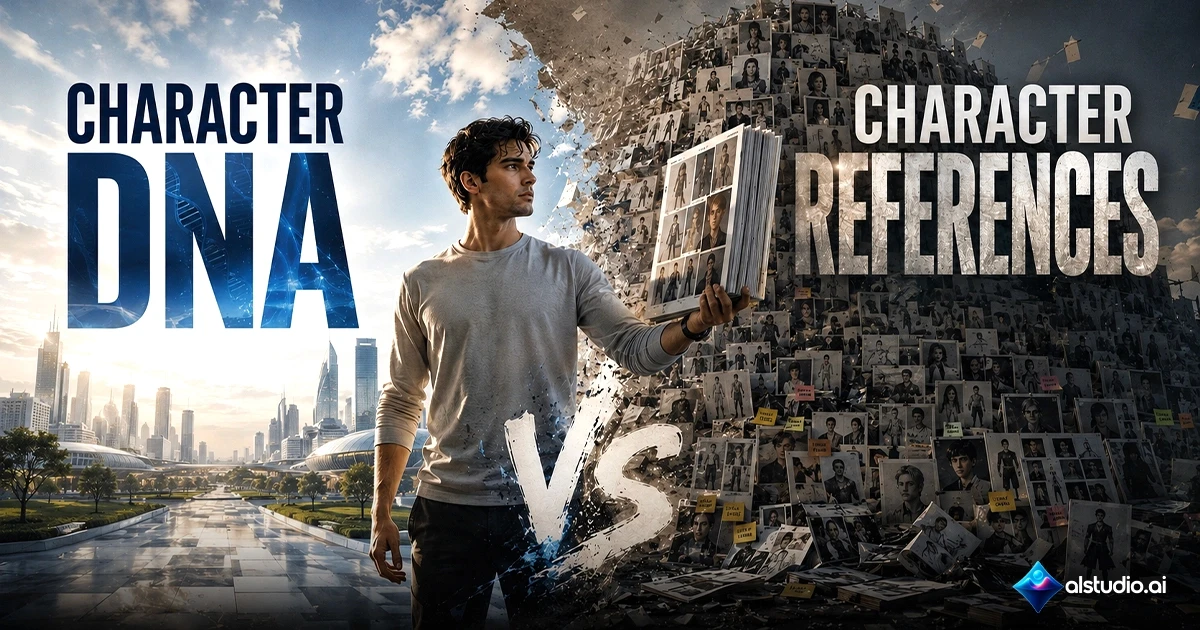
Character DNA vs Character References:
Why One Persists and One Disappears ?
Character DNA solves what character references never could. It stores your AI character as a permanent, team-accessible identity profile not a file you re-upload every session. If your characters look different across campaigns, that is not a prompting problem. It is an infrastructure problem.
Every creator who has worked with AI video or image generation knows the cycle. You spend time getting a character right the face, the hair, the clothing details, the branded accessories. You generate one solid scene. Then the session ends, the next project starts, or a colleague opens the same workflow, and you are back to square one. Per-session reference uploads are the dominant approach across every major AI platform and per-session means the character lives only as long as the tab stays open.
This article explains what Character DNA is, why character references fail at production scale, how every major AI platform currently handles consistency, and what it takes to actually solve the problem not just manage it.
What Is Character DNA in AI Content Production?
Character DNA is a stored identity profile that defines a character's visual appearance, personality, and voice in one persistent place so every generation that calls it produces the same character, without re-uploading anything.
For real production teams, this means the difference between a character that lives in a shared folder of reference images something someone has to find, attach, and hope works and a character that is built into the production system itself. When a marketing manager, a content creator, and an agency partner all need to use the same brand mascot, Character DNA means they all start from the same definition, in the same place, automatically.
Why the Definition Matters
Most people assume character consistency is a prompting problem that a better description or a more detailed reference image would fix the issue. It would not. The problem is not the quality of the reference. The problem is that the reference is not stored anywhere. It is passed as an input to a single generation request. When that request ends, the reference is gone.
Character DNA is not a fancier prompt. It is not a template with fields for hair color and eye shape. It is a system-level asset — the same kind of asset as a logo or a brand color palette that belongs in the infrastructure layer of how content is made, not in the session layer of how content is generated.
Why Character References Fail at Production Scale
The Structural Reason Most AI Platforms Break Character Consistency
The reason most AI platforms fail at character consistency is architectural: they were built around generation sessions, not production infrastructure. Reference images are passed as inputs to a generation request. They are not stored as assets in a system. When the generation ends, the reference ends with it.
One pattern emerges consistently across platforms: character fidelity degrades not because models are incapable of consistency, but because there is no persistent anchor. Each new generation re-interprets the reference from scratch. Add a complex scene prompt, change the lighting, or move to a different model, and the reference image competes with every other input signal and sometimes loses.
Midjourney's official documentation explicitly notes that when using character references, "intricate details like freckles or logos might not come out exactly right." Creator communities have documented cumulative drift directly: if you use one generated panel as the reference for the next, and that output as the reference for the one after, character identity compounds in error across the series. This is not a workflow error. It is what session-based reference systems do when pushed to production volume.
The Five Most Common Character Consistency Failures
Understanding where character consistency breaks helps diagnose which type of solution is actually needed.
1. Session Termination Loss
Cause: Reference images are attached per-session as inputs, not stored as platform assets. When the session ends, so does the character definition.
Impact: Every new campaign requires re-establishing the character from scratch, creating version drift across marketing touchpoints.
2. Cumulative Reference Drift
Cause: Teams use generated outputs as the reference for the next generation a practice that compounds small deviations into large inconsistencies over time.
Impact: A character that looked correct in Week 1 may be visually unrecognizable by Week 4 of a campaign series.
3. Detail Loss Under Scene Complexity
Cause: When a scene prompt is detailed, it competes with the character reference for model attention. Specific accessories, logos on clothing, and fine facial features are most vulnerable.
Impact: Brand-specific character details the ones that make a mascot recognizable are the first elements to disappear.
4. Team-Level Fragmentation
Cause: Reference images live in personal drives, Slack messages, or email threads. There is no shared system-level definition of who the character is.
Impact: Different team members produce visually different versions of the same character, requiring manual review and rejection of assets that cannot go to client.
5. Cross-Tool Identity Collapse
Cause: A reference calibrated for one model does not carry over to a video generation model, an image model, or a voiceover tool.
Impact: The character exists only in the context of one tool's output it cannot be the same character in a video ad, a product photo, and a voiceover script simultaneously.
The Four Types of Character Consistency Brands Actually Need
Most discussions about character consistency focus narrowly on visual face matching getting the same face across image generations. That is one layer. Production-grade character consistency requires four.
Type | What It Covers | Why It Matters |
Visual Identity | Face, body proportions, skin tone, hair, distinguishing features | Ensures the character is recognizable across every frame and format |
Wardrobe and Object Consistency | Clothing, accessories, branded items, logos on garments | Maintains brand accuracy in product and campaign contexts |
Personality and Tone | Character voice, communication style, behavioral traits | Keeps the character coherent in scripts, captions, and copy |
Voice and Dialect Match | Voiceover profile, language, regional dialect | Ensures the spoken character matches the visual character for multilingual campaigns |
When one of these layers fails, the damage is not just visual. A character with a consistent face but inconsistent wardrobe looks like a different person across ad variants. A character with a matched visual and wardrobe but a mismatched voiceover creates brand confusion in markets where the spoken identity matters as much as the visual one which, in MENA markets, is every market.
How Every Major AI Platform Currently Handles Character Consistency
The key distinction across every major platform is the same: reference-based generation versus persistent identity storage. Every current major competitor uses the first approach.
Platform | Feature | How It Works | Persistence |
Midjourney | --cref (V6) / Omni Reference (V7) | URL-uploaded image passed as generation parameter | Session-based; V6 --cref incompatible with V7. Source |
Runway Gen-4 | References (launched April 30, 2025) | Up to 3 reference images per generation; workspace storage | Workspace-based; not cross-project character profiles; max 720×720 input. Source |
Leonardo.AI | Character Reference | Face image upload with strength slider | Per-generation upload; SDXL models only. Source |
Ideogram | Character tab | Single reference photo, consistent within a session | Session-scoped; available free and via API; no team sharing. Source |
ALStudio | Character DNA (Constants Studio) | Stored identity profile linked across all studios | Persistent; team-accessible; cross-tool; links visual identity to 22+ Arabic dialect voiceover profiles |
No current competitor stores character identity as a persistent, team-accessible, cross-studio profile that connects visual appearance to voiceover dialect and survives across every project and every tool in the workflow.
Character DNA vs Reference Uploads: A Direct Comparison
Dimension | Reference Image Uploads | ALStudio Character DNA |
Setup | Upload per session | Define once, stored permanently in Constants Studio |
Team access | Manual file sharing required | Accessible by all team members across all projects |
Cross-tool use | Locked to one generation tool | Works across Film Studio, Marketing Studio, Content Studio |
Voiceover match | Not connected to voice | Links visual identity to 22+ Arabic dialect voiceover profiles |
Fidelity under complexity | Degrades in complex scenes | Persistent anchor maintained across generation contexts |
Scalability | Breaks down at high volume | Built for agency-scale production runs |
Governance | No version control | One definition governs all team outputs |
The honest tradeoff: for a solo creator producing a single short-form video, a reference image upload works. The effort is low, the session is short, the output is one asset. For any team producing recurring content a brand mascot across a 12-week campaign, a spokesperson across Arabic and English ad variants, a product character used by a brand and its agency simultaneously reference uploads generate overhead that compounds into a consistency problem at scale. Character DNA is built for that second scenario.
A Practical Example: Brand Mascot Across a Regional Campaign
Consider a MENA-based e-commerce brand launching a Ramadan campaign series. The campaign spans six weeks and requires a recurring character a brand mascot appearing across product ads, social video content, a YouTube short, and an email marketing visual, produced by an in-house team and a creative agency simultaneously.
Without a Persistent Character System
Week 1: The brand's designer creates a reference image of the mascot and sends it via Slack. The in-house team generates the first set of assets using the reference in their preferred tool. The agency receives the same reference image but works in a different model. The outputs have similar character features but different skin undertones, a different shirt color, and one output has the mascot's logo-printed hat replaced by a plain one details lost in scene complexity.
Week 2: The in-house team generates a new batch using one of the Week 1 outputs as the reference, because the original file has been updated in a shared drive and team members are uncertain which version is current. The agency generates a third variant independently. By mid-campaign, the brand has three visually distinct versions of the same mascot across its own content.
Week 3: Creative assets go to brand approval. Several are rejected for inconsistency. The team spends time sourcing the correct reference, re-generating, and re-submitting. The campaign timeline compresses and production cost rises without a corresponding increase in output volume.
With ALStudio's Character DNA
The brand defines the mascot once in Constants Studio face, clothing, color palette, personality descriptor, and a Gulf Arabic voiceover profile. Every team member and agency partner accesses the same definition. Every generation across Film Studio, Marketing Studio, and Content Studio calls the same Character DNA. The mascot looks the same in the product ad, the Reel script, the voiceover, and the email visual not because every asset was manually reviewed against a reference, but because the reference is built into the production infrastructure itself.
Ready to stop rebuilding your characters every session? ALStudio's free plan includes Character DNA access — no watermark, no credit card required. Start free on ALStudio.
How ALStudio's Character DNA Works: Step by Step
Character DNA lives inside the Constants Studio, ALStudio's shared memory layer. Here is how it works in practice:
Step 1: Define the Character in Constants Studio
Upload or generate a face and body definition. Set clothing, wardrobe, and color palette. Add a personality descriptor and behavioral tone. Link a voiceover profile from 22+ available Arabic dialect options or multilingual voice options.
Step 2: Save as a Permanent Character DNA Profile
The character is saved as a named profile not a file in a folder, but a system asset inside the platform. It is immediately accessible to all team members who have access to the workspace.
Step 3: Call Character DNA Across Any Studio
When generating in Film Studio, Marketing Studio, or Content Studio, select the Character DNA profile. The platform anchors every generation to the same identity definition. No re-upload. No re-briefing. No version confusion.
Step 4: Manage and Update From One Place
If the character needs to evolve a wardrobe update, a dialect change for a new market update the Character DNA profile once. The change propagates across all future generations automatically.
Who Needs Character DNA?
Marketing Teams
Teams spending hours on consistency review cycles know the real cost of per-session character management: it is not the generation that takes time, it is the approval and re-generation loop when assets come back inconsistent. Character DNA removes that loop by making consistency a system property, not a human review task.
Ecommerce Brands
Brands running recurring campaigns with product characters, brand mascots, or spokesperson figures need the same face and wardrobe in a product photo, a video ad, and a testimonial format often produced across different timelines and team members. Character DNA makes that possible without manual coordination.
Agencies
Agencies managing character-driven campaigns for multiple clients face both the consistency problem and the access problem: how does the full production team work from the same character definition without constant file sharing and version confusion? Character DNA solves the access problem by making the character a shared system asset, not a shared file in a Slack thread.
Content Creators
Creators producing long-form series, YouTube characters, or recurring AI video personalities know what happens when a character drifts between episodes audience recognition breaks. Character DNA gives creators a production-grade anchor that holds across a season, not just a session.
Character DNA as Part of ALStudio's Creative AI OS
Character DNA is one of four identity layers inside ALStudio's Constants Studio alongside Brand DNA, Product DNA, and Environment DNA. This is the architecture that separates ALStudio from isolated generation tools: consistency is not achieved per-prompt or per-session. It is built into the system at the infrastructure level.
Identity Layer | What It Stores |
Visual appearance, personality, dialect voiceover profile | |
Logo, brand colors, tone of voice, visual style | |
Product images, features, naming, category context | |
Scene settings, backgrounds, location identity |
When all four layers are active simultaneously, every asset produced by any team member in any studio reflects the same brand, product, character, and environmental identity without anyone needing to manage it manually.
ALStudio's Creative AI OS currently serves 10,000+ users across its production workflows, with Character DNA available on the Creator plan at $19/month and on the free plan with no watermark on any output.
Common Mistakes When Managing AI Character Consistency
Even teams that understand the problem often make the same workflow errors:
Using generated outputs as reference inputs. Every generation introduces small deviations. When that output becomes the input for the next generation, those deviations compound. By the fifth iteration, the character has drifted meaningfully from the original.
Storing reference images in unstructured shared drives. When reference files are stored in personal drives or Slack channels without version control, team members inevitably work from different versions of the same character.
Assuming one model's output will transfer to another. A character reference calibrated for a specific image model will not automatically produce the same character in a video generation model. Reference files are not cross-model identity profiles.
Treating consistency as a review task rather than a system property. Manual consistency review at the approval stage is a symptom management approach. It catches failures after they have already happened. The structural fix is to prevent drift at the generation layer which is what Character DNA does.
The Structural Answer to a Structural Problem
Reference workflows produce approximations. Character DNA produces a consistent character one that holds across your campaign, your team, your tools, and your markets.
The difference is not a workflow tip or a prompting technique. It is an architectural one: character identity either lives in the production system or it lives in a session, and sessions end.
Character DNA is one layer of ALStudio's Creative AI OS alongside Brand DNA, Product DNA, and Environment DNA designed so that consistency is infrastructure, not effort.
Start free on ALStudio Character DNA included, no watermark on any plan, no credit card required. Create your first character →
FEATURED SNIPPET
Featured Snippet Paragraph (40–60 words)
Character DNA is a stored identity profile in ALStudio that permanently defines a character's visual appearance, personality, and voice so every AI generation produces the same character without re-uploading reference images. Unlike per-session character references, which disappear when a session ends, Character DNA persists across all projects, team members, and generation tools.
Featured Snippet Bullet List
What Character DNA does that character references cannot:
Stores character identity permanently no re-upload required per session
Accessible by all team members across all projects simultaneously
Works across Film Studio, Marketing Studio, and Content Studio in one platform
Links visual identity to voiceover dialect profiles (22+ Arabic dialects supported)
Maintains fidelity in complex scenes where reference images compete with scene prompts
Enables version control one definition governs all team-generated outputs
Eliminates the review-and-rejection loop caused by character drift across campaigns
Comparison Table (Character DNA vs Character References)
Dimension | Character Reference Uploads | ALStudio Character DNA |
Persistence | Session-only | Permanent |
Team access | Manual file sharing | Shared across workspace |
Cross-tool use | Single model/tool | All ALStudio studios |
Voice integration | None | 22+ Arabic dialect profiles |
Fidelity under scene complexity | Degrades | Maintained |
Version control | None | Centralized |
Production scalability | Breaks at volume | Built for agency scale |
Character DNA vs Character References
Character DNA
Character DNA vs Character References:
Why One Persists and One Disappears ?
Character DNA solves what character references never could. It stores your AI character as a permanent, team-accessible identity profile not a file you re-upload every session. If your characters look different across campaigns, that is not a prompting problem. It is an infrastructure problem.
Every creator who has worked with AI video or image generation knows the cycle. You spend time getting a character right the face, the hair, the clothing details, the branded accessories. You generate one solid scene. Then the session ends, the next project starts, or a colleague opens the same workflow, and you are back to square one. Per-session reference uploads are the dominant approach across every major AI platform and per-session means the character lives only as long as the tab stays open.
This article explains what Character DNA is, why character references fail at production scale, how every major AI platform currently handles consistency, and what it takes to actually solve the problem not just manage it.
What Is Character DNA in AI Content Production?
Character DNA is a stored identity profile that defines a character's visual appearance, personality, and voice in one persistent place so every generation that calls it produces the same character, without re-uploading anything.
For real production teams, this means the difference between a character that lives in a shared folder of reference images something someone has to find, attach, and hope works and a character that is built into the production system itself. When a marketing manager, a content creator, and an agency partner all need to use the same brand mascot, Character DNA means they all start from the same definition, in the same place, automatically.
Why the Definition Matters
Most people assume character consistency is a prompting problem that a better description or a more detailed reference image would fix the issue. It would not. The problem is not the quality of the reference. The problem is that the reference is not stored anywhere. It is passed as an input to a single generation request. When that request ends, the reference is gone.
Character DNA is not a fancier prompt. It is not a template with fields for hair color and eye shape. It is a system-level asset — the same kind of asset as a logo or a brand color palette that belongs in the infrastructure layer of how content is made, not in the session layer of how content is generated.
Why Character References Fail at Production Scale
The Structural Reason Most AI Platforms Break Character Consistency
The reason most AI platforms fail at character consistency is architectural: they were built around generation sessions, not production infrastructure. Reference images are passed as inputs to a generation request. They are not stored as assets in a system. When the generation ends, the reference ends with it.
One pattern emerges consistently across platforms: character fidelity degrades not because models are incapable of consistency, but because there is no persistent anchor. Each new generation re-interprets the reference from scratch. Add a complex scene prompt, change the lighting, or move to a different model, and the reference image competes with every other input signal and sometimes loses.
Midjourney's official documentation explicitly notes that when using character references, "intricate details like freckles or logos might not come out exactly right." Creator communities have documented cumulative drift directly: if you use one generated panel as the reference for the next, and that output as the reference for the one after, character identity compounds in error across the series. This is not a workflow error. It is what session-based reference systems do when pushed to production volume.
The Five Most Common Character Consistency Failures
Understanding where character consistency breaks helps diagnose which type of solution is actually needed.
1. Session Termination Loss
Cause: Reference images are attached per-session as inputs, not stored as platform assets. When the session ends, so does the character definition.
Impact: Every new campaign requires re-establishing the character from scratch, creating version drift across marketing touchpoints.
2. Cumulative Reference Drift
Cause: Teams use generated outputs as the reference for the next generation a practice that compounds small deviations into large inconsistencies over time.
Impact: A character that looked correct in Week 1 may be visually unrecognizable by Week 4 of a campaign series.
3. Detail Loss Under Scene Complexity
Cause: When a scene prompt is detailed, it competes with the character reference for model attention. Specific accessories, logos on clothing, and fine facial features are most vulnerable.
Impact: Brand-specific character details the ones that make a mascot recognizable are the first elements to disappear.
4. Team-Level Fragmentation
Cause: Reference images live in personal drives, Slack messages, or email threads. There is no shared system-level definition of who the character is.
Impact: Different team members produce visually different versions of the same character, requiring manual review and rejection of assets that cannot go to client.
5. Cross-Tool Identity Collapse
Cause: A reference calibrated for one model does not carry over to a video generation model, an image model, or a voiceover tool.
Impact: The character exists only in the context of one tool's output it cannot be the same character in a video ad, a product photo, and a voiceover script simultaneously.
The Four Types of Character Consistency Brands Actually Need
Most discussions about character consistency focus narrowly on visual face matching getting the same face across image generations. That is one layer. Production-grade character consistency requires four.
Type | What It Covers | Why It Matters |
Visual Identity | Face, body proportions, skin tone, hair, distinguishing features | Ensures the character is recognizable across every frame and format |
Wardrobe and Object Consistency | Clothing, accessories, branded items, logos on garments | Maintains brand accuracy in product and campaign contexts |
Personality and Tone | Character voice, communication style, behavioral traits | Keeps the character coherent in scripts, captions, and copy |
Voice and Dialect Match | Voiceover profile, language, regional dialect | Ensures the spoken character matches the visual character for multilingual campaigns |
When one of these layers fails, the damage is not just visual. A character with a consistent face but inconsistent wardrobe looks like a different person across ad variants. A character with a matched visual and wardrobe but a mismatched voiceover creates brand confusion in markets where the spoken identity matters as much as the visual one which, in MENA markets, is every market.
How Every Major AI Platform Currently Handles Character Consistency
The key distinction across every major platform is the same: reference-based generation versus persistent identity storage. Every current major competitor uses the first approach.
Platform | Feature | How It Works | Persistence |
Midjourney | --cref (V6) / Omni Reference (V7) | URL-uploaded image passed as generation parameter | Session-based; V6 --cref incompatible with V7. Source |
Runway Gen-4 | References (launched April 30, 2025) | Up to 3 reference images per generation; workspace storage | Workspace-based; not cross-project character profiles; max 720×720 input. Source |
Leonardo.AI | Character Reference | Face image upload with strength slider | Per-generation upload; SDXL models only. Source |
Ideogram | Character tab | Single reference photo, consistent within a session | Session-scoped; available free and via API; no team sharing. Source |
ALStudio | Character DNA (Constants Studio) | Stored identity profile linked across all studios | Persistent; team-accessible; cross-tool; links visual identity to 22+ Arabic dialect voiceover profiles |
No current competitor stores character identity as a persistent, team-accessible, cross-studio profile that connects visual appearance to voiceover dialect and survives across every project and every tool in the workflow.
Character DNA vs Reference Uploads: A Direct Comparison
Dimension | Reference Image Uploads | ALStudio Character DNA |
Setup | Upload per session | Define once, stored permanently in Constants Studio |
Team access | Manual file sharing required | Accessible by all team members across all projects |
Cross-tool use | Locked to one generation tool | Works across Film Studio, Marketing Studio, Content Studio |
Voiceover match | Not connected to voice | Links visual identity to 22+ Arabic dialect voiceover profiles |
Fidelity under complexity | Degrades in complex scenes | Persistent anchor maintained across generation contexts |
Scalability | Breaks down at high volume | Built for agency-scale production runs |
Governance | No version control | One definition governs all team outputs |
The honest tradeoff: for a solo creator producing a single short-form video, a reference image upload works. The effort is low, the session is short, the output is one asset. For any team producing recurring content a brand mascot across a 12-week campaign, a spokesperson across Arabic and English ad variants, a product character used by a brand and its agency simultaneously reference uploads generate overhead that compounds into a consistency problem at scale. Character DNA is built for that second scenario.
A Practical Example: Brand Mascot Across a Regional Campaign
Consider a MENA-based e-commerce brand launching a Ramadan campaign series. The campaign spans six weeks and requires a recurring character a brand mascot appearing across product ads, social video content, a YouTube short, and an email marketing visual, produced by an in-house team and a creative agency simultaneously.
Without a Persistent Character System
Week 1: The brand's designer creates a reference image of the mascot and sends it via Slack. The in-house team generates the first set of assets using the reference in their preferred tool. The agency receives the same reference image but works in a different model. The outputs have similar character features but different skin undertones, a different shirt color, and one output has the mascot's logo-printed hat replaced by a plain one details lost in scene complexity.
Week 2: The in-house team generates a new batch using one of the Week 1 outputs as the reference, because the original file has been updated in a shared drive and team members are uncertain which version is current. The agency generates a third variant independently. By mid-campaign, the brand has three visually distinct versions of the same mascot across its own content.
Week 3: Creative assets go to brand approval. Several are rejected for inconsistency. The team spends time sourcing the correct reference, re-generating, and re-submitting. The campaign timeline compresses and production cost rises without a corresponding increase in output volume.
With ALStudio's Character DNA
The brand defines the mascot once in Constants Studio face, clothing, color palette, personality descriptor, and a Gulf Arabic voiceover profile. Every team member and agency partner accesses the same definition. Every generation across Film Studio, Marketing Studio, and Content Studio calls the same Character DNA. The mascot looks the same in the product ad, the Reel script, the voiceover, and the email visual not because every asset was manually reviewed against a reference, but because the reference is built into the production infrastructure itself.
Ready to stop rebuilding your characters every session? ALStudio's free plan includes Character DNA access — no watermark, no credit card required. Start free on ALStudio.
How ALStudio's Character DNA Works: Step by Step
Character DNA lives inside the Constants Studio, ALStudio's shared memory layer. Here is how it works in practice:
Step 1: Define the Character in Constants Studio
Upload or generate a face and body definition. Set clothing, wardrobe, and color palette. Add a personality descriptor and behavioral tone. Link a voiceover profile from 22+ available Arabic dialect options or multilingual voice options.
Step 2: Save as a Permanent Character DNA Profile
The character is saved as a named profile not a file in a folder, but a system asset inside the platform. It is immediately accessible to all team members who have access to the workspace.
Step 3: Call Character DNA Across Any Studio
When generating in Film Studio, Marketing Studio, or Content Studio, select the Character DNA profile. The platform anchors every generation to the same identity definition. No re-upload. No re-briefing. No version confusion.
Step 4: Manage and Update From One Place
If the character needs to evolve a wardrobe update, a dialect change for a new market update the Character DNA profile once. The change propagates across all future generations automatically.
Who Needs Character DNA?
Marketing Teams
Teams spending hours on consistency review cycles know the real cost of per-session character management: it is not the generation that takes time, it is the approval and re-generation loop when assets come back inconsistent. Character DNA removes that loop by making consistency a system property, not a human review task.
Ecommerce Brands
Brands running recurring campaigns with product characters, brand mascots, or spokesperson figures need the same face and wardrobe in a product photo, a video ad, and a testimonial format often produced across different timelines and team members. Character DNA makes that possible without manual coordination.
Agencies
Agencies managing character-driven campaigns for multiple clients face both the consistency problem and the access problem: how does the full production team work from the same character definition without constant file sharing and version confusion? Character DNA solves the access problem by making the character a shared system asset, not a shared file in a Slack thread.
Content Creators
Creators producing long-form series, YouTube characters, or recurring AI video personalities know what happens when a character drifts between episodes audience recognition breaks. Character DNA gives creators a production-grade anchor that holds across a season, not just a session.
Character DNA as Part of ALStudio's Creative AI OS
Character DNA is one of four identity layers inside ALStudio's Constants Studio alongside Brand DNA, Product DNA, and Environment DNA. This is the architecture that separates ALStudio from isolated generation tools: consistency is not achieved per-prompt or per-session. It is built into the system at the infrastructure level.
Identity Layer | What It Stores |
Visual appearance, personality, dialect voiceover profile | |
Logo, brand colors, tone of voice, visual style | |
Product images, features, naming, category context | |
Scene settings, backgrounds, location identity |
When all four layers are active simultaneously, every asset produced by any team member in any studio reflects the same brand, product, character, and environmental identity without anyone needing to manage it manually.
ALStudio's Creative AI OS currently serves 10,000+ users across its production workflows, with Character DNA available on the Creator plan at $19/month and on the free plan with no watermark on any output.
Common Mistakes When Managing AI Character Consistency
Even teams that understand the problem often make the same workflow errors:
Using generated outputs as reference inputs. Every generation introduces small deviations. When that output becomes the input for the next generation, those deviations compound. By the fifth iteration, the character has drifted meaningfully from the original.
Storing reference images in unstructured shared drives. When reference files are stored in personal drives or Slack channels without version control, team members inevitably work from different versions of the same character.
Assuming one model's output will transfer to another. A character reference calibrated for a specific image model will not automatically produce the same character in a video generation model. Reference files are not cross-model identity profiles.
Treating consistency as a review task rather than a system property. Manual consistency review at the approval stage is a symptom management approach. It catches failures after they have already happened. The structural fix is to prevent drift at the generation layer which is what Character DNA does.
The Structural Answer to a Structural Problem
Reference workflows produce approximations. Character DNA produces a consistent character one that holds across your campaign, your team, your tools, and your markets.
The difference is not a workflow tip or a prompting technique. It is an architectural one: character identity either lives in the production system or it lives in a session, and sessions end.
Character DNA is one layer of ALStudio's Creative AI OS alongside Brand DNA, Product DNA, and Environment DNA designed so that consistency is infrastructure, not effort.
Start free on ALStudio Character DNA included, no watermark on any plan, no credit card required. Create your first character →
FEATURED SNIPPET
Featured Snippet Paragraph (40–60 words)
Character DNA is a stored identity profile in ALStudio that permanently defines a character's visual appearance, personality, and voice so every AI generation produces the same character without re-uploading reference images. Unlike per-session character references, which disappear when a session ends, Character DNA persists across all projects, team members, and generation tools.
Featured Snippet Bullet List
What Character DNA does that character references cannot:
Stores character identity permanently no re-upload required per session
Accessible by all team members across all projects simultaneously
Works across Film Studio, Marketing Studio, and Content Studio in one platform
Links visual identity to voiceover dialect profiles (22+ Arabic dialects supported)
Maintains fidelity in complex scenes where reference images compete with scene prompts
Enables version control one definition governs all team-generated outputs
Eliminates the review-and-rejection loop caused by character drift across campaigns
Comparison Table (Character DNA vs Character References)
Dimension | Character Reference Uploads | ALStudio Character DNA |
Persistence | Session-only | Permanent |
Team access | Manual file sharing | Shared across workspace |
Cross-tool use | Single model/tool | All ALStudio studios |
Voice integration | None | 22+ Arabic dialect profiles |
Fidelity under scene complexity | Degrades | Maintained |
Version control | None | Centralized |
Production scalability | Breaks at volume | Built for agency scale |
Character DNA vs Character References
Character DNA
Character DNA vs Character References:
Why One Persists and One Disappears ?
Character DNA solves what character references never could. It stores your AI character as a permanent, team-accessible identity profile not a file you re-upload every session. If your characters look different across campaigns, that is not a prompting problem. It is an infrastructure problem.
Every creator who has worked with AI video or image generation knows the cycle. You spend time getting a character right the face, the hair, the clothing details, the branded accessories. You generate one solid scene. Then the session ends, the next project starts, or a colleague opens the same workflow, and you are back to square one. Per-session reference uploads are the dominant approach across every major AI platform and per-session means the character lives only as long as the tab stays open.
This article explains what Character DNA is, why character references fail at production scale, how every major AI platform currently handles consistency, and what it takes to actually solve the problem not just manage it.
What Is Character DNA in AI Content Production?
Character DNA is a stored identity profile that defines a character's visual appearance, personality, and voice in one persistent place so every generation that calls it produces the same character, without re-uploading anything.
For real production teams, this means the difference between a character that lives in a shared folder of reference images something someone has to find, attach, and hope works and a character that is built into the production system itself. When a marketing manager, a content creator, and an agency partner all need to use the same brand mascot, Character DNA means they all start from the same definition, in the same place, automatically.
Why the Definition Matters
Most people assume character consistency is a prompting problem that a better description or a more detailed reference image would fix the issue. It would not. The problem is not the quality of the reference. The problem is that the reference is not stored anywhere. It is passed as an input to a single generation request. When that request ends, the reference is gone.
Character DNA is not a fancier prompt. It is not a template with fields for hair color and eye shape. It is a system-level asset — the same kind of asset as a logo or a brand color palette that belongs in the infrastructure layer of how content is made, not in the session layer of how content is generated.
Why Character References Fail at Production Scale
The Structural Reason Most AI Platforms Break Character Consistency
The reason most AI platforms fail at character consistency is architectural: they were built around generation sessions, not production infrastructure. Reference images are passed as inputs to a generation request. They are not stored as assets in a system. When the generation ends, the reference ends with it.
One pattern emerges consistently across platforms: character fidelity degrades not because models are incapable of consistency, but because there is no persistent anchor. Each new generation re-interprets the reference from scratch. Add a complex scene prompt, change the lighting, or move to a different model, and the reference image competes with every other input signal and sometimes loses.
Midjourney's official documentation explicitly notes that when using character references, "intricate details like freckles or logos might not come out exactly right." Creator communities have documented cumulative drift directly: if you use one generated panel as the reference for the next, and that output as the reference for the one after, character identity compounds in error across the series. This is not a workflow error. It is what session-based reference systems do when pushed to production volume.
The Five Most Common Character Consistency Failures
Understanding where character consistency breaks helps diagnose which type of solution is actually needed.
1. Session Termination Loss
Cause: Reference images are attached per-session as inputs, not stored as platform assets. When the session ends, so does the character definition.
Impact: Every new campaign requires re-establishing the character from scratch, creating version drift across marketing touchpoints.
2. Cumulative Reference Drift
Cause: Teams use generated outputs as the reference for the next generation a practice that compounds small deviations into large inconsistencies over time.
Impact: A character that looked correct in Week 1 may be visually unrecognizable by Week 4 of a campaign series.
3. Detail Loss Under Scene Complexity
Cause: When a scene prompt is detailed, it competes with the character reference for model attention. Specific accessories, logos on clothing, and fine facial features are most vulnerable.
Impact: Brand-specific character details the ones that make a mascot recognizable are the first elements to disappear.
4. Team-Level Fragmentation
Cause: Reference images live in personal drives, Slack messages, or email threads. There is no shared system-level definition of who the character is.
Impact: Different team members produce visually different versions of the same character, requiring manual review and rejection of assets that cannot go to client.
5. Cross-Tool Identity Collapse
Cause: A reference calibrated for one model does not carry over to a video generation model, an image model, or a voiceover tool.
Impact: The character exists only in the context of one tool's output it cannot be the same character in a video ad, a product photo, and a voiceover script simultaneously.
The Four Types of Character Consistency Brands Actually Need
Most discussions about character consistency focus narrowly on visual face matching getting the same face across image generations. That is one layer. Production-grade character consistency requires four.
Type | What It Covers | Why It Matters |
Visual Identity | Face, body proportions, skin tone, hair, distinguishing features | Ensures the character is recognizable across every frame and format |
Wardrobe and Object Consistency | Clothing, accessories, branded items, logos on garments | Maintains brand accuracy in product and campaign contexts |
Personality and Tone | Character voice, communication style, behavioral traits | Keeps the character coherent in scripts, captions, and copy |
Voice and Dialect Match | Voiceover profile, language, regional dialect | Ensures the spoken character matches the visual character for multilingual campaigns |
When one of these layers fails, the damage is not just visual. A character with a consistent face but inconsistent wardrobe looks like a different person across ad variants. A character with a matched visual and wardrobe but a mismatched voiceover creates brand confusion in markets where the spoken identity matters as much as the visual one which, in MENA markets, is every market.
How Every Major AI Platform Currently Handles Character Consistency
The key distinction across every major platform is the same: reference-based generation versus persistent identity storage. Every current major competitor uses the first approach.
Platform | Feature | How It Works | Persistence |
Midjourney | --cref (V6) / Omni Reference (V7) | URL-uploaded image passed as generation parameter | Session-based; V6 --cref incompatible with V7. Source |
Runway Gen-4 | References (launched April 30, 2025) | Up to 3 reference images per generation; workspace storage | Workspace-based; not cross-project character profiles; max 720×720 input. Source |
Leonardo.AI | Character Reference | Face image upload with strength slider | Per-generation upload; SDXL models only. Source |
Ideogram | Character tab | Single reference photo, consistent within a session | Session-scoped; available free and via API; no team sharing. Source |
ALStudio | Character DNA (Constants Studio) | Stored identity profile linked across all studios | Persistent; team-accessible; cross-tool; links visual identity to 22+ Arabic dialect voiceover profiles |
No current competitor stores character identity as a persistent, team-accessible, cross-studio profile that connects visual appearance to voiceover dialect and survives across every project and every tool in the workflow.
Character DNA vs Reference Uploads: A Direct Comparison
Dimension | Reference Image Uploads | ALStudio Character DNA |
Setup | Upload per session | Define once, stored permanently in Constants Studio |
Team access | Manual file sharing required | Accessible by all team members across all projects |
Cross-tool use | Locked to one generation tool | Works across Film Studio, Marketing Studio, Content Studio |
Voiceover match | Not connected to voice | Links visual identity to 22+ Arabic dialect voiceover profiles |
Fidelity under complexity | Degrades in complex scenes | Persistent anchor maintained across generation contexts |
Scalability | Breaks down at high volume | Built for agency-scale production runs |
Governance | No version control | One definition governs all team outputs |
The honest tradeoff: for a solo creator producing a single short-form video, a reference image upload works. The effort is low, the session is short, the output is one asset. For any team producing recurring content a brand mascot across a 12-week campaign, a spokesperson across Arabic and English ad variants, a product character used by a brand and its agency simultaneously reference uploads generate overhead that compounds into a consistency problem at scale. Character DNA is built for that second scenario.
A Practical Example: Brand Mascot Across a Regional Campaign
Consider a MENA-based e-commerce brand launching a Ramadan campaign series. The campaign spans six weeks and requires a recurring character a brand mascot appearing across product ads, social video content, a YouTube short, and an email marketing visual, produced by an in-house team and a creative agency simultaneously.
Without a Persistent Character System
Week 1: The brand's designer creates a reference image of the mascot and sends it via Slack. The in-house team generates the first set of assets using the reference in their preferred tool. The agency receives the same reference image but works in a different model. The outputs have similar character features but different skin undertones, a different shirt color, and one output has the mascot's logo-printed hat replaced by a plain one details lost in scene complexity.
Week 2: The in-house team generates a new batch using one of the Week 1 outputs as the reference, because the original file has been updated in a shared drive and team members are uncertain which version is current. The agency generates a third variant independently. By mid-campaign, the brand has three visually distinct versions of the same mascot across its own content.
Week 3: Creative assets go to brand approval. Several are rejected for inconsistency. The team spends time sourcing the correct reference, re-generating, and re-submitting. The campaign timeline compresses and production cost rises without a corresponding increase in output volume.
With ALStudio's Character DNA
The brand defines the mascot once in Constants Studio face, clothing, color palette, personality descriptor, and a Gulf Arabic voiceover profile. Every team member and agency partner accesses the same definition. Every generation across Film Studio, Marketing Studio, and Content Studio calls the same Character DNA. The mascot looks the same in the product ad, the Reel script, the voiceover, and the email visual not because every asset was manually reviewed against a reference, but because the reference is built into the production infrastructure itself.
Ready to stop rebuilding your characters every session? ALStudio's free plan includes Character DNA access — no watermark, no credit card required. Start free on ALStudio.
How ALStudio's Character DNA Works: Step by Step
Character DNA lives inside the Constants Studio, ALStudio's shared memory layer. Here is how it works in practice:
Step 1: Define the Character in Constants Studio
Upload or generate a face and body definition. Set clothing, wardrobe, and color palette. Add a personality descriptor and behavioral tone. Link a voiceover profile from 22+ available Arabic dialect options or multilingual voice options.
Step 2: Save as a Permanent Character DNA Profile
The character is saved as a named profile not a file in a folder, but a system asset inside the platform. It is immediately accessible to all team members who have access to the workspace.
Step 3: Call Character DNA Across Any Studio
When generating in Film Studio, Marketing Studio, or Content Studio, select the Character DNA profile. The platform anchors every generation to the same identity definition. No re-upload. No re-briefing. No version confusion.
Step 4: Manage and Update From One Place
If the character needs to evolve a wardrobe update, a dialect change for a new market update the Character DNA profile once. The change propagates across all future generations automatically.
Who Needs Character DNA?
Marketing Teams
Teams spending hours on consistency review cycles know the real cost of per-session character management: it is not the generation that takes time, it is the approval and re-generation loop when assets come back inconsistent. Character DNA removes that loop by making consistency a system property, not a human review task.
Ecommerce Brands
Brands running recurring campaigns with product characters, brand mascots, or spokesperson figures need the same face and wardrobe in a product photo, a video ad, and a testimonial format often produced across different timelines and team members. Character DNA makes that possible without manual coordination.
Agencies
Agencies managing character-driven campaigns for multiple clients face both the consistency problem and the access problem: how does the full production team work from the same character definition without constant file sharing and version confusion? Character DNA solves the access problem by making the character a shared system asset, not a shared file in a Slack thread.
Content Creators
Creators producing long-form series, YouTube characters, or recurring AI video personalities know what happens when a character drifts between episodes audience recognition breaks. Character DNA gives creators a production-grade anchor that holds across a season, not just a session.
Character DNA as Part of ALStudio's Creative AI OS
Character DNA is one of four identity layers inside ALStudio's Constants Studio alongside Brand DNA, Product DNA, and Environment DNA. This is the architecture that separates ALStudio from isolated generation tools: consistency is not achieved per-prompt or per-session. It is built into the system at the infrastructure level.
Identity Layer | What It Stores |
Visual appearance, personality, dialect voiceover profile | |
Logo, brand colors, tone of voice, visual style | |
Product images, features, naming, category context | |
Scene settings, backgrounds, location identity |
When all four layers are active simultaneously, every asset produced by any team member in any studio reflects the same brand, product, character, and environmental identity without anyone needing to manage it manually.
ALStudio's Creative AI OS currently serves 10,000+ users across its production workflows, with Character DNA available on the Creator plan at $19/month and on the free plan with no watermark on any output.
Common Mistakes When Managing AI Character Consistency
Even teams that understand the problem often make the same workflow errors:
Using generated outputs as reference inputs. Every generation introduces small deviations. When that output becomes the input for the next generation, those deviations compound. By the fifth iteration, the character has drifted meaningfully from the original.
Storing reference images in unstructured shared drives. When reference files are stored in personal drives or Slack channels without version control, team members inevitably work from different versions of the same character.
Assuming one model's output will transfer to another. A character reference calibrated for a specific image model will not automatically produce the same character in a video generation model. Reference files are not cross-model identity profiles.
Treating consistency as a review task rather than a system property. Manual consistency review at the approval stage is a symptom management approach. It catches failures after they have already happened. The structural fix is to prevent drift at the generation layer which is what Character DNA does.
The Structural Answer to a Structural Problem
Reference workflows produce approximations. Character DNA produces a consistent character one that holds across your campaign, your team, your tools, and your markets.
The difference is not a workflow tip or a prompting technique. It is an architectural one: character identity either lives in the production system or it lives in a session, and sessions end.
Character DNA is one layer of ALStudio's Creative AI OS alongside Brand DNA, Product DNA, and Environment DNA designed so that consistency is infrastructure, not effort.
Start free on ALStudio Character DNA included, no watermark on any plan, no credit card required. Create your first character →
FEATURED SNIPPET
Featured Snippet Paragraph (40–60 words)
Character DNA is a stored identity profile in ALStudio that permanently defines a character's visual appearance, personality, and voice so every AI generation produces the same character without re-uploading reference images. Unlike per-session character references, which disappear when a session ends, Character DNA persists across all projects, team members, and generation tools.
Featured Snippet Bullet List
What Character DNA does that character references cannot:
Stores character identity permanently no re-upload required per session
Accessible by all team members across all projects simultaneously
Works across Film Studio, Marketing Studio, and Content Studio in one platform
Links visual identity to voiceover dialect profiles (22+ Arabic dialects supported)
Maintains fidelity in complex scenes where reference images compete with scene prompts
Enables version control one definition governs all team-generated outputs
Eliminates the review-and-rejection loop caused by character drift across campaigns
Comparison Table (Character DNA vs Character References)
Dimension | Character Reference Uploads | ALStudio Character DNA |
Persistence | Session-only | Permanent |
Team access | Manual file sharing | Shared across workspace |
Cross-tool use | Single model/tool | All ALStudio studios |
Voice integration | None | 22+ Arabic dialect profiles |
Fidelity under scene complexity | Degrades | Maintained |
Version control | None | Centralized |
Production scalability | Breaks at volume | Built for agency scale |
Character DNA vs Character References
Character DNA
Character DNA vs Character References:
Why One Persists and One Disappears ?
Character DNA solves what character references never could. It stores your AI character as a permanent, team-accessible identity profile not a file you re-upload every session. If your characters look different across campaigns, that is not a prompting problem. It is an infrastructure problem.
Every creator who has worked with AI video or image generation knows the cycle. You spend time getting a character right the face, the hair, the clothing details, the branded accessories. You generate one solid scene. Then the session ends, the next project starts, or a colleague opens the same workflow, and you are back to square one. Per-session reference uploads are the dominant approach across every major AI platform and per-session means the character lives only as long as the tab stays open.
This article explains what Character DNA is, why character references fail at production scale, how every major AI platform currently handles consistency, and what it takes to actually solve the problem not just manage it.
What Is Character DNA in AI Content Production?
Character DNA is a stored identity profile that defines a character's visual appearance, personality, and voice in one persistent place so every generation that calls it produces the same character, without re-uploading anything.
For real production teams, this means the difference between a character that lives in a shared folder of reference images something someone has to find, attach, and hope works and a character that is built into the production system itself. When a marketing manager, a content creator, and an agency partner all need to use the same brand mascot, Character DNA means they all start from the same definition, in the same place, automatically.
Why the Definition Matters
Most people assume character consistency is a prompting problem that a better description or a more detailed reference image would fix the issue. It would not. The problem is not the quality of the reference. The problem is that the reference is not stored anywhere. It is passed as an input to a single generation request. When that request ends, the reference is gone.
Character DNA is not a fancier prompt. It is not a template with fields for hair color and eye shape. It is a system-level asset — the same kind of asset as a logo or a brand color palette that belongs in the infrastructure layer of how content is made, not in the session layer of how content is generated.
Why Character References Fail at Production Scale
The Structural Reason Most AI Platforms Break Character Consistency
The reason most AI platforms fail at character consistency is architectural: they were built around generation sessions, not production infrastructure. Reference images are passed as inputs to a generation request. They are not stored as assets in a system. When the generation ends, the reference ends with it.
One pattern emerges consistently across platforms: character fidelity degrades not because models are incapable of consistency, but because there is no persistent anchor. Each new generation re-interprets the reference from scratch. Add a complex scene prompt, change the lighting, or move to a different model, and the reference image competes with every other input signal and sometimes loses.
Midjourney's official documentation explicitly notes that when using character references, "intricate details like freckles or logos might not come out exactly right." Creator communities have documented cumulative drift directly: if you use one generated panel as the reference for the next, and that output as the reference for the one after, character identity compounds in error across the series. This is not a workflow error. It is what session-based reference systems do when pushed to production volume.
The Five Most Common Character Consistency Failures
Understanding where character consistency breaks helps diagnose which type of solution is actually needed.
1. Session Termination Loss
Cause: Reference images are attached per-session as inputs, not stored as platform assets. When the session ends, so does the character definition.
Impact: Every new campaign requires re-establishing the character from scratch, creating version drift across marketing touchpoints.
2. Cumulative Reference Drift
Cause: Teams use generated outputs as the reference for the next generation a practice that compounds small deviations into large inconsistencies over time.
Impact: A character that looked correct in Week 1 may be visually unrecognizable by Week 4 of a campaign series.
3. Detail Loss Under Scene Complexity
Cause: When a scene prompt is detailed, it competes with the character reference for model attention. Specific accessories, logos on clothing, and fine facial features are most vulnerable.
Impact: Brand-specific character details the ones that make a mascot recognizable are the first elements to disappear.
4. Team-Level Fragmentation
Cause: Reference images live in personal drives, Slack messages, or email threads. There is no shared system-level definition of who the character is.
Impact: Different team members produce visually different versions of the same character, requiring manual review and rejection of assets that cannot go to client.
5. Cross-Tool Identity Collapse
Cause: A reference calibrated for one model does not carry over to a video generation model, an image model, or a voiceover tool.
Impact: The character exists only in the context of one tool's output it cannot be the same character in a video ad, a product photo, and a voiceover script simultaneously.
The Four Types of Character Consistency Brands Actually Need
Most discussions about character consistency focus narrowly on visual face matching getting the same face across image generations. That is one layer. Production-grade character consistency requires four.
Type | What It Covers | Why It Matters |
Visual Identity | Face, body proportions, skin tone, hair, distinguishing features | Ensures the character is recognizable across every frame and format |
Wardrobe and Object Consistency | Clothing, accessories, branded items, logos on garments | Maintains brand accuracy in product and campaign contexts |
Personality and Tone | Character voice, communication style, behavioral traits | Keeps the character coherent in scripts, captions, and copy |
Voice and Dialect Match | Voiceover profile, language, regional dialect | Ensures the spoken character matches the visual character for multilingual campaigns |
When one of these layers fails, the damage is not just visual. A character with a consistent face but inconsistent wardrobe looks like a different person across ad variants. A character with a matched visual and wardrobe but a mismatched voiceover creates brand confusion in markets where the spoken identity matters as much as the visual one which, in MENA markets, is every market.
How Every Major AI Platform Currently Handles Character Consistency
The key distinction across every major platform is the same: reference-based generation versus persistent identity storage. Every current major competitor uses the first approach.
Platform | Feature | How It Works | Persistence |
Midjourney | --cref (V6) / Omni Reference (V7) | URL-uploaded image passed as generation parameter | Session-based; V6 --cref incompatible with V7. Source |
Runway Gen-4 | References (launched April 30, 2025) | Up to 3 reference images per generation; workspace storage | Workspace-based; not cross-project character profiles; max 720×720 input. Source |
Leonardo.AI | Character Reference | Face image upload with strength slider | Per-generation upload; SDXL models only. Source |
Ideogram | Character tab | Single reference photo, consistent within a session | Session-scoped; available free and via API; no team sharing. Source |
ALStudio | Character DNA (Constants Studio) | Stored identity profile linked across all studios | Persistent; team-accessible; cross-tool; links visual identity to 22+ Arabic dialect voiceover profiles |
No current competitor stores character identity as a persistent, team-accessible, cross-studio profile that connects visual appearance to voiceover dialect and survives across every project and every tool in the workflow.
Character DNA vs Reference Uploads: A Direct Comparison
Dimension | Reference Image Uploads | ALStudio Character DNA |
Setup | Upload per session | Define once, stored permanently in Constants Studio |
Team access | Manual file sharing required | Accessible by all team members across all projects |
Cross-tool use | Locked to one generation tool | Works across Film Studio, Marketing Studio, Content Studio |
Voiceover match | Not connected to voice | Links visual identity to 22+ Arabic dialect voiceover profiles |
Fidelity under complexity | Degrades in complex scenes | Persistent anchor maintained across generation contexts |
Scalability | Breaks down at high volume | Built for agency-scale production runs |
Governance | No version control | One definition governs all team outputs |
The honest tradeoff: for a solo creator producing a single short-form video, a reference image upload works. The effort is low, the session is short, the output is one asset. For any team producing recurring content a brand mascot across a 12-week campaign, a spokesperson across Arabic and English ad variants, a product character used by a brand and its agency simultaneously reference uploads generate overhead that compounds into a consistency problem at scale. Character DNA is built for that second scenario.
A Practical Example: Brand Mascot Across a Regional Campaign
Consider a MENA-based e-commerce brand launching a Ramadan campaign series. The campaign spans six weeks and requires a recurring character a brand mascot appearing across product ads, social video content, a YouTube short, and an email marketing visual, produced by an in-house team and a creative agency simultaneously.
Without a Persistent Character System
Week 1: The brand's designer creates a reference image of the mascot and sends it via Slack. The in-house team generates the first set of assets using the reference in their preferred tool. The agency receives the same reference image but works in a different model. The outputs have similar character features but different skin undertones, a different shirt color, and one output has the mascot's logo-printed hat replaced by a plain one details lost in scene complexity.
Week 2: The in-house team generates a new batch using one of the Week 1 outputs as the reference, because the original file has been updated in a shared drive and team members are uncertain which version is current. The agency generates a third variant independently. By mid-campaign, the brand has three visually distinct versions of the same mascot across its own content.
Week 3: Creative assets go to brand approval. Several are rejected for inconsistency. The team spends time sourcing the correct reference, re-generating, and re-submitting. The campaign timeline compresses and production cost rises without a corresponding increase in output volume.
With ALStudio's Character DNA
The brand defines the mascot once in Constants Studio face, clothing, color palette, personality descriptor, and a Gulf Arabic voiceover profile. Every team member and agency partner accesses the same definition. Every generation across Film Studio, Marketing Studio, and Content Studio calls the same Character DNA. The mascot looks the same in the product ad, the Reel script, the voiceover, and the email visual not because every asset was manually reviewed against a reference, but because the reference is built into the production infrastructure itself.
Ready to stop rebuilding your characters every session? ALStudio's free plan includes Character DNA access — no watermark, no credit card required. Start free on ALStudio.
How ALStudio's Character DNA Works: Step by Step
Character DNA lives inside the Constants Studio, ALStudio's shared memory layer. Here is how it works in practice:
Step 1: Define the Character in Constants Studio
Upload or generate a face and body definition. Set clothing, wardrobe, and color palette. Add a personality descriptor and behavioral tone. Link a voiceover profile from 22+ available Arabic dialect options or multilingual voice options.
Step 2: Save as a Permanent Character DNA Profile
The character is saved as a named profile not a file in a folder, but a system asset inside the platform. It is immediately accessible to all team members who have access to the workspace.
Step 3: Call Character DNA Across Any Studio
When generating in Film Studio, Marketing Studio, or Content Studio, select the Character DNA profile. The platform anchors every generation to the same identity definition. No re-upload. No re-briefing. No version confusion.
Step 4: Manage and Update From One Place
If the character needs to evolve a wardrobe update, a dialect change for a new market update the Character DNA profile once. The change propagates across all future generations automatically.
Who Needs Character DNA?
Marketing Teams
Teams spending hours on consistency review cycles know the real cost of per-session character management: it is not the generation that takes time, it is the approval and re-generation loop when assets come back inconsistent. Character DNA removes that loop by making consistency a system property, not a human review task.
Ecommerce Brands
Brands running recurring campaigns with product characters, brand mascots, or spokesperson figures need the same face and wardrobe in a product photo, a video ad, and a testimonial format often produced across different timelines and team members. Character DNA makes that possible without manual coordination.
Agencies
Agencies managing character-driven campaigns for multiple clients face both the consistency problem and the access problem: how does the full production team work from the same character definition without constant file sharing and version confusion? Character DNA solves the access problem by making the character a shared system asset, not a shared file in a Slack thread.
Content Creators
Creators producing long-form series, YouTube characters, or recurring AI video personalities know what happens when a character drifts between episodes audience recognition breaks. Character DNA gives creators a production-grade anchor that holds across a season, not just a session.
Character DNA as Part of ALStudio's Creative AI OS
Character DNA is one of four identity layers inside ALStudio's Constants Studio alongside Brand DNA, Product DNA, and Environment DNA. This is the architecture that separates ALStudio from isolated generation tools: consistency is not achieved per-prompt or per-session. It is built into the system at the infrastructure level.
Identity Layer | What It Stores |
Visual appearance, personality, dialect voiceover profile | |
Logo, brand colors, tone of voice, visual style | |
Product images, features, naming, category context | |
Scene settings, backgrounds, location identity |
When all four layers are active simultaneously, every asset produced by any team member in any studio reflects the same brand, product, character, and environmental identity without anyone needing to manage it manually.
ALStudio's Creative AI OS currently serves 10,000+ users across its production workflows, with Character DNA available on the Creator plan at $19/month and on the free plan with no watermark on any output.
Common Mistakes When Managing AI Character Consistency
Even teams that understand the problem often make the same workflow errors:
Using generated outputs as reference inputs. Every generation introduces small deviations. When that output becomes the input for the next generation, those deviations compound. By the fifth iteration, the character has drifted meaningfully from the original.
Storing reference images in unstructured shared drives. When reference files are stored in personal drives or Slack channels without version control, team members inevitably work from different versions of the same character.
Assuming one model's output will transfer to another. A character reference calibrated for a specific image model will not automatically produce the same character in a video generation model. Reference files are not cross-model identity profiles.
Treating consistency as a review task rather than a system property. Manual consistency review at the approval stage is a symptom management approach. It catches failures after they have already happened. The structural fix is to prevent drift at the generation layer which is what Character DNA does.
The Structural Answer to a Structural Problem
Reference workflows produce approximations. Character DNA produces a consistent character one that holds across your campaign, your team, your tools, and your markets.
The difference is not a workflow tip or a prompting technique. It is an architectural one: character identity either lives in the production system or it lives in a session, and sessions end.
Character DNA is one layer of ALStudio's Creative AI OS alongside Brand DNA, Product DNA, and Environment DNA designed so that consistency is infrastructure, not effort.
Start free on ALStudio Character DNA included, no watermark on any plan, no credit card required. Create your first character →
FEATURED SNIPPET
Featured Snippet Paragraph (40–60 words)
Character DNA is a stored identity profile in ALStudio that permanently defines a character's visual appearance, personality, and voice so every AI generation produces the same character without re-uploading reference images. Unlike per-session character references, which disappear when a session ends, Character DNA persists across all projects, team members, and generation tools.
Featured Snippet Bullet List
What Character DNA does that character references cannot:
Stores character identity permanently no re-upload required per session
Accessible by all team members across all projects simultaneously
Works across Film Studio, Marketing Studio, and Content Studio in one platform
Links visual identity to voiceover dialect profiles (22+ Arabic dialects supported)
Maintains fidelity in complex scenes where reference images compete with scene prompts
Enables version control one definition governs all team-generated outputs
Eliminates the review-and-rejection loop caused by character drift across campaigns
Comparison Table (Character DNA vs Character References)
Dimension | Character Reference Uploads | ALStudio Character DNA |
Persistence | Session-only | Permanent |
Team access | Manual file sharing | Shared across workspace |
Cross-tool use | Single model/tool | All ALStudio studios |
Voice integration | None | 22+ Arabic dialect profiles |
Fidelity under scene complexity | Degrades | Maintained |
Version control | None | Centralized |
Production scalability | Breaks at volume | Built for agency scale |
Frequently Asked Questions
Everything you'd want to know before signing up and everything an agency buyer asks on the call.
What is the difference between Character DNA and a character reference image in AI?
A character reference image is a per session upload that disappears when the generation ends. Character DNA is a permanently stored identity profile inside the platform accessible to all team members, across all projects, without re uploading. For one off generations, references work. For recurring campaigns and team production, Character DNA is the structural solution.
How does ALStudio's Character DNA prevent character drift across a campaign?
Character DNA stores a fixed identity definition: face, wardrobe, color palette, personality, and voiceover profile at the system level. Every generation in every ALStudio studio calls the same profile automatically. Because the anchor is persistent rather than reinterpreted each session, the compounding drift that occurs with persession reference uploads does not happen.
Which AI platforms currently support persistent character storage?
As of mid 2025, no major public AI platform other than ALStudio stores character identity as a persistent, team accessible, cross tool profile. Midjourney uses session based Omni Reference (formerly cref), Runway Gen 4 uses workspace stored reference images per generation, Leonardo.AI uses per generation uploads, and Ideogram's character tab is session scoped. ALStudio's Character DNA is the only system that persists across sessions, tools, and team members simultaneously.
What does ALStudio's Character DNA cost, and is there a free option?
Character DNA is available on all ALStudio plans, including the free plan, which includes 5 images, 1 video, and access to limited voice and text features, with no watermark on any output. Paid plans start at $19/month (Creator plan) with full access to Constants Studio and all AI video models. Agency and enterprise B2B plans start at $499/month.
Can Character DNA work for multilingual and MENA campaigns with Arabic voiceover?
Yes. ALStudio's Character DNA uniquely links visual identity to a voiceover dialect profile, supporting 22+ Arabic dialects alongside multilingual options. For MENA campaigns where the spoken character needs to match the visual character across Gulf Arabic, Egyptian Arabic, Levantine, or other regional dialects, Character DNA connects both layers in one definition, something no other AI content platform currently offers.
Related blogs
Provide insights into team performance and engagement


Related blogs
Provide insights into team performance and engagement
Related blogs
Provide insights into team performance and engagement
Stay Ahead of AI Creativity
Get new AI models, creative workflows, product updates, and marketing insights delivered to your inbox.
Tools
©2026 Animus All Rights Reserved.
Stay Ahead of AI Creativity
Get new AI models, creative workflows, product updates, and marketing insights delivered to your inbox.
Tools
©2026 Animus All Rights Reserved.
Stay Ahead of AI Creativity
Get new AI models, creative workflows, product updates, and marketing insights delivered to your inbox.
Tools
©2026 Animus All Rights Reserved.