



Creating Consistent AI Commercials Across Multiple Campaigns
Environment DNA
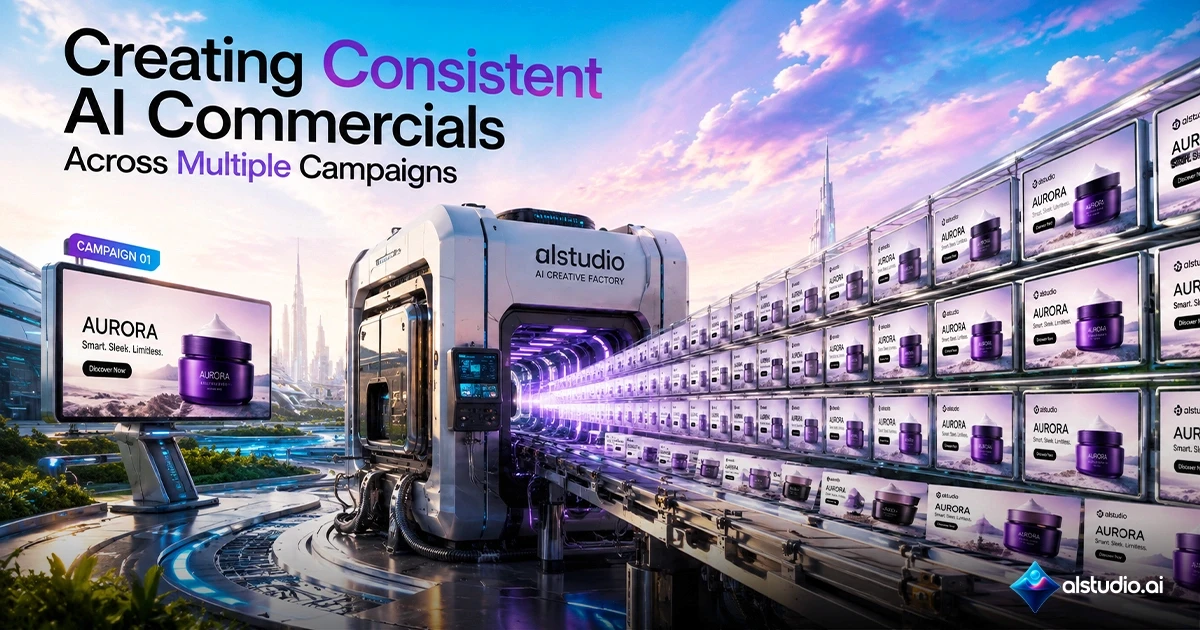
What Are Consistent AI Commercials?
Consistent AI commercials are AI-generated advertisements that maintain the same brand identity, characters, products, environments, and visual style across multiple campaigns, formats, and production cycles.
The biggest challenge in AI advertising today is not generating content. It is maintaining consistency as production scales. Teams can create impressive AI commercials in minutes, but keeping the same product, spokesperson, location, and brand presentation consistent across dozens of assets often becomes difficult.
As organizations move from AI experimentation to full-scale production, consistency becomes a business requirement. Campaigns now span social media, paid advertising, ecommerce, websites, regional markets, and video platforms. A single commercial concept can quickly evolve into hundreds of assets created by multiple people using multiple AI models.
While building ALStudio's Consistency Engine, we discovered that most consistency failures were not generation problems. They were memory problems. AI models could generate excellent content, but they could not reliably remember previous creative decisions without a dedicated system for preserving identity over time.
Featured Snippet Answer
Consistent AI commercials require more than prompts and reference images. They require a persistent system that preserves brand identity, character appearance, product details, and environments across campaigns. ALStudio achieves this through Brand DNA, Character DNA, Product DNA, and Environment DNA, allowing teams to scale commercial production while maintaining consistency across models, creators, and markets.
Why Consistent AI Commercials Matter
Short Answer
Consistent AI commercials improve brand recognition, reduce production inefficiencies, and help teams scale campaigns without introducing visual drift.
Detailed Explanation
Traditional commercial production benefits from structured workflows, approved assets, and centralized creative oversight. AI production introduces a new challenge. Every generation can potentially create a different outcome.
Without consistency controls:
Products change appearance.
Characters become less recognizable.
Locations lose continuity.
Brand presentation varies between channels.
Teams spend excessive time reviewing and correcting assets.
The larger the campaign becomes, the more severe these issues become.
Marketing teams increasingly need systems that preserve creative identity across every stage of production.
Why Most AI Commercial Workflows Fail
Short Answer
Most workflows are generation-first rather than memory-first.
Detailed Explanation
Many AI production teams rely on:
Prompts
Reference images
Asset folders
Naming conventions
Human reviews
While these approaches can produce high-quality individual assets, they do not create reusable creative memory.
In our testing while building ALStudio, we repeatedly observed that small prompt changes often resulted in significant visual differences. Teams frequently believed saved prompts would solve consistency. What we found was different.
Prompts describe outcomes.
They do not preserve identity.
Every campaign effectively starts over unless a system exists to remember what was previously approved.
This is why many organizations experience strong initial results followed by increasing inconsistency as production volume grows.
Common Consistency Problems in AI Commercial Production
Character Drift
What is it?
Characters gradually change appearance across generations.
Why does it matter?
Brand ambassadors, influencers, and recurring campaign personalities become less recognizable.
How does it happen?
Models reinterpret facial features, hairstyles, clothing, and expressions each time content is generated.
Product Mutation
What is it?
Products appear differently across campaigns.
Why does it matter?
Inaccurate product representation reduces trust and creates approval issues.
How does it happen?
AI models regenerate packaging, labels, proportions, and product details independently.
Environment Drift
What is it?
Locations change between campaigns.
Why does it matter?
Visual continuity and storytelling weaken.
How does it happen?
Most AI models recreate scenes instead of remembering them.
Brand Fragmentation
What is it?
Different teams create content that no longer feels connected.
Why does it matter?
Brand recognition decreases across channels.
How does it happen?
Teams use different prompts, references, workflows, and models.
Multi-Model Inconsistency
What is it?
Different AI models generate noticeably different results.
Why does it matter?
Campaigns lose visual cohesion.
How does it happen?
Each model interprets creative instructions differently.
The Four Layers Behind Consistent AI Commercials
Short Answer
Organizations need consistency across four areas:
Detailed Explanation
Consistency Layer | What It Controls | Why It Matters |
Brand DNA | Logos, colors, typography, tone | Maintains brand recognition |
Character DNA | Faces, appearance, identity traits | Preserves recognizable people |
Product DNA | Packaging, shape, product features | Maintains product accuracy |
Environment DNA | Locations, scenes, settings | Preserves continuity |
Many organizations focus exclusively on visual style.
In practice, commercial consistency requires all four layers.
A perfect product inside a changing environment still creates inconsistency.
A consistent environment with a changing spokesperson creates the same problem.
The strongest commercial systems preserve every layer simultaneously.
How ALStudio Creates Consistent AI Commercials
What Is the Consistency Engine?
The Consistency Engine is ALStudio's system for preserving and reusing creative identity across production workflows.
Why Does It Matter?
Without persistent memory, every campaign becomes a reconstruction exercise.
With persistent memory, teams can continue building from approved creative foundations.
How Does It Work?
The Consistency Engine operates through Constants Studio, the memory layer inside ALStudio's Creative AI OS.
It stores:
Brand DNA
Character DNA
Product DNA
Environment DNA
These assets remain available throughout production.
[SCREENSHOT: Constants Studio displaying Brand DNA, Character DNA, Product DNA, and Environment DNA connected across ALStudio]
When content is generated, approved creative foundations automatically remain connected to the workflow.
This allows consistency to survive:
Team changes
Campaign extensions
Localization
Multi-model production
Long-term content creation
A Practical Agency Example
Imagine an agency launching a beverage brand.
Campaign Launch
The team creates:
Commercial videos
Social media ads
Ecommerce assets
Product photography
Landing page visuals
Everything is approved.
Localization Phase
The client requests:
Arabic versions
English versions
Regional adaptations
Multiple creators begin producing content.
Without a consistency system:
Product labels change
Characters shift appearance
Brand colors drift
Locations become inconsistent
Campaign Expansion
The client requests a seasonal campaign.
Different team members now inherit the project.
Without persistent memory, teams spend significant time recreating previous decisions.
With ALStudio:
Brand DNA preserves visual identity
Character DNA preserves people
Product DNA preserves products
Environment DNA preserves locations
The campaign scales without losing continuity.
Enterprise Use Cases
Global Brand Management
Large organizations often manage campaigns across regions, languages, and teams.
Consistency systems help maintain brand standards regardless of market.
Product Marketing
Product launches frequently require hundreds of assets.
Product DNA helps maintain accurate product representation throughout production.
Franchise and Multi-Location Marketing
Organizations with distributed teams benefit from centralized creative memory.
Consistency can be maintained without depending on individual creators.
Internal Content Teams
Marketing departments producing content continuously can reduce approval cycles and improve efficiency.
Best Practices for Creating Consistent AI Commercials
1. Build Identity Before Generating Content
Do not start with prompts.
Start with:
Brand rules
Character definitions
Product specifications
Environment standards
2. Use Reusable Creative Systems
Approved assets should become reusable production components.
3. Standardize Workflows
Consistency improves when every creator follows the same process.
4. Preserve Approved Assets
Successful outputs should become future production references.
5. Think Beyond Individual Campaigns
Build systems that support future campaigns rather than only current projects.
Common Mistakes Teams Make
Treating Prompts as Memory
Prompts help generate content.
They do not preserve identity.
Optimizing for Single Assets
Many teams create one successful commercial and assume future assets will remain consistent.
They rarely do.
Ignoring Environment Consistency
Characters and products often receive attention while locations are neglected.
Environment drift is one of the most common consistency failures.
Using Multiple Models Without Standards
Multi-model production requires a shared consistency framework.
Without one, divergence becomes unavoidable.
Soft CTA: Evaluate Your Current Workflow
If your team spends significant time recreating prompts, rebuilding approved assets, or manually reviewing consistency issues, it may be worth evaluating whether your workflow has a generation problem or a memory problem.
Many organizations discover that production speed is no longer the bottleneck. Consistency is.
Consistent AI Commercials and Multi-Model Production
Modern commercial production rarely relies on a single AI model.
Teams increasingly use different models for:
Image generation
Video generation
Editing
Voice
Localization
ALStudio supports 18+ AI video models and integrates them into a unified workflow.
Because Brand DNA, Character DNA, Product DNA, and Environment DNA remain connected through Constants Studio, consistency can persist even when teams switch between models.
This enables scalable production without forcing organizations into a single-generation ecosystem.
Conclusion
Consistent AI commercials are not created through better prompts alone. They are created through systems that preserve creative identity across campaigns, creators, models, and time.
As AI advertising moves from experimentation to production, organizations need infrastructure that can maintain brand consistency at scale.
That is why ALStudio's Creative AI OS combines Brand DNA, Character DNA, Product DNA, Environment DNA, and the Consistency Engine into a unified production environment.
Instead of rebuilding campaigns from scratch, teams can build on approved creative memory and scale content production with confidence.
Creating Consistent AI Commercials Across Multiple Campaigns
Environment DNA
What Are Consistent AI Commercials?
Consistent AI commercials are AI-generated advertisements that maintain the same brand identity, characters, products, environments, and visual style across multiple campaigns, formats, and production cycles.
The biggest challenge in AI advertising today is not generating content. It is maintaining consistency as production scales. Teams can create impressive AI commercials in minutes, but keeping the same product, spokesperson, location, and brand presentation consistent across dozens of assets often becomes difficult.
As organizations move from AI experimentation to full-scale production, consistency becomes a business requirement. Campaigns now span social media, paid advertising, ecommerce, websites, regional markets, and video platforms. A single commercial concept can quickly evolve into hundreds of assets created by multiple people using multiple AI models.
While building ALStudio's Consistency Engine, we discovered that most consistency failures were not generation problems. They were memory problems. AI models could generate excellent content, but they could not reliably remember previous creative decisions without a dedicated system for preserving identity over time.
Featured Snippet Answer
Consistent AI commercials require more than prompts and reference images. They require a persistent system that preserves brand identity, character appearance, product details, and environments across campaigns. ALStudio achieves this through Brand DNA, Character DNA, Product DNA, and Environment DNA, allowing teams to scale commercial production while maintaining consistency across models, creators, and markets.
Why Consistent AI Commercials Matter
Short Answer
Consistent AI commercials improve brand recognition, reduce production inefficiencies, and help teams scale campaigns without introducing visual drift.
Detailed Explanation
Traditional commercial production benefits from structured workflows, approved assets, and centralized creative oversight. AI production introduces a new challenge. Every generation can potentially create a different outcome.
Without consistency controls:
Products change appearance.
Characters become less recognizable.
Locations lose continuity.
Brand presentation varies between channels.
Teams spend excessive time reviewing and correcting assets.
The larger the campaign becomes, the more severe these issues become.
Marketing teams increasingly need systems that preserve creative identity across every stage of production.
Why Most AI Commercial Workflows Fail
Short Answer
Most workflows are generation-first rather than memory-first.
Detailed Explanation
Many AI production teams rely on:
Prompts
Reference images
Asset folders
Naming conventions
Human reviews
While these approaches can produce high-quality individual assets, they do not create reusable creative memory.
In our testing while building ALStudio, we repeatedly observed that small prompt changes often resulted in significant visual differences. Teams frequently believed saved prompts would solve consistency. What we found was different.
Prompts describe outcomes.
They do not preserve identity.
Every campaign effectively starts over unless a system exists to remember what was previously approved.
This is why many organizations experience strong initial results followed by increasing inconsistency as production volume grows.
Common Consistency Problems in AI Commercial Production
Character Drift
What is it?
Characters gradually change appearance across generations.
Why does it matter?
Brand ambassadors, influencers, and recurring campaign personalities become less recognizable.
How does it happen?
Models reinterpret facial features, hairstyles, clothing, and expressions each time content is generated.
Product Mutation
What is it?
Products appear differently across campaigns.
Why does it matter?
Inaccurate product representation reduces trust and creates approval issues.
How does it happen?
AI models regenerate packaging, labels, proportions, and product details independently.
Environment Drift
What is it?
Locations change between campaigns.
Why does it matter?
Visual continuity and storytelling weaken.
How does it happen?
Most AI models recreate scenes instead of remembering them.
Brand Fragmentation
What is it?
Different teams create content that no longer feels connected.
Why does it matter?
Brand recognition decreases across channels.
How does it happen?
Teams use different prompts, references, workflows, and models.
Multi-Model Inconsistency
What is it?
Different AI models generate noticeably different results.
Why does it matter?
Campaigns lose visual cohesion.
How does it happen?
Each model interprets creative instructions differently.
The Four Layers Behind Consistent AI Commercials
Short Answer
Organizations need consistency across four areas:
Detailed Explanation
Consistency Layer | What It Controls | Why It Matters |
Brand DNA | Logos, colors, typography, tone | Maintains brand recognition |
Character DNA | Faces, appearance, identity traits | Preserves recognizable people |
Product DNA | Packaging, shape, product features | Maintains product accuracy |
Environment DNA | Locations, scenes, settings | Preserves continuity |
Many organizations focus exclusively on visual style.
In practice, commercial consistency requires all four layers.
A perfect product inside a changing environment still creates inconsistency.
A consistent environment with a changing spokesperson creates the same problem.
The strongest commercial systems preserve every layer simultaneously.
How ALStudio Creates Consistent AI Commercials
What Is the Consistency Engine?
The Consistency Engine is ALStudio's system for preserving and reusing creative identity across production workflows.
Why Does It Matter?
Without persistent memory, every campaign becomes a reconstruction exercise.
With persistent memory, teams can continue building from approved creative foundations.
How Does It Work?
The Consistency Engine operates through Constants Studio, the memory layer inside ALStudio's Creative AI OS.
It stores:
Brand DNA
Character DNA
Product DNA
Environment DNA
These assets remain available throughout production.
[SCREENSHOT: Constants Studio displaying Brand DNA, Character DNA, Product DNA, and Environment DNA connected across ALStudio]
When content is generated, approved creative foundations automatically remain connected to the workflow.
This allows consistency to survive:
Team changes
Campaign extensions
Localization
Multi-model production
Long-term content creation
A Practical Agency Example
Imagine an agency launching a beverage brand.
Campaign Launch
The team creates:
Commercial videos
Social media ads
Ecommerce assets
Product photography
Landing page visuals
Everything is approved.
Localization Phase
The client requests:
Arabic versions
English versions
Regional adaptations
Multiple creators begin producing content.
Without a consistency system:
Product labels change
Characters shift appearance
Brand colors drift
Locations become inconsistent
Campaign Expansion
The client requests a seasonal campaign.
Different team members now inherit the project.
Without persistent memory, teams spend significant time recreating previous decisions.
With ALStudio:
Brand DNA preserves visual identity
Character DNA preserves people
Product DNA preserves products
Environment DNA preserves locations
The campaign scales without losing continuity.
Enterprise Use Cases
Global Brand Management
Large organizations often manage campaigns across regions, languages, and teams.
Consistency systems help maintain brand standards regardless of market.
Product Marketing
Product launches frequently require hundreds of assets.
Product DNA helps maintain accurate product representation throughout production.
Franchise and Multi-Location Marketing
Organizations with distributed teams benefit from centralized creative memory.
Consistency can be maintained without depending on individual creators.
Internal Content Teams
Marketing departments producing content continuously can reduce approval cycles and improve efficiency.
Best Practices for Creating Consistent AI Commercials
1. Build Identity Before Generating Content
Do not start with prompts.
Start with:
Brand rules
Character definitions
Product specifications
Environment standards
2. Use Reusable Creative Systems
Approved assets should become reusable production components.
3. Standardize Workflows
Consistency improves when every creator follows the same process.
4. Preserve Approved Assets
Successful outputs should become future production references.
5. Think Beyond Individual Campaigns
Build systems that support future campaigns rather than only current projects.
Common Mistakes Teams Make
Treating Prompts as Memory
Prompts help generate content.
They do not preserve identity.
Optimizing for Single Assets
Many teams create one successful commercial and assume future assets will remain consistent.
They rarely do.
Ignoring Environment Consistency
Characters and products often receive attention while locations are neglected.
Environment drift is one of the most common consistency failures.
Using Multiple Models Without Standards
Multi-model production requires a shared consistency framework.
Without one, divergence becomes unavoidable.
Soft CTA: Evaluate Your Current Workflow
If your team spends significant time recreating prompts, rebuilding approved assets, or manually reviewing consistency issues, it may be worth evaluating whether your workflow has a generation problem or a memory problem.
Many organizations discover that production speed is no longer the bottleneck. Consistency is.
Consistent AI Commercials and Multi-Model Production
Modern commercial production rarely relies on a single AI model.
Teams increasingly use different models for:
Image generation
Video generation
Editing
Voice
Localization
ALStudio supports 18+ AI video models and integrates them into a unified workflow.
Because Brand DNA, Character DNA, Product DNA, and Environment DNA remain connected through Constants Studio, consistency can persist even when teams switch between models.
This enables scalable production without forcing organizations into a single-generation ecosystem.
Conclusion
Consistent AI commercials are not created through better prompts alone. They are created through systems that preserve creative identity across campaigns, creators, models, and time.
As AI advertising moves from experimentation to production, organizations need infrastructure that can maintain brand consistency at scale.
That is why ALStudio's Creative AI OS combines Brand DNA, Character DNA, Product DNA, Environment DNA, and the Consistency Engine into a unified production environment.
Instead of rebuilding campaigns from scratch, teams can build on approved creative memory and scale content production with confidence.
Creating Consistent AI Commercials Across Multiple Campaigns
Environment DNA
What Are Consistent AI Commercials?
Consistent AI commercials are AI-generated advertisements that maintain the same brand identity, characters, products, environments, and visual style across multiple campaigns, formats, and production cycles.
The biggest challenge in AI advertising today is not generating content. It is maintaining consistency as production scales. Teams can create impressive AI commercials in minutes, but keeping the same product, spokesperson, location, and brand presentation consistent across dozens of assets often becomes difficult.
As organizations move from AI experimentation to full-scale production, consistency becomes a business requirement. Campaigns now span social media, paid advertising, ecommerce, websites, regional markets, and video platforms. A single commercial concept can quickly evolve into hundreds of assets created by multiple people using multiple AI models.
While building ALStudio's Consistency Engine, we discovered that most consistency failures were not generation problems. They were memory problems. AI models could generate excellent content, but they could not reliably remember previous creative decisions without a dedicated system for preserving identity over time.
Featured Snippet Answer
Consistent AI commercials require more than prompts and reference images. They require a persistent system that preserves brand identity, character appearance, product details, and environments across campaigns. ALStudio achieves this through Brand DNA, Character DNA, Product DNA, and Environment DNA, allowing teams to scale commercial production while maintaining consistency across models, creators, and markets.
Why Consistent AI Commercials Matter
Short Answer
Consistent AI commercials improve brand recognition, reduce production inefficiencies, and help teams scale campaigns without introducing visual drift.
Detailed Explanation
Traditional commercial production benefits from structured workflows, approved assets, and centralized creative oversight. AI production introduces a new challenge. Every generation can potentially create a different outcome.
Without consistency controls:
Products change appearance.
Characters become less recognizable.
Locations lose continuity.
Brand presentation varies between channels.
Teams spend excessive time reviewing and correcting assets.
The larger the campaign becomes, the more severe these issues become.
Marketing teams increasingly need systems that preserve creative identity across every stage of production.
Why Most AI Commercial Workflows Fail
Short Answer
Most workflows are generation-first rather than memory-first.
Detailed Explanation
Many AI production teams rely on:
Prompts
Reference images
Asset folders
Naming conventions
Human reviews
While these approaches can produce high-quality individual assets, they do not create reusable creative memory.
In our testing while building ALStudio, we repeatedly observed that small prompt changes often resulted in significant visual differences. Teams frequently believed saved prompts would solve consistency. What we found was different.
Prompts describe outcomes.
They do not preserve identity.
Every campaign effectively starts over unless a system exists to remember what was previously approved.
This is why many organizations experience strong initial results followed by increasing inconsistency as production volume grows.
Common Consistency Problems in AI Commercial Production
Character Drift
What is it?
Characters gradually change appearance across generations.
Why does it matter?
Brand ambassadors, influencers, and recurring campaign personalities become less recognizable.
How does it happen?
Models reinterpret facial features, hairstyles, clothing, and expressions each time content is generated.
Product Mutation
What is it?
Products appear differently across campaigns.
Why does it matter?
Inaccurate product representation reduces trust and creates approval issues.
How does it happen?
AI models regenerate packaging, labels, proportions, and product details independently.
Environment Drift
What is it?
Locations change between campaigns.
Why does it matter?
Visual continuity and storytelling weaken.
How does it happen?
Most AI models recreate scenes instead of remembering them.
Brand Fragmentation
What is it?
Different teams create content that no longer feels connected.
Why does it matter?
Brand recognition decreases across channels.
How does it happen?
Teams use different prompts, references, workflows, and models.
Multi-Model Inconsistency
What is it?
Different AI models generate noticeably different results.
Why does it matter?
Campaigns lose visual cohesion.
How does it happen?
Each model interprets creative instructions differently.
The Four Layers Behind Consistent AI Commercials
Short Answer
Organizations need consistency across four areas:
Detailed Explanation
Consistency Layer | What It Controls | Why It Matters |
Brand DNA | Logos, colors, typography, tone | Maintains brand recognition |
Character DNA | Faces, appearance, identity traits | Preserves recognizable people |
Product DNA | Packaging, shape, product features | Maintains product accuracy |
Environment DNA | Locations, scenes, settings | Preserves continuity |
Many organizations focus exclusively on visual style.
In practice, commercial consistency requires all four layers.
A perfect product inside a changing environment still creates inconsistency.
A consistent environment with a changing spokesperson creates the same problem.
The strongest commercial systems preserve every layer simultaneously.
How ALStudio Creates Consistent AI Commercials
What Is the Consistency Engine?
The Consistency Engine is ALStudio's system for preserving and reusing creative identity across production workflows.
Why Does It Matter?
Without persistent memory, every campaign becomes a reconstruction exercise.
With persistent memory, teams can continue building from approved creative foundations.
How Does It Work?
The Consistency Engine operates through Constants Studio, the memory layer inside ALStudio's Creative AI OS.
It stores:
Brand DNA
Character DNA
Product DNA
Environment DNA
These assets remain available throughout production.
[SCREENSHOT: Constants Studio displaying Brand DNA, Character DNA, Product DNA, and Environment DNA connected across ALStudio]
When content is generated, approved creative foundations automatically remain connected to the workflow.
This allows consistency to survive:
Team changes
Campaign extensions
Localization
Multi-model production
Long-term content creation
A Practical Agency Example
Imagine an agency launching a beverage brand.
Campaign Launch
The team creates:
Commercial videos
Social media ads
Ecommerce assets
Product photography
Landing page visuals
Everything is approved.
Localization Phase
The client requests:
Arabic versions
English versions
Regional adaptations
Multiple creators begin producing content.
Without a consistency system:
Product labels change
Characters shift appearance
Brand colors drift
Locations become inconsistent
Campaign Expansion
The client requests a seasonal campaign.
Different team members now inherit the project.
Without persistent memory, teams spend significant time recreating previous decisions.
With ALStudio:
Brand DNA preserves visual identity
Character DNA preserves people
Product DNA preserves products
Environment DNA preserves locations
The campaign scales without losing continuity.
Enterprise Use Cases
Global Brand Management
Large organizations often manage campaigns across regions, languages, and teams.
Consistency systems help maintain brand standards regardless of market.
Product Marketing
Product launches frequently require hundreds of assets.
Product DNA helps maintain accurate product representation throughout production.
Franchise and Multi-Location Marketing
Organizations with distributed teams benefit from centralized creative memory.
Consistency can be maintained without depending on individual creators.
Internal Content Teams
Marketing departments producing content continuously can reduce approval cycles and improve efficiency.
Best Practices for Creating Consistent AI Commercials
1. Build Identity Before Generating Content
Do not start with prompts.
Start with:
Brand rules
Character definitions
Product specifications
Environment standards
2. Use Reusable Creative Systems
Approved assets should become reusable production components.
3. Standardize Workflows
Consistency improves when every creator follows the same process.
4. Preserve Approved Assets
Successful outputs should become future production references.
5. Think Beyond Individual Campaigns
Build systems that support future campaigns rather than only current projects.
Common Mistakes Teams Make
Treating Prompts as Memory
Prompts help generate content.
They do not preserve identity.
Optimizing for Single Assets
Many teams create one successful commercial and assume future assets will remain consistent.
They rarely do.
Ignoring Environment Consistency
Characters and products often receive attention while locations are neglected.
Environment drift is one of the most common consistency failures.
Using Multiple Models Without Standards
Multi-model production requires a shared consistency framework.
Without one, divergence becomes unavoidable.
Soft CTA: Evaluate Your Current Workflow
If your team spends significant time recreating prompts, rebuilding approved assets, or manually reviewing consistency issues, it may be worth evaluating whether your workflow has a generation problem or a memory problem.
Many organizations discover that production speed is no longer the bottleneck. Consistency is.
Consistent AI Commercials and Multi-Model Production
Modern commercial production rarely relies on a single AI model.
Teams increasingly use different models for:
Image generation
Video generation
Editing
Voice
Localization
ALStudio supports 18+ AI video models and integrates them into a unified workflow.
Because Brand DNA, Character DNA, Product DNA, and Environment DNA remain connected through Constants Studio, consistency can persist even when teams switch between models.
This enables scalable production without forcing organizations into a single-generation ecosystem.
Conclusion
Consistent AI commercials are not created through better prompts alone. They are created through systems that preserve creative identity across campaigns, creators, models, and time.
As AI advertising moves from experimentation to production, organizations need infrastructure that can maintain brand consistency at scale.
That is why ALStudio's Creative AI OS combines Brand DNA, Character DNA, Product DNA, Environment DNA, and the Consistency Engine into a unified production environment.
Instead of rebuilding campaigns from scratch, teams can build on approved creative memory and scale content production with confidence.
Creating Consistent AI Commercials Across Multiple Campaigns
Environment DNA
What Are Consistent AI Commercials?
Consistent AI commercials are AI-generated advertisements that maintain the same brand identity, characters, products, environments, and visual style across multiple campaigns, formats, and production cycles.
The biggest challenge in AI advertising today is not generating content. It is maintaining consistency as production scales. Teams can create impressive AI commercials in minutes, but keeping the same product, spokesperson, location, and brand presentation consistent across dozens of assets often becomes difficult.
As organizations move from AI experimentation to full-scale production, consistency becomes a business requirement. Campaigns now span social media, paid advertising, ecommerce, websites, regional markets, and video platforms. A single commercial concept can quickly evolve into hundreds of assets created by multiple people using multiple AI models.
While building ALStudio's Consistency Engine, we discovered that most consistency failures were not generation problems. They were memory problems. AI models could generate excellent content, but they could not reliably remember previous creative decisions without a dedicated system for preserving identity over time.
Featured Snippet Answer
Consistent AI commercials require more than prompts and reference images. They require a persistent system that preserves brand identity, character appearance, product details, and environments across campaigns. ALStudio achieves this through Brand DNA, Character DNA, Product DNA, and Environment DNA, allowing teams to scale commercial production while maintaining consistency across models, creators, and markets.
Why Consistent AI Commercials Matter
Short Answer
Consistent AI commercials improve brand recognition, reduce production inefficiencies, and help teams scale campaigns without introducing visual drift.
Detailed Explanation
Traditional commercial production benefits from structured workflows, approved assets, and centralized creative oversight. AI production introduces a new challenge. Every generation can potentially create a different outcome.
Without consistency controls:
Products change appearance.
Characters become less recognizable.
Locations lose continuity.
Brand presentation varies between channels.
Teams spend excessive time reviewing and correcting assets.
The larger the campaign becomes, the more severe these issues become.
Marketing teams increasingly need systems that preserve creative identity across every stage of production.
Why Most AI Commercial Workflows Fail
Short Answer
Most workflows are generation-first rather than memory-first.
Detailed Explanation
Many AI production teams rely on:
Prompts
Reference images
Asset folders
Naming conventions
Human reviews
While these approaches can produce high-quality individual assets, they do not create reusable creative memory.
In our testing while building ALStudio, we repeatedly observed that small prompt changes often resulted in significant visual differences. Teams frequently believed saved prompts would solve consistency. What we found was different.
Prompts describe outcomes.
They do not preserve identity.
Every campaign effectively starts over unless a system exists to remember what was previously approved.
This is why many organizations experience strong initial results followed by increasing inconsistency as production volume grows.
Common Consistency Problems in AI Commercial Production
Character Drift
What is it?
Characters gradually change appearance across generations.
Why does it matter?
Brand ambassadors, influencers, and recurring campaign personalities become less recognizable.
How does it happen?
Models reinterpret facial features, hairstyles, clothing, and expressions each time content is generated.
Product Mutation
What is it?
Products appear differently across campaigns.
Why does it matter?
Inaccurate product representation reduces trust and creates approval issues.
How does it happen?
AI models regenerate packaging, labels, proportions, and product details independently.
Environment Drift
What is it?
Locations change between campaigns.
Why does it matter?
Visual continuity and storytelling weaken.
How does it happen?
Most AI models recreate scenes instead of remembering them.
Brand Fragmentation
What is it?
Different teams create content that no longer feels connected.
Why does it matter?
Brand recognition decreases across channels.
How does it happen?
Teams use different prompts, references, workflows, and models.
Multi-Model Inconsistency
What is it?
Different AI models generate noticeably different results.
Why does it matter?
Campaigns lose visual cohesion.
How does it happen?
Each model interprets creative instructions differently.
The Four Layers Behind Consistent AI Commercials
Short Answer
Organizations need consistency across four areas:
Detailed Explanation
Consistency Layer | What It Controls | Why It Matters |
Brand DNA | Logos, colors, typography, tone | Maintains brand recognition |
Character DNA | Faces, appearance, identity traits | Preserves recognizable people |
Product DNA | Packaging, shape, product features | Maintains product accuracy |
Environment DNA | Locations, scenes, settings | Preserves continuity |
Many organizations focus exclusively on visual style.
In practice, commercial consistency requires all four layers.
A perfect product inside a changing environment still creates inconsistency.
A consistent environment with a changing spokesperson creates the same problem.
The strongest commercial systems preserve every layer simultaneously.
How ALStudio Creates Consistent AI Commercials
What Is the Consistency Engine?
The Consistency Engine is ALStudio's system for preserving and reusing creative identity across production workflows.
Why Does It Matter?
Without persistent memory, every campaign becomes a reconstruction exercise.
With persistent memory, teams can continue building from approved creative foundations.
How Does It Work?
The Consistency Engine operates through Constants Studio, the memory layer inside ALStudio's Creative AI OS.
It stores:
Brand DNA
Character DNA
Product DNA
Environment DNA
These assets remain available throughout production.
[SCREENSHOT: Constants Studio displaying Brand DNA, Character DNA, Product DNA, and Environment DNA connected across ALStudio]
When content is generated, approved creative foundations automatically remain connected to the workflow.
This allows consistency to survive:
Team changes
Campaign extensions
Localization
Multi-model production
Long-term content creation
A Practical Agency Example
Imagine an agency launching a beverage brand.
Campaign Launch
The team creates:
Commercial videos
Social media ads
Ecommerce assets
Product photography
Landing page visuals
Everything is approved.
Localization Phase
The client requests:
Arabic versions
English versions
Regional adaptations
Multiple creators begin producing content.
Without a consistency system:
Product labels change
Characters shift appearance
Brand colors drift
Locations become inconsistent
Campaign Expansion
The client requests a seasonal campaign.
Different team members now inherit the project.
Without persistent memory, teams spend significant time recreating previous decisions.
With ALStudio:
Brand DNA preserves visual identity
Character DNA preserves people
Product DNA preserves products
Environment DNA preserves locations
The campaign scales without losing continuity.
Enterprise Use Cases
Global Brand Management
Large organizations often manage campaigns across regions, languages, and teams.
Consistency systems help maintain brand standards regardless of market.
Product Marketing
Product launches frequently require hundreds of assets.
Product DNA helps maintain accurate product representation throughout production.
Franchise and Multi-Location Marketing
Organizations with distributed teams benefit from centralized creative memory.
Consistency can be maintained without depending on individual creators.
Internal Content Teams
Marketing departments producing content continuously can reduce approval cycles and improve efficiency.
Best Practices for Creating Consistent AI Commercials
1. Build Identity Before Generating Content
Do not start with prompts.
Start with:
Brand rules
Character definitions
Product specifications
Environment standards
2. Use Reusable Creative Systems
Approved assets should become reusable production components.
3. Standardize Workflows
Consistency improves when every creator follows the same process.
4. Preserve Approved Assets
Successful outputs should become future production references.
5. Think Beyond Individual Campaigns
Build systems that support future campaigns rather than only current projects.
Common Mistakes Teams Make
Treating Prompts as Memory
Prompts help generate content.
They do not preserve identity.
Optimizing for Single Assets
Many teams create one successful commercial and assume future assets will remain consistent.
They rarely do.
Ignoring Environment Consistency
Characters and products often receive attention while locations are neglected.
Environment drift is one of the most common consistency failures.
Using Multiple Models Without Standards
Multi-model production requires a shared consistency framework.
Without one, divergence becomes unavoidable.
Soft CTA: Evaluate Your Current Workflow
If your team spends significant time recreating prompts, rebuilding approved assets, or manually reviewing consistency issues, it may be worth evaluating whether your workflow has a generation problem or a memory problem.
Many organizations discover that production speed is no longer the bottleneck. Consistency is.
Consistent AI Commercials and Multi-Model Production
Modern commercial production rarely relies on a single AI model.
Teams increasingly use different models for:
Image generation
Video generation
Editing
Voice
Localization
ALStudio supports 18+ AI video models and integrates them into a unified workflow.
Because Brand DNA, Character DNA, Product DNA, and Environment DNA remain connected through Constants Studio, consistency can persist even when teams switch between models.
This enables scalable production without forcing organizations into a single-generation ecosystem.
Conclusion
Consistent AI commercials are not created through better prompts alone. They are created through systems that preserve creative identity across campaigns, creators, models, and time.
As AI advertising moves from experimentation to production, organizations need infrastructure that can maintain brand consistency at scale.
That is why ALStudio's Creative AI OS combines Brand DNA, Character DNA, Product DNA, Environment DNA, and the Consistency Engine into a unified production environment.
Instead of rebuilding campaigns from scratch, teams can build on approved creative memory and scale content production with confidence.
Frequently Asked Questions
Everything you'd want to know before signing up and everything an agency buyer asks on the call.
How much does a system for consistent AI commercials typically cost?
The cost varies depending on production volume, workflow complexity, and team size. Organizations should evaluate not only software costs but also the time spent correcting inconsistencies, recreating assets, and managing approvals.
What is the difference between prompts and a consistency system?
Prompts describe desired outputs. Consistency systems preserve approved creative identity. While prompts help generate content, consistency systems help maintain continuity across future campaigns.
Can consistent AI commercials work across multiple AI models?
Switching aspect ratios
How long does implementation take?
Implementation depends on campaign complexity and the number of assets being standardized. Organizations that define Brand DNA, Character DNA, Product DNA, and Environment DNA early generally achieve faster adoption.
What business outcomes do consistent AI commercials improve?
Consistent AI commercials can reduce review cycles, improve brand recognition, streamline localization, accelerate campaign scaling, and help teams maintain quality across large production environments.
Related blogs
Provide insights into team performance and engagement



Related blogs
Provide insights into team performance and engagement
Related blogs
Provide insights into team performance and engagement
Stay Ahead of AI Creativity
Get new AI models, creative workflows, product updates, and marketing insights delivered to your inbox.
Tools
©2026 Animus All Rights Reserved.
Stay Ahead of AI Creativity
Get new AI models, creative workflows, product updates, and marketing insights delivered to your inbox.
Tools
©2026 Animus All Rights Reserved.
Stay Ahead of AI Creativity
Get new AI models, creative workflows, product updates, and marketing insights delivered to your inbox.
Tools
©2026 Animus All Rights Reserved.