



Best Higgsfield Alternative for Agencies
Comparisons & alternatives
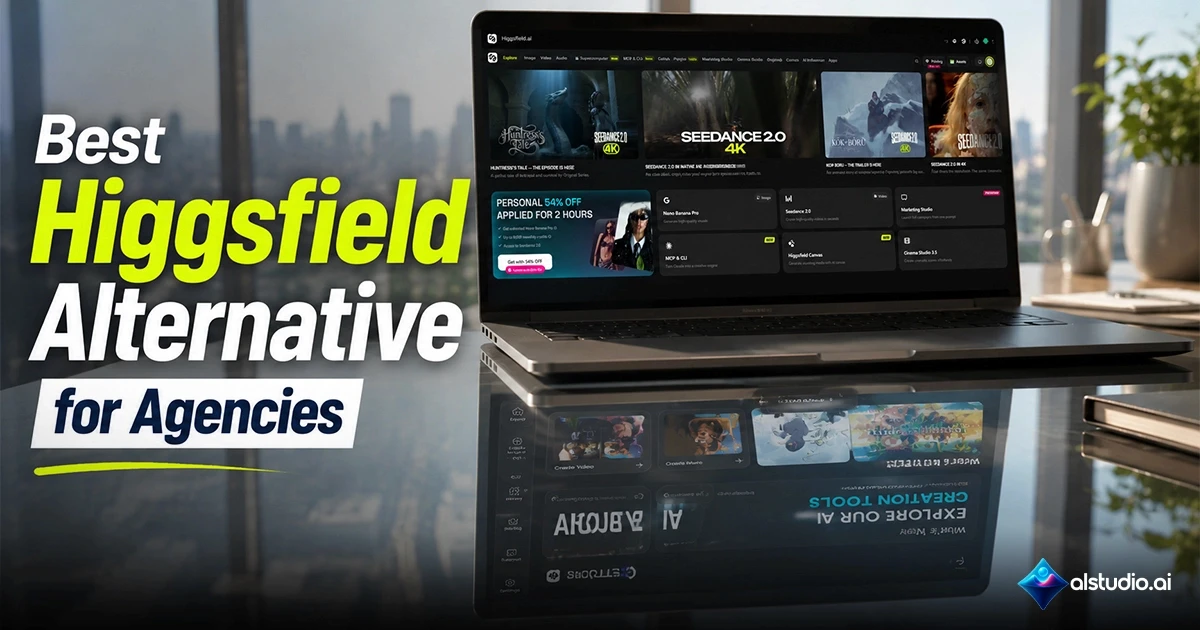
Best Higgsfield Alternative for Agencies Managing
Multiple Brands in 2026
TL;DR
Choose Higgsfield if you need individual AI video clips. Choose ALStudio if your agency manages multiple client brands and needs consistent campaign production across video, content, voiceovers, and social formats.
The difference: Higgsfield helps teams generate assets. ALStudio helps agencies operate production. |
If you are searching for the best Higgsfield alternative, you are probably past the point of asking whether AI can generate impressive video. Most platforms can. The harder question the one this article addresses is which platform helps agencies produce consistent, on-brand campaigns across multiple client accounts without rebuilding context every time.
This guide compares Higgsfield and ALStudio.ai across the capabilities that matter most to agencies: brand memory, team collaboration, multi-client management, and production scalability. By the end, you will have a clear answer on which tool fits your operational reality.
Why Agencies Eventually Outgrow AI Video Generators
When agencies first adopt AI, they evaluate tools based on generation quality. Can it create a realistic video? Can it generate a strong product shot? Can it produce engaging social content?
Those questions matter but only for the first few months.
After a few months of production, a different problem appears. The issue is no longer generating content. The issue is managing content production across multiple brands simultaneously.
A modern agency may be responsible for:
• Five or more active client retainers
• Multiple campaign calendars running in parallel
• Several social platforms per client
• Product launches and regional content variations
• Multiple stakeholders and approval workflows
At that scale, generation quality stops being the bottleneck. Consistency becomes the bottleneck. The challenge shifts from creating content to coordinating production.
Most comparison articles focus on video quality, model counts, or pricing. Very few address the operational reality of running production for multiple brands simultaneously. That is where the difference between a video generator and a Creative AI Operating System becomes critical.
Why the Team Should Not Be the Memory
One pattern appears repeatedly inside growing agencies: the team becomes responsible for remembering everything.
• Which logo version is currently approved?
• Which product photography standard is active?
• Which character reference belongs to which client?
• Which visual style was used last quarter?
• Which campaign rules changed after last month's review?
Most agencies solve these problems using shared drives, Notion pages, brand documents, and internal reference boards. The AI generates. The team remembers.
As client volume increases, that approach becomes unsustainable. The result: more revisions, more QA cycles, more internal coordination, delayed approvals, and growing production overhead.
The problem is not generation quality. The problem is memory. Most AI platforms generate content effectively. Very few remember context effectively. That distinction becomes increasingly important as agencies scale.
What Makes an AI Platform Agency-Grade
Agency-grade AI production is not a generation feature. It is production infrastructure.
A platform becomes agency-grade when it can:
• Store client identity persistently
• Maintain consistency across campaigns without re-uploading references
• Support multiple team members from a shared source of truth
• Reduce revision cycles through system-level consistency
• Scale production capacity without scaling coordination overhead
For a creator, a good AI tool generates a strong output. For an agency, a good AI tool helps deliver campaigns repeatedly, consistently, and profitably. Every approval cycle caused by visual inconsistency reduces margin. The consistency layer is not a nice-to-have. It becomes part of the agency's operating system.
Higgsfield Alternative Comparison: ALStudio vs Higgsfield
Capability | Higgsfield | ALStudio |
AI video generation | Yes | Yes |
Multiple AI video models | Yes | Yes |
Character consistency | Soul ID | Character DNA |
Brand consistency | Limited | Brand DNA |
Product consistency | Limited | Product DNA |
Environment consistency | Limited | Environment DNA |
Team-wide persistent memory | No | Yes (Constants Studio) |
Arabic voiceovers | Limited availability | 22+ dialects |
Social campaign production | Limited | Social Factory |
Written content generation | Limited | Content Studio |
Multi-client workspace management | Limited | Built for agencies |
White-label support | Limited | Yes |
Watermark-free output | Plan dependent | All plans |
The most important difference in this comparison is not video quality. It is what happens after generation how the platform maintains identity, consistency, and efficiency across the entire production lifecycle.
How Reference-Based Workflows Create Hidden Production Costs
Most AI video platforms including Higgsfield were designed around the creator workflow. A user opens a project, uploads references, generates content, exports the result, and starts again next time.
This workflow works well for individual creators. It becomes structurally expensive when multiple team members are producing content for multiple brands simultaneously.
The core structural challenge is that reference-based generation is session-based. Every new project requires rebuilding context. Every new campaign requires re-establishing visual identity. Every new team member requires manual access to the correct references.
A typical production cycle in a reference-based workflow often includes:
• Locating approved assets from shared drives
• Finding and uploading current character references
• Re-entering product specifications and brand guidelines
• Reviewing outputs for visual consistency
• Regenerating content that drifted from brand standards
• Coordinating approvals across delayed review cycles
Individually, each of these tasks seems small. Collectively, across multiple clients and dozens of deliverables per month, they compound into significant operational overhead.
These costs rarely appear as line items on software invoices. They appear as additional revisions, delayed approvals, internal coordination hours, and margin erosion.
Constants Studio: ALStudio's Persistent Memory Layer
Constants Studio is ALStudio's shared memory architecture. It sits beneath every production workflow and stores four persistent identity systems that remain active across future campaigns, future projects, and future team members.
Brand DNA
Stores logo rules, color systems, typography, visual style, and tone of voice. Every team member generating content for that client automatically works from the same brand foundation.
Character DNA
Stores approved faces, personas, appearance rules, and character references. Characters remain visually consistent across videos, campaigns, and formats without repeated uploads.
Product DNA
Stores product visuals, packaging details, approved render styles, and product specifications. Products look identical across every ad, video, and social post without manual reference management.
Environment DNA
Stores locations, scene settings, background styles, and environmental specifications. Scene continuity is maintained across campaigns automatically.
Key operational shift:
Without Constants Studio: Configure brand identity per project, per team member, per campaign. With Constants Studio: Configure once. Every Studio, every workflow, every team member reads from the same persistent source of truth. |
A Practical Agency Example: Three Clients, One Team
Imagine a digital agency managing three active retainers simultaneously.
• Client A (Ecommerce): Weekly product campaigns across Instagram, TikTok, and paid social.
• Client B (Real Estate): Property launches, walkthrough videos, and regional content.
• Client C (Financial Services): Educational explainers and product awareness campaigns.
Without persistent brand memory, team members upload different references. Product appearance drifts between campaigns. Brand colors become inconsistent across team members. Approvals take longer as reviewers flag inconsistencies. Revision cycles expand.
With Constants Studio, each client is configured once. Brand DNA stores the visual identity. Character DNA stores approved personas. Product DNA stores product visuals. Environment DNA stores scene specifications. Every team member generates from the same shared system. Consistency becomes automatic rather than manual.
ALStudio's Full Production Architecture
Constants Studio is the memory layer. It feeds ALStudio's full suite of production Studios:
• Content Studio: Campaign briefs, blog posts, social captions, email campaigns, product descriptions, and scripts.
• Film Studio: Cinematic videos, product films, character-driven content, and commercial advertisements.
• Marketing Studio: Social campaigns, paid advertisements, UGC campaigns, and multi-platform content packages.
• Editor Studio: Video editing, post-production, upscaling, and content refinement.
Each Studio reads from the same stored identity system. Teams do not need to rebuild brand context between workflows. Every output starts with brand identity already attached.
For agencies with Arabic-speaking audiences, ALStudio also supports 22+ Arabic dialect voiceovers including Egyptian, Gulf, Levantine, and other regional variants a significant capability gap relative to most AI video platforms.
When Video Quality Stops Being the Decision
When agencies first evaluate AI platforms, generation quality is the primary variable. Which platform creates the best video? Which produces the most realistic motion?
Over time, the gap between leading AI models narrows. Most major platforms now generate impressive content. The larger challenge becomes operational.
Agencies eventually evaluate platforms based on:
• Consistency across campaigns and team members
• Production speed relative to revision cycles
• Collaboration infrastructure for multi-person teams
• Localization support for regional campaigns
• Campaign scalability without proportional overhead growth
The platform that eliminates five revision rounds often creates more business value than the platform that produces a slightly better individual clip. Generation quality is important. Production efficiency becomes critical at scale.
Who Should Use ALStudio as a Higgsfield Alternative
ALStudio delivers the most value for:
• Agencies managing multiple client brands with recurring campaign production needs.
• Marketing teams running content across multiple channels who need shared identity systems.
• Ecommerce brands with large product catalogs requiring visual consistency across all campaigns.
• Multi-market organizations producing localized content who need centralized brand governance.
• Content creators building long-term series or recurring characters who need persistent visual identity.
Who Should Stay with Higgsfield
ALStudio is not the right fit for everyone. If you only create occasional standalone videos, work independently without collaboration requirements, and do not need persistent brand memory or campaign-level consistency, a dedicated video generation platform may be sufficient. ALStudio creates the most value when production complexity and client volume begin to increase.
Final Verdict: The Best Higgsfield Alternative for Agencies in 2026
The right question when evaluating a Higgsfield alternative is not which platform generates better video. The better question is which platform removes more operational work from the production process.
For creators, a standalone video generator is often enough. For agencies managing multiple brands, multiple campaigns, multiple stakeholders, and multiple delivery formats, the challenge is much larger than generation. The challenge is consistency at scale.
ALStudio was built as a Creative AI Operating System not a standalone video generator specifically because agencies need production infrastructure, not just generation capability. Constants Studio stores Brand DNA, Character DNA, Product DNA, and Environment DNA once, then applies them automatically across every workflow and every team member.
The result: fewer revisions, stronger consistency, faster approvals, Arabic and multilingual voiceover support, and a production system that becomes more valuable with every client account added.
If your team is spending more time rebuilding context than creating content, it may be time to replace the workflow not just the software.
Featured Snippet
Featured Snippet (Target: 'What is the best Higgsfield alternative for agencies?')
ALStudio.ai is the strongest Higgsfield alternative for agencies managing multiple brands. Unlike Higgsfield which focuses on AI video generation ALStudio functions as a Creative AI Operating System. Its Constants Studio module stores Brand DNA, Character DNA, Product DNA, and Environment DNA persistently, so agencies never need to re-upload references or rebuild brand context between campaigns. ALStudio also includes Content Studio, Film Studio, Marketing Studio, and Editor Studio, plus support for 22+ Arabic dialect voiceovers. A free plan is available with access to all core features including watermark-free output. |
Best Higgsfield Alternative for Agencies
Comparisons & alternatives
Best Higgsfield Alternative for Agencies Managing
Multiple Brands in 2026
TL;DR
Choose Higgsfield if you need individual AI video clips. Choose ALStudio if your agency manages multiple client brands and needs consistent campaign production across video, content, voiceovers, and social formats.
The difference: Higgsfield helps teams generate assets. ALStudio helps agencies operate production. |
If you are searching for the best Higgsfield alternative, you are probably past the point of asking whether AI can generate impressive video. Most platforms can. The harder question the one this article addresses is which platform helps agencies produce consistent, on-brand campaigns across multiple client accounts without rebuilding context every time.
This guide compares Higgsfield and ALStudio.ai across the capabilities that matter most to agencies: brand memory, team collaboration, multi-client management, and production scalability. By the end, you will have a clear answer on which tool fits your operational reality.
Why Agencies Eventually Outgrow AI Video Generators
When agencies first adopt AI, they evaluate tools based on generation quality. Can it create a realistic video? Can it generate a strong product shot? Can it produce engaging social content?
Those questions matter but only for the first few months.
After a few months of production, a different problem appears. The issue is no longer generating content. The issue is managing content production across multiple brands simultaneously.
A modern agency may be responsible for:
• Five or more active client retainers
• Multiple campaign calendars running in parallel
• Several social platforms per client
• Product launches and regional content variations
• Multiple stakeholders and approval workflows
At that scale, generation quality stops being the bottleneck. Consistency becomes the bottleneck. The challenge shifts from creating content to coordinating production.
Most comparison articles focus on video quality, model counts, or pricing. Very few address the operational reality of running production for multiple brands simultaneously. That is where the difference between a video generator and a Creative AI Operating System becomes critical.
Why the Team Should Not Be the Memory
One pattern appears repeatedly inside growing agencies: the team becomes responsible for remembering everything.
• Which logo version is currently approved?
• Which product photography standard is active?
• Which character reference belongs to which client?
• Which visual style was used last quarter?
• Which campaign rules changed after last month's review?
Most agencies solve these problems using shared drives, Notion pages, brand documents, and internal reference boards. The AI generates. The team remembers.
As client volume increases, that approach becomes unsustainable. The result: more revisions, more QA cycles, more internal coordination, delayed approvals, and growing production overhead.
The problem is not generation quality. The problem is memory. Most AI platforms generate content effectively. Very few remember context effectively. That distinction becomes increasingly important as agencies scale.
What Makes an AI Platform Agency-Grade
Agency-grade AI production is not a generation feature. It is production infrastructure.
A platform becomes agency-grade when it can:
• Store client identity persistently
• Maintain consistency across campaigns without re-uploading references
• Support multiple team members from a shared source of truth
• Reduce revision cycles through system-level consistency
• Scale production capacity without scaling coordination overhead
For a creator, a good AI tool generates a strong output. For an agency, a good AI tool helps deliver campaigns repeatedly, consistently, and profitably. Every approval cycle caused by visual inconsistency reduces margin. The consistency layer is not a nice-to-have. It becomes part of the agency's operating system.
Higgsfield Alternative Comparison: ALStudio vs Higgsfield
Capability | Higgsfield | ALStudio |
AI video generation | Yes | Yes |
Multiple AI video models | Yes | Yes |
Character consistency | Soul ID | Character DNA |
Brand consistency | Limited | Brand DNA |
Product consistency | Limited | Product DNA |
Environment consistency | Limited | Environment DNA |
Team-wide persistent memory | No | Yes (Constants Studio) |
Arabic voiceovers | Limited availability | 22+ dialects |
Social campaign production | Limited | Social Factory |
Written content generation | Limited | Content Studio |
Multi-client workspace management | Limited | Built for agencies |
White-label support | Limited | Yes |
Watermark-free output | Plan dependent | All plans |
The most important difference in this comparison is not video quality. It is what happens after generation how the platform maintains identity, consistency, and efficiency across the entire production lifecycle.
How Reference-Based Workflows Create Hidden Production Costs
Most AI video platforms including Higgsfield were designed around the creator workflow. A user opens a project, uploads references, generates content, exports the result, and starts again next time.
This workflow works well for individual creators. It becomes structurally expensive when multiple team members are producing content for multiple brands simultaneously.
The core structural challenge is that reference-based generation is session-based. Every new project requires rebuilding context. Every new campaign requires re-establishing visual identity. Every new team member requires manual access to the correct references.
A typical production cycle in a reference-based workflow often includes:
• Locating approved assets from shared drives
• Finding and uploading current character references
• Re-entering product specifications and brand guidelines
• Reviewing outputs for visual consistency
• Regenerating content that drifted from brand standards
• Coordinating approvals across delayed review cycles
Individually, each of these tasks seems small. Collectively, across multiple clients and dozens of deliverables per month, they compound into significant operational overhead.
These costs rarely appear as line items on software invoices. They appear as additional revisions, delayed approvals, internal coordination hours, and margin erosion.
Constants Studio: ALStudio's Persistent Memory Layer
Constants Studio is ALStudio's shared memory architecture. It sits beneath every production workflow and stores four persistent identity systems that remain active across future campaigns, future projects, and future team members.
Brand DNA
Stores logo rules, color systems, typography, visual style, and tone of voice. Every team member generating content for that client automatically works from the same brand foundation.
Character DNA
Stores approved faces, personas, appearance rules, and character references. Characters remain visually consistent across videos, campaigns, and formats without repeated uploads.
Product DNA
Stores product visuals, packaging details, approved render styles, and product specifications. Products look identical across every ad, video, and social post without manual reference management.
Environment DNA
Stores locations, scene settings, background styles, and environmental specifications. Scene continuity is maintained across campaigns automatically.
Key operational shift:
Without Constants Studio: Configure brand identity per project, per team member, per campaign. With Constants Studio: Configure once. Every Studio, every workflow, every team member reads from the same persistent source of truth. |
A Practical Agency Example: Three Clients, One Team
Imagine a digital agency managing three active retainers simultaneously.
• Client A (Ecommerce): Weekly product campaigns across Instagram, TikTok, and paid social.
• Client B (Real Estate): Property launches, walkthrough videos, and regional content.
• Client C (Financial Services): Educational explainers and product awareness campaigns.
Without persistent brand memory, team members upload different references. Product appearance drifts between campaigns. Brand colors become inconsistent across team members. Approvals take longer as reviewers flag inconsistencies. Revision cycles expand.
With Constants Studio, each client is configured once. Brand DNA stores the visual identity. Character DNA stores approved personas. Product DNA stores product visuals. Environment DNA stores scene specifications. Every team member generates from the same shared system. Consistency becomes automatic rather than manual.
ALStudio's Full Production Architecture
Constants Studio is the memory layer. It feeds ALStudio's full suite of production Studios:
• Content Studio: Campaign briefs, blog posts, social captions, email campaigns, product descriptions, and scripts.
• Film Studio: Cinematic videos, product films, character-driven content, and commercial advertisements.
• Marketing Studio: Social campaigns, paid advertisements, UGC campaigns, and multi-platform content packages.
• Editor Studio: Video editing, post-production, upscaling, and content refinement.
Each Studio reads from the same stored identity system. Teams do not need to rebuild brand context between workflows. Every output starts with brand identity already attached.
For agencies with Arabic-speaking audiences, ALStudio also supports 22+ Arabic dialect voiceovers including Egyptian, Gulf, Levantine, and other regional variants a significant capability gap relative to most AI video platforms.
When Video Quality Stops Being the Decision
When agencies first evaluate AI platforms, generation quality is the primary variable. Which platform creates the best video? Which produces the most realistic motion?
Over time, the gap between leading AI models narrows. Most major platforms now generate impressive content. The larger challenge becomes operational.
Agencies eventually evaluate platforms based on:
• Consistency across campaigns and team members
• Production speed relative to revision cycles
• Collaboration infrastructure for multi-person teams
• Localization support for regional campaigns
• Campaign scalability without proportional overhead growth
The platform that eliminates five revision rounds often creates more business value than the platform that produces a slightly better individual clip. Generation quality is important. Production efficiency becomes critical at scale.
Who Should Use ALStudio as a Higgsfield Alternative
ALStudio delivers the most value for:
• Agencies managing multiple client brands with recurring campaign production needs.
• Marketing teams running content across multiple channels who need shared identity systems.
• Ecommerce brands with large product catalogs requiring visual consistency across all campaigns.
• Multi-market organizations producing localized content who need centralized brand governance.
• Content creators building long-term series or recurring characters who need persistent visual identity.
Who Should Stay with Higgsfield
ALStudio is not the right fit for everyone. If you only create occasional standalone videos, work independently without collaboration requirements, and do not need persistent brand memory or campaign-level consistency, a dedicated video generation platform may be sufficient. ALStudio creates the most value when production complexity and client volume begin to increase.
Final Verdict: The Best Higgsfield Alternative for Agencies in 2026
The right question when evaluating a Higgsfield alternative is not which platform generates better video. The better question is which platform removes more operational work from the production process.
For creators, a standalone video generator is often enough. For agencies managing multiple brands, multiple campaigns, multiple stakeholders, and multiple delivery formats, the challenge is much larger than generation. The challenge is consistency at scale.
ALStudio was built as a Creative AI Operating System not a standalone video generator specifically because agencies need production infrastructure, not just generation capability. Constants Studio stores Brand DNA, Character DNA, Product DNA, and Environment DNA once, then applies them automatically across every workflow and every team member.
The result: fewer revisions, stronger consistency, faster approvals, Arabic and multilingual voiceover support, and a production system that becomes more valuable with every client account added.
If your team is spending more time rebuilding context than creating content, it may be time to replace the workflow not just the software.
Featured Snippet
Featured Snippet (Target: 'What is the best Higgsfield alternative for agencies?')
ALStudio.ai is the strongest Higgsfield alternative for agencies managing multiple brands. Unlike Higgsfield which focuses on AI video generation ALStudio functions as a Creative AI Operating System. Its Constants Studio module stores Brand DNA, Character DNA, Product DNA, and Environment DNA persistently, so agencies never need to re-upload references or rebuild brand context between campaigns. ALStudio also includes Content Studio, Film Studio, Marketing Studio, and Editor Studio, plus support for 22+ Arabic dialect voiceovers. A free plan is available with access to all core features including watermark-free output. |
Best Higgsfield Alternative for Agencies
Comparisons & alternatives
Best Higgsfield Alternative for Agencies Managing
Multiple Brands in 2026
TL;DR
Choose Higgsfield if you need individual AI video clips. Choose ALStudio if your agency manages multiple client brands and needs consistent campaign production across video, content, voiceovers, and social formats.
The difference: Higgsfield helps teams generate assets. ALStudio helps agencies operate production. |
If you are searching for the best Higgsfield alternative, you are probably past the point of asking whether AI can generate impressive video. Most platforms can. The harder question the one this article addresses is which platform helps agencies produce consistent, on-brand campaigns across multiple client accounts without rebuilding context every time.
This guide compares Higgsfield and ALStudio.ai across the capabilities that matter most to agencies: brand memory, team collaboration, multi-client management, and production scalability. By the end, you will have a clear answer on which tool fits your operational reality.
Why Agencies Eventually Outgrow AI Video Generators
When agencies first adopt AI, they evaluate tools based on generation quality. Can it create a realistic video? Can it generate a strong product shot? Can it produce engaging social content?
Those questions matter but only for the first few months.
After a few months of production, a different problem appears. The issue is no longer generating content. The issue is managing content production across multiple brands simultaneously.
A modern agency may be responsible for:
• Five or more active client retainers
• Multiple campaign calendars running in parallel
• Several social platforms per client
• Product launches and regional content variations
• Multiple stakeholders and approval workflows
At that scale, generation quality stops being the bottleneck. Consistency becomes the bottleneck. The challenge shifts from creating content to coordinating production.
Most comparison articles focus on video quality, model counts, or pricing. Very few address the operational reality of running production for multiple brands simultaneously. That is where the difference between a video generator and a Creative AI Operating System becomes critical.
Why the Team Should Not Be the Memory
One pattern appears repeatedly inside growing agencies: the team becomes responsible for remembering everything.
• Which logo version is currently approved?
• Which product photography standard is active?
• Which character reference belongs to which client?
• Which visual style was used last quarter?
• Which campaign rules changed after last month's review?
Most agencies solve these problems using shared drives, Notion pages, brand documents, and internal reference boards. The AI generates. The team remembers.
As client volume increases, that approach becomes unsustainable. The result: more revisions, more QA cycles, more internal coordination, delayed approvals, and growing production overhead.
The problem is not generation quality. The problem is memory. Most AI platforms generate content effectively. Very few remember context effectively. That distinction becomes increasingly important as agencies scale.
What Makes an AI Platform Agency-Grade
Agency-grade AI production is not a generation feature. It is production infrastructure.
A platform becomes agency-grade when it can:
• Store client identity persistently
• Maintain consistency across campaigns without re-uploading references
• Support multiple team members from a shared source of truth
• Reduce revision cycles through system-level consistency
• Scale production capacity without scaling coordination overhead
For a creator, a good AI tool generates a strong output. For an agency, a good AI tool helps deliver campaigns repeatedly, consistently, and profitably. Every approval cycle caused by visual inconsistency reduces margin. The consistency layer is not a nice-to-have. It becomes part of the agency's operating system.
Higgsfield Alternative Comparison: ALStudio vs Higgsfield
Capability | Higgsfield | ALStudio |
AI video generation | Yes | Yes |
Multiple AI video models | Yes | Yes |
Character consistency | Soul ID | Character DNA |
Brand consistency | Limited | Brand DNA |
Product consistency | Limited | Product DNA |
Environment consistency | Limited | Environment DNA |
Team-wide persistent memory | No | Yes (Constants Studio) |
Arabic voiceovers | Limited availability | 22+ dialects |
Social campaign production | Limited | Social Factory |
Written content generation | Limited | Content Studio |
Multi-client workspace management | Limited | Built for agencies |
White-label support | Limited | Yes |
Watermark-free output | Plan dependent | All plans |
The most important difference in this comparison is not video quality. It is what happens after generation how the platform maintains identity, consistency, and efficiency across the entire production lifecycle.
How Reference-Based Workflows Create Hidden Production Costs
Most AI video platforms including Higgsfield were designed around the creator workflow. A user opens a project, uploads references, generates content, exports the result, and starts again next time.
This workflow works well for individual creators. It becomes structurally expensive when multiple team members are producing content for multiple brands simultaneously.
The core structural challenge is that reference-based generation is session-based. Every new project requires rebuilding context. Every new campaign requires re-establishing visual identity. Every new team member requires manual access to the correct references.
A typical production cycle in a reference-based workflow often includes:
• Locating approved assets from shared drives
• Finding and uploading current character references
• Re-entering product specifications and brand guidelines
• Reviewing outputs for visual consistency
• Regenerating content that drifted from brand standards
• Coordinating approvals across delayed review cycles
Individually, each of these tasks seems small. Collectively, across multiple clients and dozens of deliverables per month, they compound into significant operational overhead.
These costs rarely appear as line items on software invoices. They appear as additional revisions, delayed approvals, internal coordination hours, and margin erosion.
Constants Studio: ALStudio's Persistent Memory Layer
Constants Studio is ALStudio's shared memory architecture. It sits beneath every production workflow and stores four persistent identity systems that remain active across future campaigns, future projects, and future team members.
Brand DNA
Stores logo rules, color systems, typography, visual style, and tone of voice. Every team member generating content for that client automatically works from the same brand foundation.
Character DNA
Stores approved faces, personas, appearance rules, and character references. Characters remain visually consistent across videos, campaigns, and formats without repeated uploads.
Product DNA
Stores product visuals, packaging details, approved render styles, and product specifications. Products look identical across every ad, video, and social post without manual reference management.
Environment DNA
Stores locations, scene settings, background styles, and environmental specifications. Scene continuity is maintained across campaigns automatically.
Key operational shift:
Without Constants Studio: Configure brand identity per project, per team member, per campaign. With Constants Studio: Configure once. Every Studio, every workflow, every team member reads from the same persistent source of truth. |
A Practical Agency Example: Three Clients, One Team
Imagine a digital agency managing three active retainers simultaneously.
• Client A (Ecommerce): Weekly product campaigns across Instagram, TikTok, and paid social.
• Client B (Real Estate): Property launches, walkthrough videos, and regional content.
• Client C (Financial Services): Educational explainers and product awareness campaigns.
Without persistent brand memory, team members upload different references. Product appearance drifts between campaigns. Brand colors become inconsistent across team members. Approvals take longer as reviewers flag inconsistencies. Revision cycles expand.
With Constants Studio, each client is configured once. Brand DNA stores the visual identity. Character DNA stores approved personas. Product DNA stores product visuals. Environment DNA stores scene specifications. Every team member generates from the same shared system. Consistency becomes automatic rather than manual.
ALStudio's Full Production Architecture
Constants Studio is the memory layer. It feeds ALStudio's full suite of production Studios:
• Content Studio: Campaign briefs, blog posts, social captions, email campaigns, product descriptions, and scripts.
• Film Studio: Cinematic videos, product films, character-driven content, and commercial advertisements.
• Marketing Studio: Social campaigns, paid advertisements, UGC campaigns, and multi-platform content packages.
• Editor Studio: Video editing, post-production, upscaling, and content refinement.
Each Studio reads from the same stored identity system. Teams do not need to rebuild brand context between workflows. Every output starts with brand identity already attached.
For agencies with Arabic-speaking audiences, ALStudio also supports 22+ Arabic dialect voiceovers including Egyptian, Gulf, Levantine, and other regional variants a significant capability gap relative to most AI video platforms.
When Video Quality Stops Being the Decision
When agencies first evaluate AI platforms, generation quality is the primary variable. Which platform creates the best video? Which produces the most realistic motion?
Over time, the gap between leading AI models narrows. Most major platforms now generate impressive content. The larger challenge becomes operational.
Agencies eventually evaluate platforms based on:
• Consistency across campaigns and team members
• Production speed relative to revision cycles
• Collaboration infrastructure for multi-person teams
• Localization support for regional campaigns
• Campaign scalability without proportional overhead growth
The platform that eliminates five revision rounds often creates more business value than the platform that produces a slightly better individual clip. Generation quality is important. Production efficiency becomes critical at scale.
Who Should Use ALStudio as a Higgsfield Alternative
ALStudio delivers the most value for:
• Agencies managing multiple client brands with recurring campaign production needs.
• Marketing teams running content across multiple channels who need shared identity systems.
• Ecommerce brands with large product catalogs requiring visual consistency across all campaigns.
• Multi-market organizations producing localized content who need centralized brand governance.
• Content creators building long-term series or recurring characters who need persistent visual identity.
Who Should Stay with Higgsfield
ALStudio is not the right fit for everyone. If you only create occasional standalone videos, work independently without collaboration requirements, and do not need persistent brand memory or campaign-level consistency, a dedicated video generation platform may be sufficient. ALStudio creates the most value when production complexity and client volume begin to increase.
Final Verdict: The Best Higgsfield Alternative for Agencies in 2026
The right question when evaluating a Higgsfield alternative is not which platform generates better video. The better question is which platform removes more operational work from the production process.
For creators, a standalone video generator is often enough. For agencies managing multiple brands, multiple campaigns, multiple stakeholders, and multiple delivery formats, the challenge is much larger than generation. The challenge is consistency at scale.
ALStudio was built as a Creative AI Operating System not a standalone video generator specifically because agencies need production infrastructure, not just generation capability. Constants Studio stores Brand DNA, Character DNA, Product DNA, and Environment DNA once, then applies them automatically across every workflow and every team member.
The result: fewer revisions, stronger consistency, faster approvals, Arabic and multilingual voiceover support, and a production system that becomes more valuable with every client account added.
If your team is spending more time rebuilding context than creating content, it may be time to replace the workflow not just the software.
Featured Snippet
Featured Snippet (Target: 'What is the best Higgsfield alternative for agencies?')
ALStudio.ai is the strongest Higgsfield alternative for agencies managing multiple brands. Unlike Higgsfield which focuses on AI video generation ALStudio functions as a Creative AI Operating System. Its Constants Studio module stores Brand DNA, Character DNA, Product DNA, and Environment DNA persistently, so agencies never need to re-upload references or rebuild brand context between campaigns. ALStudio also includes Content Studio, Film Studio, Marketing Studio, and Editor Studio, plus support for 22+ Arabic dialect voiceovers. A free plan is available with access to all core features including watermark-free output. |
Best Higgsfield Alternative for Agencies
Comparisons & alternatives
Best Higgsfield Alternative for Agencies Managing
Multiple Brands in 2026
TL;DR
Choose Higgsfield if you need individual AI video clips. Choose ALStudio if your agency manages multiple client brands and needs consistent campaign production across video, content, voiceovers, and social formats.
The difference: Higgsfield helps teams generate assets. ALStudio helps agencies operate production. |
If you are searching for the best Higgsfield alternative, you are probably past the point of asking whether AI can generate impressive video. Most platforms can. The harder question the one this article addresses is which platform helps agencies produce consistent, on-brand campaigns across multiple client accounts without rebuilding context every time.
This guide compares Higgsfield and ALStudio.ai across the capabilities that matter most to agencies: brand memory, team collaboration, multi-client management, and production scalability. By the end, you will have a clear answer on which tool fits your operational reality.
Why Agencies Eventually Outgrow AI Video Generators
When agencies first adopt AI, they evaluate tools based on generation quality. Can it create a realistic video? Can it generate a strong product shot? Can it produce engaging social content?
Those questions matter but only for the first few months.
After a few months of production, a different problem appears. The issue is no longer generating content. The issue is managing content production across multiple brands simultaneously.
A modern agency may be responsible for:
• Five or more active client retainers
• Multiple campaign calendars running in parallel
• Several social platforms per client
• Product launches and regional content variations
• Multiple stakeholders and approval workflows
At that scale, generation quality stops being the bottleneck. Consistency becomes the bottleneck. The challenge shifts from creating content to coordinating production.
Most comparison articles focus on video quality, model counts, or pricing. Very few address the operational reality of running production for multiple brands simultaneously. That is where the difference between a video generator and a Creative AI Operating System becomes critical.
Why the Team Should Not Be the Memory
One pattern appears repeatedly inside growing agencies: the team becomes responsible for remembering everything.
• Which logo version is currently approved?
• Which product photography standard is active?
• Which character reference belongs to which client?
• Which visual style was used last quarter?
• Which campaign rules changed after last month's review?
Most agencies solve these problems using shared drives, Notion pages, brand documents, and internal reference boards. The AI generates. The team remembers.
As client volume increases, that approach becomes unsustainable. The result: more revisions, more QA cycles, more internal coordination, delayed approvals, and growing production overhead.
The problem is not generation quality. The problem is memory. Most AI platforms generate content effectively. Very few remember context effectively. That distinction becomes increasingly important as agencies scale.
What Makes an AI Platform Agency-Grade
Agency-grade AI production is not a generation feature. It is production infrastructure.
A platform becomes agency-grade when it can:
• Store client identity persistently
• Maintain consistency across campaigns without re-uploading references
• Support multiple team members from a shared source of truth
• Reduce revision cycles through system-level consistency
• Scale production capacity without scaling coordination overhead
For a creator, a good AI tool generates a strong output. For an agency, a good AI tool helps deliver campaigns repeatedly, consistently, and profitably. Every approval cycle caused by visual inconsistency reduces margin. The consistency layer is not a nice-to-have. It becomes part of the agency's operating system.
Higgsfield Alternative Comparison: ALStudio vs Higgsfield
Capability | Higgsfield | ALStudio |
AI video generation | Yes | Yes |
Multiple AI video models | Yes | Yes |
Character consistency | Soul ID | Character DNA |
Brand consistency | Limited | Brand DNA |
Product consistency | Limited | Product DNA |
Environment consistency | Limited | Environment DNA |
Team-wide persistent memory | No | Yes (Constants Studio) |
Arabic voiceovers | Limited availability | 22+ dialects |
Social campaign production | Limited | Social Factory |
Written content generation | Limited | Content Studio |
Multi-client workspace management | Limited | Built for agencies |
White-label support | Limited | Yes |
Watermark-free output | Plan dependent | All plans |
The most important difference in this comparison is not video quality. It is what happens after generation how the platform maintains identity, consistency, and efficiency across the entire production lifecycle.
How Reference-Based Workflows Create Hidden Production Costs
Most AI video platforms including Higgsfield were designed around the creator workflow. A user opens a project, uploads references, generates content, exports the result, and starts again next time.
This workflow works well for individual creators. It becomes structurally expensive when multiple team members are producing content for multiple brands simultaneously.
The core structural challenge is that reference-based generation is session-based. Every new project requires rebuilding context. Every new campaign requires re-establishing visual identity. Every new team member requires manual access to the correct references.
A typical production cycle in a reference-based workflow often includes:
• Locating approved assets from shared drives
• Finding and uploading current character references
• Re-entering product specifications and brand guidelines
• Reviewing outputs for visual consistency
• Regenerating content that drifted from brand standards
• Coordinating approvals across delayed review cycles
Individually, each of these tasks seems small. Collectively, across multiple clients and dozens of deliverables per month, they compound into significant operational overhead.
These costs rarely appear as line items on software invoices. They appear as additional revisions, delayed approvals, internal coordination hours, and margin erosion.
Constants Studio: ALStudio's Persistent Memory Layer
Constants Studio is ALStudio's shared memory architecture. It sits beneath every production workflow and stores four persistent identity systems that remain active across future campaigns, future projects, and future team members.
Brand DNA
Stores logo rules, color systems, typography, visual style, and tone of voice. Every team member generating content for that client automatically works from the same brand foundation.
Character DNA
Stores approved faces, personas, appearance rules, and character references. Characters remain visually consistent across videos, campaigns, and formats without repeated uploads.
Product DNA
Stores product visuals, packaging details, approved render styles, and product specifications. Products look identical across every ad, video, and social post without manual reference management.
Environment DNA
Stores locations, scene settings, background styles, and environmental specifications. Scene continuity is maintained across campaigns automatically.
Key operational shift:
Without Constants Studio: Configure brand identity per project, per team member, per campaign. With Constants Studio: Configure once. Every Studio, every workflow, every team member reads from the same persistent source of truth. |
A Practical Agency Example: Three Clients, One Team
Imagine a digital agency managing three active retainers simultaneously.
• Client A (Ecommerce): Weekly product campaigns across Instagram, TikTok, and paid social.
• Client B (Real Estate): Property launches, walkthrough videos, and regional content.
• Client C (Financial Services): Educational explainers and product awareness campaigns.
Without persistent brand memory, team members upload different references. Product appearance drifts between campaigns. Brand colors become inconsistent across team members. Approvals take longer as reviewers flag inconsistencies. Revision cycles expand.
With Constants Studio, each client is configured once. Brand DNA stores the visual identity. Character DNA stores approved personas. Product DNA stores product visuals. Environment DNA stores scene specifications. Every team member generates from the same shared system. Consistency becomes automatic rather than manual.
ALStudio's Full Production Architecture
Constants Studio is the memory layer. It feeds ALStudio's full suite of production Studios:
• Content Studio: Campaign briefs, blog posts, social captions, email campaigns, product descriptions, and scripts.
• Film Studio: Cinematic videos, product films, character-driven content, and commercial advertisements.
• Marketing Studio: Social campaigns, paid advertisements, UGC campaigns, and multi-platform content packages.
• Editor Studio: Video editing, post-production, upscaling, and content refinement.
Each Studio reads from the same stored identity system. Teams do not need to rebuild brand context between workflows. Every output starts with brand identity already attached.
For agencies with Arabic-speaking audiences, ALStudio also supports 22+ Arabic dialect voiceovers including Egyptian, Gulf, Levantine, and other regional variants a significant capability gap relative to most AI video platforms.
When Video Quality Stops Being the Decision
When agencies first evaluate AI platforms, generation quality is the primary variable. Which platform creates the best video? Which produces the most realistic motion?
Over time, the gap between leading AI models narrows. Most major platforms now generate impressive content. The larger challenge becomes operational.
Agencies eventually evaluate platforms based on:
• Consistency across campaigns and team members
• Production speed relative to revision cycles
• Collaboration infrastructure for multi-person teams
• Localization support for regional campaigns
• Campaign scalability without proportional overhead growth
The platform that eliminates five revision rounds often creates more business value than the platform that produces a slightly better individual clip. Generation quality is important. Production efficiency becomes critical at scale.
Who Should Use ALStudio as a Higgsfield Alternative
ALStudio delivers the most value for:
• Agencies managing multiple client brands with recurring campaign production needs.
• Marketing teams running content across multiple channels who need shared identity systems.
• Ecommerce brands with large product catalogs requiring visual consistency across all campaigns.
• Multi-market organizations producing localized content who need centralized brand governance.
• Content creators building long-term series or recurring characters who need persistent visual identity.
Who Should Stay with Higgsfield
ALStudio is not the right fit for everyone. If you only create occasional standalone videos, work independently without collaboration requirements, and do not need persistent brand memory or campaign-level consistency, a dedicated video generation platform may be sufficient. ALStudio creates the most value when production complexity and client volume begin to increase.
Final Verdict: The Best Higgsfield Alternative for Agencies in 2026
The right question when evaluating a Higgsfield alternative is not which platform generates better video. The better question is which platform removes more operational work from the production process.
For creators, a standalone video generator is often enough. For agencies managing multiple brands, multiple campaigns, multiple stakeholders, and multiple delivery formats, the challenge is much larger than generation. The challenge is consistency at scale.
ALStudio was built as a Creative AI Operating System not a standalone video generator specifically because agencies need production infrastructure, not just generation capability. Constants Studio stores Brand DNA, Character DNA, Product DNA, and Environment DNA once, then applies them automatically across every workflow and every team member.
The result: fewer revisions, stronger consistency, faster approvals, Arabic and multilingual voiceover support, and a production system that becomes more valuable with every client account added.
If your team is spending more time rebuilding context than creating content, it may be time to replace the workflow not just the software.
Featured Snippet
Featured Snippet (Target: 'What is the best Higgsfield alternative for agencies?')
ALStudio.ai is the strongest Higgsfield alternative for agencies managing multiple brands. Unlike Higgsfield which focuses on AI video generation ALStudio functions as a Creative AI Operating System. Its Constants Studio module stores Brand DNA, Character DNA, Product DNA, and Environment DNA persistently, so agencies never need to re-upload references or rebuild brand context between campaigns. ALStudio also includes Content Studio, Film Studio, Marketing Studio, and Editor Studio, plus support for 22+ Arabic dialect voiceovers. A free plan is available with access to all core features including watermark-free output. |
Frequently Asked Questions
Everything you'd want to know before signing up and everything an agency buyer asks on the call.
What is the best Higgsfield alternative for agencies managing multiple brands?
ALStudio.ai is the leading Higgsfield alternative for multi-brand agencies. It combines AI video generation with a persistent memory layer called Constants Studio, which stores Brand DNA, Character DNA, Product DNA, and Environment DNA for each client. This allows every team member to generate onbrand content without reuploading references or rebuilding context for each project
What is the difference between Higgsfield and ALStudio?
Higgsfield is an AI video generation platform designed primarily for creators producing individual clips. ALStudio is a Creative AI Operating System designed for agencies and marketing teams that need to manage consistent production across multiple brands, campaigns, team members, and content formats. The core difference is that ALStudio includes persistent brand memory, while Higgsfield relies on session based reference uploads.
What is Brand DNA in ALStudio?
Brand DNA is a stored identity system inside ALStudio's Constants Studio. It contains visual guidelines, tone of voice specifications, typography rules, color systems, and content standards for a specific brand or client. Once configured, Brand DNA remains active across all future campaigns and team members without re entry, ensuring every output is automatically on brand.
Does ALStudio support Arabic voiceovers?
Yes. ALStudio supports 22 or more Arabic dialect voiceovers including Egyptian, Gulf, Levantine, and other regional variants. This makes it one of the few AI production platforms with comprehensive Arabic first multilingual support, a key advantage for agencies operating across MENA markets.
Is there a free plan available on ALStudio?
Yes. ALStudio offers a free plan that includes image generation, video generation, access to Constants Studio, and watermark free output across all generated content. Paid plans unlock higher production volumes, additional models, and expanded team collaboration features.
Related blogs
Provide insights into team performance and engagement


Related blogs
Provide insights into team performance and engagement
Related blogs
Provide insights into team performance and engagement
Stay Ahead of AI Creativity
Get new AI models, creative workflows, product updates, and marketing insights delivered to your inbox.
Tools
©2026 Animus All Rights Reserved.
Stay Ahead of AI Creativity
Get new AI models, creative workflows, product updates, and marketing insights delivered to your inbox.
Tools
©2026 Animus All Rights Reserved.
Stay Ahead of AI Creativity
Get new AI models, creative workflows, product updates, and marketing insights delivered to your inbox.
Tools
©2026 Animus All Rights Reserved.