



Product DNA vs Product Reference Images
Product DNA
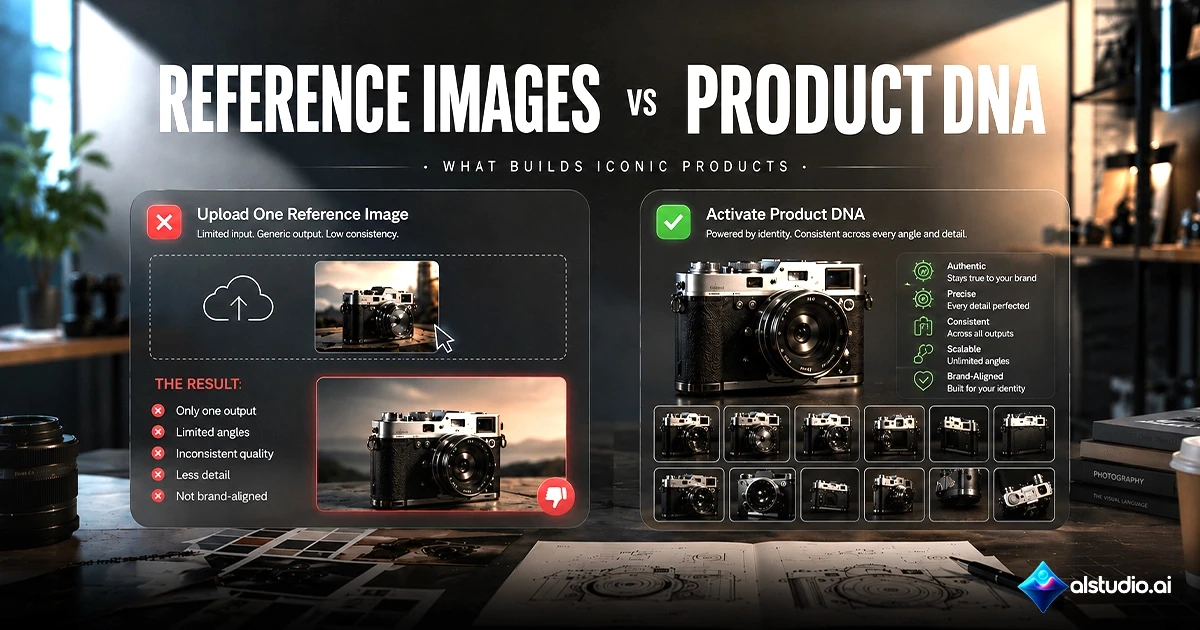
Product DNA vs Reference Images:
Why AI Product Consistency Breaks (and What Actually Fixes It)
When teams compare product DNA vs reference images, the real question isn't which input looks better in a single generation. It's which one survives a hundred generations, across three AI models and five creators, without falling apart. Reference images are the default starting point for most AI content workflows: upload a product photo, generate a scene, hope the result holds. It works once. It rarely holds at scale.
If you've watched the same product photo produce slightly different results every time you upload it, even into the same tool, you haven't done anything wrong. You're using a workaround in a place where a system should exist. This article breaks down exactly why reference images fail at scale, what Product DNA does differently, and how to decide which approach fits your production stage.
Quick Answer
Reference images are temporary visual inputs that exist only for a single AI generation session. Product DNA is a persistent, structured identity layer that stores a product's defining attributes (shape, materials, color, proportions, label placement) once and applies them automatically across every future generation, model, and team member. Reference images show a model what a product looks like. Product DNA tells a model what a product is, and remembers it.
What Is the Difference Between Product DNA and Reference Images?
What it is: Reference images are session-level inputs. Product DNA is production-level infrastructure.
Why it matters: The distinction determines whether your team rebuilds consistency every time it starts a new campaign, or builds it once and reuses it indefinitely.
How it works: A reference image gives a model a single visual snapshot to interpret at generation time. Once the session ends, that interpretation disappears with it. Product DNA stores the product's structural attributes as a system record inside ALStudio's Constants Studio, so every Studio and every connected model pulls from the same definition automatically, with no re-upload required.
Capability | Reference Images | Product DNA |
Maintains identity across sessions | No | Yes |
Shared across teams | Manual | Automatic |
Works across multiple AI models | Limited | Yes |
Requires re-uploading | Every session | Never |
Stores structural product attributes | No | Yes |
Supports large-scale campaigns | Limited | Yes |
Prevents iteration decay | No | Yes |
Designed for production workflows | No | Yes |
Reference images are useful creative inputs for one-off generations. Product DNA is production infrastructure for teams generating at volume. That distinction becomes more important the moment an organization moves from experimentation into ongoing AI content operations.
Why Product Consistency Has Become a Bigger Problem in 2026
AI content production has shifted from experimentation to operational scale. Marketing teams are no longer generating a handful of images a month, they're producing hundreds of assets across social media, ecommerce listings, paid ads, product launches, regional campaigns, and AI video.
At the same time, production workflows have fragmented. Most teams now combine multiple AI tools in a single campaign stack, using different models for image generation, video creation, editing, and localization. That creates a new challenge: maintaining one recognizable product identity across an environment where every tool interprets visual information differently.
Product consistency has evolved from a creative nice-to-have into an operational requirement. Brands can generate content faster than ever, but most consistency systems haven't kept pace. Product DNA exists to close that gap.
What Is Product DNA in AI Generation?
What it is: Product DNA is a structured, persistent identity layer for a specific product, stored once and applied automatically across every AI generation, workflow, and team member.
Why it matters: It removes the need to re-upload, re-describe, or re-correct a product's appearance every time someone on the team starts a new generation session.
How it works: Instead of defining a product by a single photo, Product DNA defines it by what it structurally is:
Shape geometry
Material properties
Surface finish
Color values
Label placement
Typography
Product proportions
Usage context
That definition becomes a permanent system record rather than a file someone has to remember to attach. The difference most teams miss is the difference between showing an AI model a product and telling it what the product is. Reference images show. Product DNA tells, and it remembers.
This matters because AI image and video models don't interpret pictures the way a human creative director does. They extract statistical features from visual inputs, and those features vary between generations. A structured identity layer bypasses that variability by supplying the defining attributes directly, rather than asking the model to re-infer them from a photo every single time.
Why Reference Images Fail at Scale
What it is: Reference-image workflows ask an AI model to infer product identity fresh, every session, from a picture.
Why it matters: That re-inference is exactly where consistency breaks down once more than one person, model, or campaign is involved.
How it works: Every major AI generation model treats each session as stateless. Close the session, open a new one, and the reference image from before is gone. The model has no memory of it. You start over.
In practice, this plays out in a predictable pattern:
Each creator uploads a slightly different reference.
Each reference captures slightly different lighting.
Each angle reveals different visual features.
Each generation introduces small, compounding differences.
Across enough campaigns, these small differences stack into multiple visual versions of the same product. What started as one product becomes several. Sameness.co has documented a related pattern of iteration decay, where output stays relatively stable in early generations but drifts as more generations accumulate. Venngage's analysis of AI brand management similarly noted that teams often maintain separate libraries of prompts and references purely to try to preserve consistency between sessions, which is itself a sign the underlying system isn't doing that job for them.
Video generation makes the problem worse. Leonardo.ai's documentation notes that products can warp or shift appearance during AI video generation because reference images don't supply structural constraints across motion. A reference image can influence a first frame. It can't reliably govern every frame after it.
Common Product Consistency Failures in AI Generation
Session Drift
AI models are stateless between generations. Every new session treats your product as unknown, which means teams repeatedly re-upload references and gradually accumulate visual variation they never intended.
Team Fragmentation
Different creators reach for different reference types. Some prefer lifestyle shots, others use packshots or packaging renders. Without a shared source of truth, one product turns into several visual interpretations depending on who generated it.
Iteration Decay
Consistency measurably degrades as generation counts climb, particularly in long-running campaigns that span weeks or months. The longer the campaign, the more visually incoherent the product can become if nothing is anchoring it.
Video Shape Instability
AI video models interpolate between frames. Without structural constraints on geometry, product shape can drift mid-motion, leading to expensive regeneration cycles and manual review.
Cross-Model Inconsistency
Modern workflows rarely rely on one model. Teams combine systems for speed and quality, but the same product can appear differently depending on which model rendered it, because each model interprets a reference image differently.
The 4 Types of AI Consistency Brands Actually Need
Most conversations about visual consistency focus only on characters or style. In reality, brands need four separate consistency systems working together.
Type | What It Covers | Why It Matters |
Product Consistency | Product appearance across content | Product recognition |
Character Consistency | Faces and spokespersons | Audience familiarity |
Environment Consistency | Locations and scenes | Story continuity |
Brand Consistency | Colors, fonts, logos, tone | Brand recognition |
When product consistency fails while the other three hold steady, customers recognize the brand but not the product itself. For ecommerce brands in particular, that's often the most damaging form of inconsistency, since it directly affects whether a shopper trusts that the ad and the product page show the same item.
How Major AI Platforms Approach Product Consistency
Platform | Method | Persistence |
Runway Gen-4.5 | Reference Images | Session Only |
Kling 3.0 | Omni References | Session Only |
Seedance 2.0 | Reference Clusters | Session Only |
Veo 3.1 | Reference-Based Workflows | Session Only |
Persistent |
The pattern across the market is consistent: most platforms treat consistency as something to reconstruct per session. Reference-based systems require creators to continuously recreate the same setup. Product DNA governs consistency automatically, once defined, without requiring anyone to remember to repeat the setup.
(Note: model names and version numbers above reflect the platforms as referenced at time of writing. Given how quickly model releases move, confirm current version numbers before publishing.)
Real-World Use Cases
Marketing Team Use Case
A marketing team running paid social, organic content, and email creative for one product line defines that product once in Constants Studio. Every creator on the team, regardless of which Studio they're working in, generates from the same Product DNA. New hires don't need a briefing document explaining "use this exact reference image", the identity is already built into the system.
Agency Use Case
Agencies managing multiple clients face a different risk: cross-contamination, where one client's product attributes bleed into another's campaign through shared prompts, shared creators, or shared model sessions. Product DNA keeps each client's product identity isolated and persistent, so account teams can switch between clients without manually resetting references each time.
Enterprise Use Case
Enterprise teams running content across regional markets, multiple business units, or multiple agencies of record need one source of truth that doesn't depend on any single person's memory or file organization. Product DNA functions as that source of truth, stored at the system level rather than in someone's downloads folder.
Ecommerce Brand Use Case
Ecommerce brands need the product in an ad, a marketplace listing, and a product page to visibly be the same item. Product DNA keeps geometry, color, and label placement constant across all three, which supports recognition through the full buying journey rather than just at the point of first impression.
A Practical Example: Regional Product Launch, With and Without Product DNA
Imagine a beverage brand running a three-stage campaign across MENA.
Week 1, Awareness: Five creators generate content. Each uses a different reference image. The bottle begins appearing slightly differently across assets.
Week 2, Consideration: The team moves into video. Reference images have to be uploaded again. Several videos need regeneration because the bottle changes shape mid-motion.
Week 3, Conversion: The product now exists in multiple visual versions. Customers encounter different representations of it throughout the buying journey, and recognition declines.
The same campaign with Product DNA: The product is defined once inside Constants Studio before production starts. Every creator generates from the same Product DNA. Every model uses the same identity. Every campaign produces the same product, with no re-uploading, no fragmentation, and no drift to troubleshoot mid-launch.
Benefits of Product DNA Over Reference Images
Eliminates re-upload cycles. Define the product once; every Studio and every team member inherits it automatically.
Removes single points of failure. Consistency no longer depends on one creator's file organization or memory.
Holds up across models. Because the attributes are structural rather than visual, switching between models doesn't reset the product's identity.
Scales with campaign volume. More creators and more campaigns no longer multiply visual drift.
Supports video, not just stills. Structural constraints carry through motion in a way a flat reference image can't.
Limitations of Product DNA
To be clear-eyed about where Product DNA fits, it's worth naming what it doesn't solve:
It requires upfront definition. A product has to be defined once inside Constants Studio before the benefits kick in; it isn't retroactive for content already produced elsewhere.
It's built for repeated production, not single one-off generations. A team generating a single image for a single use case may not need a persistent layer at all.
It depends on the product being stable. If a product's physical design changes frequently (limited editions, fast-rotating SKUs), the DNA record needs to be updated to match, the same way a brand kit needs updating when a logo changes.
It's a system-level solution, not a prompting trick. Teams looking for a quick one-time fix inside a single tool's chat window won't find Product DNA there, it lives at the platform level.
Common Mistakes Teams Make With AI Product Consistency
Assuming a better photo fixes the problem. Higher-resolution or better-lit reference images still get re-interpreted from scratch every session. The variance comes from the architecture, not the photo quality.
Letting every creator choose their own reference. Without a shared standard, five creators produce five slightly different versions of the same product.
Treating video the same as stills. A reference that's "close enough" for a static image is often insufficient once motion is introduced.
Testing in only one model. Consistency that holds in one AI model doesn't automatically hold in another; cross-model testing catches this early.
Treating consistency as a one-time setup. Product attributes, once defined, still need periodic review as packaging or product design evolves.
Best Practices for Implementing Product DNA
Audit existing product visual assets before defining anything, so the DNA record reflects the most current product design.
Define structural attributes (geometry, materials, color, proportions) rather than relying on a single "best" photo.
Standardize the definition across every creator and Studio touching that product, not just the original creator.
Test the defined identity across each AI model in the workflow before scaling production.
Revisit the DNA record whenever the physical product changes.
How to Implement Product DNA: Step-by-Step
Audit current product assets. Collect the existing photos, renders, and packaging files being used as references today.
Define the product once inside Constants Studio. Input shape geometry, materials, color values, label placement, typography, and proportions.
Standardize across the team. Make the Product DNA record the default source for every Studio (Content, Film, Marketing, Editor) rather than an optional input.
Test across models. Generate sample content across each AI model in your stack to confirm the identity holds before a full campaign rollout.
Monitor and refine. Revisit the record when the product itself changes, and extend the same approach to Brand DNA, Character DNA, and Environment DNA as campaigns expand.
Lessons From Building ALStudio's Consistency Engine
Observation 1: Reference images are an interface, not an architecture. They work for individual creators generating small volumes of content, but fail once teams need consistency across months of production. Better reference images alone didn't solve the problem in internal testing, the variance came from the architecture itself.
Observation 2: Model switching multiplies inconsistency. Testing the same reference image across multiple models produced noticeably different outputs each time. Each model interprets references differently, so consistency can't depend on any single model's behavior.
Observation 3: Video consistency is a structural problem, not a photography problem. For stills, references can get close. For video, they generally don't, since AI video systems simulate motion and need structural constraints on geometry and materials to keep a product stable as it moves.
These observations, drawn from testing across more than 20 internal campaign scenarios covering image generation, video production, multilingual content, and multi-model workflows, directly shaped the architecture behind Product DNA and Constants Studio.
Who Needs Product DNA?
Marketing teams scaling campaigns without accumulating product drift.
Ecommerce brands maintaining recognition between ads and product pages.
Agencies managing multiple client identities without cross-contamination.
Content creators delivering consistent sponsored content across formats.
Enterprise teams establishing one source of truth for AI-generated product content.
Conclusion: Product DNA vs Reference Images, the Production Decision
The comparison between product DNA vs reference images isn't really about image quality. It's about whether consistency is something your team rebuilds every session, or something the system maintains for them. Reference images are a reasonable starting point for a single creator generating a handful of assets. They were never designed to hold up across multiple creators, multiple models, and ongoing campaigns, and that's exactly where most teams start running into drift.
Product DNA, as part of ALStudio's Creative AI OS, takes a different approach: define a product once, store it permanently inside Constants Studio, and apply it automatically across every campaign, creator, and AI model going forward. Start with Product DNA, then extend the same approach to Brand DNA, Character DNA, and Environment DNA as production scales.
Start free with ALStudio. No watermark. No credit card required.
Featured Snippet Optimization
Featured Snippet Paragraph (52 words)
Product DNA vs reference images comes down to persistence. Reference images are temporary visual inputs that exist only for one AI generation session and disappear afterward. Product DNA is a structured, persistent identity layer that stores a product's shape, materials, color, and proportions once, then applies them automatically across every future generation and model.
Featured Snippet Bullet List
Reference images vs Product DNA at a glance:
Reference images: re-uploaded every session, interpreted differently each time, no memory between generations.
Product DNA: defined once, stored permanently, applied automatically across teams and models.
Reference images work for single, small-scale generations.
Product DNA is built for ongoing, multi-creator, multi-model production.
Comparison Table
Capability | Reference Images | Product DNA |
Maintains identity across sessions | No | Yes |
Shared across teams | Manual | Automatic |
Works across multiple AI models | Limited | Yes |
Requires re-uploading | Every session | Never |
Prevents iteration decay | No | Yes |
Product DNA vs Product Reference Images
Product DNA
Product DNA vs Reference Images:
Why AI Product Consistency Breaks (and What Actually Fixes It)
When teams compare product DNA vs reference images, the real question isn't which input looks better in a single generation. It's which one survives a hundred generations, across three AI models and five creators, without falling apart. Reference images are the default starting point for most AI content workflows: upload a product photo, generate a scene, hope the result holds. It works once. It rarely holds at scale.
If you've watched the same product photo produce slightly different results every time you upload it, even into the same tool, you haven't done anything wrong. You're using a workaround in a place where a system should exist. This article breaks down exactly why reference images fail at scale, what Product DNA does differently, and how to decide which approach fits your production stage.
Quick Answer
Reference images are temporary visual inputs that exist only for a single AI generation session. Product DNA is a persistent, structured identity layer that stores a product's defining attributes (shape, materials, color, proportions, label placement) once and applies them automatically across every future generation, model, and team member. Reference images show a model what a product looks like. Product DNA tells a model what a product is, and remembers it.
What Is the Difference Between Product DNA and Reference Images?
What it is: Reference images are session-level inputs. Product DNA is production-level infrastructure.
Why it matters: The distinction determines whether your team rebuilds consistency every time it starts a new campaign, or builds it once and reuses it indefinitely.
How it works: A reference image gives a model a single visual snapshot to interpret at generation time. Once the session ends, that interpretation disappears with it. Product DNA stores the product's structural attributes as a system record inside ALStudio's Constants Studio, so every Studio and every connected model pulls from the same definition automatically, with no re-upload required.
Capability | Reference Images | Product DNA |
Maintains identity across sessions | No | Yes |
Shared across teams | Manual | Automatic |
Works across multiple AI models | Limited | Yes |
Requires re-uploading | Every session | Never |
Stores structural product attributes | No | Yes |
Supports large-scale campaigns | Limited | Yes |
Prevents iteration decay | No | Yes |
Designed for production workflows | No | Yes |
Reference images are useful creative inputs for one-off generations. Product DNA is production infrastructure for teams generating at volume. That distinction becomes more important the moment an organization moves from experimentation into ongoing AI content operations.
Why Product Consistency Has Become a Bigger Problem in 2026
AI content production has shifted from experimentation to operational scale. Marketing teams are no longer generating a handful of images a month, they're producing hundreds of assets across social media, ecommerce listings, paid ads, product launches, regional campaigns, and AI video.
At the same time, production workflows have fragmented. Most teams now combine multiple AI tools in a single campaign stack, using different models for image generation, video creation, editing, and localization. That creates a new challenge: maintaining one recognizable product identity across an environment where every tool interprets visual information differently.
Product consistency has evolved from a creative nice-to-have into an operational requirement. Brands can generate content faster than ever, but most consistency systems haven't kept pace. Product DNA exists to close that gap.
What Is Product DNA in AI Generation?
What it is: Product DNA is a structured, persistent identity layer for a specific product, stored once and applied automatically across every AI generation, workflow, and team member.
Why it matters: It removes the need to re-upload, re-describe, or re-correct a product's appearance every time someone on the team starts a new generation session.
How it works: Instead of defining a product by a single photo, Product DNA defines it by what it structurally is:
Shape geometry
Material properties
Surface finish
Color values
Label placement
Typography
Product proportions
Usage context
That definition becomes a permanent system record rather than a file someone has to remember to attach. The difference most teams miss is the difference between showing an AI model a product and telling it what the product is. Reference images show. Product DNA tells, and it remembers.
This matters because AI image and video models don't interpret pictures the way a human creative director does. They extract statistical features from visual inputs, and those features vary between generations. A structured identity layer bypasses that variability by supplying the defining attributes directly, rather than asking the model to re-infer them from a photo every single time.
Why Reference Images Fail at Scale
What it is: Reference-image workflows ask an AI model to infer product identity fresh, every session, from a picture.
Why it matters: That re-inference is exactly where consistency breaks down once more than one person, model, or campaign is involved.
How it works: Every major AI generation model treats each session as stateless. Close the session, open a new one, and the reference image from before is gone. The model has no memory of it. You start over.
In practice, this plays out in a predictable pattern:
Each creator uploads a slightly different reference.
Each reference captures slightly different lighting.
Each angle reveals different visual features.
Each generation introduces small, compounding differences.
Across enough campaigns, these small differences stack into multiple visual versions of the same product. What started as one product becomes several. Sameness.co has documented a related pattern of iteration decay, where output stays relatively stable in early generations but drifts as more generations accumulate. Venngage's analysis of AI brand management similarly noted that teams often maintain separate libraries of prompts and references purely to try to preserve consistency between sessions, which is itself a sign the underlying system isn't doing that job for them.
Video generation makes the problem worse. Leonardo.ai's documentation notes that products can warp or shift appearance during AI video generation because reference images don't supply structural constraints across motion. A reference image can influence a first frame. It can't reliably govern every frame after it.
Common Product Consistency Failures in AI Generation
Session Drift
AI models are stateless between generations. Every new session treats your product as unknown, which means teams repeatedly re-upload references and gradually accumulate visual variation they never intended.
Team Fragmentation
Different creators reach for different reference types. Some prefer lifestyle shots, others use packshots or packaging renders. Without a shared source of truth, one product turns into several visual interpretations depending on who generated it.
Iteration Decay
Consistency measurably degrades as generation counts climb, particularly in long-running campaigns that span weeks or months. The longer the campaign, the more visually incoherent the product can become if nothing is anchoring it.
Video Shape Instability
AI video models interpolate between frames. Without structural constraints on geometry, product shape can drift mid-motion, leading to expensive regeneration cycles and manual review.
Cross-Model Inconsistency
Modern workflows rarely rely on one model. Teams combine systems for speed and quality, but the same product can appear differently depending on which model rendered it, because each model interprets a reference image differently.
The 4 Types of AI Consistency Brands Actually Need
Most conversations about visual consistency focus only on characters or style. In reality, brands need four separate consistency systems working together.
Type | What It Covers | Why It Matters |
Product Consistency | Product appearance across content | Product recognition |
Character Consistency | Faces and spokespersons | Audience familiarity |
Environment Consistency | Locations and scenes | Story continuity |
Brand Consistency | Colors, fonts, logos, tone | Brand recognition |
When product consistency fails while the other three hold steady, customers recognize the brand but not the product itself. For ecommerce brands in particular, that's often the most damaging form of inconsistency, since it directly affects whether a shopper trusts that the ad and the product page show the same item.
How Major AI Platforms Approach Product Consistency
Platform | Method | Persistence |
Runway Gen-4.5 | Reference Images | Session Only |
Kling 3.0 | Omni References | Session Only |
Seedance 2.0 | Reference Clusters | Session Only |
Veo 3.1 | Reference-Based Workflows | Session Only |
Persistent |
The pattern across the market is consistent: most platforms treat consistency as something to reconstruct per session. Reference-based systems require creators to continuously recreate the same setup. Product DNA governs consistency automatically, once defined, without requiring anyone to remember to repeat the setup.
(Note: model names and version numbers above reflect the platforms as referenced at time of writing. Given how quickly model releases move, confirm current version numbers before publishing.)
Real-World Use Cases
Marketing Team Use Case
A marketing team running paid social, organic content, and email creative for one product line defines that product once in Constants Studio. Every creator on the team, regardless of which Studio they're working in, generates from the same Product DNA. New hires don't need a briefing document explaining "use this exact reference image", the identity is already built into the system.
Agency Use Case
Agencies managing multiple clients face a different risk: cross-contamination, where one client's product attributes bleed into another's campaign through shared prompts, shared creators, or shared model sessions. Product DNA keeps each client's product identity isolated and persistent, so account teams can switch between clients without manually resetting references each time.
Enterprise Use Case
Enterprise teams running content across regional markets, multiple business units, or multiple agencies of record need one source of truth that doesn't depend on any single person's memory or file organization. Product DNA functions as that source of truth, stored at the system level rather than in someone's downloads folder.
Ecommerce Brand Use Case
Ecommerce brands need the product in an ad, a marketplace listing, and a product page to visibly be the same item. Product DNA keeps geometry, color, and label placement constant across all three, which supports recognition through the full buying journey rather than just at the point of first impression.
A Practical Example: Regional Product Launch, With and Without Product DNA
Imagine a beverage brand running a three-stage campaign across MENA.
Week 1, Awareness: Five creators generate content. Each uses a different reference image. The bottle begins appearing slightly differently across assets.
Week 2, Consideration: The team moves into video. Reference images have to be uploaded again. Several videos need regeneration because the bottle changes shape mid-motion.
Week 3, Conversion: The product now exists in multiple visual versions. Customers encounter different representations of it throughout the buying journey, and recognition declines.
The same campaign with Product DNA: The product is defined once inside Constants Studio before production starts. Every creator generates from the same Product DNA. Every model uses the same identity. Every campaign produces the same product, with no re-uploading, no fragmentation, and no drift to troubleshoot mid-launch.
Benefits of Product DNA Over Reference Images
Eliminates re-upload cycles. Define the product once; every Studio and every team member inherits it automatically.
Removes single points of failure. Consistency no longer depends on one creator's file organization or memory.
Holds up across models. Because the attributes are structural rather than visual, switching between models doesn't reset the product's identity.
Scales with campaign volume. More creators and more campaigns no longer multiply visual drift.
Supports video, not just stills. Structural constraints carry through motion in a way a flat reference image can't.
Limitations of Product DNA
To be clear-eyed about where Product DNA fits, it's worth naming what it doesn't solve:
It requires upfront definition. A product has to be defined once inside Constants Studio before the benefits kick in; it isn't retroactive for content already produced elsewhere.
It's built for repeated production, not single one-off generations. A team generating a single image for a single use case may not need a persistent layer at all.
It depends on the product being stable. If a product's physical design changes frequently (limited editions, fast-rotating SKUs), the DNA record needs to be updated to match, the same way a brand kit needs updating when a logo changes.
It's a system-level solution, not a prompting trick. Teams looking for a quick one-time fix inside a single tool's chat window won't find Product DNA there, it lives at the platform level.
Common Mistakes Teams Make With AI Product Consistency
Assuming a better photo fixes the problem. Higher-resolution or better-lit reference images still get re-interpreted from scratch every session. The variance comes from the architecture, not the photo quality.
Letting every creator choose their own reference. Without a shared standard, five creators produce five slightly different versions of the same product.
Treating video the same as stills. A reference that's "close enough" for a static image is often insufficient once motion is introduced.
Testing in only one model. Consistency that holds in one AI model doesn't automatically hold in another; cross-model testing catches this early.
Treating consistency as a one-time setup. Product attributes, once defined, still need periodic review as packaging or product design evolves.
Best Practices for Implementing Product DNA
Audit existing product visual assets before defining anything, so the DNA record reflects the most current product design.
Define structural attributes (geometry, materials, color, proportions) rather than relying on a single "best" photo.
Standardize the definition across every creator and Studio touching that product, not just the original creator.
Test the defined identity across each AI model in the workflow before scaling production.
Revisit the DNA record whenever the physical product changes.
How to Implement Product DNA: Step-by-Step
Audit current product assets. Collect the existing photos, renders, and packaging files being used as references today.
Define the product once inside Constants Studio. Input shape geometry, materials, color values, label placement, typography, and proportions.
Standardize across the team. Make the Product DNA record the default source for every Studio (Content, Film, Marketing, Editor) rather than an optional input.
Test across models. Generate sample content across each AI model in your stack to confirm the identity holds before a full campaign rollout.
Monitor and refine. Revisit the record when the product itself changes, and extend the same approach to Brand DNA, Character DNA, and Environment DNA as campaigns expand.
Lessons From Building ALStudio's Consistency Engine
Observation 1: Reference images are an interface, not an architecture. They work for individual creators generating small volumes of content, but fail once teams need consistency across months of production. Better reference images alone didn't solve the problem in internal testing, the variance came from the architecture itself.
Observation 2: Model switching multiplies inconsistency. Testing the same reference image across multiple models produced noticeably different outputs each time. Each model interprets references differently, so consistency can't depend on any single model's behavior.
Observation 3: Video consistency is a structural problem, not a photography problem. For stills, references can get close. For video, they generally don't, since AI video systems simulate motion and need structural constraints on geometry and materials to keep a product stable as it moves.
These observations, drawn from testing across more than 20 internal campaign scenarios covering image generation, video production, multilingual content, and multi-model workflows, directly shaped the architecture behind Product DNA and Constants Studio.
Who Needs Product DNA?
Marketing teams scaling campaigns without accumulating product drift.
Ecommerce brands maintaining recognition between ads and product pages.
Agencies managing multiple client identities without cross-contamination.
Content creators delivering consistent sponsored content across formats.
Enterprise teams establishing one source of truth for AI-generated product content.
Conclusion: Product DNA vs Reference Images, the Production Decision
The comparison between product DNA vs reference images isn't really about image quality. It's about whether consistency is something your team rebuilds every session, or something the system maintains for them. Reference images are a reasonable starting point for a single creator generating a handful of assets. They were never designed to hold up across multiple creators, multiple models, and ongoing campaigns, and that's exactly where most teams start running into drift.
Product DNA, as part of ALStudio's Creative AI OS, takes a different approach: define a product once, store it permanently inside Constants Studio, and apply it automatically across every campaign, creator, and AI model going forward. Start with Product DNA, then extend the same approach to Brand DNA, Character DNA, and Environment DNA as production scales.
Start free with ALStudio. No watermark. No credit card required.
Featured Snippet Optimization
Featured Snippet Paragraph (52 words)
Product DNA vs reference images comes down to persistence. Reference images are temporary visual inputs that exist only for one AI generation session and disappear afterward. Product DNA is a structured, persistent identity layer that stores a product's shape, materials, color, and proportions once, then applies them automatically across every future generation and model.
Featured Snippet Bullet List
Reference images vs Product DNA at a glance:
Reference images: re-uploaded every session, interpreted differently each time, no memory between generations.
Product DNA: defined once, stored permanently, applied automatically across teams and models.
Reference images work for single, small-scale generations.
Product DNA is built for ongoing, multi-creator, multi-model production.
Comparison Table
Capability | Reference Images | Product DNA |
Maintains identity across sessions | No | Yes |
Shared across teams | Manual | Automatic |
Works across multiple AI models | Limited | Yes |
Requires re-uploading | Every session | Never |
Prevents iteration decay | No | Yes |
Product DNA vs Product Reference Images
Product DNA
Product DNA vs Reference Images:
Why AI Product Consistency Breaks (and What Actually Fixes It)
When teams compare product DNA vs reference images, the real question isn't which input looks better in a single generation. It's which one survives a hundred generations, across three AI models and five creators, without falling apart. Reference images are the default starting point for most AI content workflows: upload a product photo, generate a scene, hope the result holds. It works once. It rarely holds at scale.
If you've watched the same product photo produce slightly different results every time you upload it, even into the same tool, you haven't done anything wrong. You're using a workaround in a place where a system should exist. This article breaks down exactly why reference images fail at scale, what Product DNA does differently, and how to decide which approach fits your production stage.
Quick Answer
Reference images are temporary visual inputs that exist only for a single AI generation session. Product DNA is a persistent, structured identity layer that stores a product's defining attributes (shape, materials, color, proportions, label placement) once and applies them automatically across every future generation, model, and team member. Reference images show a model what a product looks like. Product DNA tells a model what a product is, and remembers it.
What Is the Difference Between Product DNA and Reference Images?
What it is: Reference images are session-level inputs. Product DNA is production-level infrastructure.
Why it matters: The distinction determines whether your team rebuilds consistency every time it starts a new campaign, or builds it once and reuses it indefinitely.
How it works: A reference image gives a model a single visual snapshot to interpret at generation time. Once the session ends, that interpretation disappears with it. Product DNA stores the product's structural attributes as a system record inside ALStudio's Constants Studio, so every Studio and every connected model pulls from the same definition automatically, with no re-upload required.
Capability | Reference Images | Product DNA |
Maintains identity across sessions | No | Yes |
Shared across teams | Manual | Automatic |
Works across multiple AI models | Limited | Yes |
Requires re-uploading | Every session | Never |
Stores structural product attributes | No | Yes |
Supports large-scale campaigns | Limited | Yes |
Prevents iteration decay | No | Yes |
Designed for production workflows | No | Yes |
Reference images are useful creative inputs for one-off generations. Product DNA is production infrastructure for teams generating at volume. That distinction becomes more important the moment an organization moves from experimentation into ongoing AI content operations.
Why Product Consistency Has Become a Bigger Problem in 2026
AI content production has shifted from experimentation to operational scale. Marketing teams are no longer generating a handful of images a month, they're producing hundreds of assets across social media, ecommerce listings, paid ads, product launches, regional campaigns, and AI video.
At the same time, production workflows have fragmented. Most teams now combine multiple AI tools in a single campaign stack, using different models for image generation, video creation, editing, and localization. That creates a new challenge: maintaining one recognizable product identity across an environment where every tool interprets visual information differently.
Product consistency has evolved from a creative nice-to-have into an operational requirement. Brands can generate content faster than ever, but most consistency systems haven't kept pace. Product DNA exists to close that gap.
What Is Product DNA in AI Generation?
What it is: Product DNA is a structured, persistent identity layer for a specific product, stored once and applied automatically across every AI generation, workflow, and team member.
Why it matters: It removes the need to re-upload, re-describe, or re-correct a product's appearance every time someone on the team starts a new generation session.
How it works: Instead of defining a product by a single photo, Product DNA defines it by what it structurally is:
Shape geometry
Material properties
Surface finish
Color values
Label placement
Typography
Product proportions
Usage context
That definition becomes a permanent system record rather than a file someone has to remember to attach. The difference most teams miss is the difference between showing an AI model a product and telling it what the product is. Reference images show. Product DNA tells, and it remembers.
This matters because AI image and video models don't interpret pictures the way a human creative director does. They extract statistical features from visual inputs, and those features vary between generations. A structured identity layer bypasses that variability by supplying the defining attributes directly, rather than asking the model to re-infer them from a photo every single time.
Why Reference Images Fail at Scale
What it is: Reference-image workflows ask an AI model to infer product identity fresh, every session, from a picture.
Why it matters: That re-inference is exactly where consistency breaks down once more than one person, model, or campaign is involved.
How it works: Every major AI generation model treats each session as stateless. Close the session, open a new one, and the reference image from before is gone. The model has no memory of it. You start over.
In practice, this plays out in a predictable pattern:
Each creator uploads a slightly different reference.
Each reference captures slightly different lighting.
Each angle reveals different visual features.
Each generation introduces small, compounding differences.
Across enough campaigns, these small differences stack into multiple visual versions of the same product. What started as one product becomes several. Sameness.co has documented a related pattern of iteration decay, where output stays relatively stable in early generations but drifts as more generations accumulate. Venngage's analysis of AI brand management similarly noted that teams often maintain separate libraries of prompts and references purely to try to preserve consistency between sessions, which is itself a sign the underlying system isn't doing that job for them.
Video generation makes the problem worse. Leonardo.ai's documentation notes that products can warp or shift appearance during AI video generation because reference images don't supply structural constraints across motion. A reference image can influence a first frame. It can't reliably govern every frame after it.
Common Product Consistency Failures in AI Generation
Session Drift
AI models are stateless between generations. Every new session treats your product as unknown, which means teams repeatedly re-upload references and gradually accumulate visual variation they never intended.
Team Fragmentation
Different creators reach for different reference types. Some prefer lifestyle shots, others use packshots or packaging renders. Without a shared source of truth, one product turns into several visual interpretations depending on who generated it.
Iteration Decay
Consistency measurably degrades as generation counts climb, particularly in long-running campaigns that span weeks or months. The longer the campaign, the more visually incoherent the product can become if nothing is anchoring it.
Video Shape Instability
AI video models interpolate between frames. Without structural constraints on geometry, product shape can drift mid-motion, leading to expensive regeneration cycles and manual review.
Cross-Model Inconsistency
Modern workflows rarely rely on one model. Teams combine systems for speed and quality, but the same product can appear differently depending on which model rendered it, because each model interprets a reference image differently.
The 4 Types of AI Consistency Brands Actually Need
Most conversations about visual consistency focus only on characters or style. In reality, brands need four separate consistency systems working together.
Type | What It Covers | Why It Matters |
Product Consistency | Product appearance across content | Product recognition |
Character Consistency | Faces and spokespersons | Audience familiarity |
Environment Consistency | Locations and scenes | Story continuity |
Brand Consistency | Colors, fonts, logos, tone | Brand recognition |
When product consistency fails while the other three hold steady, customers recognize the brand but not the product itself. For ecommerce brands in particular, that's often the most damaging form of inconsistency, since it directly affects whether a shopper trusts that the ad and the product page show the same item.
How Major AI Platforms Approach Product Consistency
Platform | Method | Persistence |
Runway Gen-4.5 | Reference Images | Session Only |
Kling 3.0 | Omni References | Session Only |
Seedance 2.0 | Reference Clusters | Session Only |
Veo 3.1 | Reference-Based Workflows | Session Only |
Persistent |
The pattern across the market is consistent: most platforms treat consistency as something to reconstruct per session. Reference-based systems require creators to continuously recreate the same setup. Product DNA governs consistency automatically, once defined, without requiring anyone to remember to repeat the setup.
(Note: model names and version numbers above reflect the platforms as referenced at time of writing. Given how quickly model releases move, confirm current version numbers before publishing.)
Real-World Use Cases
Marketing Team Use Case
A marketing team running paid social, organic content, and email creative for one product line defines that product once in Constants Studio. Every creator on the team, regardless of which Studio they're working in, generates from the same Product DNA. New hires don't need a briefing document explaining "use this exact reference image", the identity is already built into the system.
Agency Use Case
Agencies managing multiple clients face a different risk: cross-contamination, where one client's product attributes bleed into another's campaign through shared prompts, shared creators, or shared model sessions. Product DNA keeps each client's product identity isolated and persistent, so account teams can switch between clients without manually resetting references each time.
Enterprise Use Case
Enterprise teams running content across regional markets, multiple business units, or multiple agencies of record need one source of truth that doesn't depend on any single person's memory or file organization. Product DNA functions as that source of truth, stored at the system level rather than in someone's downloads folder.
Ecommerce Brand Use Case
Ecommerce brands need the product in an ad, a marketplace listing, and a product page to visibly be the same item. Product DNA keeps geometry, color, and label placement constant across all three, which supports recognition through the full buying journey rather than just at the point of first impression.
A Practical Example: Regional Product Launch, With and Without Product DNA
Imagine a beverage brand running a three-stage campaign across MENA.
Week 1, Awareness: Five creators generate content. Each uses a different reference image. The bottle begins appearing slightly differently across assets.
Week 2, Consideration: The team moves into video. Reference images have to be uploaded again. Several videos need regeneration because the bottle changes shape mid-motion.
Week 3, Conversion: The product now exists in multiple visual versions. Customers encounter different representations of it throughout the buying journey, and recognition declines.
The same campaign with Product DNA: The product is defined once inside Constants Studio before production starts. Every creator generates from the same Product DNA. Every model uses the same identity. Every campaign produces the same product, with no re-uploading, no fragmentation, and no drift to troubleshoot mid-launch.
Benefits of Product DNA Over Reference Images
Eliminates re-upload cycles. Define the product once; every Studio and every team member inherits it automatically.
Removes single points of failure. Consistency no longer depends on one creator's file organization or memory.
Holds up across models. Because the attributes are structural rather than visual, switching between models doesn't reset the product's identity.
Scales with campaign volume. More creators and more campaigns no longer multiply visual drift.
Supports video, not just stills. Structural constraints carry through motion in a way a flat reference image can't.
Limitations of Product DNA
To be clear-eyed about where Product DNA fits, it's worth naming what it doesn't solve:
It requires upfront definition. A product has to be defined once inside Constants Studio before the benefits kick in; it isn't retroactive for content already produced elsewhere.
It's built for repeated production, not single one-off generations. A team generating a single image for a single use case may not need a persistent layer at all.
It depends on the product being stable. If a product's physical design changes frequently (limited editions, fast-rotating SKUs), the DNA record needs to be updated to match, the same way a brand kit needs updating when a logo changes.
It's a system-level solution, not a prompting trick. Teams looking for a quick one-time fix inside a single tool's chat window won't find Product DNA there, it lives at the platform level.
Common Mistakes Teams Make With AI Product Consistency
Assuming a better photo fixes the problem. Higher-resolution or better-lit reference images still get re-interpreted from scratch every session. The variance comes from the architecture, not the photo quality.
Letting every creator choose their own reference. Without a shared standard, five creators produce five slightly different versions of the same product.
Treating video the same as stills. A reference that's "close enough" for a static image is often insufficient once motion is introduced.
Testing in only one model. Consistency that holds in one AI model doesn't automatically hold in another; cross-model testing catches this early.
Treating consistency as a one-time setup. Product attributes, once defined, still need periodic review as packaging or product design evolves.
Best Practices for Implementing Product DNA
Audit existing product visual assets before defining anything, so the DNA record reflects the most current product design.
Define structural attributes (geometry, materials, color, proportions) rather than relying on a single "best" photo.
Standardize the definition across every creator and Studio touching that product, not just the original creator.
Test the defined identity across each AI model in the workflow before scaling production.
Revisit the DNA record whenever the physical product changes.
How to Implement Product DNA: Step-by-Step
Audit current product assets. Collect the existing photos, renders, and packaging files being used as references today.
Define the product once inside Constants Studio. Input shape geometry, materials, color values, label placement, typography, and proportions.
Standardize across the team. Make the Product DNA record the default source for every Studio (Content, Film, Marketing, Editor) rather than an optional input.
Test across models. Generate sample content across each AI model in your stack to confirm the identity holds before a full campaign rollout.
Monitor and refine. Revisit the record when the product itself changes, and extend the same approach to Brand DNA, Character DNA, and Environment DNA as campaigns expand.
Lessons From Building ALStudio's Consistency Engine
Observation 1: Reference images are an interface, not an architecture. They work for individual creators generating small volumes of content, but fail once teams need consistency across months of production. Better reference images alone didn't solve the problem in internal testing, the variance came from the architecture itself.
Observation 2: Model switching multiplies inconsistency. Testing the same reference image across multiple models produced noticeably different outputs each time. Each model interprets references differently, so consistency can't depend on any single model's behavior.
Observation 3: Video consistency is a structural problem, not a photography problem. For stills, references can get close. For video, they generally don't, since AI video systems simulate motion and need structural constraints on geometry and materials to keep a product stable as it moves.
These observations, drawn from testing across more than 20 internal campaign scenarios covering image generation, video production, multilingual content, and multi-model workflows, directly shaped the architecture behind Product DNA and Constants Studio.
Who Needs Product DNA?
Marketing teams scaling campaigns without accumulating product drift.
Ecommerce brands maintaining recognition between ads and product pages.
Agencies managing multiple client identities without cross-contamination.
Content creators delivering consistent sponsored content across formats.
Enterprise teams establishing one source of truth for AI-generated product content.
Conclusion: Product DNA vs Reference Images, the Production Decision
The comparison between product DNA vs reference images isn't really about image quality. It's about whether consistency is something your team rebuilds every session, or something the system maintains for them. Reference images are a reasonable starting point for a single creator generating a handful of assets. They were never designed to hold up across multiple creators, multiple models, and ongoing campaigns, and that's exactly where most teams start running into drift.
Product DNA, as part of ALStudio's Creative AI OS, takes a different approach: define a product once, store it permanently inside Constants Studio, and apply it automatically across every campaign, creator, and AI model going forward. Start with Product DNA, then extend the same approach to Brand DNA, Character DNA, and Environment DNA as production scales.
Start free with ALStudio. No watermark. No credit card required.
Featured Snippet Optimization
Featured Snippet Paragraph (52 words)
Product DNA vs reference images comes down to persistence. Reference images are temporary visual inputs that exist only for one AI generation session and disappear afterward. Product DNA is a structured, persistent identity layer that stores a product's shape, materials, color, and proportions once, then applies them automatically across every future generation and model.
Featured Snippet Bullet List
Reference images vs Product DNA at a glance:
Reference images: re-uploaded every session, interpreted differently each time, no memory between generations.
Product DNA: defined once, stored permanently, applied automatically across teams and models.
Reference images work for single, small-scale generations.
Product DNA is built for ongoing, multi-creator, multi-model production.
Comparison Table
Capability | Reference Images | Product DNA |
Maintains identity across sessions | No | Yes |
Shared across teams | Manual | Automatic |
Works across multiple AI models | Limited | Yes |
Requires re-uploading | Every session | Never |
Prevents iteration decay | No | Yes |
Product DNA vs Product Reference Images
Product DNA
Product DNA vs Reference Images:
Why AI Product Consistency Breaks (and What Actually Fixes It)
When teams compare product DNA vs reference images, the real question isn't which input looks better in a single generation. It's which one survives a hundred generations, across three AI models and five creators, without falling apart. Reference images are the default starting point for most AI content workflows: upload a product photo, generate a scene, hope the result holds. It works once. It rarely holds at scale.
If you've watched the same product photo produce slightly different results every time you upload it, even into the same tool, you haven't done anything wrong. You're using a workaround in a place where a system should exist. This article breaks down exactly why reference images fail at scale, what Product DNA does differently, and how to decide which approach fits your production stage.
Quick Answer
Reference images are temporary visual inputs that exist only for a single AI generation session. Product DNA is a persistent, structured identity layer that stores a product's defining attributes (shape, materials, color, proportions, label placement) once and applies them automatically across every future generation, model, and team member. Reference images show a model what a product looks like. Product DNA tells a model what a product is, and remembers it.
What Is the Difference Between Product DNA and Reference Images?
What it is: Reference images are session-level inputs. Product DNA is production-level infrastructure.
Why it matters: The distinction determines whether your team rebuilds consistency every time it starts a new campaign, or builds it once and reuses it indefinitely.
How it works: A reference image gives a model a single visual snapshot to interpret at generation time. Once the session ends, that interpretation disappears with it. Product DNA stores the product's structural attributes as a system record inside ALStudio's Constants Studio, so every Studio and every connected model pulls from the same definition automatically, with no re-upload required.
Capability | Reference Images | Product DNA |
Maintains identity across sessions | No | Yes |
Shared across teams | Manual | Automatic |
Works across multiple AI models | Limited | Yes |
Requires re-uploading | Every session | Never |
Stores structural product attributes | No | Yes |
Supports large-scale campaigns | Limited | Yes |
Prevents iteration decay | No | Yes |
Designed for production workflows | No | Yes |
Reference images are useful creative inputs for one-off generations. Product DNA is production infrastructure for teams generating at volume. That distinction becomes more important the moment an organization moves from experimentation into ongoing AI content operations.
Why Product Consistency Has Become a Bigger Problem in 2026
AI content production has shifted from experimentation to operational scale. Marketing teams are no longer generating a handful of images a month, they're producing hundreds of assets across social media, ecommerce listings, paid ads, product launches, regional campaigns, and AI video.
At the same time, production workflows have fragmented. Most teams now combine multiple AI tools in a single campaign stack, using different models for image generation, video creation, editing, and localization. That creates a new challenge: maintaining one recognizable product identity across an environment where every tool interprets visual information differently.
Product consistency has evolved from a creative nice-to-have into an operational requirement. Brands can generate content faster than ever, but most consistency systems haven't kept pace. Product DNA exists to close that gap.
What Is Product DNA in AI Generation?
What it is: Product DNA is a structured, persistent identity layer for a specific product, stored once and applied automatically across every AI generation, workflow, and team member.
Why it matters: It removes the need to re-upload, re-describe, or re-correct a product's appearance every time someone on the team starts a new generation session.
How it works: Instead of defining a product by a single photo, Product DNA defines it by what it structurally is:
Shape geometry
Material properties
Surface finish
Color values
Label placement
Typography
Product proportions
Usage context
That definition becomes a permanent system record rather than a file someone has to remember to attach. The difference most teams miss is the difference between showing an AI model a product and telling it what the product is. Reference images show. Product DNA tells, and it remembers.
This matters because AI image and video models don't interpret pictures the way a human creative director does. They extract statistical features from visual inputs, and those features vary between generations. A structured identity layer bypasses that variability by supplying the defining attributes directly, rather than asking the model to re-infer them from a photo every single time.
Why Reference Images Fail at Scale
What it is: Reference-image workflows ask an AI model to infer product identity fresh, every session, from a picture.
Why it matters: That re-inference is exactly where consistency breaks down once more than one person, model, or campaign is involved.
How it works: Every major AI generation model treats each session as stateless. Close the session, open a new one, and the reference image from before is gone. The model has no memory of it. You start over.
In practice, this plays out in a predictable pattern:
Each creator uploads a slightly different reference.
Each reference captures slightly different lighting.
Each angle reveals different visual features.
Each generation introduces small, compounding differences.
Across enough campaigns, these small differences stack into multiple visual versions of the same product. What started as one product becomes several. Sameness.co has documented a related pattern of iteration decay, where output stays relatively stable in early generations but drifts as more generations accumulate. Venngage's analysis of AI brand management similarly noted that teams often maintain separate libraries of prompts and references purely to try to preserve consistency between sessions, which is itself a sign the underlying system isn't doing that job for them.
Video generation makes the problem worse. Leonardo.ai's documentation notes that products can warp or shift appearance during AI video generation because reference images don't supply structural constraints across motion. A reference image can influence a first frame. It can't reliably govern every frame after it.
Common Product Consistency Failures in AI Generation
Session Drift
AI models are stateless between generations. Every new session treats your product as unknown, which means teams repeatedly re-upload references and gradually accumulate visual variation they never intended.
Team Fragmentation
Different creators reach for different reference types. Some prefer lifestyle shots, others use packshots or packaging renders. Without a shared source of truth, one product turns into several visual interpretations depending on who generated it.
Iteration Decay
Consistency measurably degrades as generation counts climb, particularly in long-running campaigns that span weeks or months. The longer the campaign, the more visually incoherent the product can become if nothing is anchoring it.
Video Shape Instability
AI video models interpolate between frames. Without structural constraints on geometry, product shape can drift mid-motion, leading to expensive regeneration cycles and manual review.
Cross-Model Inconsistency
Modern workflows rarely rely on one model. Teams combine systems for speed and quality, but the same product can appear differently depending on which model rendered it, because each model interprets a reference image differently.
The 4 Types of AI Consistency Brands Actually Need
Most conversations about visual consistency focus only on characters or style. In reality, brands need four separate consistency systems working together.
Type | What It Covers | Why It Matters |
Product Consistency | Product appearance across content | Product recognition |
Character Consistency | Faces and spokespersons | Audience familiarity |
Environment Consistency | Locations and scenes | Story continuity |
Brand Consistency | Colors, fonts, logos, tone | Brand recognition |
When product consistency fails while the other three hold steady, customers recognize the brand but not the product itself. For ecommerce brands in particular, that's often the most damaging form of inconsistency, since it directly affects whether a shopper trusts that the ad and the product page show the same item.
How Major AI Platforms Approach Product Consistency
Platform | Method | Persistence |
Runway Gen-4.5 | Reference Images | Session Only |
Kling 3.0 | Omni References | Session Only |
Seedance 2.0 | Reference Clusters | Session Only |
Veo 3.1 | Reference-Based Workflows | Session Only |
Persistent |
The pattern across the market is consistent: most platforms treat consistency as something to reconstruct per session. Reference-based systems require creators to continuously recreate the same setup. Product DNA governs consistency automatically, once defined, without requiring anyone to remember to repeat the setup.
(Note: model names and version numbers above reflect the platforms as referenced at time of writing. Given how quickly model releases move, confirm current version numbers before publishing.)
Real-World Use Cases
Marketing Team Use Case
A marketing team running paid social, organic content, and email creative for one product line defines that product once in Constants Studio. Every creator on the team, regardless of which Studio they're working in, generates from the same Product DNA. New hires don't need a briefing document explaining "use this exact reference image", the identity is already built into the system.
Agency Use Case
Agencies managing multiple clients face a different risk: cross-contamination, where one client's product attributes bleed into another's campaign through shared prompts, shared creators, or shared model sessions. Product DNA keeps each client's product identity isolated and persistent, so account teams can switch between clients without manually resetting references each time.
Enterprise Use Case
Enterprise teams running content across regional markets, multiple business units, or multiple agencies of record need one source of truth that doesn't depend on any single person's memory or file organization. Product DNA functions as that source of truth, stored at the system level rather than in someone's downloads folder.
Ecommerce Brand Use Case
Ecommerce brands need the product in an ad, a marketplace listing, and a product page to visibly be the same item. Product DNA keeps geometry, color, and label placement constant across all three, which supports recognition through the full buying journey rather than just at the point of first impression.
A Practical Example: Regional Product Launch, With and Without Product DNA
Imagine a beverage brand running a three-stage campaign across MENA.
Week 1, Awareness: Five creators generate content. Each uses a different reference image. The bottle begins appearing slightly differently across assets.
Week 2, Consideration: The team moves into video. Reference images have to be uploaded again. Several videos need regeneration because the bottle changes shape mid-motion.
Week 3, Conversion: The product now exists in multiple visual versions. Customers encounter different representations of it throughout the buying journey, and recognition declines.
The same campaign with Product DNA: The product is defined once inside Constants Studio before production starts. Every creator generates from the same Product DNA. Every model uses the same identity. Every campaign produces the same product, with no re-uploading, no fragmentation, and no drift to troubleshoot mid-launch.
Benefits of Product DNA Over Reference Images
Eliminates re-upload cycles. Define the product once; every Studio and every team member inherits it automatically.
Removes single points of failure. Consistency no longer depends on one creator's file organization or memory.
Holds up across models. Because the attributes are structural rather than visual, switching between models doesn't reset the product's identity.
Scales with campaign volume. More creators and more campaigns no longer multiply visual drift.
Supports video, not just stills. Structural constraints carry through motion in a way a flat reference image can't.
Limitations of Product DNA
To be clear-eyed about where Product DNA fits, it's worth naming what it doesn't solve:
It requires upfront definition. A product has to be defined once inside Constants Studio before the benefits kick in; it isn't retroactive for content already produced elsewhere.
It's built for repeated production, not single one-off generations. A team generating a single image for a single use case may not need a persistent layer at all.
It depends on the product being stable. If a product's physical design changes frequently (limited editions, fast-rotating SKUs), the DNA record needs to be updated to match, the same way a brand kit needs updating when a logo changes.
It's a system-level solution, not a prompting trick. Teams looking for a quick one-time fix inside a single tool's chat window won't find Product DNA there, it lives at the platform level.
Common Mistakes Teams Make With AI Product Consistency
Assuming a better photo fixes the problem. Higher-resolution or better-lit reference images still get re-interpreted from scratch every session. The variance comes from the architecture, not the photo quality.
Letting every creator choose their own reference. Without a shared standard, five creators produce five slightly different versions of the same product.
Treating video the same as stills. A reference that's "close enough" for a static image is often insufficient once motion is introduced.
Testing in only one model. Consistency that holds in one AI model doesn't automatically hold in another; cross-model testing catches this early.
Treating consistency as a one-time setup. Product attributes, once defined, still need periodic review as packaging or product design evolves.
Best Practices for Implementing Product DNA
Audit existing product visual assets before defining anything, so the DNA record reflects the most current product design.
Define structural attributes (geometry, materials, color, proportions) rather than relying on a single "best" photo.
Standardize the definition across every creator and Studio touching that product, not just the original creator.
Test the defined identity across each AI model in the workflow before scaling production.
Revisit the DNA record whenever the physical product changes.
How to Implement Product DNA: Step-by-Step
Audit current product assets. Collect the existing photos, renders, and packaging files being used as references today.
Define the product once inside Constants Studio. Input shape geometry, materials, color values, label placement, typography, and proportions.
Standardize across the team. Make the Product DNA record the default source for every Studio (Content, Film, Marketing, Editor) rather than an optional input.
Test across models. Generate sample content across each AI model in your stack to confirm the identity holds before a full campaign rollout.
Monitor and refine. Revisit the record when the product itself changes, and extend the same approach to Brand DNA, Character DNA, and Environment DNA as campaigns expand.
Lessons From Building ALStudio's Consistency Engine
Observation 1: Reference images are an interface, not an architecture. They work for individual creators generating small volumes of content, but fail once teams need consistency across months of production. Better reference images alone didn't solve the problem in internal testing, the variance came from the architecture itself.
Observation 2: Model switching multiplies inconsistency. Testing the same reference image across multiple models produced noticeably different outputs each time. Each model interprets references differently, so consistency can't depend on any single model's behavior.
Observation 3: Video consistency is a structural problem, not a photography problem. For stills, references can get close. For video, they generally don't, since AI video systems simulate motion and need structural constraints on geometry and materials to keep a product stable as it moves.
These observations, drawn from testing across more than 20 internal campaign scenarios covering image generation, video production, multilingual content, and multi-model workflows, directly shaped the architecture behind Product DNA and Constants Studio.
Who Needs Product DNA?
Marketing teams scaling campaigns without accumulating product drift.
Ecommerce brands maintaining recognition between ads and product pages.
Agencies managing multiple client identities without cross-contamination.
Content creators delivering consistent sponsored content across formats.
Enterprise teams establishing one source of truth for AI-generated product content.
Conclusion: Product DNA vs Reference Images, the Production Decision
The comparison between product DNA vs reference images isn't really about image quality. It's about whether consistency is something your team rebuilds every session, or something the system maintains for them. Reference images are a reasonable starting point for a single creator generating a handful of assets. They were never designed to hold up across multiple creators, multiple models, and ongoing campaigns, and that's exactly where most teams start running into drift.
Product DNA, as part of ALStudio's Creative AI OS, takes a different approach: define a product once, store it permanently inside Constants Studio, and apply it automatically across every campaign, creator, and AI model going forward. Start with Product DNA, then extend the same approach to Brand DNA, Character DNA, and Environment DNA as production scales.
Start free with ALStudio. No watermark. No credit card required.
Featured Snippet Optimization
Featured Snippet Paragraph (52 words)
Product DNA vs reference images comes down to persistence. Reference images are temporary visual inputs that exist only for one AI generation session and disappear afterward. Product DNA is a structured, persistent identity layer that stores a product's shape, materials, color, and proportions once, then applies them automatically across every future generation and model.
Featured Snippet Bullet List
Reference images vs Product DNA at a glance:
Reference images: re-uploaded every session, interpreted differently each time, no memory between generations.
Product DNA: defined once, stored permanently, applied automatically across teams and models.
Reference images work for single, small-scale generations.
Product DNA is built for ongoing, multi-creator, multi-model production.
Comparison Table
Capability | Reference Images | Product DNA |
Maintains identity across sessions | No | Yes |
Shared across teams | Manual | Automatic |
Works across multiple AI models | Limited | Yes |
Requires re-uploading | Every session | Never |
Prevents iteration decay | No | Yes |
Frequently Asked Questions
Everything you'd want to know before signing up and everything an agency buyer asks on the call.
Is Product DNA worth it if I'm only running one campaign right now?
If you're generating a small batch of assets for a single campaign with one creator, reference images may be sufficient. Product DNA pays off once you have multiple creators, multiple AI models, or ongoing production, where reuploading and rechecking references becomes a recurring time cost rather than a one time task.
How is Product DNA different from just using a better reference image?
A better reference image still gets reinterpreted from scratch in every new session, since AI models don't retain memory between generations. Product DNA stores the product's structural attributes as a permanent system record, so the identity persists automatically without depending on image quality or reuploading.
Does switching AI models break Product DNA, the way it breaks reference images?
No. Reference images are interpreted differently by each model, which is why the same photo produces different results across platforms. Product DNA is model agnostic: because it defines structural attributes rather than a single image, it can be applied consistently across multiple connected AI models in a workflow.
What's the practical difference between Product DNA and a brand kit?
A brand kit stores brand level assets like logos, colors, and fonts. Product DNA stores the structural identity of one specific product, including its geometry, materials, proportions, and appearance rules. They solve related but separate problems and are typically used alongside each other.
Do I need to set up Product DNA for every product I sell?
Only for products you're actively generating AI content for on a recurring basis. One off or rarely promoted SKUs may not need a persistent identity layer. Teams typically prioritize products with the highest content volume or the most cross team, cross model production first.
Related blogs
Provide insights into team performance and engagement



Related blogs
Provide insights into team performance and engagement
Related blogs
Provide insights into team performance and engagement
Stay Ahead of AI Creativity
Get new AI models, creative workflows, product updates, and marketing insights delivered to your inbox.
Tools
©2026 Animus All Rights Reserved.
Stay Ahead of AI Creativity
Get new AI models, creative workflows, product updates, and marketing insights delivered to your inbox.
Tools
©2026 Animus All Rights Reserved.
Stay Ahead of AI Creativity
Get new AI models, creative workflows, product updates, and marketing insights delivered to your inbox.
Tools
©2026 Animus All Rights Reserved.