



What Is Environment DNA in AI Content Creation?
Environment DNA
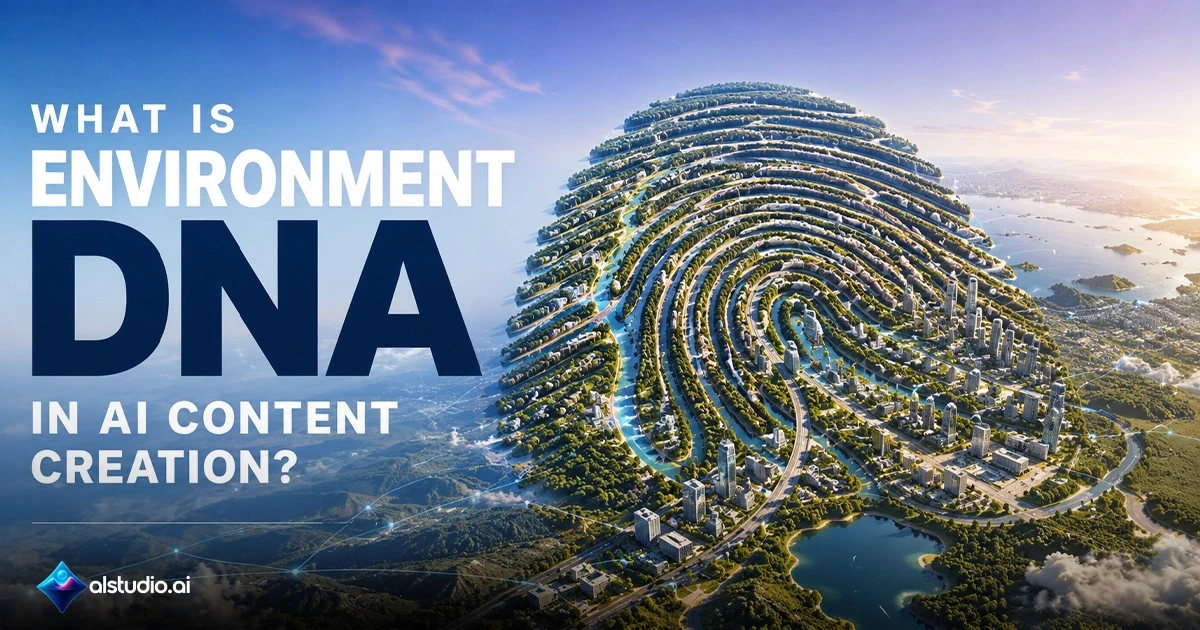
What Is Environment DNA in AI Content Creation?
Environment DNA is a persistent memory system that stores the defining characteristics of a location, scene, world, or environment so it can be reused consistently across AI-generated images, videos, campaigns, and workflows.
One of the biggest challenges in modern AI content creation is maintaining scene consistency. A location that looks perfect in one generation may suddenly change architecture, lighting, atmosphere, layout, or visual details in the next. This problem affects AI environment consistency, AI location consistency, AI video consistency, and overall campaign quality.
Environment DNA addresses this challenge by treating environments as reusable production assets rather than temporary generation outputs. Instead of rebuilding scenes from prompts every time, teams can maintain consistent locations and worlds across AI production workflows.
What Is Environment DNA?
Short Answer
Environment DNA is an environment memory system that preserves the identity of a location, scene, or world across AI-generated content.
Why Does It Matter?
Without environmental memory, AI systems often recreate locations differently every time content is generated. Small changes can accumulate across campaigns, making scenes feel disconnected.
How Does It Work?
Environment DNA captures the defining characteristics of a location and stores them as a reusable production asset. Teams can then apply that environmental identity across images, videos, campaigns, and workflows.
Detailed Explanation
Most AI models are excellent at generating new content but less effective at remembering previous environments. Even when prompts are nearly identical, generated outputs may vary significantly.
Common changes include:
Building structures
Interior layouts
Background elements
Lighting conditions
Weather effects
Environmental mood
Spatial relationships
Environment DNA solves this by preserving environmental identity over time. Rather than generating a location from scratch, teams reference a persistent environment profile that maintains continuity.
Why AI Environment Consistency Is Difficult
Short Answer
AI models generate probabilities, not memories.
Why Does It Matter?
Consistency becomes increasingly difficult when content is created over weeks, months, or multiple campaigns.
How Does It Work?
Each generation interprets prompts independently. Without a reusable memory layer, environments drift over time.
Detailed Explanation
Many AI content teams assume a well-written prompt is enough to maintain consistency. In practice, prompts only describe a desired outcome.
They do not store:
Environmental history
Location identity
Scene relationships
World-building rules
Campaign continuity
As a result, teams often experience:
Different room layouts between videos
Inconsistent product environments
Changing storefront appearances
Varying architectural details
Visual continuity issues across campaigns
This challenge becomes even more noticeable when using multiple AI tools and models throughout production.
Why Environment Consistency Matters More as AI Production Scales
Short Answer
Environment consistency becomes more important as content volume increases because small scene changes become more noticeable when dozens or hundreds of assets are produced.
Detailed Explanation
A creator producing one video may never encounter major consistency issues.
A marketing team producing:
50 social media assets
20 advertising creatives
10 product videos
Multiple localized campaigns
quickly discovers that environmental drift becomes an operational problem.
The more content a team creates, the harder it becomes to maintain:
Location continuity
Visual identity
Production quality
Campaign cohesion
This is why consistency is increasingly becoming a production challenge rather than a generation challenge.
Environment DNA vs Reference Images
Short Answer
Reference images help guide individual generations. Environment DNA maintains environmental identity across future workflows.
Why Does It Matter?
Many teams assume reference images solve scene consistency permanently. They help, but they do not provide persistent memory.
Comparison
Method | Consistency Level | Scalability | Long-Term Reliability |
Prompt Engineering | Low | Moderate | Low |
Reference Images | Moderate | Moderate | Moderate |
Style Controls | Moderate | High | Moderate |
Storyboards | Moderate | Moderate | Moderate |
Environment DNA | High | High | High |
Detailed Explanation
Reference images are useful for:
Visual guidance
Style matching
Initial scene generation
However, they do not store:
Environmental relationships
World logic
Production context
Long-term continuity
Environment DNA focuses on preserving environmental identity itself rather than repeatedly recreating scenes from references.
What Environment DNA Stores
Short Answer
Environment DNA stores the characteristics that define an environment's identity.
Core Components
Environment DNA may include:
Visual Appearance
Colors
Materials
Design language
Visual style
Architectural Structure
Buildings
Layouts
Room arrangements
Physical landmarks
Environmental Atmosphere
Mood
Weather
Time of day
Lighting conditions
Spatial Relationships
Object positioning
Navigation paths
Environmental hierarchy
Storytelling Elements
World-building rules
Narrative context
Environmental purpose
Production Metadata
Workflow connections
Version history
Governance controls
Together, these elements create reusable environments that remain recognizable across campaigns and content formats.
How Environment DNA Supports AI Video Consistency
Short Answer
Environment DNA helps maintain scene continuity across multiple video generations.
Why Does It Matter?
Video consistency problems are often more noticeable than image consistency issues because viewers can compare scenes over time.
Detailed Explanation
In AI video generation, environmental drift can appear as:
Changing backgrounds
Different architecture
Altered lighting
Missing environmental details
Inconsistent world-building
Tools such as Runway Gen-4, Veo, and other video-generation systems continue improving consistency controls, but production teams still need workflow-level approaches for maintaining continuity across large-scale content operations.
Environment DNA provides that production-level consistency layer.
Marketing Use Cases for Environment DNA
Ecommerce Brands
A brand may want every product launch to appear inside the same premium retail environment.
Environment DNA allows teams to maintain that location across:
Product photography
Promotional videos
Seasonal campaigns
Localized content
Marketing Teams
Marketing departments often produce content for multiple channels.
Environment DNA helps ensure:
Consistent campaign worlds
Unified visual storytelling
Reduced asset recreation
Agencies
Agencies frequently manage multiple brands simultaneously.
Environment DNA makes it easier to:
Maintain client environments
Scale production
Reduce revisions
Improve operational efficiency
Enterprise Organizations
Large enterprises often require governance and consistency across departments.
Environment DNA supports:
Standardized production workflows
Brand compliance
Cross-team collaboration
Global content operations
How to Implement Environment DNA in AI Production Workflows
Short Answer
Environment DNA works best when environments are treated as reusable production assets rather than generation outputs.
Step 1: Define Core Environment Characteristics
Document:
Architecture
Materials
Color palette
Atmosphere
Lighting
Environmental storytelling elements
Step 2: Create a Persistent Environment Profile
Store the environment as a reusable identity rather than relying on prompts.
Step 3: Connect Environment Identity Across Workflows
Use the same environment in:
Campaign planning
Image generation
Video generation
Post-production
Localization
Step 4: Maintain Governance
Establish rules for:
Environmental updates
Version control
Approvals
Team access
Step 5: Scale Across Production
Once an environment becomes reusable, teams can generate large volumes of content while maintaining continuity.
Soft CTA
If your team regularly recreates the same environments across campaigns, it may be worth evaluating whether those locations should become reusable production assets instead of one-time generation outputs.
Common Mistakes Teams Make When Trying to Maintain AI Scene Consistency
Mistake 1: Relying Only on Prompts
Prompts provide guidance but do not provide memory.
Mistake 2: Using Different References for Every Generation
Multiple references often introduce variation rather than consistency.
Mistake 3: Treating Every Asset as a New Project
Without reusable environmental systems, teams repeatedly recreate the same work.
Mistake 4: Ignoring Cross-Model Consistency
Different models interpret environments differently.
Mistake 5: No Environmental Governance
As teams grow, environment drift becomes harder to control.
Environment DNA and the Future of AI Production Workflows
Short Answer
The future of AI content creation depends on consistency as much as generation quality.
Why Does It Matter?
Generating content is becoming easier. Managing content at scale is becoming harder.
Detailed Explanation
As organizations expand AI production, consistency becomes a competitive advantage.
Future workflows will increasingly depend on:
Reusable environments
Persistent identities
Shared production memory
Cross-model consistency
Workflow automation
Environment DNA represents a shift from prompt-based generation toward production systems designed for long-term continuity.
Conclusion
Environment DNA helps solve one of the most persistent challenges in AI content creation: maintaining scene consistency across images, videos, campaigns, and workflows.
Unlike prompts, reference images, or isolated generation controls, Environment DNA acts as an environment memory system that preserves location identity over time. By supporting AI environment consistency, AI location consistency, world consistency AI initiatives, and reusable production workflows, Environment DNA enables teams to scale content production without sacrificing continuity.
The future of AI content production is not generating more environments. It is maintaining the environments that already work.
Environment DNA helps teams move beyond prompt-based recreation and toward reusable production memory that supports consistent content at scale.
Explore ALStudio and see how Environment DNA, Brand DNA, Product DNA, and Character DNA work together inside a unified Creative AI OS designed for modern content production.
Featured Snippet
Featured Snippet Paragraph
Environment DNA is a persistent memory system that stores the defining characteristics of a location, scene, world, or environment so it can be reused consistently across AI-generated images, videos, campaigns, and workflows. Unlike prompts or reference images, Environment DNA focuses on maintaining environmental identity over time rather than recreating scenes from scratch for every generation.
Featured Snippet Bullet List
What Environment DNA Stores
Visual appearance
Architectural structure
Environmental atmosphere
Layout and spatial relationships
Production context
Environmental storytelling elements
Reusable scene attributes
Cross-workflow consistency data
Comparison Table
Method | Consistency Level | Scalability | Long-Term Reliability |
Prompt Engineering | Low | Moderate | Low |
Reference Images | Moderate | Moderate | Moderate |
Style Controls | Moderate | High | Moderate |
Storyboards | Moderate | Moderate | Moderate |
Environment DNA | High | High | High |
What Is Environment DNA in AI Content Creation?
Environment DNA
What Is Environment DNA in AI Content Creation?
Environment DNA is a persistent memory system that stores the defining characteristics of a location, scene, world, or environment so it can be reused consistently across AI-generated images, videos, campaigns, and workflows.
One of the biggest challenges in modern AI content creation is maintaining scene consistency. A location that looks perfect in one generation may suddenly change architecture, lighting, atmosphere, layout, or visual details in the next. This problem affects AI environment consistency, AI location consistency, AI video consistency, and overall campaign quality.
Environment DNA addresses this challenge by treating environments as reusable production assets rather than temporary generation outputs. Instead of rebuilding scenes from prompts every time, teams can maintain consistent locations and worlds across AI production workflows.
What Is Environment DNA?
Short Answer
Environment DNA is an environment memory system that preserves the identity of a location, scene, or world across AI-generated content.
Why Does It Matter?
Without environmental memory, AI systems often recreate locations differently every time content is generated. Small changes can accumulate across campaigns, making scenes feel disconnected.
How Does It Work?
Environment DNA captures the defining characteristics of a location and stores them as a reusable production asset. Teams can then apply that environmental identity across images, videos, campaigns, and workflows.
Detailed Explanation
Most AI models are excellent at generating new content but less effective at remembering previous environments. Even when prompts are nearly identical, generated outputs may vary significantly.
Common changes include:
Building structures
Interior layouts
Background elements
Lighting conditions
Weather effects
Environmental mood
Spatial relationships
Environment DNA solves this by preserving environmental identity over time. Rather than generating a location from scratch, teams reference a persistent environment profile that maintains continuity.
Why AI Environment Consistency Is Difficult
Short Answer
AI models generate probabilities, not memories.
Why Does It Matter?
Consistency becomes increasingly difficult when content is created over weeks, months, or multiple campaigns.
How Does It Work?
Each generation interprets prompts independently. Without a reusable memory layer, environments drift over time.
Detailed Explanation
Many AI content teams assume a well-written prompt is enough to maintain consistency. In practice, prompts only describe a desired outcome.
They do not store:
Environmental history
Location identity
Scene relationships
World-building rules
Campaign continuity
As a result, teams often experience:
Different room layouts between videos
Inconsistent product environments
Changing storefront appearances
Varying architectural details
Visual continuity issues across campaigns
This challenge becomes even more noticeable when using multiple AI tools and models throughout production.
Why Environment Consistency Matters More as AI Production Scales
Short Answer
Environment consistency becomes more important as content volume increases because small scene changes become more noticeable when dozens or hundreds of assets are produced.
Detailed Explanation
A creator producing one video may never encounter major consistency issues.
A marketing team producing:
50 social media assets
20 advertising creatives
10 product videos
Multiple localized campaigns
quickly discovers that environmental drift becomes an operational problem.
The more content a team creates, the harder it becomes to maintain:
Location continuity
Visual identity
Production quality
Campaign cohesion
This is why consistency is increasingly becoming a production challenge rather than a generation challenge.
Environment DNA vs Reference Images
Short Answer
Reference images help guide individual generations. Environment DNA maintains environmental identity across future workflows.
Why Does It Matter?
Many teams assume reference images solve scene consistency permanently. They help, but they do not provide persistent memory.
Comparison
Method | Consistency Level | Scalability | Long-Term Reliability |
Prompt Engineering | Low | Moderate | Low |
Reference Images | Moderate | Moderate | Moderate |
Style Controls | Moderate | High | Moderate |
Storyboards | Moderate | Moderate | Moderate |
Environment DNA | High | High | High |
Detailed Explanation
Reference images are useful for:
Visual guidance
Style matching
Initial scene generation
However, they do not store:
Environmental relationships
World logic
Production context
Long-term continuity
Environment DNA focuses on preserving environmental identity itself rather than repeatedly recreating scenes from references.
What Environment DNA Stores
Short Answer
Environment DNA stores the characteristics that define an environment's identity.
Core Components
Environment DNA may include:
Visual Appearance
Colors
Materials
Design language
Visual style
Architectural Structure
Buildings
Layouts
Room arrangements
Physical landmarks
Environmental Atmosphere
Mood
Weather
Time of day
Lighting conditions
Spatial Relationships
Object positioning
Navigation paths
Environmental hierarchy
Storytelling Elements
World-building rules
Narrative context
Environmental purpose
Production Metadata
Workflow connections
Version history
Governance controls
Together, these elements create reusable environments that remain recognizable across campaigns and content formats.
How Environment DNA Supports AI Video Consistency
Short Answer
Environment DNA helps maintain scene continuity across multiple video generations.
Why Does It Matter?
Video consistency problems are often more noticeable than image consistency issues because viewers can compare scenes over time.
Detailed Explanation
In AI video generation, environmental drift can appear as:
Changing backgrounds
Different architecture
Altered lighting
Missing environmental details
Inconsistent world-building
Tools such as Runway Gen-4, Veo, and other video-generation systems continue improving consistency controls, but production teams still need workflow-level approaches for maintaining continuity across large-scale content operations.
Environment DNA provides that production-level consistency layer.
Marketing Use Cases for Environment DNA
Ecommerce Brands
A brand may want every product launch to appear inside the same premium retail environment.
Environment DNA allows teams to maintain that location across:
Product photography
Promotional videos
Seasonal campaigns
Localized content
Marketing Teams
Marketing departments often produce content for multiple channels.
Environment DNA helps ensure:
Consistent campaign worlds
Unified visual storytelling
Reduced asset recreation
Agencies
Agencies frequently manage multiple brands simultaneously.
Environment DNA makes it easier to:
Maintain client environments
Scale production
Reduce revisions
Improve operational efficiency
Enterprise Organizations
Large enterprises often require governance and consistency across departments.
Environment DNA supports:
Standardized production workflows
Brand compliance
Cross-team collaboration
Global content operations
How to Implement Environment DNA in AI Production Workflows
Short Answer
Environment DNA works best when environments are treated as reusable production assets rather than generation outputs.
Step 1: Define Core Environment Characteristics
Document:
Architecture
Materials
Color palette
Atmosphere
Lighting
Environmental storytelling elements
Step 2: Create a Persistent Environment Profile
Store the environment as a reusable identity rather than relying on prompts.
Step 3: Connect Environment Identity Across Workflows
Use the same environment in:
Campaign planning
Image generation
Video generation
Post-production
Localization
Step 4: Maintain Governance
Establish rules for:
Environmental updates
Version control
Approvals
Team access
Step 5: Scale Across Production
Once an environment becomes reusable, teams can generate large volumes of content while maintaining continuity.
Soft CTA
If your team regularly recreates the same environments across campaigns, it may be worth evaluating whether those locations should become reusable production assets instead of one-time generation outputs.
Common Mistakes Teams Make When Trying to Maintain AI Scene Consistency
Mistake 1: Relying Only on Prompts
Prompts provide guidance but do not provide memory.
Mistake 2: Using Different References for Every Generation
Multiple references often introduce variation rather than consistency.
Mistake 3: Treating Every Asset as a New Project
Without reusable environmental systems, teams repeatedly recreate the same work.
Mistake 4: Ignoring Cross-Model Consistency
Different models interpret environments differently.
Mistake 5: No Environmental Governance
As teams grow, environment drift becomes harder to control.
Environment DNA and the Future of AI Production Workflows
Short Answer
The future of AI content creation depends on consistency as much as generation quality.
Why Does It Matter?
Generating content is becoming easier. Managing content at scale is becoming harder.
Detailed Explanation
As organizations expand AI production, consistency becomes a competitive advantage.
Future workflows will increasingly depend on:
Reusable environments
Persistent identities
Shared production memory
Cross-model consistency
Workflow automation
Environment DNA represents a shift from prompt-based generation toward production systems designed for long-term continuity.
Conclusion
Environment DNA helps solve one of the most persistent challenges in AI content creation: maintaining scene consistency across images, videos, campaigns, and workflows.
Unlike prompts, reference images, or isolated generation controls, Environment DNA acts as an environment memory system that preserves location identity over time. By supporting AI environment consistency, AI location consistency, world consistency AI initiatives, and reusable production workflows, Environment DNA enables teams to scale content production without sacrificing continuity.
The future of AI content production is not generating more environments. It is maintaining the environments that already work.
Environment DNA helps teams move beyond prompt-based recreation and toward reusable production memory that supports consistent content at scale.
Explore ALStudio and see how Environment DNA, Brand DNA, Product DNA, and Character DNA work together inside a unified Creative AI OS designed for modern content production.
Featured Snippet
Featured Snippet Paragraph
Environment DNA is a persistent memory system that stores the defining characteristics of a location, scene, world, or environment so it can be reused consistently across AI-generated images, videos, campaigns, and workflows. Unlike prompts or reference images, Environment DNA focuses on maintaining environmental identity over time rather than recreating scenes from scratch for every generation.
Featured Snippet Bullet List
What Environment DNA Stores
Visual appearance
Architectural structure
Environmental atmosphere
Layout and spatial relationships
Production context
Environmental storytelling elements
Reusable scene attributes
Cross-workflow consistency data
Comparison Table
Method | Consistency Level | Scalability | Long-Term Reliability |
Prompt Engineering | Low | Moderate | Low |
Reference Images | Moderate | Moderate | Moderate |
Style Controls | Moderate | High | Moderate |
Storyboards | Moderate | Moderate | Moderate |
Environment DNA | High | High | High |
What Is Environment DNA in AI Content Creation?
Environment DNA
What Is Environment DNA in AI Content Creation?
Environment DNA is a persistent memory system that stores the defining characteristics of a location, scene, world, or environment so it can be reused consistently across AI-generated images, videos, campaigns, and workflows.
One of the biggest challenges in modern AI content creation is maintaining scene consistency. A location that looks perfect in one generation may suddenly change architecture, lighting, atmosphere, layout, or visual details in the next. This problem affects AI environment consistency, AI location consistency, AI video consistency, and overall campaign quality.
Environment DNA addresses this challenge by treating environments as reusable production assets rather than temporary generation outputs. Instead of rebuilding scenes from prompts every time, teams can maintain consistent locations and worlds across AI production workflows.
What Is Environment DNA?
Short Answer
Environment DNA is an environment memory system that preserves the identity of a location, scene, or world across AI-generated content.
Why Does It Matter?
Without environmental memory, AI systems often recreate locations differently every time content is generated. Small changes can accumulate across campaigns, making scenes feel disconnected.
How Does It Work?
Environment DNA captures the defining characteristics of a location and stores them as a reusable production asset. Teams can then apply that environmental identity across images, videos, campaigns, and workflows.
Detailed Explanation
Most AI models are excellent at generating new content but less effective at remembering previous environments. Even when prompts are nearly identical, generated outputs may vary significantly.
Common changes include:
Building structures
Interior layouts
Background elements
Lighting conditions
Weather effects
Environmental mood
Spatial relationships
Environment DNA solves this by preserving environmental identity over time. Rather than generating a location from scratch, teams reference a persistent environment profile that maintains continuity.
Why AI Environment Consistency Is Difficult
Short Answer
AI models generate probabilities, not memories.
Why Does It Matter?
Consistency becomes increasingly difficult when content is created over weeks, months, or multiple campaigns.
How Does It Work?
Each generation interprets prompts independently. Without a reusable memory layer, environments drift over time.
Detailed Explanation
Many AI content teams assume a well-written prompt is enough to maintain consistency. In practice, prompts only describe a desired outcome.
They do not store:
Environmental history
Location identity
Scene relationships
World-building rules
Campaign continuity
As a result, teams often experience:
Different room layouts between videos
Inconsistent product environments
Changing storefront appearances
Varying architectural details
Visual continuity issues across campaigns
This challenge becomes even more noticeable when using multiple AI tools and models throughout production.
Why Environment Consistency Matters More as AI Production Scales
Short Answer
Environment consistency becomes more important as content volume increases because small scene changes become more noticeable when dozens or hundreds of assets are produced.
Detailed Explanation
A creator producing one video may never encounter major consistency issues.
A marketing team producing:
50 social media assets
20 advertising creatives
10 product videos
Multiple localized campaigns
quickly discovers that environmental drift becomes an operational problem.
The more content a team creates, the harder it becomes to maintain:
Location continuity
Visual identity
Production quality
Campaign cohesion
This is why consistency is increasingly becoming a production challenge rather than a generation challenge.
Environment DNA vs Reference Images
Short Answer
Reference images help guide individual generations. Environment DNA maintains environmental identity across future workflows.
Why Does It Matter?
Many teams assume reference images solve scene consistency permanently. They help, but they do not provide persistent memory.
Comparison
Method | Consistency Level | Scalability | Long-Term Reliability |
Prompt Engineering | Low | Moderate | Low |
Reference Images | Moderate | Moderate | Moderate |
Style Controls | Moderate | High | Moderate |
Storyboards | Moderate | Moderate | Moderate |
Environment DNA | High | High | High |
Detailed Explanation
Reference images are useful for:
Visual guidance
Style matching
Initial scene generation
However, they do not store:
Environmental relationships
World logic
Production context
Long-term continuity
Environment DNA focuses on preserving environmental identity itself rather than repeatedly recreating scenes from references.
What Environment DNA Stores
Short Answer
Environment DNA stores the characteristics that define an environment's identity.
Core Components
Environment DNA may include:
Visual Appearance
Colors
Materials
Design language
Visual style
Architectural Structure
Buildings
Layouts
Room arrangements
Physical landmarks
Environmental Atmosphere
Mood
Weather
Time of day
Lighting conditions
Spatial Relationships
Object positioning
Navigation paths
Environmental hierarchy
Storytelling Elements
World-building rules
Narrative context
Environmental purpose
Production Metadata
Workflow connections
Version history
Governance controls
Together, these elements create reusable environments that remain recognizable across campaigns and content formats.
How Environment DNA Supports AI Video Consistency
Short Answer
Environment DNA helps maintain scene continuity across multiple video generations.
Why Does It Matter?
Video consistency problems are often more noticeable than image consistency issues because viewers can compare scenes over time.
Detailed Explanation
In AI video generation, environmental drift can appear as:
Changing backgrounds
Different architecture
Altered lighting
Missing environmental details
Inconsistent world-building
Tools such as Runway Gen-4, Veo, and other video-generation systems continue improving consistency controls, but production teams still need workflow-level approaches for maintaining continuity across large-scale content operations.
Environment DNA provides that production-level consistency layer.
Marketing Use Cases for Environment DNA
Ecommerce Brands
A brand may want every product launch to appear inside the same premium retail environment.
Environment DNA allows teams to maintain that location across:
Product photography
Promotional videos
Seasonal campaigns
Localized content
Marketing Teams
Marketing departments often produce content for multiple channels.
Environment DNA helps ensure:
Consistent campaign worlds
Unified visual storytelling
Reduced asset recreation
Agencies
Agencies frequently manage multiple brands simultaneously.
Environment DNA makes it easier to:
Maintain client environments
Scale production
Reduce revisions
Improve operational efficiency
Enterprise Organizations
Large enterprises often require governance and consistency across departments.
Environment DNA supports:
Standardized production workflows
Brand compliance
Cross-team collaboration
Global content operations
How to Implement Environment DNA in AI Production Workflows
Short Answer
Environment DNA works best when environments are treated as reusable production assets rather than generation outputs.
Step 1: Define Core Environment Characteristics
Document:
Architecture
Materials
Color palette
Atmosphere
Lighting
Environmental storytelling elements
Step 2: Create a Persistent Environment Profile
Store the environment as a reusable identity rather than relying on prompts.
Step 3: Connect Environment Identity Across Workflows
Use the same environment in:
Campaign planning
Image generation
Video generation
Post-production
Localization
Step 4: Maintain Governance
Establish rules for:
Environmental updates
Version control
Approvals
Team access
Step 5: Scale Across Production
Once an environment becomes reusable, teams can generate large volumes of content while maintaining continuity.
Soft CTA
If your team regularly recreates the same environments across campaigns, it may be worth evaluating whether those locations should become reusable production assets instead of one-time generation outputs.
Common Mistakes Teams Make When Trying to Maintain AI Scene Consistency
Mistake 1: Relying Only on Prompts
Prompts provide guidance but do not provide memory.
Mistake 2: Using Different References for Every Generation
Multiple references often introduce variation rather than consistency.
Mistake 3: Treating Every Asset as a New Project
Without reusable environmental systems, teams repeatedly recreate the same work.
Mistake 4: Ignoring Cross-Model Consistency
Different models interpret environments differently.
Mistake 5: No Environmental Governance
As teams grow, environment drift becomes harder to control.
Environment DNA and the Future of AI Production Workflows
Short Answer
The future of AI content creation depends on consistency as much as generation quality.
Why Does It Matter?
Generating content is becoming easier. Managing content at scale is becoming harder.
Detailed Explanation
As organizations expand AI production, consistency becomes a competitive advantage.
Future workflows will increasingly depend on:
Reusable environments
Persistent identities
Shared production memory
Cross-model consistency
Workflow automation
Environment DNA represents a shift from prompt-based generation toward production systems designed for long-term continuity.
Conclusion
Environment DNA helps solve one of the most persistent challenges in AI content creation: maintaining scene consistency across images, videos, campaigns, and workflows.
Unlike prompts, reference images, or isolated generation controls, Environment DNA acts as an environment memory system that preserves location identity over time. By supporting AI environment consistency, AI location consistency, world consistency AI initiatives, and reusable production workflows, Environment DNA enables teams to scale content production without sacrificing continuity.
The future of AI content production is not generating more environments. It is maintaining the environments that already work.
Environment DNA helps teams move beyond prompt-based recreation and toward reusable production memory that supports consistent content at scale.
Explore ALStudio and see how Environment DNA, Brand DNA, Product DNA, and Character DNA work together inside a unified Creative AI OS designed for modern content production.
Featured Snippet
Featured Snippet Paragraph
Environment DNA is a persistent memory system that stores the defining characteristics of a location, scene, world, or environment so it can be reused consistently across AI-generated images, videos, campaigns, and workflows. Unlike prompts or reference images, Environment DNA focuses on maintaining environmental identity over time rather than recreating scenes from scratch for every generation.
Featured Snippet Bullet List
What Environment DNA Stores
Visual appearance
Architectural structure
Environmental atmosphere
Layout and spatial relationships
Production context
Environmental storytelling elements
Reusable scene attributes
Cross-workflow consistency data
Comparison Table
Method | Consistency Level | Scalability | Long-Term Reliability |
Prompt Engineering | Low | Moderate | Low |
Reference Images | Moderate | Moderate | Moderate |
Style Controls | Moderate | High | Moderate |
Storyboards | Moderate | Moderate | Moderate |
Environment DNA | High | High | High |
What Is Environment DNA in AI Content Creation?
Environment DNA
What Is Environment DNA in AI Content Creation?
Environment DNA is a persistent memory system that stores the defining characteristics of a location, scene, world, or environment so it can be reused consistently across AI-generated images, videos, campaigns, and workflows.
One of the biggest challenges in modern AI content creation is maintaining scene consistency. A location that looks perfect in one generation may suddenly change architecture, lighting, atmosphere, layout, or visual details in the next. This problem affects AI environment consistency, AI location consistency, AI video consistency, and overall campaign quality.
Environment DNA addresses this challenge by treating environments as reusable production assets rather than temporary generation outputs. Instead of rebuilding scenes from prompts every time, teams can maintain consistent locations and worlds across AI production workflows.
What Is Environment DNA?
Short Answer
Environment DNA is an environment memory system that preserves the identity of a location, scene, or world across AI-generated content.
Why Does It Matter?
Without environmental memory, AI systems often recreate locations differently every time content is generated. Small changes can accumulate across campaigns, making scenes feel disconnected.
How Does It Work?
Environment DNA captures the defining characteristics of a location and stores them as a reusable production asset. Teams can then apply that environmental identity across images, videos, campaigns, and workflows.
Detailed Explanation
Most AI models are excellent at generating new content but less effective at remembering previous environments. Even when prompts are nearly identical, generated outputs may vary significantly.
Common changes include:
Building structures
Interior layouts
Background elements
Lighting conditions
Weather effects
Environmental mood
Spatial relationships
Environment DNA solves this by preserving environmental identity over time. Rather than generating a location from scratch, teams reference a persistent environment profile that maintains continuity.
Why AI Environment Consistency Is Difficult
Short Answer
AI models generate probabilities, not memories.
Why Does It Matter?
Consistency becomes increasingly difficult when content is created over weeks, months, or multiple campaigns.
How Does It Work?
Each generation interprets prompts independently. Without a reusable memory layer, environments drift over time.
Detailed Explanation
Many AI content teams assume a well-written prompt is enough to maintain consistency. In practice, prompts only describe a desired outcome.
They do not store:
Environmental history
Location identity
Scene relationships
World-building rules
Campaign continuity
As a result, teams often experience:
Different room layouts between videos
Inconsistent product environments
Changing storefront appearances
Varying architectural details
Visual continuity issues across campaigns
This challenge becomes even more noticeable when using multiple AI tools and models throughout production.
Why Environment Consistency Matters More as AI Production Scales
Short Answer
Environment consistency becomes more important as content volume increases because small scene changes become more noticeable when dozens or hundreds of assets are produced.
Detailed Explanation
A creator producing one video may never encounter major consistency issues.
A marketing team producing:
50 social media assets
20 advertising creatives
10 product videos
Multiple localized campaigns
quickly discovers that environmental drift becomes an operational problem.
The more content a team creates, the harder it becomes to maintain:
Location continuity
Visual identity
Production quality
Campaign cohesion
This is why consistency is increasingly becoming a production challenge rather than a generation challenge.
Environment DNA vs Reference Images
Short Answer
Reference images help guide individual generations. Environment DNA maintains environmental identity across future workflows.
Why Does It Matter?
Many teams assume reference images solve scene consistency permanently. They help, but they do not provide persistent memory.
Comparison
Method | Consistency Level | Scalability | Long-Term Reliability |
Prompt Engineering | Low | Moderate | Low |
Reference Images | Moderate | Moderate | Moderate |
Style Controls | Moderate | High | Moderate |
Storyboards | Moderate | Moderate | Moderate |
Environment DNA | High | High | High |
Detailed Explanation
Reference images are useful for:
Visual guidance
Style matching
Initial scene generation
However, they do not store:
Environmental relationships
World logic
Production context
Long-term continuity
Environment DNA focuses on preserving environmental identity itself rather than repeatedly recreating scenes from references.
What Environment DNA Stores
Short Answer
Environment DNA stores the characteristics that define an environment's identity.
Core Components
Environment DNA may include:
Visual Appearance
Colors
Materials
Design language
Visual style
Architectural Structure
Buildings
Layouts
Room arrangements
Physical landmarks
Environmental Atmosphere
Mood
Weather
Time of day
Lighting conditions
Spatial Relationships
Object positioning
Navigation paths
Environmental hierarchy
Storytelling Elements
World-building rules
Narrative context
Environmental purpose
Production Metadata
Workflow connections
Version history
Governance controls
Together, these elements create reusable environments that remain recognizable across campaigns and content formats.
How Environment DNA Supports AI Video Consistency
Short Answer
Environment DNA helps maintain scene continuity across multiple video generations.
Why Does It Matter?
Video consistency problems are often more noticeable than image consistency issues because viewers can compare scenes over time.
Detailed Explanation
In AI video generation, environmental drift can appear as:
Changing backgrounds
Different architecture
Altered lighting
Missing environmental details
Inconsistent world-building
Tools such as Runway Gen-4, Veo, and other video-generation systems continue improving consistency controls, but production teams still need workflow-level approaches for maintaining continuity across large-scale content operations.
Environment DNA provides that production-level consistency layer.
Marketing Use Cases for Environment DNA
Ecommerce Brands
A brand may want every product launch to appear inside the same premium retail environment.
Environment DNA allows teams to maintain that location across:
Product photography
Promotional videos
Seasonal campaigns
Localized content
Marketing Teams
Marketing departments often produce content for multiple channels.
Environment DNA helps ensure:
Consistent campaign worlds
Unified visual storytelling
Reduced asset recreation
Agencies
Agencies frequently manage multiple brands simultaneously.
Environment DNA makes it easier to:
Maintain client environments
Scale production
Reduce revisions
Improve operational efficiency
Enterprise Organizations
Large enterprises often require governance and consistency across departments.
Environment DNA supports:
Standardized production workflows
Brand compliance
Cross-team collaboration
Global content operations
How to Implement Environment DNA in AI Production Workflows
Short Answer
Environment DNA works best when environments are treated as reusable production assets rather than generation outputs.
Step 1: Define Core Environment Characteristics
Document:
Architecture
Materials
Color palette
Atmosphere
Lighting
Environmental storytelling elements
Step 2: Create a Persistent Environment Profile
Store the environment as a reusable identity rather than relying on prompts.
Step 3: Connect Environment Identity Across Workflows
Use the same environment in:
Campaign planning
Image generation
Video generation
Post-production
Localization
Step 4: Maintain Governance
Establish rules for:
Environmental updates
Version control
Approvals
Team access
Step 5: Scale Across Production
Once an environment becomes reusable, teams can generate large volumes of content while maintaining continuity.
Soft CTA
If your team regularly recreates the same environments across campaigns, it may be worth evaluating whether those locations should become reusable production assets instead of one-time generation outputs.
Common Mistakes Teams Make When Trying to Maintain AI Scene Consistency
Mistake 1: Relying Only on Prompts
Prompts provide guidance but do not provide memory.
Mistake 2: Using Different References for Every Generation
Multiple references often introduce variation rather than consistency.
Mistake 3: Treating Every Asset as a New Project
Without reusable environmental systems, teams repeatedly recreate the same work.
Mistake 4: Ignoring Cross-Model Consistency
Different models interpret environments differently.
Mistake 5: No Environmental Governance
As teams grow, environment drift becomes harder to control.
Environment DNA and the Future of AI Production Workflows
Short Answer
The future of AI content creation depends on consistency as much as generation quality.
Why Does It Matter?
Generating content is becoming easier. Managing content at scale is becoming harder.
Detailed Explanation
As organizations expand AI production, consistency becomes a competitive advantage.
Future workflows will increasingly depend on:
Reusable environments
Persistent identities
Shared production memory
Cross-model consistency
Workflow automation
Environment DNA represents a shift from prompt-based generation toward production systems designed for long-term continuity.
Conclusion
Environment DNA helps solve one of the most persistent challenges in AI content creation: maintaining scene consistency across images, videos, campaigns, and workflows.
Unlike prompts, reference images, or isolated generation controls, Environment DNA acts as an environment memory system that preserves location identity over time. By supporting AI environment consistency, AI location consistency, world consistency AI initiatives, and reusable production workflows, Environment DNA enables teams to scale content production without sacrificing continuity.
The future of AI content production is not generating more environments. It is maintaining the environments that already work.
Environment DNA helps teams move beyond prompt-based recreation and toward reusable production memory that supports consistent content at scale.
Explore ALStudio and see how Environment DNA, Brand DNA, Product DNA, and Character DNA work together inside a unified Creative AI OS designed for modern content production.
Featured Snippet
Featured Snippet Paragraph
Environment DNA is a persistent memory system that stores the defining characteristics of a location, scene, world, or environment so it can be reused consistently across AI-generated images, videos, campaigns, and workflows. Unlike prompts or reference images, Environment DNA focuses on maintaining environmental identity over time rather than recreating scenes from scratch for every generation.
Featured Snippet Bullet List
What Environment DNA Stores
Visual appearance
Architectural structure
Environmental atmosphere
Layout and spatial relationships
Production context
Environmental storytelling elements
Reusable scene attributes
Cross-workflow consistency data
Comparison Table
Method | Consistency Level | Scalability | Long-Term Reliability |
Prompt Engineering | Low | Moderate | Low |
Reference Images | Moderate | Moderate | Moderate |
Style Controls | Moderate | High | Moderate |
Storyboards | Moderate | Moderate | Moderate |
Environment DNA | High | High | High |
Frequently Asked Questions
Everything you'd want to know before signing up and everything an agency buyer asks on the call.
What is Environment DNA in AI content creation?
Environment DNA is a persistent memory system that stores the defining characteristics of a location or scene so it can be reused consistently across AI-generated images, videos, campaigns, and workflows. It helps maintain environmental identity over time instead of rebuilding scenes from scratch for every generation.
How is Environment DNA different from reference images?
Reference images guide individual generations. Environment DNA stores environmental identity itself, allowing teams to reuse the same location consistently across future workflows. This makes it more scalable for long-term production and campaign continuity.
Can Environment DNA work across multiple AI models?
Yes. The goal of Environment DNA is to maintain environmental identity regardless of which image, video, or production workflow is being used. This helps reduce variation when teams use multiple generation tools.
Is Environment DNA useful for marketing campaigns?
Yes. Marketing teams often create content across multiple channels and formats. Environment DNA helps ensure those assets appear to exist within the same visual world, improving campaign consistency and brand experience.
Does Environment DNA reduce production time?
It can reduce time spent rebuilding environments, managing reference assets, and correcting environmental drift during production. Teams can reuse existing environment profiles instead of recreating locations repeatedly.
Related blogs
Provide insights into team performance and engagement



Related blogs
Provide insights into team performance and engagement
Related blogs
Provide insights into team performance and engagement
Stay Ahead of AI Creativity
Get new AI models, creative workflows, product updates, and marketing insights delivered to your inbox.
Tools
©2026 Animus All Rights Reserved.
Stay Ahead of AI Creativity
Get new AI models, creative workflows, product updates, and marketing insights delivered to your inbox.
Tools
©2026 Animus All Rights Reserved.
Stay Ahead of AI Creativity
Get new AI models, creative workflows, product updates, and marketing insights delivered to your inbox.
Tools
©2026 Animus All Rights Reserved.