



Brand DNA vs Traditional Brand Guidelines
Brand DNA
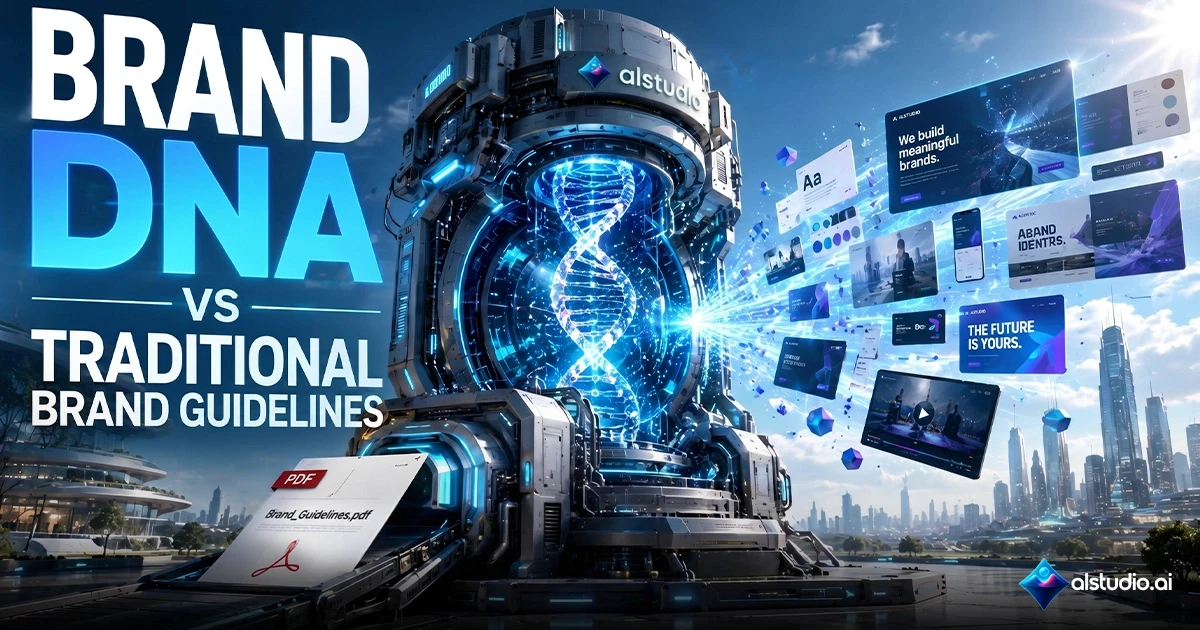
Brand DNA vs Brand Guidelines:
What's the Difference and Why It Matters for AI Content ?
Most marketing teams have brand guidelines. Very few have Brand DNA.
On the surface, those two things sound similar. In practice, the difference between brand DNA and brand guidelines is the difference between a brand that stays consistent at scale and one that slowly drifts every time AI generates a new piece of content.
If your team is already using AI tools for content production and spending more time correcting those outputs than you expected the distinction matters more than you might think.
What Are Brand Guidelines?
Brand guidelines are a static reference document. They define how your brand looks, speaks, and presents itself. A typical brand guidelines document includes:
Logo usage rules and clear space requirements
Color palette with hex, RGB, and CMYK values
Typography choices and hierarchy
Photography and illustration style
Tone of voice principles
Messaging pillars and positioning statements
Do and don't examples
Brand guidelines serve a clear purpose. They give designers, copywriters, agencies, and new team members a shared reference point. When a team is small and content volume is manageable, they work reasonably well.
The problem is not what brand guidelines contain. The problem is what they are: a document. A PDF. A slide deck. A static file that someone has to open, read, interpret, and then manually apply to whatever they are creating.
That process worked when humans were producing all of the content. It breaks down when AI is generating hundreds or thousands of pieces of content simultaneously and when each AI generation is an independent, memoryless event.
What Is Brand DNA?
Brand DNA is a persistent, structured memory layer that stores brand knowledge in a format that can be actively referenced during content generation, not just read by humans before they start working.
The core idea: brand guidelines tell people what the brand is. Brand DNA gives AI systems an active, structured source of truth to draw from at the moment content is being created.
Where brand guidelines live in a document, Brand DNA lives inside the generation environment. It is not a PDF that gets referenced occasionally. It is a connected memory that informs every output automatically.
In practice, Brand DNA captures the same information as brand guidelines — voice, visual identity, positioning, personas but structures it as operational data rather than descriptive documentation.
Brand DNA vs Brand Guidelines: The Core Differences
Dimension | Brand Guidelines | Brand DNA |
Format | Static document (PDF, slide deck) | Structured, persistent memory layer |
Accessibility | Opened and read manually | Referenced automatically during generation |
Update mechanism | File version updates | Live system updates |
AI compatibility | Not natively compatible | Designed for AI-native workflows |
Consistency mechanism | Human interpretation | Systematic application at generation |
Scope | Typically single-language | Multi-language and multi-dialect capable |
Drift prevention | Reactive (catch after creation) | Proactive (inform before creation) |
Scalability | Degrades as volume increases | Designed to scale with content volume |
The difference is not cosmetic. It reflects a fundamentally different understanding of what keeps a brand consistent in an environment where AI is generating content at scale.
Why Brand Guidelines Were Never Built for AI
Brand guidelines were designed for a world where humans produced all content.
In that world, a designer could absorb guidelines over months of practice. A copywriter could internalize voice through repeated campaign work. A creative director became a living memory system who remembered what had been approved before.
Human memory filled the gaps between documentation and execution.
When generative AI entered marketing workflows, that buffer disappeared almost immediately. AI tools do not absorb guidelines through experience. They do not remember what was approved last week. Every generation is a fresh probabilistic event statistically independent from every generation that came before.
This is the core mechanism behind what is often called brand drift.
A generative model samples from a range of possible outputs every time it creates content. Generate an image using the same prompt twice and you will frequently receive different outputs. The same character might appear with subtly different features. Product details might shift. Tone might vary from post to post.
The model is not malfunctioning. It is doing exactly what it was designed to do. The inconsistency appears because there was never a persistent reference for the model to hold onto between generations.
Brand guidelines do not solve this problem because they were never designed to solve this problem. They were designed for human readers, not for AI generation systems.
The Five Dimensions Where Brand Drift Occurs
Brand consistency is not one problem. It is five interconnected problems, and guidelines typically address only parts of them:
1. Brand Voice Consistency
The language, tone, personality, and positioning of the brand. Every piece of content should sound like it came from the same organization regardless of who or what created it.
2. Character Consistency
Recurring people, spokespersons, avatars, and visual identities should remain recognizable across campaigns, channels, and over time. AI-generated characters are particularly vulnerable to visual drift between generations.
3. Product Consistency
Products must appear accurately and consistently across every image, video, and advertisement. Colors, shapes, labels, and features should not shift between renders.
4. Environment Consistency
Recurring locations, scenes, and visual worlds should maintain continuity. A brand that uses a specific visual environment repeatedly needs that environment to remain recognizable.
5. Visual Identity Consistency
Colors, composition, typography, layout patterns, and overall aesthetic should remain aligned with established brand standards.
Brand guidelines typically describe all five of these dimensions. Brand DNA actively enforces them during generation.
The Memory Problem Behind AI Brand Drift
Most teams encountering inconsistency in AI-generated content assume they have an AI problem.
In reality, most have a memory problem.
The AI generates exactly what it is asked to generate. The challenge is that every creator, every tool, and every workflow is operating from a slightly different interpretation of the brand because the brand exists as a document that gets interpreted rather than as structured memory that gets applied.
When you understand drift as a memory problem rather than a prompting problem, many common solutions reveal their limitations:
Better prompts improve individual outputs but do not create a shared foundation across teams, agencies, and tools. The next user writes a different prompt. The next agency has a different interpretation. Prompts are not memory.
More approvals slow damage but do not prevent it. Review workflows catch inconsistency after content already exists. They are a correction layer, not a prevention layer.
Governance systems improve visibility but still operate reactively. They flag what is wrong; they do not eliminate the conditions that created the problem.
None of these approaches address the root cause: there is no persistent, shared memory that every generation references automatically.
What Brand DNA Changes About AI Content Production
Brand DNA restructures where consistency enters the workflow.
The traditional workflow looks like this:
Brand Guidelines → Prompt → AI Generation → Review → Revisions → Publish
Every stage introduces interpretation. The AI interprets the prompt. The reviewer interprets the brand. The next team member interprets the review.
A Brand DNA workflow looks like this:
Brand Memory → Generation → Publish
The brand is no longer consulted after creation. It is active during creation.
This changes outcomes because consistency becomes an input rather than an afterthought. The first output already starts closer to the correct answer. Review cycles get shorter. Corrections decrease. New team members become productive faster because they are working from a shared foundation rather than their own interpretation of a guidelines document.
Real Use Cases: Where the Difference Becomes Visible
Marketing Agency Use Case
An agency managing six enterprise clients across two regions runs a team of creative producers, copywriters, and freelancers generating AI content daily.
With brand guidelines, every producer reads the client guidelines and applies their own interpretation. Outputs vary. The review team corrects. Deadlines slip.
With Brand DNA embedded in the production environment, every generation starts from the same structured reference. Voice stays consistent regardless of which producer creates the content. Visual outputs maintain approved color and composition standards. The correction cycle shrinks significantly.
Enterprise Marketing Use Case
A large enterprise operates marketing teams across four regions, three business units, and multiple agencies. Content is generated in English, Arabic, and regional dialects simultaneously.
With brand guidelines, consistency depends on every team, in every market, interpreting the same document correctly. The larger the organization, the more interpretations exist. Inconsistency compounds at scale.
With Brand DNA, the same structured memory informs every generation across all regions and languages. The brand sounds like the same company in every market.
E-Commerce Brand Use Case
An ecommerce brand uses AI to generate product images, advertising creatives, and social content at high volume.
With brand guidelines alone, product appearances drift across renders. Colors shift. Characters change. The campaign looks assembled rather than designed.
With persistent Product DNA and Character DNA active during generation, product visuals maintain accuracy across every asset. The campaign maintains coherence as volume increases.
Why This Problem Is Harder in MENA
Most discussions about AI brand consistency assume a single-language environment.
That assumption breaks down immediately across MENA markets, where organizations often operate simultaneously across English, Modern Standard Arabic, and multiple Arabic dialects.
Brand guidelines written in one language rarely translate directly into consistent brand execution across all languages. Tone shifts. Formality changes. Cultural register varies. A campaign that sounds authoritative and credible in English may sound stiff, generic, or inconsistent in Arabic if the underlying brand knowledge has not been structured for multi-language application.
This creates localization drift a second layer of inconsistency that sits on top of the base consistency challenges every AI content team already faces.
For organizations in banking, healthcare, telecom, government, and enterprise technology, this is not simply a branding problem. It is a trust problem. A brand that sounds inconsistent across markets loses credibility even when the underlying offer is identical.
Brand DNA that persists across languages including Modern Standard Arabic and regional dialects addresses both the generation consistency problem and the localization drift problem simultaneously.
Want to see how ALStudio's Brand DNA layer keeps AI-generated content consistent across campaigns, channels, and languages? Explore the platform and request a demo.
The Governance vs Memory Distinction
It is worth being clear about what governance systems do and do not solve.
Governance systems are valuable. They make guidelines more accessible. They reduce manual review time. They help teams identify off-brand content faster. Modern platforms increasingly offer brand kits, asset libraries, voice controls, and approval workflows that address real operational problems.
But governance systems still operate after generation. They detect inconsistency. They do not prevent it at the source.
The question is not whether organizations need governance. They do.
The question is whether governance alone can keep up with the volume of AI-generated content being produced today and whether it will be able to keep up as that volume continues to increase.
As content production scales, the hidden cost of correction compounds. Teams spend time regenerating images. Copywriters rewrite outputs. Review cycles absorb hours that were supposed to be saved. Campaign launches slip.
Individually, these corrections appear minor. Collectively, they represent a second production workflow running alongside the first a consistency tax that grows as content volume grows.
Governance catches the errors. Memory reduces the probability of creating them.
How to Move from Brand Guidelines to Brand DNA
Transitioning from a static guidelines approach to a memory-based approach does not require discarding existing documentation. It requires restructuring it.
Step 1: Audit your existing brand guidelines Identify which elements are most critical to maintain consistently across AI-generated content: voice and tone, visual standards, product representation, character design, recurring environments.
Step 2: Structure brand knowledge as operational data Move from descriptive documentation to structured parameters. Voice principles become consistent prompt-level inputs. Visual standards become persistent style references. Product details become accurate representations that every generation draws from.
Step 3: Centralize the memory layer Brand knowledge should exist in one place that every tool, team, and workflow references not distributed across individual prompt libraries, agency briefings, and disconnected asset folders.
Step 4: Separate governance from generation Continue running governance and approval workflows. But position them as a quality layer on top of a generation process that already starts from shared brand memory not as the primary mechanism keeping content consistent.
Step 5: Apply across languages and markets For organizations operating across multiple languages, ensure brand memory is structured to maintain consistent identity across every language track, not just the primary market language.
Common Mistakes Teams Make
Treating prompts as a consistency system. Prompts improve individual outputs. They do not create a shared foundation across teams and tools.
Relying on review to catch everything. As content volume grows, review cannot scale at the same rate. Catching errors after creation is more expensive than reducing their frequency before creation.
Fragmenting brand knowledge across tools. When voice lives in one platform, visuals in another, and product standards in a third, inconsistency moves into the gaps between systems.
Ignoring localization drift. Visual consistency and voice consistency are separate challenges. Maintaining one while neglecting the other creates a brand that looks the same but sounds like a different company across markets.
Updating guidelines without updating the generation environment. When brand guidelines change, every connected generation system should reflect that change automatically not through a new document that people may or may not read.
The Next Generation of Brand Management
For decades, brand management was fundamentally a documentation challenge. The goal was to help human creators remember the brand.
The AI era changes the requirement.
The challenge is no longer helping humans remember. The challenge is giving AI systems persistent access to structured brand knowledge so that every generation begins from an accurate, consistent foundation rather than from an independent probabilistic event.
The brands that solve this first will gain a meaningful advantage: faster production, fewer corrections, more consistent consumer experience, and greater trust at every touchpoint.
Brand guidelines will remain part of the toolkit. They serve a legitimate purpose in onboarding, human communication, and legal brand protection.
But brand guidelines alone are not sufficient as a consistency mechanism in an AI-native production environment.
Brand DNA is the operational complement that makes consistent AI content production possible at scale.
Conclusion: Brand DNA vs Brand Guidelines in the AI Era
The difference between brand DNA and brand guidelines is not a matter of terminology. It reflects a structural shift in how brand consistency needs to work when AI is generating content at volume.
Brand guidelines describe the brand to humans. Brand DNA gives AI systems a persistent, structured memory that informs generation before the first word is written or the first image is produced.
Teams that recognize this distinction and build their production infrastructure accordingly are not just reducing correction cycles. They are building a compounding advantage in consistency, speed, and scalability that widens as content volume grows.
The question is no longer whether your brand has guidelines. It is whether your brand has memory.
ALStudio is a Creative AI OS built around persistent brand memory. Brand DNA, Character DNA, Product DNA, and Environment DNA work together inside a single generation environment to keep AI-produced content consistent across teams, channels, languages, and markets. See how it works.
FEATURED SNIPPET
Featured Snippet Paragraph (52 words)
Brand DNA is a persistent memory layer that gives AI generation systems structured access to brand knowledge during content creation. Brand guidelines are static documents designed for human readers. The key difference: guidelines describe the brand after the fact; Brand DNA informs AI generation before content is produced, preventing brand drift at scale.
Featured Snippet Bullet List
Brand DNA vs Brand Guidelines Key Differences:
Brand guidelines are static documents; Brand DNA is an active memory layer
Guidelines require human interpretation; Brand DNA applies automatically during AI generation
Guidelines are read before work begins; Brand DNA is referenced during every generation
Guidelines degrade in consistency as AI content volume scales; Brand DNA is designed to scale
Guidelines exist outside AI tools; Brand DNA exists inside the generation environment
Brand guidelines catch drift through governance; Brand DNA reduces the probability of drift at the source
Comparison Table
Brand Guidelines | Brand DNA | |
Format | Static document | Persistent memory layer |
Designed for | Human creators | AI generation systems |
When it applies | Before work begins | During every generation |
Update mechanism | New document version | Live system update |
Consistency approach | Human interpretation | Systematic application |
Scale behavior | Degrades at high volume | Designed for high-volume production |
Language support | Typically single-language | Multi-language and multi-dialect |
Drift prevention | Reactive (governance) | Proactive (memory-at-generation) |
Brand DNA vs Traditional Brand Guidelines
Brand DNA
Brand DNA vs Brand Guidelines:
What's the Difference and Why It Matters for AI Content ?
Most marketing teams have brand guidelines. Very few have Brand DNA.
On the surface, those two things sound similar. In practice, the difference between brand DNA and brand guidelines is the difference between a brand that stays consistent at scale and one that slowly drifts every time AI generates a new piece of content.
If your team is already using AI tools for content production and spending more time correcting those outputs than you expected the distinction matters more than you might think.
What Are Brand Guidelines?
Brand guidelines are a static reference document. They define how your brand looks, speaks, and presents itself. A typical brand guidelines document includes:
Logo usage rules and clear space requirements
Color palette with hex, RGB, and CMYK values
Typography choices and hierarchy
Photography and illustration style
Tone of voice principles
Messaging pillars and positioning statements
Do and don't examples
Brand guidelines serve a clear purpose. They give designers, copywriters, agencies, and new team members a shared reference point. When a team is small and content volume is manageable, they work reasonably well.
The problem is not what brand guidelines contain. The problem is what they are: a document. A PDF. A slide deck. A static file that someone has to open, read, interpret, and then manually apply to whatever they are creating.
That process worked when humans were producing all of the content. It breaks down when AI is generating hundreds or thousands of pieces of content simultaneously and when each AI generation is an independent, memoryless event.
What Is Brand DNA?
Brand DNA is a persistent, structured memory layer that stores brand knowledge in a format that can be actively referenced during content generation, not just read by humans before they start working.
The core idea: brand guidelines tell people what the brand is. Brand DNA gives AI systems an active, structured source of truth to draw from at the moment content is being created.
Where brand guidelines live in a document, Brand DNA lives inside the generation environment. It is not a PDF that gets referenced occasionally. It is a connected memory that informs every output automatically.
In practice, Brand DNA captures the same information as brand guidelines — voice, visual identity, positioning, personas but structures it as operational data rather than descriptive documentation.
Brand DNA vs Brand Guidelines: The Core Differences
Dimension | Brand Guidelines | Brand DNA |
Format | Static document (PDF, slide deck) | Structured, persistent memory layer |
Accessibility | Opened and read manually | Referenced automatically during generation |
Update mechanism | File version updates | Live system updates |
AI compatibility | Not natively compatible | Designed for AI-native workflows |
Consistency mechanism | Human interpretation | Systematic application at generation |
Scope | Typically single-language | Multi-language and multi-dialect capable |
Drift prevention | Reactive (catch after creation) | Proactive (inform before creation) |
Scalability | Degrades as volume increases | Designed to scale with content volume |
The difference is not cosmetic. It reflects a fundamentally different understanding of what keeps a brand consistent in an environment where AI is generating content at scale.
Why Brand Guidelines Were Never Built for AI
Brand guidelines were designed for a world where humans produced all content.
In that world, a designer could absorb guidelines over months of practice. A copywriter could internalize voice through repeated campaign work. A creative director became a living memory system who remembered what had been approved before.
Human memory filled the gaps between documentation and execution.
When generative AI entered marketing workflows, that buffer disappeared almost immediately. AI tools do not absorb guidelines through experience. They do not remember what was approved last week. Every generation is a fresh probabilistic event statistically independent from every generation that came before.
This is the core mechanism behind what is often called brand drift.
A generative model samples from a range of possible outputs every time it creates content. Generate an image using the same prompt twice and you will frequently receive different outputs. The same character might appear with subtly different features. Product details might shift. Tone might vary from post to post.
The model is not malfunctioning. It is doing exactly what it was designed to do. The inconsistency appears because there was never a persistent reference for the model to hold onto between generations.
Brand guidelines do not solve this problem because they were never designed to solve this problem. They were designed for human readers, not for AI generation systems.
The Five Dimensions Where Brand Drift Occurs
Brand consistency is not one problem. It is five interconnected problems, and guidelines typically address only parts of them:
1. Brand Voice Consistency
The language, tone, personality, and positioning of the brand. Every piece of content should sound like it came from the same organization regardless of who or what created it.
2. Character Consistency
Recurring people, spokespersons, avatars, and visual identities should remain recognizable across campaigns, channels, and over time. AI-generated characters are particularly vulnerable to visual drift between generations.
3. Product Consistency
Products must appear accurately and consistently across every image, video, and advertisement. Colors, shapes, labels, and features should not shift between renders.
4. Environment Consistency
Recurring locations, scenes, and visual worlds should maintain continuity. A brand that uses a specific visual environment repeatedly needs that environment to remain recognizable.
5. Visual Identity Consistency
Colors, composition, typography, layout patterns, and overall aesthetic should remain aligned with established brand standards.
Brand guidelines typically describe all five of these dimensions. Brand DNA actively enforces them during generation.
The Memory Problem Behind AI Brand Drift
Most teams encountering inconsistency in AI-generated content assume they have an AI problem.
In reality, most have a memory problem.
The AI generates exactly what it is asked to generate. The challenge is that every creator, every tool, and every workflow is operating from a slightly different interpretation of the brand because the brand exists as a document that gets interpreted rather than as structured memory that gets applied.
When you understand drift as a memory problem rather than a prompting problem, many common solutions reveal their limitations:
Better prompts improve individual outputs but do not create a shared foundation across teams, agencies, and tools. The next user writes a different prompt. The next agency has a different interpretation. Prompts are not memory.
More approvals slow damage but do not prevent it. Review workflows catch inconsistency after content already exists. They are a correction layer, not a prevention layer.
Governance systems improve visibility but still operate reactively. They flag what is wrong; they do not eliminate the conditions that created the problem.
None of these approaches address the root cause: there is no persistent, shared memory that every generation references automatically.
What Brand DNA Changes About AI Content Production
Brand DNA restructures where consistency enters the workflow.
The traditional workflow looks like this:
Brand Guidelines → Prompt → AI Generation → Review → Revisions → Publish
Every stage introduces interpretation. The AI interprets the prompt. The reviewer interprets the brand. The next team member interprets the review.
A Brand DNA workflow looks like this:
Brand Memory → Generation → Publish
The brand is no longer consulted after creation. It is active during creation.
This changes outcomes because consistency becomes an input rather than an afterthought. The first output already starts closer to the correct answer. Review cycles get shorter. Corrections decrease. New team members become productive faster because they are working from a shared foundation rather than their own interpretation of a guidelines document.
Real Use Cases: Where the Difference Becomes Visible
Marketing Agency Use Case
An agency managing six enterprise clients across two regions runs a team of creative producers, copywriters, and freelancers generating AI content daily.
With brand guidelines, every producer reads the client guidelines and applies their own interpretation. Outputs vary. The review team corrects. Deadlines slip.
With Brand DNA embedded in the production environment, every generation starts from the same structured reference. Voice stays consistent regardless of which producer creates the content. Visual outputs maintain approved color and composition standards. The correction cycle shrinks significantly.
Enterprise Marketing Use Case
A large enterprise operates marketing teams across four regions, three business units, and multiple agencies. Content is generated in English, Arabic, and regional dialects simultaneously.
With brand guidelines, consistency depends on every team, in every market, interpreting the same document correctly. The larger the organization, the more interpretations exist. Inconsistency compounds at scale.
With Brand DNA, the same structured memory informs every generation across all regions and languages. The brand sounds like the same company in every market.
E-Commerce Brand Use Case
An ecommerce brand uses AI to generate product images, advertising creatives, and social content at high volume.
With brand guidelines alone, product appearances drift across renders. Colors shift. Characters change. The campaign looks assembled rather than designed.
With persistent Product DNA and Character DNA active during generation, product visuals maintain accuracy across every asset. The campaign maintains coherence as volume increases.
Why This Problem Is Harder in MENA
Most discussions about AI brand consistency assume a single-language environment.
That assumption breaks down immediately across MENA markets, where organizations often operate simultaneously across English, Modern Standard Arabic, and multiple Arabic dialects.
Brand guidelines written in one language rarely translate directly into consistent brand execution across all languages. Tone shifts. Formality changes. Cultural register varies. A campaign that sounds authoritative and credible in English may sound stiff, generic, or inconsistent in Arabic if the underlying brand knowledge has not been structured for multi-language application.
This creates localization drift a second layer of inconsistency that sits on top of the base consistency challenges every AI content team already faces.
For organizations in banking, healthcare, telecom, government, and enterprise technology, this is not simply a branding problem. It is a trust problem. A brand that sounds inconsistent across markets loses credibility even when the underlying offer is identical.
Brand DNA that persists across languages including Modern Standard Arabic and regional dialects addresses both the generation consistency problem and the localization drift problem simultaneously.
Want to see how ALStudio's Brand DNA layer keeps AI-generated content consistent across campaigns, channels, and languages? Explore the platform and request a demo.
The Governance vs Memory Distinction
It is worth being clear about what governance systems do and do not solve.
Governance systems are valuable. They make guidelines more accessible. They reduce manual review time. They help teams identify off-brand content faster. Modern platforms increasingly offer brand kits, asset libraries, voice controls, and approval workflows that address real operational problems.
But governance systems still operate after generation. They detect inconsistency. They do not prevent it at the source.
The question is not whether organizations need governance. They do.
The question is whether governance alone can keep up with the volume of AI-generated content being produced today and whether it will be able to keep up as that volume continues to increase.
As content production scales, the hidden cost of correction compounds. Teams spend time regenerating images. Copywriters rewrite outputs. Review cycles absorb hours that were supposed to be saved. Campaign launches slip.
Individually, these corrections appear minor. Collectively, they represent a second production workflow running alongside the first a consistency tax that grows as content volume grows.
Governance catches the errors. Memory reduces the probability of creating them.
How to Move from Brand Guidelines to Brand DNA
Transitioning from a static guidelines approach to a memory-based approach does not require discarding existing documentation. It requires restructuring it.
Step 1: Audit your existing brand guidelines Identify which elements are most critical to maintain consistently across AI-generated content: voice and tone, visual standards, product representation, character design, recurring environments.
Step 2: Structure brand knowledge as operational data Move from descriptive documentation to structured parameters. Voice principles become consistent prompt-level inputs. Visual standards become persistent style references. Product details become accurate representations that every generation draws from.
Step 3: Centralize the memory layer Brand knowledge should exist in one place that every tool, team, and workflow references not distributed across individual prompt libraries, agency briefings, and disconnected asset folders.
Step 4: Separate governance from generation Continue running governance and approval workflows. But position them as a quality layer on top of a generation process that already starts from shared brand memory not as the primary mechanism keeping content consistent.
Step 5: Apply across languages and markets For organizations operating across multiple languages, ensure brand memory is structured to maintain consistent identity across every language track, not just the primary market language.
Common Mistakes Teams Make
Treating prompts as a consistency system. Prompts improve individual outputs. They do not create a shared foundation across teams and tools.
Relying on review to catch everything. As content volume grows, review cannot scale at the same rate. Catching errors after creation is more expensive than reducing their frequency before creation.
Fragmenting brand knowledge across tools. When voice lives in one platform, visuals in another, and product standards in a third, inconsistency moves into the gaps between systems.
Ignoring localization drift. Visual consistency and voice consistency are separate challenges. Maintaining one while neglecting the other creates a brand that looks the same but sounds like a different company across markets.
Updating guidelines without updating the generation environment. When brand guidelines change, every connected generation system should reflect that change automatically not through a new document that people may or may not read.
The Next Generation of Brand Management
For decades, brand management was fundamentally a documentation challenge. The goal was to help human creators remember the brand.
The AI era changes the requirement.
The challenge is no longer helping humans remember. The challenge is giving AI systems persistent access to structured brand knowledge so that every generation begins from an accurate, consistent foundation rather than from an independent probabilistic event.
The brands that solve this first will gain a meaningful advantage: faster production, fewer corrections, more consistent consumer experience, and greater trust at every touchpoint.
Brand guidelines will remain part of the toolkit. They serve a legitimate purpose in onboarding, human communication, and legal brand protection.
But brand guidelines alone are not sufficient as a consistency mechanism in an AI-native production environment.
Brand DNA is the operational complement that makes consistent AI content production possible at scale.
Conclusion: Brand DNA vs Brand Guidelines in the AI Era
The difference between brand DNA and brand guidelines is not a matter of terminology. It reflects a structural shift in how brand consistency needs to work when AI is generating content at volume.
Brand guidelines describe the brand to humans. Brand DNA gives AI systems a persistent, structured memory that informs generation before the first word is written or the first image is produced.
Teams that recognize this distinction and build their production infrastructure accordingly are not just reducing correction cycles. They are building a compounding advantage in consistency, speed, and scalability that widens as content volume grows.
The question is no longer whether your brand has guidelines. It is whether your brand has memory.
ALStudio is a Creative AI OS built around persistent brand memory. Brand DNA, Character DNA, Product DNA, and Environment DNA work together inside a single generation environment to keep AI-produced content consistent across teams, channels, languages, and markets. See how it works.
FEATURED SNIPPET
Featured Snippet Paragraph (52 words)
Brand DNA is a persistent memory layer that gives AI generation systems structured access to brand knowledge during content creation. Brand guidelines are static documents designed for human readers. The key difference: guidelines describe the brand after the fact; Brand DNA informs AI generation before content is produced, preventing brand drift at scale.
Featured Snippet Bullet List
Brand DNA vs Brand Guidelines Key Differences:
Brand guidelines are static documents; Brand DNA is an active memory layer
Guidelines require human interpretation; Brand DNA applies automatically during AI generation
Guidelines are read before work begins; Brand DNA is referenced during every generation
Guidelines degrade in consistency as AI content volume scales; Brand DNA is designed to scale
Guidelines exist outside AI tools; Brand DNA exists inside the generation environment
Brand guidelines catch drift through governance; Brand DNA reduces the probability of drift at the source
Comparison Table
Brand Guidelines | Brand DNA | |
Format | Static document | Persistent memory layer |
Designed for | Human creators | AI generation systems |
When it applies | Before work begins | During every generation |
Update mechanism | New document version | Live system update |
Consistency approach | Human interpretation | Systematic application |
Scale behavior | Degrades at high volume | Designed for high-volume production |
Language support | Typically single-language | Multi-language and multi-dialect |
Drift prevention | Reactive (governance) | Proactive (memory-at-generation) |
Brand DNA vs Traditional Brand Guidelines
Brand DNA
Brand DNA vs Brand Guidelines:
What's the Difference and Why It Matters for AI Content ?
Most marketing teams have brand guidelines. Very few have Brand DNA.
On the surface, those two things sound similar. In practice, the difference between brand DNA and brand guidelines is the difference between a brand that stays consistent at scale and one that slowly drifts every time AI generates a new piece of content.
If your team is already using AI tools for content production and spending more time correcting those outputs than you expected the distinction matters more than you might think.
What Are Brand Guidelines?
Brand guidelines are a static reference document. They define how your brand looks, speaks, and presents itself. A typical brand guidelines document includes:
Logo usage rules and clear space requirements
Color palette with hex, RGB, and CMYK values
Typography choices and hierarchy
Photography and illustration style
Tone of voice principles
Messaging pillars and positioning statements
Do and don't examples
Brand guidelines serve a clear purpose. They give designers, copywriters, agencies, and new team members a shared reference point. When a team is small and content volume is manageable, they work reasonably well.
The problem is not what brand guidelines contain. The problem is what they are: a document. A PDF. A slide deck. A static file that someone has to open, read, interpret, and then manually apply to whatever they are creating.
That process worked when humans were producing all of the content. It breaks down when AI is generating hundreds or thousands of pieces of content simultaneously and when each AI generation is an independent, memoryless event.
What Is Brand DNA?
Brand DNA is a persistent, structured memory layer that stores brand knowledge in a format that can be actively referenced during content generation, not just read by humans before they start working.
The core idea: brand guidelines tell people what the brand is. Brand DNA gives AI systems an active, structured source of truth to draw from at the moment content is being created.
Where brand guidelines live in a document, Brand DNA lives inside the generation environment. It is not a PDF that gets referenced occasionally. It is a connected memory that informs every output automatically.
In practice, Brand DNA captures the same information as brand guidelines — voice, visual identity, positioning, personas but structures it as operational data rather than descriptive documentation.
Brand DNA vs Brand Guidelines: The Core Differences
Dimension | Brand Guidelines | Brand DNA |
Format | Static document (PDF, slide deck) | Structured, persistent memory layer |
Accessibility | Opened and read manually | Referenced automatically during generation |
Update mechanism | File version updates | Live system updates |
AI compatibility | Not natively compatible | Designed for AI-native workflows |
Consistency mechanism | Human interpretation | Systematic application at generation |
Scope | Typically single-language | Multi-language and multi-dialect capable |
Drift prevention | Reactive (catch after creation) | Proactive (inform before creation) |
Scalability | Degrades as volume increases | Designed to scale with content volume |
The difference is not cosmetic. It reflects a fundamentally different understanding of what keeps a brand consistent in an environment where AI is generating content at scale.
Why Brand Guidelines Were Never Built for AI
Brand guidelines were designed for a world where humans produced all content.
In that world, a designer could absorb guidelines over months of practice. A copywriter could internalize voice through repeated campaign work. A creative director became a living memory system who remembered what had been approved before.
Human memory filled the gaps between documentation and execution.
When generative AI entered marketing workflows, that buffer disappeared almost immediately. AI tools do not absorb guidelines through experience. They do not remember what was approved last week. Every generation is a fresh probabilistic event statistically independent from every generation that came before.
This is the core mechanism behind what is often called brand drift.
A generative model samples from a range of possible outputs every time it creates content. Generate an image using the same prompt twice and you will frequently receive different outputs. The same character might appear with subtly different features. Product details might shift. Tone might vary from post to post.
The model is not malfunctioning. It is doing exactly what it was designed to do. The inconsistency appears because there was never a persistent reference for the model to hold onto between generations.
Brand guidelines do not solve this problem because they were never designed to solve this problem. They were designed for human readers, not for AI generation systems.
The Five Dimensions Where Brand Drift Occurs
Brand consistency is not one problem. It is five interconnected problems, and guidelines typically address only parts of them:
1. Brand Voice Consistency
The language, tone, personality, and positioning of the brand. Every piece of content should sound like it came from the same organization regardless of who or what created it.
2. Character Consistency
Recurring people, spokespersons, avatars, and visual identities should remain recognizable across campaigns, channels, and over time. AI-generated characters are particularly vulnerable to visual drift between generations.
3. Product Consistency
Products must appear accurately and consistently across every image, video, and advertisement. Colors, shapes, labels, and features should not shift between renders.
4. Environment Consistency
Recurring locations, scenes, and visual worlds should maintain continuity. A brand that uses a specific visual environment repeatedly needs that environment to remain recognizable.
5. Visual Identity Consistency
Colors, composition, typography, layout patterns, and overall aesthetic should remain aligned with established brand standards.
Brand guidelines typically describe all five of these dimensions. Brand DNA actively enforces them during generation.
The Memory Problem Behind AI Brand Drift
Most teams encountering inconsistency in AI-generated content assume they have an AI problem.
In reality, most have a memory problem.
The AI generates exactly what it is asked to generate. The challenge is that every creator, every tool, and every workflow is operating from a slightly different interpretation of the brand because the brand exists as a document that gets interpreted rather than as structured memory that gets applied.
When you understand drift as a memory problem rather than a prompting problem, many common solutions reveal their limitations:
Better prompts improve individual outputs but do not create a shared foundation across teams, agencies, and tools. The next user writes a different prompt. The next agency has a different interpretation. Prompts are not memory.
More approvals slow damage but do not prevent it. Review workflows catch inconsistency after content already exists. They are a correction layer, not a prevention layer.
Governance systems improve visibility but still operate reactively. They flag what is wrong; they do not eliminate the conditions that created the problem.
None of these approaches address the root cause: there is no persistent, shared memory that every generation references automatically.
What Brand DNA Changes About AI Content Production
Brand DNA restructures where consistency enters the workflow.
The traditional workflow looks like this:
Brand Guidelines → Prompt → AI Generation → Review → Revisions → Publish
Every stage introduces interpretation. The AI interprets the prompt. The reviewer interprets the brand. The next team member interprets the review.
A Brand DNA workflow looks like this:
Brand Memory → Generation → Publish
The brand is no longer consulted after creation. It is active during creation.
This changes outcomes because consistency becomes an input rather than an afterthought. The first output already starts closer to the correct answer. Review cycles get shorter. Corrections decrease. New team members become productive faster because they are working from a shared foundation rather than their own interpretation of a guidelines document.
Real Use Cases: Where the Difference Becomes Visible
Marketing Agency Use Case
An agency managing six enterprise clients across two regions runs a team of creative producers, copywriters, and freelancers generating AI content daily.
With brand guidelines, every producer reads the client guidelines and applies their own interpretation. Outputs vary. The review team corrects. Deadlines slip.
With Brand DNA embedded in the production environment, every generation starts from the same structured reference. Voice stays consistent regardless of which producer creates the content. Visual outputs maintain approved color and composition standards. The correction cycle shrinks significantly.
Enterprise Marketing Use Case
A large enterprise operates marketing teams across four regions, three business units, and multiple agencies. Content is generated in English, Arabic, and regional dialects simultaneously.
With brand guidelines, consistency depends on every team, in every market, interpreting the same document correctly. The larger the organization, the more interpretations exist. Inconsistency compounds at scale.
With Brand DNA, the same structured memory informs every generation across all regions and languages. The brand sounds like the same company in every market.
E-Commerce Brand Use Case
An ecommerce brand uses AI to generate product images, advertising creatives, and social content at high volume.
With brand guidelines alone, product appearances drift across renders. Colors shift. Characters change. The campaign looks assembled rather than designed.
With persistent Product DNA and Character DNA active during generation, product visuals maintain accuracy across every asset. The campaign maintains coherence as volume increases.
Why This Problem Is Harder in MENA
Most discussions about AI brand consistency assume a single-language environment.
That assumption breaks down immediately across MENA markets, where organizations often operate simultaneously across English, Modern Standard Arabic, and multiple Arabic dialects.
Brand guidelines written in one language rarely translate directly into consistent brand execution across all languages. Tone shifts. Formality changes. Cultural register varies. A campaign that sounds authoritative and credible in English may sound stiff, generic, or inconsistent in Arabic if the underlying brand knowledge has not been structured for multi-language application.
This creates localization drift a second layer of inconsistency that sits on top of the base consistency challenges every AI content team already faces.
For organizations in banking, healthcare, telecom, government, and enterprise technology, this is not simply a branding problem. It is a trust problem. A brand that sounds inconsistent across markets loses credibility even when the underlying offer is identical.
Brand DNA that persists across languages including Modern Standard Arabic and regional dialects addresses both the generation consistency problem and the localization drift problem simultaneously.
Want to see how ALStudio's Brand DNA layer keeps AI-generated content consistent across campaigns, channels, and languages? Explore the platform and request a demo.
The Governance vs Memory Distinction
It is worth being clear about what governance systems do and do not solve.
Governance systems are valuable. They make guidelines more accessible. They reduce manual review time. They help teams identify off-brand content faster. Modern platforms increasingly offer brand kits, asset libraries, voice controls, and approval workflows that address real operational problems.
But governance systems still operate after generation. They detect inconsistency. They do not prevent it at the source.
The question is not whether organizations need governance. They do.
The question is whether governance alone can keep up with the volume of AI-generated content being produced today and whether it will be able to keep up as that volume continues to increase.
As content production scales, the hidden cost of correction compounds. Teams spend time regenerating images. Copywriters rewrite outputs. Review cycles absorb hours that were supposed to be saved. Campaign launches slip.
Individually, these corrections appear minor. Collectively, they represent a second production workflow running alongside the first a consistency tax that grows as content volume grows.
Governance catches the errors. Memory reduces the probability of creating them.
How to Move from Brand Guidelines to Brand DNA
Transitioning from a static guidelines approach to a memory-based approach does not require discarding existing documentation. It requires restructuring it.
Step 1: Audit your existing brand guidelines Identify which elements are most critical to maintain consistently across AI-generated content: voice and tone, visual standards, product representation, character design, recurring environments.
Step 2: Structure brand knowledge as operational data Move from descriptive documentation to structured parameters. Voice principles become consistent prompt-level inputs. Visual standards become persistent style references. Product details become accurate representations that every generation draws from.
Step 3: Centralize the memory layer Brand knowledge should exist in one place that every tool, team, and workflow references not distributed across individual prompt libraries, agency briefings, and disconnected asset folders.
Step 4: Separate governance from generation Continue running governance and approval workflows. But position them as a quality layer on top of a generation process that already starts from shared brand memory not as the primary mechanism keeping content consistent.
Step 5: Apply across languages and markets For organizations operating across multiple languages, ensure brand memory is structured to maintain consistent identity across every language track, not just the primary market language.
Common Mistakes Teams Make
Treating prompts as a consistency system. Prompts improve individual outputs. They do not create a shared foundation across teams and tools.
Relying on review to catch everything. As content volume grows, review cannot scale at the same rate. Catching errors after creation is more expensive than reducing their frequency before creation.
Fragmenting brand knowledge across tools. When voice lives in one platform, visuals in another, and product standards in a third, inconsistency moves into the gaps between systems.
Ignoring localization drift. Visual consistency and voice consistency are separate challenges. Maintaining one while neglecting the other creates a brand that looks the same but sounds like a different company across markets.
Updating guidelines without updating the generation environment. When brand guidelines change, every connected generation system should reflect that change automatically not through a new document that people may or may not read.
The Next Generation of Brand Management
For decades, brand management was fundamentally a documentation challenge. The goal was to help human creators remember the brand.
The AI era changes the requirement.
The challenge is no longer helping humans remember. The challenge is giving AI systems persistent access to structured brand knowledge so that every generation begins from an accurate, consistent foundation rather than from an independent probabilistic event.
The brands that solve this first will gain a meaningful advantage: faster production, fewer corrections, more consistent consumer experience, and greater trust at every touchpoint.
Brand guidelines will remain part of the toolkit. They serve a legitimate purpose in onboarding, human communication, and legal brand protection.
But brand guidelines alone are not sufficient as a consistency mechanism in an AI-native production environment.
Brand DNA is the operational complement that makes consistent AI content production possible at scale.
Conclusion: Brand DNA vs Brand Guidelines in the AI Era
The difference between brand DNA and brand guidelines is not a matter of terminology. It reflects a structural shift in how brand consistency needs to work when AI is generating content at volume.
Brand guidelines describe the brand to humans. Brand DNA gives AI systems a persistent, structured memory that informs generation before the first word is written or the first image is produced.
Teams that recognize this distinction and build their production infrastructure accordingly are not just reducing correction cycles. They are building a compounding advantage in consistency, speed, and scalability that widens as content volume grows.
The question is no longer whether your brand has guidelines. It is whether your brand has memory.
ALStudio is a Creative AI OS built around persistent brand memory. Brand DNA, Character DNA, Product DNA, and Environment DNA work together inside a single generation environment to keep AI-produced content consistent across teams, channels, languages, and markets. See how it works.
FEATURED SNIPPET
Featured Snippet Paragraph (52 words)
Brand DNA is a persistent memory layer that gives AI generation systems structured access to brand knowledge during content creation. Brand guidelines are static documents designed for human readers. The key difference: guidelines describe the brand after the fact; Brand DNA informs AI generation before content is produced, preventing brand drift at scale.
Featured Snippet Bullet List
Brand DNA vs Brand Guidelines Key Differences:
Brand guidelines are static documents; Brand DNA is an active memory layer
Guidelines require human interpretation; Brand DNA applies automatically during AI generation
Guidelines are read before work begins; Brand DNA is referenced during every generation
Guidelines degrade in consistency as AI content volume scales; Brand DNA is designed to scale
Guidelines exist outside AI tools; Brand DNA exists inside the generation environment
Brand guidelines catch drift through governance; Brand DNA reduces the probability of drift at the source
Comparison Table
Brand Guidelines | Brand DNA | |
Format | Static document | Persistent memory layer |
Designed for | Human creators | AI generation systems |
When it applies | Before work begins | During every generation |
Update mechanism | New document version | Live system update |
Consistency approach | Human interpretation | Systematic application |
Scale behavior | Degrades at high volume | Designed for high-volume production |
Language support | Typically single-language | Multi-language and multi-dialect |
Drift prevention | Reactive (governance) | Proactive (memory-at-generation) |
Brand DNA vs Traditional Brand Guidelines
Brand DNA
Brand DNA vs Brand Guidelines:
What's the Difference and Why It Matters for AI Content ?
Most marketing teams have brand guidelines. Very few have Brand DNA.
On the surface, those two things sound similar. In practice, the difference between brand DNA and brand guidelines is the difference between a brand that stays consistent at scale and one that slowly drifts every time AI generates a new piece of content.
If your team is already using AI tools for content production and spending more time correcting those outputs than you expected the distinction matters more than you might think.
What Are Brand Guidelines?
Brand guidelines are a static reference document. They define how your brand looks, speaks, and presents itself. A typical brand guidelines document includes:
Logo usage rules and clear space requirements
Color palette with hex, RGB, and CMYK values
Typography choices and hierarchy
Photography and illustration style
Tone of voice principles
Messaging pillars and positioning statements
Do and don't examples
Brand guidelines serve a clear purpose. They give designers, copywriters, agencies, and new team members a shared reference point. When a team is small and content volume is manageable, they work reasonably well.
The problem is not what brand guidelines contain. The problem is what they are: a document. A PDF. A slide deck. A static file that someone has to open, read, interpret, and then manually apply to whatever they are creating.
That process worked when humans were producing all of the content. It breaks down when AI is generating hundreds or thousands of pieces of content simultaneously and when each AI generation is an independent, memoryless event.
What Is Brand DNA?
Brand DNA is a persistent, structured memory layer that stores brand knowledge in a format that can be actively referenced during content generation, not just read by humans before they start working.
The core idea: brand guidelines tell people what the brand is. Brand DNA gives AI systems an active, structured source of truth to draw from at the moment content is being created.
Where brand guidelines live in a document, Brand DNA lives inside the generation environment. It is not a PDF that gets referenced occasionally. It is a connected memory that informs every output automatically.
In practice, Brand DNA captures the same information as brand guidelines — voice, visual identity, positioning, personas but structures it as operational data rather than descriptive documentation.
Brand DNA vs Brand Guidelines: The Core Differences
Dimension | Brand Guidelines | Brand DNA |
Format | Static document (PDF, slide deck) | Structured, persistent memory layer |
Accessibility | Opened and read manually | Referenced automatically during generation |
Update mechanism | File version updates | Live system updates |
AI compatibility | Not natively compatible | Designed for AI-native workflows |
Consistency mechanism | Human interpretation | Systematic application at generation |
Scope | Typically single-language | Multi-language and multi-dialect capable |
Drift prevention | Reactive (catch after creation) | Proactive (inform before creation) |
Scalability | Degrades as volume increases | Designed to scale with content volume |
The difference is not cosmetic. It reflects a fundamentally different understanding of what keeps a brand consistent in an environment where AI is generating content at scale.
Why Brand Guidelines Were Never Built for AI
Brand guidelines were designed for a world where humans produced all content.
In that world, a designer could absorb guidelines over months of practice. A copywriter could internalize voice through repeated campaign work. A creative director became a living memory system who remembered what had been approved before.
Human memory filled the gaps between documentation and execution.
When generative AI entered marketing workflows, that buffer disappeared almost immediately. AI tools do not absorb guidelines through experience. They do not remember what was approved last week. Every generation is a fresh probabilistic event statistically independent from every generation that came before.
This is the core mechanism behind what is often called brand drift.
A generative model samples from a range of possible outputs every time it creates content. Generate an image using the same prompt twice and you will frequently receive different outputs. The same character might appear with subtly different features. Product details might shift. Tone might vary from post to post.
The model is not malfunctioning. It is doing exactly what it was designed to do. The inconsistency appears because there was never a persistent reference for the model to hold onto between generations.
Brand guidelines do not solve this problem because they were never designed to solve this problem. They were designed for human readers, not for AI generation systems.
The Five Dimensions Where Brand Drift Occurs
Brand consistency is not one problem. It is five interconnected problems, and guidelines typically address only parts of them:
1. Brand Voice Consistency
The language, tone, personality, and positioning of the brand. Every piece of content should sound like it came from the same organization regardless of who or what created it.
2. Character Consistency
Recurring people, spokespersons, avatars, and visual identities should remain recognizable across campaigns, channels, and over time. AI-generated characters are particularly vulnerable to visual drift between generations.
3. Product Consistency
Products must appear accurately and consistently across every image, video, and advertisement. Colors, shapes, labels, and features should not shift between renders.
4. Environment Consistency
Recurring locations, scenes, and visual worlds should maintain continuity. A brand that uses a specific visual environment repeatedly needs that environment to remain recognizable.
5. Visual Identity Consistency
Colors, composition, typography, layout patterns, and overall aesthetic should remain aligned with established brand standards.
Brand guidelines typically describe all five of these dimensions. Brand DNA actively enforces them during generation.
The Memory Problem Behind AI Brand Drift
Most teams encountering inconsistency in AI-generated content assume they have an AI problem.
In reality, most have a memory problem.
The AI generates exactly what it is asked to generate. The challenge is that every creator, every tool, and every workflow is operating from a slightly different interpretation of the brand because the brand exists as a document that gets interpreted rather than as structured memory that gets applied.
When you understand drift as a memory problem rather than a prompting problem, many common solutions reveal their limitations:
Better prompts improve individual outputs but do not create a shared foundation across teams, agencies, and tools. The next user writes a different prompt. The next agency has a different interpretation. Prompts are not memory.
More approvals slow damage but do not prevent it. Review workflows catch inconsistency after content already exists. They are a correction layer, not a prevention layer.
Governance systems improve visibility but still operate reactively. They flag what is wrong; they do not eliminate the conditions that created the problem.
None of these approaches address the root cause: there is no persistent, shared memory that every generation references automatically.
What Brand DNA Changes About AI Content Production
Brand DNA restructures where consistency enters the workflow.
The traditional workflow looks like this:
Brand Guidelines → Prompt → AI Generation → Review → Revisions → Publish
Every stage introduces interpretation. The AI interprets the prompt. The reviewer interprets the brand. The next team member interprets the review.
A Brand DNA workflow looks like this:
Brand Memory → Generation → Publish
The brand is no longer consulted after creation. It is active during creation.
This changes outcomes because consistency becomes an input rather than an afterthought. The first output already starts closer to the correct answer. Review cycles get shorter. Corrections decrease. New team members become productive faster because they are working from a shared foundation rather than their own interpretation of a guidelines document.
Real Use Cases: Where the Difference Becomes Visible
Marketing Agency Use Case
An agency managing six enterprise clients across two regions runs a team of creative producers, copywriters, and freelancers generating AI content daily.
With brand guidelines, every producer reads the client guidelines and applies their own interpretation. Outputs vary. The review team corrects. Deadlines slip.
With Brand DNA embedded in the production environment, every generation starts from the same structured reference. Voice stays consistent regardless of which producer creates the content. Visual outputs maintain approved color and composition standards. The correction cycle shrinks significantly.
Enterprise Marketing Use Case
A large enterprise operates marketing teams across four regions, three business units, and multiple agencies. Content is generated in English, Arabic, and regional dialects simultaneously.
With brand guidelines, consistency depends on every team, in every market, interpreting the same document correctly. The larger the organization, the more interpretations exist. Inconsistency compounds at scale.
With Brand DNA, the same structured memory informs every generation across all regions and languages. The brand sounds like the same company in every market.
E-Commerce Brand Use Case
An ecommerce brand uses AI to generate product images, advertising creatives, and social content at high volume.
With brand guidelines alone, product appearances drift across renders. Colors shift. Characters change. The campaign looks assembled rather than designed.
With persistent Product DNA and Character DNA active during generation, product visuals maintain accuracy across every asset. The campaign maintains coherence as volume increases.
Why This Problem Is Harder in MENA
Most discussions about AI brand consistency assume a single-language environment.
That assumption breaks down immediately across MENA markets, where organizations often operate simultaneously across English, Modern Standard Arabic, and multiple Arabic dialects.
Brand guidelines written in one language rarely translate directly into consistent brand execution across all languages. Tone shifts. Formality changes. Cultural register varies. A campaign that sounds authoritative and credible in English may sound stiff, generic, or inconsistent in Arabic if the underlying brand knowledge has not been structured for multi-language application.
This creates localization drift a second layer of inconsistency that sits on top of the base consistency challenges every AI content team already faces.
For organizations in banking, healthcare, telecom, government, and enterprise technology, this is not simply a branding problem. It is a trust problem. A brand that sounds inconsistent across markets loses credibility even when the underlying offer is identical.
Brand DNA that persists across languages including Modern Standard Arabic and regional dialects addresses both the generation consistency problem and the localization drift problem simultaneously.
Want to see how ALStudio's Brand DNA layer keeps AI-generated content consistent across campaigns, channels, and languages? Explore the platform and request a demo.
The Governance vs Memory Distinction
It is worth being clear about what governance systems do and do not solve.
Governance systems are valuable. They make guidelines more accessible. They reduce manual review time. They help teams identify off-brand content faster. Modern platforms increasingly offer brand kits, asset libraries, voice controls, and approval workflows that address real operational problems.
But governance systems still operate after generation. They detect inconsistency. They do not prevent it at the source.
The question is not whether organizations need governance. They do.
The question is whether governance alone can keep up with the volume of AI-generated content being produced today and whether it will be able to keep up as that volume continues to increase.
As content production scales, the hidden cost of correction compounds. Teams spend time regenerating images. Copywriters rewrite outputs. Review cycles absorb hours that were supposed to be saved. Campaign launches slip.
Individually, these corrections appear minor. Collectively, they represent a second production workflow running alongside the first a consistency tax that grows as content volume grows.
Governance catches the errors. Memory reduces the probability of creating them.
How to Move from Brand Guidelines to Brand DNA
Transitioning from a static guidelines approach to a memory-based approach does not require discarding existing documentation. It requires restructuring it.
Step 1: Audit your existing brand guidelines Identify which elements are most critical to maintain consistently across AI-generated content: voice and tone, visual standards, product representation, character design, recurring environments.
Step 2: Structure brand knowledge as operational data Move from descriptive documentation to structured parameters. Voice principles become consistent prompt-level inputs. Visual standards become persistent style references. Product details become accurate representations that every generation draws from.
Step 3: Centralize the memory layer Brand knowledge should exist in one place that every tool, team, and workflow references not distributed across individual prompt libraries, agency briefings, and disconnected asset folders.
Step 4: Separate governance from generation Continue running governance and approval workflows. But position them as a quality layer on top of a generation process that already starts from shared brand memory not as the primary mechanism keeping content consistent.
Step 5: Apply across languages and markets For organizations operating across multiple languages, ensure brand memory is structured to maintain consistent identity across every language track, not just the primary market language.
Common Mistakes Teams Make
Treating prompts as a consistency system. Prompts improve individual outputs. They do not create a shared foundation across teams and tools.
Relying on review to catch everything. As content volume grows, review cannot scale at the same rate. Catching errors after creation is more expensive than reducing their frequency before creation.
Fragmenting brand knowledge across tools. When voice lives in one platform, visuals in another, and product standards in a third, inconsistency moves into the gaps between systems.
Ignoring localization drift. Visual consistency and voice consistency are separate challenges. Maintaining one while neglecting the other creates a brand that looks the same but sounds like a different company across markets.
Updating guidelines without updating the generation environment. When brand guidelines change, every connected generation system should reflect that change automatically not through a new document that people may or may not read.
The Next Generation of Brand Management
For decades, brand management was fundamentally a documentation challenge. The goal was to help human creators remember the brand.
The AI era changes the requirement.
The challenge is no longer helping humans remember. The challenge is giving AI systems persistent access to structured brand knowledge so that every generation begins from an accurate, consistent foundation rather than from an independent probabilistic event.
The brands that solve this first will gain a meaningful advantage: faster production, fewer corrections, more consistent consumer experience, and greater trust at every touchpoint.
Brand guidelines will remain part of the toolkit. They serve a legitimate purpose in onboarding, human communication, and legal brand protection.
But brand guidelines alone are not sufficient as a consistency mechanism in an AI-native production environment.
Brand DNA is the operational complement that makes consistent AI content production possible at scale.
Conclusion: Brand DNA vs Brand Guidelines in the AI Era
The difference between brand DNA and brand guidelines is not a matter of terminology. It reflects a structural shift in how brand consistency needs to work when AI is generating content at volume.
Brand guidelines describe the brand to humans. Brand DNA gives AI systems a persistent, structured memory that informs generation before the first word is written or the first image is produced.
Teams that recognize this distinction and build their production infrastructure accordingly are not just reducing correction cycles. They are building a compounding advantage in consistency, speed, and scalability that widens as content volume grows.
The question is no longer whether your brand has guidelines. It is whether your brand has memory.
ALStudio is a Creative AI OS built around persistent brand memory. Brand DNA, Character DNA, Product DNA, and Environment DNA work together inside a single generation environment to keep AI-produced content consistent across teams, channels, languages, and markets. See how it works.
FEATURED SNIPPET
Featured Snippet Paragraph (52 words)
Brand DNA is a persistent memory layer that gives AI generation systems structured access to brand knowledge during content creation. Brand guidelines are static documents designed for human readers. The key difference: guidelines describe the brand after the fact; Brand DNA informs AI generation before content is produced, preventing brand drift at scale.
Featured Snippet Bullet List
Brand DNA vs Brand Guidelines Key Differences:
Brand guidelines are static documents; Brand DNA is an active memory layer
Guidelines require human interpretation; Brand DNA applies automatically during AI generation
Guidelines are read before work begins; Brand DNA is referenced during every generation
Guidelines degrade in consistency as AI content volume scales; Brand DNA is designed to scale
Guidelines exist outside AI tools; Brand DNA exists inside the generation environment
Brand guidelines catch drift through governance; Brand DNA reduces the probability of drift at the source
Comparison Table
Brand Guidelines | Brand DNA | |
Format | Static document | Persistent memory layer |
Designed for | Human creators | AI generation systems |
When it applies | Before work begins | During every generation |
Update mechanism | New document version | Live system update |
Consistency approach | Human interpretation | Systematic application |
Scale behavior | Degrades at high volume | Designed for high-volume production |
Language support | Typically single-language | Multi-language and multi-dialect |
Drift prevention | Reactive (governance) | Proactive (memory-at-generation) |
Frequently Asked Questions
Everything you'd want to know before signing up and everything an agency buyer asks on the call.
What is Brand DNA and how is it different from brand guidelines?
Brand DNA is a structured, persistent memory layer that AI generation systems reference automatically during content creation. Brand guidelines are static documents designed for human readers. The practical difference: guidelines require interpretation before work begins, while Brand DNA informs every generation automatically reducing brand drift without depending on human recall or prompt quality.
Can you maintain brand consistency using brand guidelines alone with AI tools?
Brand guidelines alone are insufficient for AI content consistency at scale. Generative AI systems have no persistent memory between outputs. Every generation is an independent event. Without a structured memory layer connected to the generation environment, outputs will vary regardless of how detailed the guidelines document is. Guidelines describe the brand; they do not anchor AI generation.
How does Brand DNA prevent brand drift in AI-generated content?
Brand DNA works by embedding structured brand knowledge voice, visual standards, product specifications, character references, environmental standards directly into the generation environment. Instead of applying brand standards after content is created through review and correction, Brand DNA makes the brand an active input at generation. This reduces drift at the source rather than catching it downstream.
Does switching from brand guidelines to Brand DNA require rebuilding everything from scratch?
No. The transition begins with your existing guidelines. The process involves restructuring documented brand knowledge into operational data: converting voice principles into structured parameters, visual standards into persistent style references, and product details into generation-ready specifications. Existing governance workflows remain valuable alongside Brand DNA they become a quality layer on top of a generation process that already starts from a consistent foundation.
How does Brand DNA handle multi-language and multi-market content consistency?
This is one area where Brand DNA offers a significant advantage over traditional guidelines. Brand guidelines are typically written in a primary language and require separate localization work. Brand DNA can be structured to maintain consistent brand identity across multiple languages and dialects simultaneously so a brand sounds like the same company in English, Modern Standard Arabic, and regional Arabic dialects, not just looks the same visually.
What is Brand DNA and how is it different from brand guidelines?
Brand DNA is a structured, persistent memory layer that AI generation systems reference automatically during content creation. Brand guidelines are static documents designed for human readers. The practical difference: guidelines require interpretation before work begins, while Brand DNA informs every generation automatically reducing brand drift without depending on human recall or prompt quality.
Can you maintain brand consistency using brand guidelines alone with AI tools?
Brand guidelines alone are insufficient for AI content consistency at scale. Generative AI systems have no persistent memory between outputs. Every generation is an independent event. Without a structured memory layer connected to the generation environment, outputs will vary regardless of how detailed the guidelines document is. Guidelines describe the brand; they do not anchor AI generation.
How does Brand DNA prevent brand drift in AI-generated content?
Brand DNA works by embedding structured brand knowledge voice, visual standards, product specifications, character references, environmental standards directly into the generation environment. Instead of applying brand standards after content is created through review and correction, Brand DNA makes the brand an active input at generation. This reduces drift at the source rather than catching it downstream.
Does switching from brand guidelines to Brand DNA require rebuilding everything from scratch?
No. The transition begins with your existing guidelines. The process involves restructuring documented brand knowledge into operational data: converting voice principles into structured parameters, visual standards into persistent style references, and product details into generation-ready specifications. Existing governance workflows remain valuable alongside Brand DNA they become a quality layer on top of a generation process that already starts from a consistent foundation.
How does Brand DNA handle multi-language and multi-market content consistency?
This is one area where Brand DNA offers a significant advantage over traditional guidelines. Brand guidelines are typically written in a primary language and require separate localization work. Brand DNA can be structured to maintain consistent brand identity across multiple languages and dialects simultaneously so a brand sounds like the same company in English, Modern Standard Arabic, and regional Arabic dialects, not just looks the same visually.
What is Brand DNA and how is it different from brand guidelines?
Brand DNA is a structured, persistent memory layer that AI generation systems reference automatically during content creation. Brand guidelines are static documents designed for human readers. The practical difference: guidelines require interpretation before work begins, while Brand DNA informs every generation automatically reducing brand drift without depending on human recall or prompt quality.
Can you maintain brand consistency using brand guidelines alone with AI tools?
Brand guidelines alone are insufficient for AI content consistency at scale. Generative AI systems have no persistent memory between outputs. Every generation is an independent event. Without a structured memory layer connected to the generation environment, outputs will vary regardless of how detailed the guidelines document is. Guidelines describe the brand; they do not anchor AI generation.
How does Brand DNA prevent brand drift in AI-generated content?
Brand DNA works by embedding structured brand knowledge voice, visual standards, product specifications, character references, environmental standards directly into the generation environment. Instead of applying brand standards after content is created through review and correction, Brand DNA makes the brand an active input at generation. This reduces drift at the source rather than catching it downstream.
Does switching from brand guidelines to Brand DNA require rebuilding everything from scratch?
No. The transition begins with your existing guidelines. The process involves restructuring documented brand knowledge into operational data: converting voice principles into structured parameters, visual standards into persistent style references, and product details into generation-ready specifications. Existing governance workflows remain valuable alongside Brand DNA they become a quality layer on top of a generation process that already starts from a consistent foundation.
How does Brand DNA handle multi-language and multi-market content consistency?
This is one area where Brand DNA offers a significant advantage over traditional guidelines. Brand guidelines are typically written in a primary language and require separate localization work. Brand DNA can be structured to maintain consistent brand identity across multiple languages and dialects simultaneously so a brand sounds like the same company in English, Modern Standard Arabic, and regional Arabic dialects, not just looks the same visually.
What is Brand DNA and how is it different from brand guidelines?
Brand DNA is a structured, persistent memory layer that AI generation systems reference automatically during content creation. Brand guidelines are static documents designed for human readers. The practical difference: guidelines require interpretation before work begins, while Brand DNA informs every generation automatically reducing brand drift without depending on human recall or prompt quality.
Can you maintain brand consistency using brand guidelines alone with AI tools?
Brand guidelines alone are insufficient for AI content consistency at scale. Generative AI systems have no persistent memory between outputs. Every generation is an independent event. Without a structured memory layer connected to the generation environment, outputs will vary regardless of how detailed the guidelines document is. Guidelines describe the brand; they do not anchor AI generation.
How does Brand DNA prevent brand drift in AI-generated content?
Brand DNA works by embedding structured brand knowledge voice, visual standards, product specifications, character references, environmental standards directly into the generation environment. Instead of applying brand standards after content is created through review and correction, Brand DNA makes the brand an active input at generation. This reduces drift at the source rather than catching it downstream.
Does switching from brand guidelines to Brand DNA require rebuilding everything from scratch?
No. The transition begins with your existing guidelines. The process involves restructuring documented brand knowledge into operational data: converting voice principles into structured parameters, visual standards into persistent style references, and product details into generation-ready specifications. Existing governance workflows remain valuable alongside Brand DNA they become a quality layer on top of a generation process that already starts from a consistent foundation.
How does Brand DNA handle multi-language and multi-market content consistency?
This is one area where Brand DNA offers a significant advantage over traditional guidelines. Brand guidelines are typically written in a primary language and require separate localization work. Brand DNA can be structured to maintain consistent brand identity across multiple languages and dialects simultaneously so a brand sounds like the same company in English, Modern Standard Arabic, and regional Arabic dialects, not just looks the same visually.
Related blogs
Provide insights into team performance and engagement


Related blogs
Provide insights into team performance and engagement
Related blogs
Provide insights into team performance and engagement
Stay Ahead of AI Creativity
Get new AI models, creative workflows, product updates, and marketing insights delivered to your inbox.
Tools
©2026 Animus All Rights Reserved.
Stay Ahead of AI Creativity
Get new AI models, creative workflows, product updates, and marketing insights delivered to your inbox.
Tools
©2026 Animus All Rights Reserved.
Stay Ahead of AI Creativity
Get new AI models, creative workflows, product updates, and marketing insights delivered to your inbox.
Tools
©2026 Animus All Rights Reserved.